Most advice about how to make a resume stand out is wrong. A resume doesn't stand out because of icons, colours, sidebars, or a clever layout. It stands out because a recruiter can see, fast, that the candidate fits the role and has evidence to prove it.
The most effective approach is simple. Write bullet points that show results, align the resume tightly to the job description, and format it so it's easy to scan. Candidates who also build your LinkedIn personal brand create stronger consistency across their application. For readers who want to compare their document against what hiring teams notice, this guide on what recruiters look for in resumes is a useful next step.
How to Make Your Resume Stand Out: The Right Way
A standout resume is not a creative exercise. It is a business case.
That means every section should answer one question: why should this candidate get an interview instead of the next person? The strongest resumes do that by proving value, not by describing activity.
Three things make the difference:
- Evidence over claims. Replace “hard-working” and “results-driven” with achievements that show what changed because of the work.
- Alignment over volume. Mirror the language of the vacancy where it's truthful, and move the most relevant experience to the top.
- Clarity over design tricks. A recruiter should be able to skim the page and understand the fit in seconds.
A resume stands out when it makes the hiring decision feel easier.
That's the standard to use while editing. If a line doesn't strengthen the case for this role, it's probably taking up space.
Is your resume actually getting responses?
Your resume might be missing something important
Upload your resume → see its weakest areas → fix them, one by one.
Free. Takes less than 2 minutes.
Write Bullet Points That Show Impact: Not Just Tasks
Most weak resumes fail in the same place. The work history reads like a job description.
That's a problem because tasks don't separate one candidate from another. Hundreds of applicants may have “managed schedules”, “supported projects”, or “worked with stakeholders”. What gets attention is the outcome of that work.
Employer-backed guidance recommends quantifying achievements because recruiters spend only seconds on each resume, and a useful benchmark is to treat every bullet as a measurable claim, such as time saved, cost reduced, conversion increased, or volume handled, as noted by Pamten's resume guidance.

Use a bullet point formula that forces proof
A practical structure works well:
Action + tool or scope + result
That formula stops vague writing. It forces the candidate to say what was done, where it happened, and why it mattered.
Compare these examples.
Before
- Responsible for managing social media accounts
- Helped with email campaigns
- Worked with the sales team
After
- Planned and scheduled social content across key channels, increasing organic engagement over the campaign period
- Built and sent segmented email campaigns using the company CRM, improving response quality from target audiences
- Partnered with sales to refine lead handoff criteria, reducing wasted follow-up on low-fit enquiries
The improved version works because it answers the recruiter's silent question: so what?
Before and after examples by profession
Tech
Before
- Developed software features
- Fixed bugs
- Worked in an agile team
After
- Built new product features in collaboration with design and QA, helping deliver roadmap priorities on schedule
- Diagnosed and resolved recurring defects in production, improving reliability for end users
- Contributed to sprint planning, ticket estimation, and release testing across a cross-functional engineering team
The second set is still qualitative, but it's sharper. If a candidate has real figures tied to release speed, usage, error reduction, or workload handled, those should be included.
Marketing
Before
- Managed paid ads
- Wrote content
- Reported on campaign performance
After
- Managed paid search and social campaigns, adjusting targeting and creative based on performance data
- Produced landing page and email copy aligned to campaign goals and audience intent
- Reported campaign results to stakeholders and used findings to improve future activity
Operations
Before
- Responsible for stock control
- Dealt with suppliers
- Improved processes
After
- Maintained stock accuracy across routine ordering and replenishment activity
- Coordinated with suppliers to resolve delivery issues and keep operations moving
- Reviewed day-to-day workflows and introduced changes that reduced delays and improved handovers
What to quantify
Not every role has revenue targets, and that's fine. Numbers can still appear in many forms.
- Time: hours saved, turnaround time reduced, deadlines met
- Volume: customers supported, cases handled, projects delivered
- Quality: error reduction, fewer complaints, improved accuracy
- Efficiency: optimized processes, faster approvals, smoother workflows
- Scope: team size, number of locations, size of portfolio
Practical rule: If a bullet could appear on someone else's resume without changing a word, it isn't specific enough.
How to rewrite an existing role in 15 minutes
A fast editing method works well:
- List the original tasks. Write them out exactly as they appear now.
- Add the outcome. What improved, moved faster, sold better, or ran more smoothly?
- Add context. Name the tool, audience, product, team, or process involved.
- Cut filler. Remove “responsible for”, “duties included”, and empty adjectives.
- Check relevance. Keep the bullets that support the target role.
Candidates who need more examples can use these resume bullet point examples to compare weak and strong phrasing side by side.
A resume starts to stand out when the experience section stops reading like admin and starts reading like evidence.
Align Your Resume with ATS and the Job Description
“Tailor your resume” is common advice, but it's often too vague to be useful. The practical version is this: reverse-engineer the vacancy.
The strongest workflow is to extract the important words and requirements from the job description, map them to real evidence, and place them where both a recruiter and an Applicant Tracking System can find them. Guidance from Indeed and Robert Half recommends tailoring each resume to the role and using the employer's wording where truthful, which improves both ATS compatibility and human readability, as explained in Indeed's resume advice.
Build a simple keyword matrix
A keyword matrix sounds technical, but it can be done in a basic document or spreadsheet.
Start by pulling out these categories from the vacancy:
- Technical skills such as software, platforms, tools, or systems
- Core responsibilities such as reporting, stakeholder management, analysis, or delivery
- Qualifications such as certifications, licences, or subject knowledge
- Soft skills that appear repeatedly, such as communication, organisation, or collaboration
Then map each item to proof from the candidate's background.
Example Job Description Keyword Mapping
| Keyword from Job Description | Your Evidence | Where to Place on Resume |
|---|---|---|
| Stakeholder management | Coordinated updates and approvals across internal teams and external partners | Professional summary and work experience |
| Excel | Built reports, tracked data, maintained dashboards | Skills section and relevant role bullets |
| Project delivery | Supported timelines, milestones, and handovers | Work experience |
| Customer service | Managed enquiries, resolved issues, maintained satisfaction | Summary and work experience |
| Reporting | Produced weekly or monthly reports for managers | Work experience |
This method solves two common problems. It stops candidates from stuffing random keywords into the page, and it stops them from missing obvious terms the employer cares about.
Mirror the employer's language honestly
If the vacancy says “client onboarding” and the candidate has done that work, use “client onboarding”. Don't hide it behind a different phrase like “new account setup” unless both terms are included naturally.
If the vacancy says “cross-functional collaboration”, don't force that phrase into five places. Use it once where the evidence is strongest, then support it with clear examples elsewhere.
A recruiter should recognise the fit without having to translate the resume.
Use the employer's wording when it matches the candidate's actual experience. Don't copy the advert. Translate experience into the employer's language.
Make the file easy for ATS and humans
Formatting choices affect readability. Some designs look polished but create problems when software tries to parse the content or when a recruiter scans quickly.
A safer setup includes:
- Standard headings: use “Work Experience”, “Skills”, “Education”, and “Professional Summary”
- Simple layout: avoid tables, text boxes, graphics, and multi-column designs in the main document structure
- Clear sequencing: place the most relevant experience high on the page
- Consistent wording: match job-title variations only where they're accurate
For candidates who want a more detailed process, this guide on how to tailor resume to job description shows how to turn a vacancy into edits section by section.
A resume becomes more competitive when it feels written for one role, not recycled for twenty.
Choose a Format That Highlights Your Strengths
Format matters, but not in the way many candidates think. The goal is not to impress with design. The goal is to make strong evidence impossible to miss.
Recruiters spend only seconds on first-pass screening, and concise, well-structured resumes perform better. Aston Carter notes that the typical resume is 1 to 2 pages, with one-page resumes averaging about 287 words and two-page resumes about 506 words, which reinforces the need to write sharply rather than write more in its article on making your resume stand out.
Which format works best
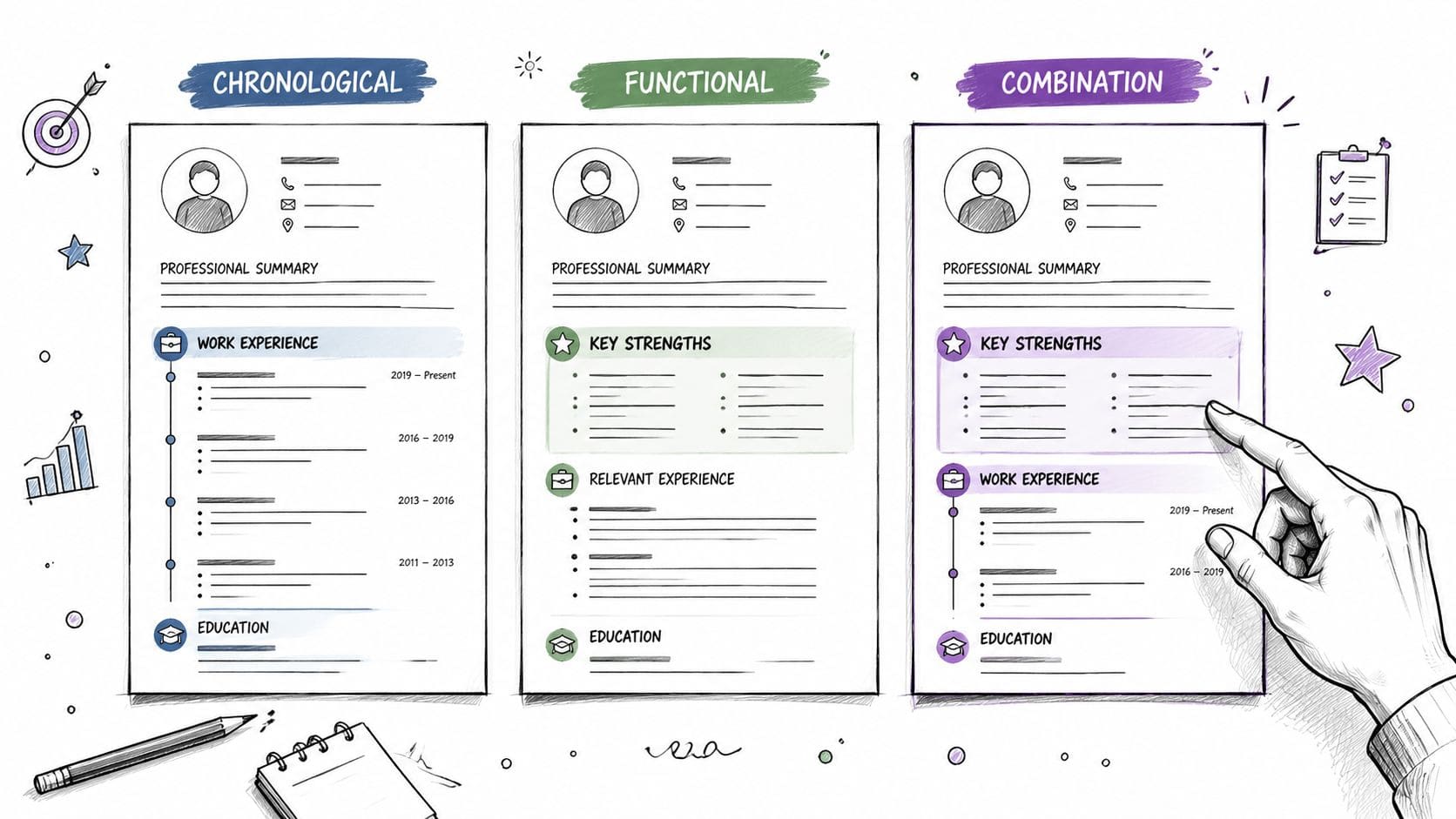
There are three common resume formats.
| Format | Best for | Risk |
|---|---|---|
| Reverse-chronological | Most applicants with a clear work history | Very little if the experience is relevant |
| Functional | Candidates trying to emphasise skills over timeline | Often raises questions because experience is harder to follow |
| Combination | Candidates with strong skills and relevant experience | Can become cluttered if both sections repeat each other |
For most applicants, reverse-chronological is the safest and strongest choice. It matches what recruiters expect. It also makes career progression, recency, and relevance easier to assess.
Functional resumes often look like they're hiding something, even when that isn't the intention. Combination resumes can work, but only if the content is tightly edited.
Make the layout invisible
The best formatting doesn't draw attention to itself. It guides the eye.
A strong layout usually includes:
- Clear headings: easy to scan and consistent from top to bottom
- Short bullet points: easier to absorb than heavy paragraphs
- White space: enough room for each section to breathe
- Simple fonts: Arial, Calibri, and Georgia are easier to read than decorative fonts
- Logical order: summary, skills, work experience, education, then extras if relevant
Design principle: If the layout is the most memorable thing on the page, the content probably isn't strong enough.
Page length and content control
For most UK job seekers, a concise document is stronger than a full career archive. Older roles can be trimmed. Early experience can be shortened to one or two lines if it no longer supports the current target role.
That is where many resumes improve quickly. They don't need more history. They need better selection.
Candidates comparing structure options can use this resume format guide to decide whether to keep a standard layout or adjust it for a career change or mixed background.
Address Career Gaps and Non-Linear Paths
A career gap is not the disaster many candidates think it is. What hurts a resume is not the gap itself. It's the absence of recent, relevant proof.
That matters because gaps are common. ONS data cited in AARP's discussion of employment gaps found that 44.6% of workers aged 50 to 64 had at least one employment gap of six months or more, and 21.7% had a gap of two years or more, which makes gap-aware resume strategy a practical need rather than an edge case, as outlined in AARP's article on resume employment gaps.
Don't hide the gap. Control the interpretation.
Recruiters usually want a simple answer to two questions:
- Is this candidate current?
- Can this candidate do the job now?
The resume should answer both quickly.
A compact summary can do a lot of work here. Instead of opening with a vague personal profile, use it to establish present relevance.
Weak summary
Results-driven professional with excellent communication skills seeking a new opportunity.
Better summary
Operations professional with experience in coordination, supplier communication, and process improvement. Recently completed sector-relevant training and delivered project-based work that strengthened reporting and workflow management skills.
The second version redirects attention from the gap to current capability.
Show activity, not emptiness
A non-linear path often includes useful evidence that candidates leave out. That's a mistake.
Strong options include:
- Recent training: courses, certifications, refreshers, or technical learning
- Project work: freelance assignments, consulting, contract work, or self-directed projects
- Volunteering: especially where it shows leadership, organisation, service, or digital tools
- Care responsibilities with skill relevance: only if framed professionally and linked to capability
- Return-to-work preparation: software refresh, portfolio work, networking, or industry events
If several short assignments happened across one period, grouping them under one heading can reduce clutter.
Example
Independent Projects and Consulting
Selected project work covering process documentation, stakeholder coordination, and administrative support.
That reads more confidently than four scattered short entries.
A gap becomes less important when the top half of the resume proves the candidate is current, capable, and targeted.
Candidates who need wording help can review these resume gaps in employment examples for practical phrasing that stays honest without underselling the experience.
Final Checks and Digital Enhancements
Many resumes miss the mark in the last ten minutes, not the first hour. Strong experience loses weight fast when the document contains date errors, mismatched titles, or links that do not support the case you are trying to make.
Review it like a hiring manager who is looking for reasons to move on.
A good final check goes beyond spellcheck:
- Read it aloud: weak phrasing, repeated words, and clumsy sentences stand out faster
- Proof line by line from the bottom up: this helps catch spelling and formatting errors your brain skips in normal reading
- Verify every title, employer, and date: credibility problems matter more than minor wording choices
- Check software names, certifications, and acronyms: small factual errors make expertise look inflated
- Compare the resume against the job description one last time: confirm that the most relevant evidence appears in the top half, not buried later
Here is the standard I use. If a recruiter reads only the first third of the page, they should still understand the target role, the candidate's strongest evidence, and the results that make an interview worth scheduling.
Digital add-ons should follow the same rule. Include them only if they add proof.
A LinkedIn profile should match the direction of the resume. Same target role. Same recent experience. Same core skills. If the resume says operations analyst and LinkedIn reads open to anything in admin, project support, and marketing, the application feels unfocused.
A portfolio, GitHub profile, case study page, or project folder can help, but only when it shows relevant work clearly. For creative, product, training, or brand-facing roles, a short walkthrough of the work can strengthen that proof. If video helps explain the work, tools that create studio-quality videos can make that presentation cleaner and easier to review.
Before: LinkedIn headline says "Experienced Professional Seeking New Opportunities."
After: LinkedIn headline says "Project Coordinator | Vendor Management, Scheduling, Budget Tracking"
Before: portfolio link goes to a generic homepage with no context.
After: portfolio link goes to a project page titled "Onboarding Redesign, reduced training confusion and improved completion process"
The same principle applies here as it does across the resume. Do not add extras to look impressive. Add proof that helps an employer say yes.
Frequently Asked Questions About Standout Resumes
Should a resume be one page or two pages?
Either can work. The better question is whether every line earns its place. If a second page contains relevant evidence, keep it. If it's filled with old duties, trim it.
What makes a resume stand out to recruiters fastest?
Clear relevance at the top. A targeted summary, matched skills, and strong bullet points make a faster impact than design choices.
Is it worth using colour or graphics?
Usually no. Clean formatting is more useful than visual decoration. Most candidates improve their results more by sharpening content than by changing appearance.
How often should a resume be tailored?
For each role that matters. The core document can stay stable, but the summary, skills emphasis, and selected bullet points should reflect the vacancy.
What should be removed from a weak resume?
Generic soft-skill claims, dense paragraphs, outdated experience that no longer supports the target role, and bullets that only describe tasks without showing value.
A stronger application starts with a clearer CV. CV Anywhere helps candidates build ATS-friendly CVs, check fit against job descriptions, and track applications in one place so each submission is sharper, more relevant, and easier to manage.