You're probably staring at a blank document wondering how to write a resume with no experience without sounding unqualified. The fix is to stop building your resume around jobs you have not had and start building it around proof of ability. That means skills, class projects, volunteer work, campus leadership, certifications, and even serious family responsibilities.
A no-experience resume works when it does three things fast. It shows relevant skills near the top, turns unpaid work into evidence, and mirrors the language in the job description so recruiters and Applicant Tracking Systems can understand your fit. This guide gives you the exact structure, formulas, and examples to do that.
Your No-Experience Resume Built in 5 Steps
A strong no-experience resume usually comes together after one frustrating moment: you open a template, reach the work history section, and realize the page is built for someone else. The fix is not to leave that space looking thin. The fix is to replace missing job titles with proof.
Build the resume in this order so each section earns its place:
- Choose a format that puts evidence near the top. For many students and recent grads, that means a hybrid layout that leads with skills, projects, and education. If you want help choosing the right structure, review these resume format options for early-career candidates.
- Write a summary that states your value clearly. Focus on the role you are targeting, the tools or strengths you already use well, and the kind of problems you can help solve.
- Treat education and projects like experience. A class project, capstone, lab, student publication, or portfolio piece counts when it shows what you built, improved, researched, or presented.
- Translate unpaid work into business-relevant results. Volunteer shifts, club leadership, freelance help for friends, and family responsibilities can all demonstrate reliability, planning, communication, and follow-through.
- Match the language of the job posting. If the employer asks for customer service, scheduling, Excel, research, or social media support, those exact terms should appear where you can support them.
This order works because hiring teams do not need a perfect background. They need enough evidence to answer one question: Can this person handle the work?
That is why framing matters so much. "Helped with family business" is weak. "Handled customer orders, updated inventory in spreadsheets, and responded to 15 to 20 daily inquiries" gives the employer something concrete to evaluate.
Use a simple formula for bullets: action + task + tool or context + result. For example:
- Before: Responsible for social media for student club
- After: Created weekly Instagram posts for a 40-member student club, promoted events, and helped increase average attendance
One rule decides what stays on the page. If an activity proves you can organize work, learn systems, communicate clearly, solve problems, or follow through, it belongs on your resume.
Does your resume clearly show results for each role?
Turn a weak resume into a stronger one
Upload your resume → get stronger wording instantly → fix the weakest parts first.
No need to rewrite. Start with your current resume.
Choose a Resume Format That Highlights Your Strengths
The wrong format makes you look less qualified than you are. The right one changes the order of information so recruiters see ability first.
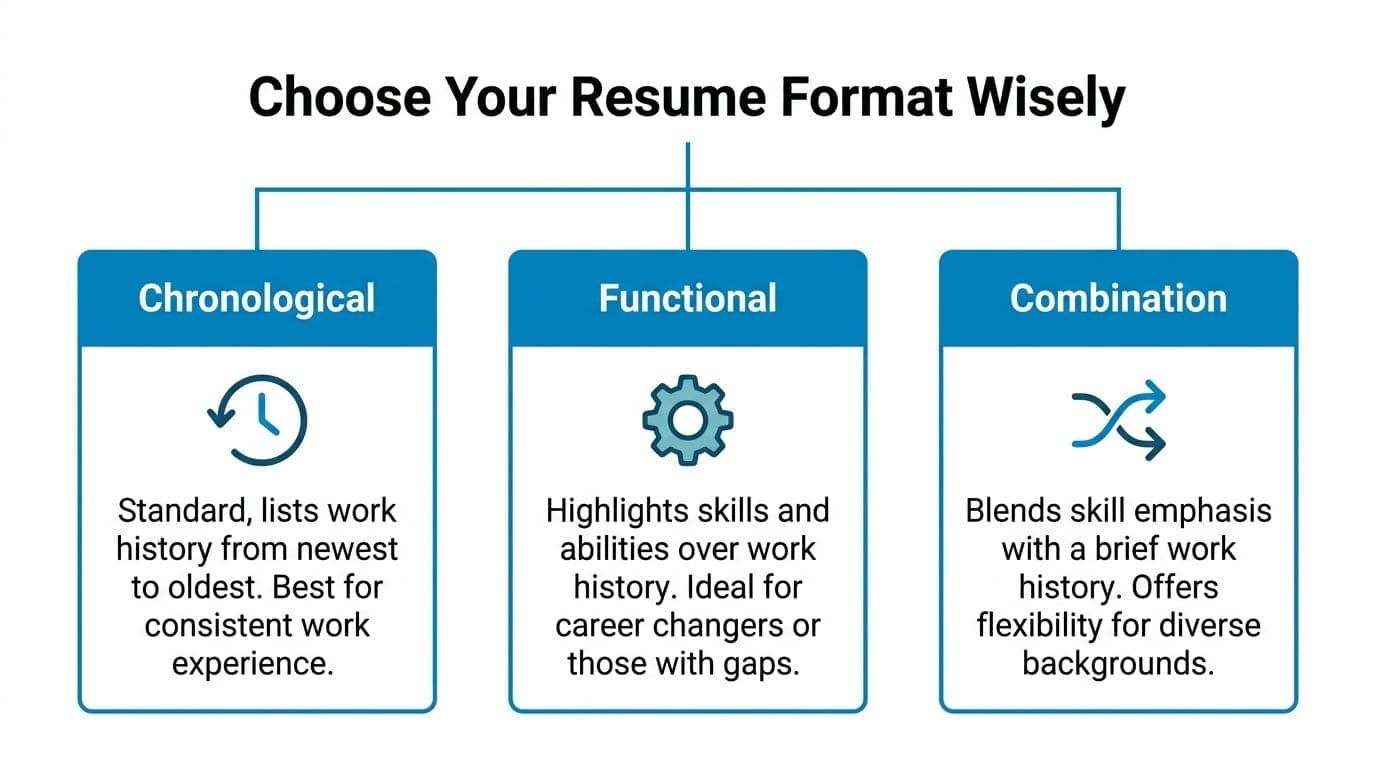
For candidates with no experience, a functional or hybrid resume format is often the better choice because it prioritizes skills, and an estimated 75% of resumes are rejected by ATS before a human sees them, according to Mployee's guide on resumes with no experience.
The three formats and the trade-offs
| Format | Best for | Weakness for no-experience candidates | Verdict |
|---|---|---|---|
| Chronological | People with steady work history | Puts an empty experience section in the spotlight | Usually a poor fit |
| Functional | Career changers and skill-heavy applicants | Can feel too abstract if unsupported by projects or education | Good in some cases |
| Hybrid | Students, grads, and early-career applicants | Requires thoughtful section order | Best option for most readers |
A chronological resume starts with work history. If that section is thin, the format works against you.
A functional resume starts with skills. That helps, but if you only list skills without showing where you used them, it can read like a wishlist.
A hybrid resume solves both problems. It leads with a summary and skills, then backs them up with education, projects, and selected experience. That gives you both relevance and credibility.
The section order that works
Use this order for a strong no-experience resume:
- Header with name, phone, email, city, LinkedIn, and portfolio if relevant
- Professional summary
- Key skills
- Education
- Projects
- Volunteer or campus experience
- Additional sections such as certifications, languages, or technical tools
This structure puts proof where it matters most. The recruiter sees your fit before noticing what is missing.
What to leave out
In the US, leave out details that do not help your candidacy.
- Photo: Skip it
- Birth date: Do not include it
- Full street address: City and state are enough
- Unfocused hobbies: Only include them if they support the role
If you want a fuller breakdown of format choices, this guide on resume format is the logical next step.
Practical takeaway: A recruiter should understand your target role and strongest skills within the first few seconds of scanning the page.
Write a Powerful Summary Instead of a Vague Objective
A recruiter opens your resume and sees no job history worth talking about. The summary has to do the heavy lifting fast. In a few lines, it should answer three questions: what role you are targeting, what skills you already use well, and where you have applied them.
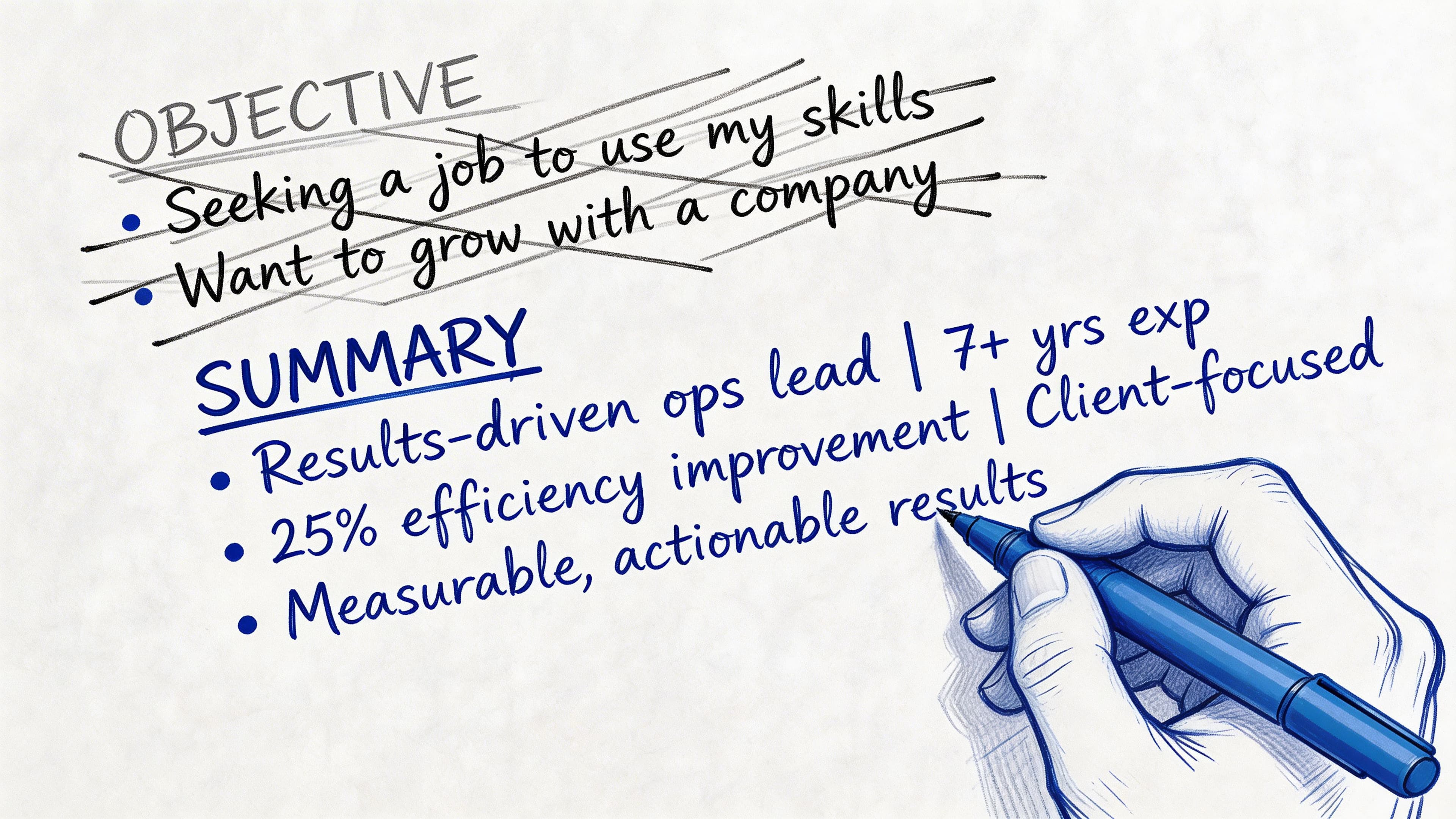
Many entry-level resumes waste that space on an objective statement. That approach focuses on the candidate's goals instead of the employer's needs.
Why objectives fall flat
An objective often sounds like this:
"Seeking an entry-level marketing role where I can grow my skills."
Hiring managers read that and learn almost nothing. The candidate wants a job. Every applicant does.
A summary works better because it frames your value before the recruiter starts looking for formal experience:
"Detail-oriented marketing graduate with experience creating campaign materials through academic projects and student organizations. Skilled in content planning, written communication, and Canva. Ready to support a marketing team with organized execution and audience-focused content."
That version does real work. It names the role, shows relevant skills, gives proof of where those skills came from, and points to a practical contribution.
Use a formula that turns unpaid experience into evidence
Write your summary with this structure:
[Target role or professional identity] + [2 to 3 job-relevant skills] + [where you used them] + [result or value you can provide]
That formula matters when you have little or no paid experience because it forces you to translate classes, projects, volunteer work, campus leadership, and family responsibilities into employer language.
Here are stronger examples.
For admin roles "Organized administrative assistant candidate with strengths in scheduling, customer communication, and Excel, built through volunteer coordination and campus event support. Trusted to keep details accurate and tasks on track. Ready to support a busy office with dependable day-to-day organization."
For teaching roles "Recent education graduate with training in lesson planning, classroom communication, and student support. Applied those skills through tutoring, field placements, and curriculum projects. Prepared to help students learn in a structured, supportive classroom."
For data roles "Aspiring data analyst with skills in Excel, data cleaning, and presenting findings, developed through coursework and independent projects. Experience turning raw information into clear takeaways for non-technical audiences. Ready to contribute careful analysis and accurate reporting."
Before and after: weak summary vs strong summary
Weak: "Motivated college student seeking an opportunity to grow and use my skills."
Strong: "Business student with experience managing budgets and schedules for a family household while completing team-based academic projects. Skilled in Excel, organization, and written communication. Ready to bring accurate tracking and follow-through to an operations or admin role."
The second version wins because it does not apologize for limited work history. It frames real responsibility as evidence.
I advise clients to test every summary against one standard: could a recruiter picture you doing the job after reading it? If the answer is no, the summary is still too vague.
What to avoid
- Generic traits without proof: "hardworking," "motivated," and "passionate"
- Skill dumping: long lists with no context
- Empty career goals: phrases about "learning" or "growing"
- One generic version: rewrite the summary for each role you apply to
If you want help with phrasing and structure, this guide on how to write resume summary gives a clear breakdown. If you need more headline-style inspiration, these personal brand statement examples for students can help you sharpen your opening language.
Frame Your Education and Projects as Relevant Experience
Education is not just a line item when you have no work history. It is one of your strongest assets.
Most weak resumes do this:
B.A. in Communications, May 2026
That tells a recruiter almost nothing.
A stronger entry shows relevance:
B.A. in Communications, May 2026 Relevant coursework: Digital Media, Public Speaking, Business Writing Capstone project: Built a campaign plan for a local nonprofit, including audience research, messaging, and social content Awards: Dean's List
That version gives the recruiter material to work with. It shows training, applied work, and focus.
Expand the education section when it helps
Include more than your school and degree if the details strengthen your case.
Add items like:
- Relevant coursework if it matches the role
- GPA if it is above 3.5
- Capstone or thesis if it demonstrates useful skills
- Academic awards if they signal consistency or high performance
- Certifications and short programs if they support the job target
A dedicated education on a resume guide can help if you are unsure what belongs there.
Projects are often your best evidence
Recruiters hiring entry-level candidates want proof that you can do something useful. Projects provide that proof.
For tech and digital roles, including micro-credentials and virtual work programs from platforms like Forage can increase interview rates by 35%, compared with an 18% lift from traditional extracurriculars, according to the University of Rochester's article on writing a resume with no work experience.
That matters because many candidates still bury projects at the bottom or leave them off entirely.
How to write a project entry
Use this structure:
Project name What the project was Tools or skills used What you produced What the outcome showed
Examples:
Student market research project Conducted audience research for a class campaign assignment focused on local retail behavior. Used survey design, Excel, and presentation skills to organize findings and recommend messaging themes for different customer groups.
Personal portfolio website Built a personal portfolio site to showcase writing samples and design work. Used a website builder, basic SEO principles, and content organization to present projects clearly for recruiters and clients.
Forage virtual experience program Completed a virtual work program focused on product analysis and stakeholder communication. Practiced task prioritization, business writing, and role-specific problem-solving through simulated assignments.
Tip: If a project taught you a tool, solved a problem, or produced a deliverable, it counts.
The strongest project entries read like mini case studies. The weak ones read like class attendance.
Showcase Transferable Skills from Unpaid Work
This is the section most first-time applicants undersell.
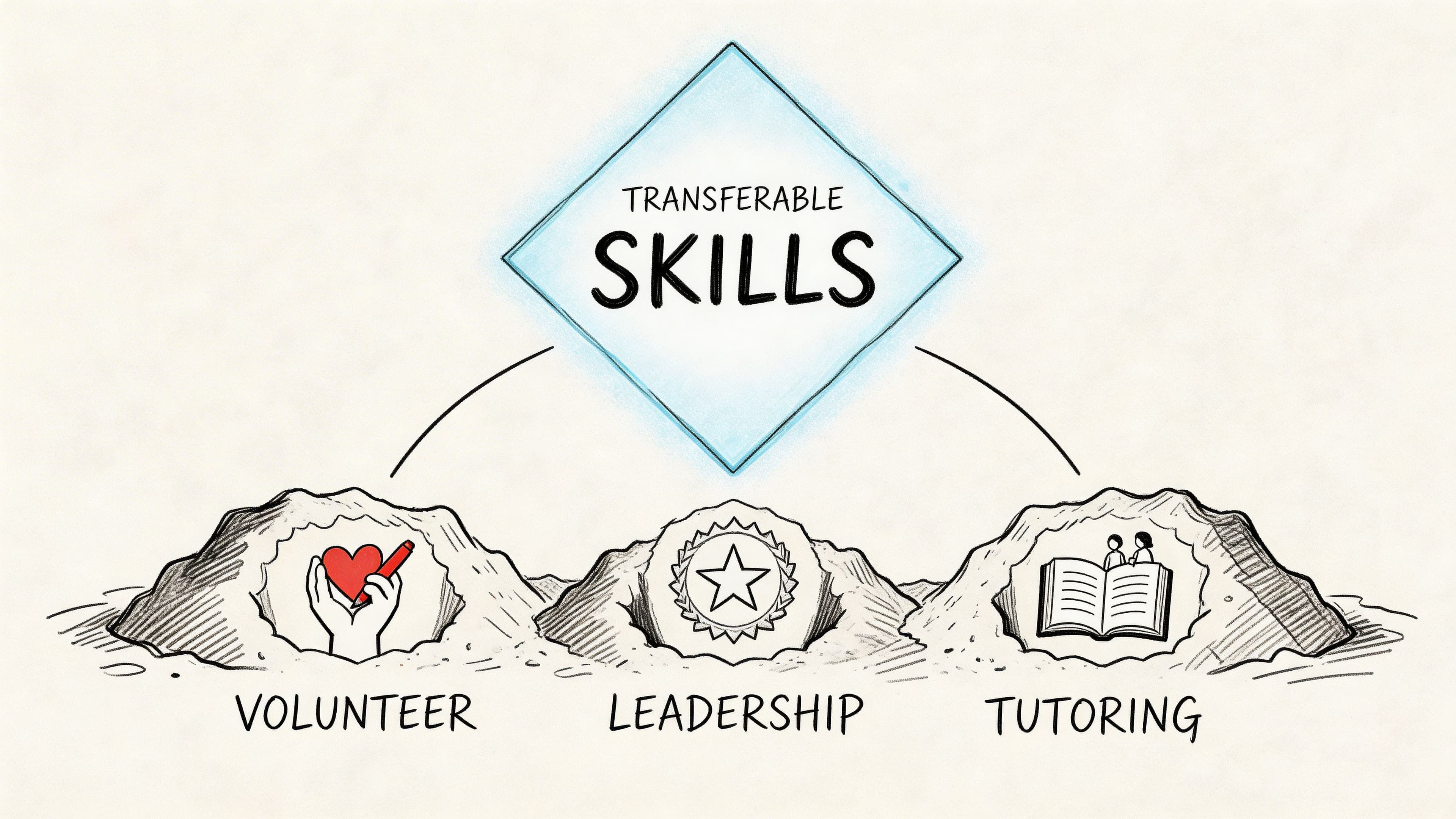
A 2024 LinkedIn Workforce Report found that 68% of hiring managers value life skills such as time management from non-professional contexts for entry-level roles, yet only 12% of no-experience resumes include them with quantification, according to the University of Washington's article on how to create a no-experience resume.
That gap is your opportunity.
What counts as transferable experience
If you did work that required responsibility, coordination, communication, or problem-solving, you can use it.
Good sources include:
- Volunteer work
- Student clubs
- Tutoring
- Babysitting
- Caregiving
- Helping in a family business
- Sports leadership
- Freelance or creative side projects
The mistake is describing these experiences as duties. The stronger move is describing them as outcomes.
Use this bullet formula
A reliable bullet formula is:
Action verb + task + result
Examples of strong action verbs include organized, coordinated, created, supported, trained, researched, improved, and delivered.
Compare these before-and-after versions.
| Weak bullet | Stronger bullet |
|---|---|
| Helped with a family business | Supported daily operations for a family business by handling customer communication, organizing inventory records, and assisting with scheduling |
| Babysat children | Managed daily schedules for children, balancing school pickup, meals, homework support, and time-sensitive routines |
| Volunteered at events | Coordinated volunteer check-in and setup tasks for community events, helping keep activities organized and on schedule |
| Tutored students | Designed customized lesson support for students in challenging subjects and adapted explanations based on learning needs |
None of those stronger bullets need invented statistics to be effective. They work because they show scope, judgment, and relevance.
How to frame family responsibilities professionally
This is one of the most overlooked areas in resume writing.
Candidates often assume caregiving or household management is "not real experience." Employers do not necessarily see it that way when it is framed well.
Examples:
Caregiver for family member Coordinated appointment schedules, maintained organized records, and managed day-to-day routines requiring discretion, consistency, and time management.
Household operations support Handled recurring scheduling, purchasing, and task coordination across a busy household, strengthening organization and follow-through under changing priorities.
Family business support Assisted with customer-facing tasks, order tracking, and basic administrative support, building communication and multitasking skills in a fast-paced setting.
Use STAR when you get stuck
If writing bullets feels hard, use STAR in rough notes first:
- Situation: What was happening?
- Task: What were you responsible for?
- Action: What did you do?
- Result: What improved, got completed, or stayed on track?
Then compress that into one bullet.
For help identifying which skills to feature, this breakdown of resume hard and soft skills is useful.
Key idea: Paid work is only one form of experience. Responsibility, initiative, and follow-through are what employers hire for.
Tailor Your Resume to Every Job Description
A generic resume is easy to ignore. A customized one gets understood faster.
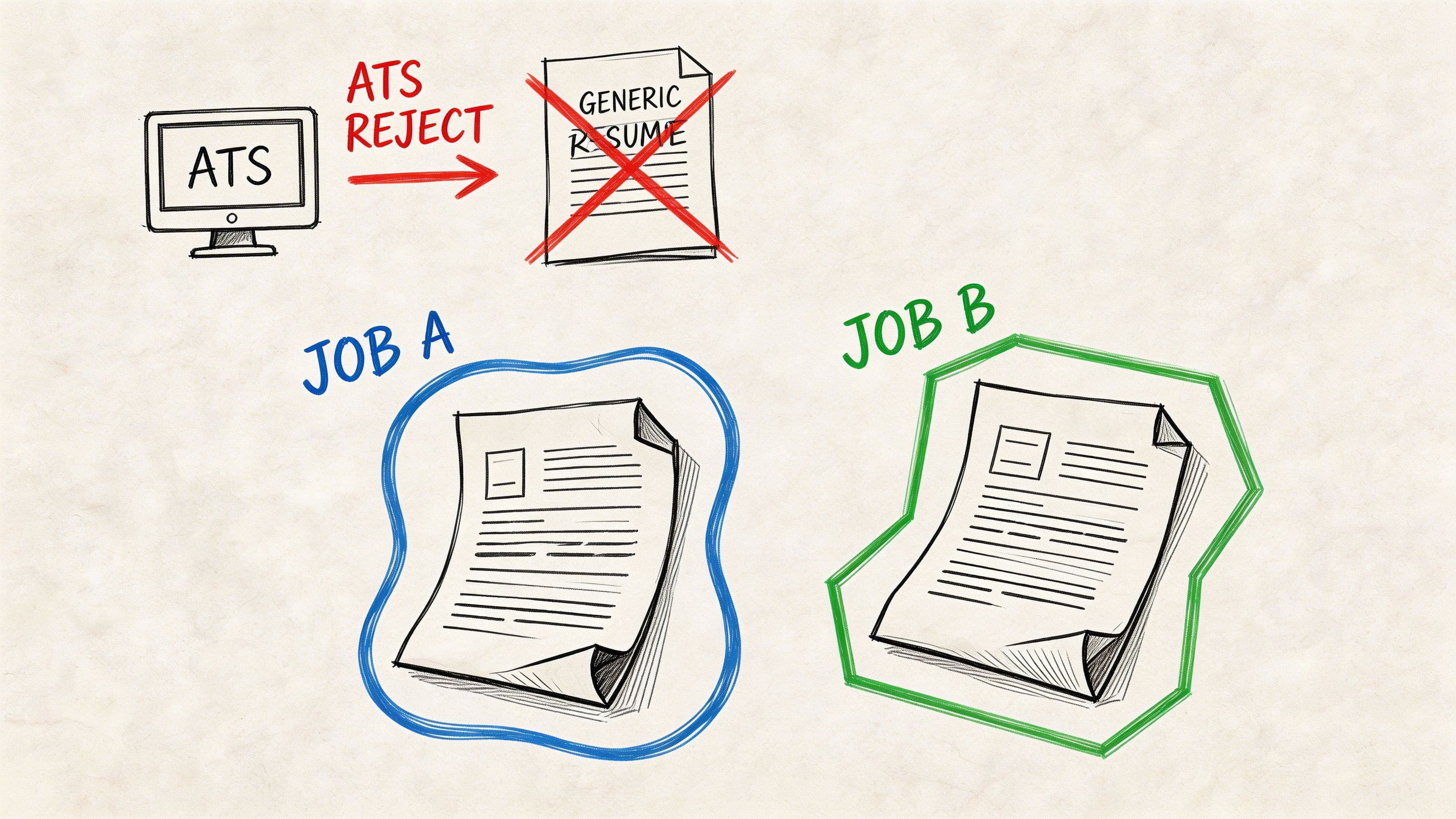
With over 90% of Fortune 500 companies using ATS, tailoring your resume by mirroring language and skills from the job description is one of the most effective ways to get through the first screen, according to GoSkills' guide to writing a resume with little experience.
The practical workflow
Do this for every application:
Read the job description closely Highlight repeated skills, tools, and traits.
Pull out priority terms Look for phrases such as customer service, time management, Microsoft Excel, scheduling, collaboration, Python, or communication.
Match those terms to real evidence Do not just paste keywords into a skills block. Put them in your summary, skills section, and bullets where they make sense.
Adjust section emphasis For an admin role, move scheduling, organization, and Excel closer to the top. For a marketing role, lead with content, analytics, and communication.
A simple example
If a job description asks for:
- time management
- organizational skills
- customer service
- Microsoft Excel
You might revise your resume like this:
Summary Organized entry-level candidate with strengths in customer communication, scheduling, and Microsoft Excel developed through volunteer coordination and academic project work.
Skills Microsoft Excel, email management, time management, customer service, organization
Experience bullet Supported event registration and attendee communication, helping maintain organized records and timely responses.
That is tailoring. It is specific, honest, and readable.
Tools can speed this up
If you are applying to many roles, manual tailoring takes time. One option is to use tools that compare your resume against a job description and highlight missing keywords or weak alignment. CV Anywhere includes a Smart CV Builder and JD Fit Checker that analyze job descriptions, suggest skill alignment, and help organize applications in one place. If you want the manual process, this guide on how to tailor resume to job description covers the same workflow.
Do not keyword-stuff. Use the employer's language where it accurately reflects your experience. If you cannot support a term in an interview, leave it out.
Frequently Asked Questions About No-Experience Resumes
How long should a no-experience resume be
Keep it to one page. If you cannot explain your fit clearly on one page at this stage, the issue is usually focus, not space.
Should I include high school information
Include high school only if you are very early in your education or it contains highly relevant achievements. Once college, university, or substantial training is on the page, high school usually becomes less important.
Do I need a cover letter too
If the role allows one, yes. A cover letter helps connect your projects, education, and motivation to the role in a way a resume cannot always do.
Should I add a photo to my resume
For the US market, no. Keep the resume bias-resistant and professional. Put attention into your LinkedIn presence instead. If you need help with that, this guide to the best profile picture for LinkedIn is a practical starting point.
What file format should I use
Use PDF unless the employer asks for another format. It preserves layout and usually prevents formatting shifts.
If you want to build, tailor, and track your applications in one place, CV Anywhere combines resume creation, job-description matching, and application tracking so you can move from draft to submission with less manual work.