
Most business analyst CV advice gets one important thing wrong. It assumes the candidate already has the title, the projects, and the obvious BA bullet points to prove it. That leaves out career changers, civil servants, operations staff, PMO analysts, and graduates whose work is analytical but not labelled "Business Analyst".
That's a problem in a market where UK demand for business analysts rose 188% between 2019 and 2024, and average pay reached £47,500, according to LinkedIn's UK Jobs on the Rise coverage. A business analyst resume has to do two jobs at once. It has to read clearly to a recruiter and map cleanly to an ATS. Candidates building teams should also understand this from the other side. Firms hiring internationally often review BA CVs alongside adjacent analyst profiles, which is why broader hiring resources such as Hire LATAM talent can be useful for understanding how skills are positioned across markets.
The strongest CVs don't list duties. They show decisions influenced, processes improved, stakeholders aligned, and outcomes delivered. Candidates who want a faster starting point can work from a business analyst CV template and then tailor every line to the target role.
Your Guide to a Standout Business Analyst CV
A strong business analyst resume is built around evidence, not activity. Recruiters don't shortlist someone because they "gathered requirements" or "worked with stakeholders". They shortlist someone who clarified requirements for a difficult project, reduced ambiguity, improved delivery, or gave decision-makers better information.
That matters even more for non-traditional candidates. A policy officer may have mapped processes, defined future-state changes, and coordinated cross-functional approvals without ever holding a BA title. An operations coordinator may have investigated workflow failures, documented requirements, and supported system rollouts. On a weak CV, that experience reads as admin. On a strong one, it reads as business analysis.
Practical rule: If a bullet point could describe almost anyone in the team, it won't help a shortlist.
The difference usually comes down to three things:
- Clear structure: a CV that's easy to scan in seconds
- Specific language: tools, methods, and outcomes that match the vacancy
- Business impact: bullets that show what changed because the candidate was involved
A hiring manager's first pass is simple. Can this person handle requirements, analysis, delivery support, stakeholder communication, and change in a real business setting? If the answer isn't obvious from the first half of page one, the CV usually drops out.
Is your resume actually getting responses?
Your resume might be missing something important
Upload your resume → see its weakest areas → fix them, one by one.
Free. Takes less than 2 minutes.
Structuring Your BA CV for Readability and ATS
Before content quality matters, layout has to do its job. A business analyst CV should use a reverse chronological format almost every time. It lets recruiters see recent relevance first, and it gives ATS software a structure it can parse more reliably.
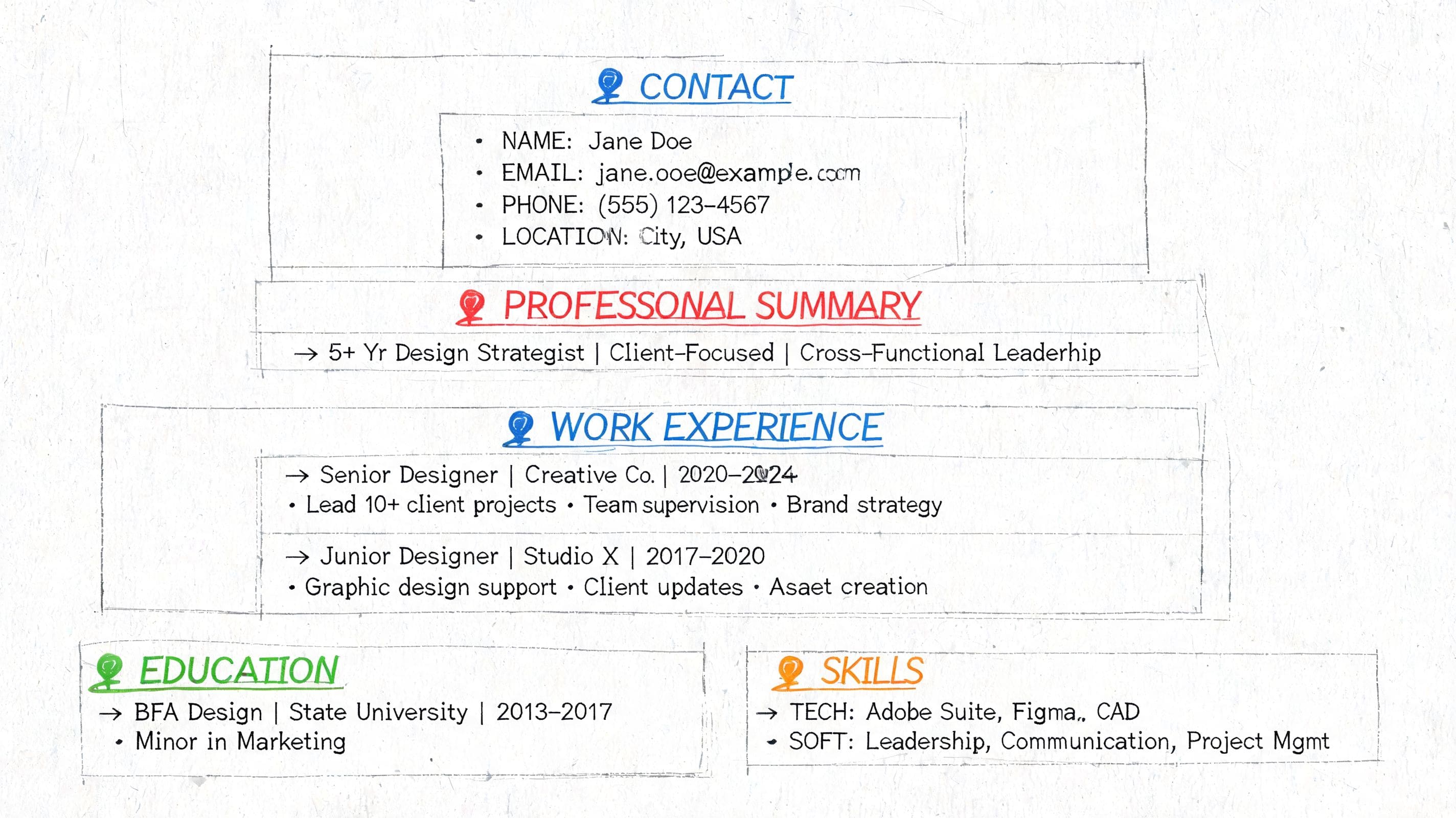
Candidates who want to understand why formatting matters can review how resume parsing software works. The practical takeaway is simple. Standard headings, clean dates, and straightforward section order are easier for software and humans to read.
The section order that works
Use this order for most BA applications:
- Name and contact details
- Professional summary
- Key skills
- Professional experience
- Certifications
- Education
- Additional sections, only if relevant, such as publications, tools, or languages
This order front-loads relevance. The summary sets direction. The skills section gives keyword coverage. The experience section proves the claims.
A clean ATS-friendly CV template helps because it avoids design choices that look polished but create parsing problems.
What the summary should do
The professional summary isn't a personal statement. It's a positioning block.
Good summary:
Business Analyst with experience in process mapping, stakeholder engagement, requirements documentation, and reporting across public sector and operations environments. Delivered analysis that supported service improvement, system change, and cross-team decision-making. Comfortable working with SQL, Agile delivery, workshops, and process documentation.
Weak summary:
Hard-working professional seeking a challenging role where excellent communication skills and passion for analysis can be utilised.
The first version tells the recruiter what kind of BA they're looking at. The second says almost nothing.
What to include in Key Skills
The skills section should be short and specific. It isn't a dumping ground for every platform ever touched.
Use grouped skills such as:
- Analysis: requirements elicitation, process mapping, gap analysis, user stories
- Tools: SQL, Jira, Confluence, Excel, Power BI, Visio
- Methods: Agile, Scrum, Waterfall, BPMN, UAT support
- Stakeholder work: workshop facilitation, stakeholder mapping, requirements validation
This section works best when every skill is either supported later in experience or clearly relevant to the target role.
What to avoid in the layout
Some formatting choices still hurt otherwise good CVs:
- Functional formats: These hide chronology and usually create suspicion around missing experience.
- Graphics-heavy templates: Icons, text boxes, and columns can interfere with ATS reading.
- Long profile sections: If the summary becomes a half-page narrative, it dilutes the strongest evidence.
- Dense paragraphs: Business analysis is about clarity. The CV should reflect that.
Recruiters often decide whether to keep reading before they've finished the first role entry. Layout isn't cosmetic. It controls what gets noticed.
From Duties to Data: Writing Bullet Points That Deliver
Most business analyst CVs break down at this point. According to CIPD, UK business analyst applicants with quantified achievements on their CVs achieve 3.2 times higher callback rates, and 68% of BA CVs are rejected primarily because they list responsibilities instead of measurable business impact.
A hiring manager doesn't need proof that a candidate knows what a BA is supposed to do. They need proof that the candidate did it effectively.
The standard that gets shortlisted
Every strong bullet point answers four questions:
- What was the problem or task?
- What did the candidate do?
- What changed as a result?
- Why did that result matter to the business?
That's why the STAR method still works well for BA CVs. Not because recruiters want textbook structure, but because STAR forces evidence into the line.
How to build a better bullet point
Start with the raw duty.
Example:
- Responsible for gathering requirements from stakeholders
That's not wrong. It's just too thin. It says nothing about complexity, ownership, or outcome.
Now rebuild it:
- Led requirements workshops across finance, operations, and IT teams, producing agreed user stories and process documentation that reduced ambiguity during delivery and improved handover into testing
This version is stronger because it shows ownership, scope, and effect. Even without a hard metric, it still sounds like business analysis, not administration.
CV Bullet Points From Weak to Winning
| Weak (Responsibility-Focused) | Strong (Achievement-Focused) |
|---|---|
| Gathered requirements from stakeholders | Led stakeholder workshops to capture and prioritise requirements for a service change programme, producing clear user stories and acceptance criteria for delivery teams |
| Supported process improvement work | Mapped current-state workflows, identified failure points, and recommended process changes that improved handoffs between teams |
| Worked with data and reporting | Analysed operational data in Excel and Power BI to identify service bottlenecks and support decisions on resource allocation |
| Assisted with system testing | Coordinated UAT preparation, tracked defects, and worked with users to clarify expected outcomes before release |
| Documented business processes | Produced process maps and requirements documents that gave delivery, compliance, and operations teams a shared view of change impacts |
| Managed stakeholder communication | Acted as the link between policy, service, and technical teams, translating business needs into deliverables that could be built and tested |
Where to find metrics if the role wasn't commercial
Many candidates freeze at this point because they think they have "no metrics". Usually, they do have them. They're just using the wrong lens.
For BA work, useful evidence often comes from:
- Time: reduced delays, faster approvals, quicker handovers, shorter cycle times
- Volume: case loads reviewed, workshops run, teams supported, processes mapped
- Quality: fewer defects, clearer requirements, lower rework, improved data accuracy
- Risk: compliance issues avoided, audit readiness improved, stronger controls
- Delivery: milestones met, release readiness improved, dependencies resolved
A civil servant may not have a sales figure to quote, but they may have improved turnaround, reduced duplication, or supported a high-priority change programme. That still counts.
Translating non-BA experience into BA language
This is the gap that most business analyst resume guides miss. Job titles don't matter as much as evidence of BA-shaped work.
A few practical rewrites:
Policy officer
- Weak: Produced reports and worked with different departments
- Better: Analysed policy implementation issues, gathered input from operational teams, and documented process changes to support service improvement
Operations coordinator
- Weak: Helped teams improve processes
- Better: Reviewed workflow bottlenecks, documented pain points, and supported process redesign discussions with frontline and management stakeholders
Project support officer
- Weak: Assisted project managers with documentation
- Better: Maintained requirements logs, tracked change requests, and supported stakeholder communication across delivery workstreams
A recruiter doesn't need the old title to say "Business Analyst". They need the evidence to sound recognisable.
A practical rewrite method
When reviewing any role on the CV, use this sequence:
- List the actual tasks performed
- Circle anything analytical, such as investigating issues, documenting needs, validating changes, or improving workflows
- Add context, including who was involved and what the work supported
- Add an outcome, even if it's qualitative
- Replace weak verbs like "helped" or "responsible for" with stronger ones such as analysed, facilitated, mapped, documented, prioritised, validated, or coordinated
Candidates struggling with this part often benefit from reviewing more examples of strong CV bullet points, especially before rewriting older roles.
Mastering Keywords for Business Analyst Roles
A good business analyst resume isn't just persuasive. It's also findable. According to Reed.co.uk, ATS filters out up to 75% of business analyst CVs, and integrating 15 to 20 core keywords such as "SQL querying", "Agile requirements elicitation", and "stakeholder mapping" can increase ATS pass rates from 55% to over 90%.
That doesn't mean stuffing the page with jargon. It means matching the language of the vacancy with enough precision that both software and recruiters recognise the fit.

The four keyword groups that matter
Most BA job descriptions contain a mix of keyword types. Candidates should pull terms from each category.
Technical tools
These are concrete and easy to miss if they're buried in old bullet points.
Examples:
- SQL
- Power BI
- Excel
- Jira
- Confluence
- Visio
- Tableau
Analysis and delivery terms
These signal the actual work of the role.
Examples:
- requirements elicitation
- process mapping
- stakeholder management
- gap analysis
- user stories
- acceptance criteria
- UAT
- workshop facilitation
Methods and frameworks
These tell the employer how the candidate works.
Examples:
- Agile
- Scrum
- Waterfall
- BPMN
- change management
- business process modelling
Sector and domain language
Many UK candidates lose relevance at this stage. A public sector role may use language around service design, policy delivery, governance, or operational change. A private sector role may lean into product, commercial performance, or transformation.
Where keywords should go
A keyword only in the skills section is weaker than a keyword shown in context.
Use this pattern:
- Summary: 3 to 5 of the most important terms
- Skills section: grouped keyword coverage
- Experience bullets: proof that the skill was used
- Certifications section: relevant credentials if held
Bad keyword use:
- SQL, Agile, stakeholder management, Jira, UAT, BPMN, workshop facilitation
Better keyword use:
- Used SQL and Power BI to analyse service performance data and present findings to operational stakeholders
- Facilitated Agile workshops to define user stories, clarify acceptance criteria, and support UAT readiness
How to tailor one CV without rewriting everything
The easiest method is to keep a strong base CV and then tune three areas per application:
- Summary: align it to the role's top themes
- Skills: reorder and trim for relevance
- Top bullets: revise the first one or two bullets under each recent role using the vacancy's wording
That gives the CV enough specificity without rebuilding it from scratch each time. Candidates who want a structured workflow for this can use guides on tailoring a CV to a job description.
Keyword matching works best when the same term appears naturally in more than one place, first as a capability, then as evidence.
Adapting Your CV for Junior Senior and Lead Roles
The same experience can look underpowered or overplayed depending on the level of role targeted. A junior BA CV should show promise and analytical discipline. A senior BA CV should show ownership, influence, and business judgement. A lead BA CV should show strategic direction and leadership across change.

Junior business analyst CV focus
For entry-level and early-career candidates, the mistake is trying to sound more senior than the evidence supports. That usually backfires.
The better approach is to show:
- exposure to requirements, data, process work, or testing
- academic or project-based evidence
- tool familiarity
- reliability in supporting delivery teams
Good junior phrasing:
- Supported requirements gathering sessions and documented actions, risks, and open points for follow-up
- Built reporting packs in Excel and Power BI to help teams track service trends
- Produced process documentation for internal workflow reviews during a systems change project
For career changers, this level is often the right target even if they have years of work experience elsewhere. Seniority in one field doesn't automatically convert to seniority in BA work.
Senior business analyst CV focus
At senior level, the CV has to move beyond support and into ownership.
Recruiters expect evidence such as:
- leading workshops
- managing difficult stakeholders
- shaping scope and priorities
- handling ambiguity
- improving delivery quality
- linking analysis work to business outcomes
Good senior phrasing:
- Led cross-functional workshops to define scope, align stakeholders, and turn operational issues into prioritised change requirements
- Owned requirements traceability and change control across a multi-team delivery programme
- Worked with product, operations, and technical leads to resolve competing priorities and maintain delivery momentum
This is also where certifications can strengthen credibility. For experienced professionals, including relevant credentials such as the IIBA's CCBA can lead to a 28% salary uplift, with average certified UK BA salaries at £52,000 compared with £40,000 for uncertified peers, according to Reed's average salary checker.
Lead business analyst CV focus
Lead roles need a wider lens. A lead BA isn't just a better executor. They set standards, coordinate analysts, and influence change at programme level.
Strong lead CV themes include:
- practice leadership
- stakeholder influence at senior level
- governance and consistency
- mentoring
- portfolio or programme contribution
Good lead phrasing:
- Set analysis standards across multiple workstreams, improving consistency in requirements, documentation, and stakeholder engagement
- Coached junior analysts on workshop facilitation, requirements quality, and traceability practices
- Partnered with programme leadership to shape analysis priorities across strategic change initiatives
The higher the role, the less the CV should read like a task list and the more it should read like decision-making in action.
Five Common BA CV Mistakes to Avoid
Good candidates still get rejected for avoidable reasons. Most of the time, the issue isn't lack of ability. It's weak presentation.
Mistake one using a generic CV
Don't: send the same document to every BA vacancy.
Do: align the summary, skills, and most recent bullets to the language of the role. A finance BA post and a public sector change BA post often want different signals.
Mistake two hiding behind a functional format
Don't: group everything under broad headings like "analysis" and "communication" while downplaying job history.
Do: use reverse chronological order so recruiters can see where the work happened and how the candidate progressed.
Mistake three writing duties instead of outcomes
Don't: rely on phrases like "responsible for", "worked with", or "involved in".
Do: show what changed. If the bullet has no result, it probably needs rewriting.
Mistake four overloading the CV with jargon
Don't: assume every reader will decode every acronym or internal tool reference.
Do: give enough context for the line to make sense outside the previous employer. "Produced BRDs and managed RAID" may be accurate, but it's thin and overly internal.
Mistake five ignoring final quality checks
Don't: send a CV with inconsistent dates, messy spacing, or role titles that don't match LinkedIn.
Do: review it as both recruiter and ATS would. Candidates who need a final pre-send checklist should review common ATS CV mistakes before applying.
Business Analyst CV FAQs
How long should a business analyst CV be in the UK
Usually two pages. Early-career candidates can keep it tighter if they don't yet have much relevant material. Senior candidates should still avoid padding.
Should a career changer use the title Business Analyst on the CV
Only if it reflects the target role and the evidence supports it. It's safer to use the actual job title and then write a summary that positions the candidate for BA work.
What if there are no obvious metrics
Use qualitative outcomes where needed, then look for time saved, errors reduced, processes improved, reports produced, stakeholders aligned, or delivery supported. Most analytical roles contain usable evidence even when they weren't commercial.
Are certifications worth adding
Yes, if they're relevant and genuine. Put recognised BA certifications in their own section so they don't get buried.
Should every application use a different CV
Not a completely different CV, but each application should have specific wording. The strongest candidates keep one core version and adjust it for the vacancy.
CV Anywhere helps candidates turn a solid draft into an application-ready CV with an ATS-friendly builder, job description fit checking, and application tracking in one place. For business analyst roles, that's especially useful when the challenge isn't lack of experience but translating that experience into the language recruiters shortlist.