The best career change cover letter examples in the UK prove your value by directly bridging your past experience to the future role. For a successful pivot, you must immediately address the hiring manager's primary concern: can you perform this job without direct experience? The answer is to strategically frame your transferable skills, demonstrate your commitment through research or retraining, and tell a compelling story about why this change makes sense for both you and the employer. This guide provides 10 powerful examples and templates to show you exactly how it's done, with a focus on the UK job market.
We will dissect the specific strategies behind each letter, from the 'Skills-Bridge' method that maps your competencies directly onto the job description, to the 'Passion-and-Purpose' narrative that explains your 'why'. You'll learn how to focus on achievements over responsibilities, turning a potential weakness into your greatest strength. These career change cover letter examples are your blueprint for getting noticed in 2026. Each one includes a detailed breakdown, a copyable template, and actionable tips for customisation, helping you secure that first crucial interview.
Beyond the content, the professional presentation of your application is critical. When submitting your cover letter via email, mastering proper email etiquette in a professional setting ensures your message is received clearly and professionally. This guide will help you craft a document that not only tells a great story but also looks the part, giving you the confidence to make your next career move a success.
1. The Skills-Bridge Cover Letter
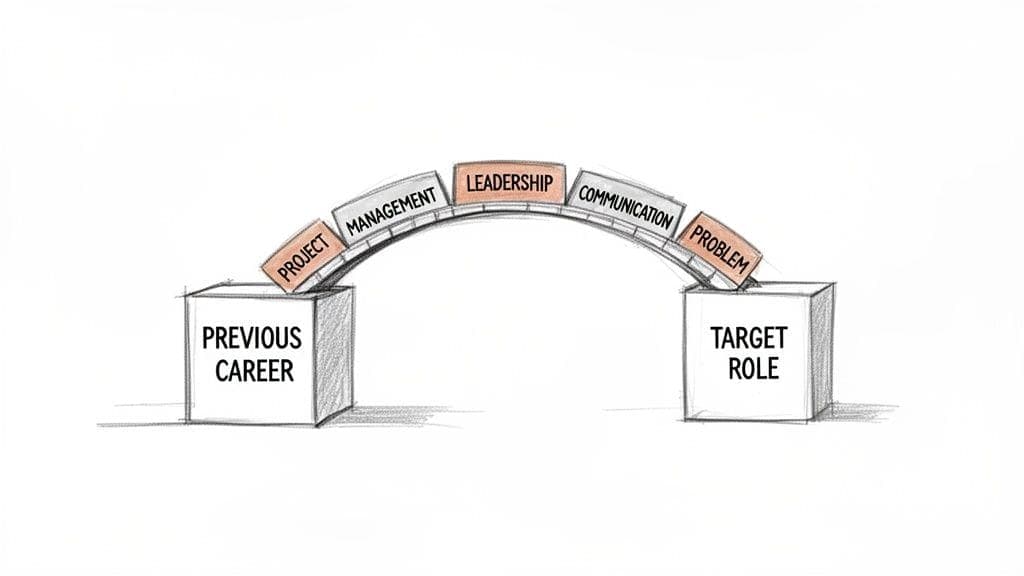
The Skills-Bridge is a powerful format for a career change cover letter that directly tackles the main question in a recruiter's mind: can you do this job without direct industry experience? This approach works by explicitly connecting your transferable skills from a previous career to the specific requirements of your new target role. Instead of hiding your career change, you confidently reframe it as a source of unique, applicable strengths.
Why this method is effective
This method is direct and pre-empts doubt. It shows you have analysed the job requirements and can articulate exactly how your background has prepared you, building a solid case for your candidacy from the first paragraph.
Consider a primary school teacher moving into corporate training. The skills-bridge letter would highlight their experience in curriculum development, managing diverse learning needs, and measuring progress through assessments. Likewise, a marketing professional pivoting to UX Design would emphasise their background in user research, data analysis, and crafting user-centric communication campaigns. A core part of this strategy involves a clear understanding of both hard and soft skills on your CV and how they translate across sectors.
How to implement this strategy
- Start strong: Your opening paragraph should immediately state the new role you are pursuing and introduce 1-2 of your most relevant transferable skills.
- Use a T-format: In the body of your letter, create two columns. One side lists the "Key Requirement" from the job description, and the other details your "Relevant Experience" with a metric-backed example.
- Focus on results: Don't just list skills; quantify them. For instance, instead of "managed projects," write "Led a team of 8 to deliver a company-wide software rollout 15% under budget."
- Be confident: Your tone should be assertive, not apologetic. Frame your career change as a deliberate, strategic move that brings fresh perspective to the role. This is one of the most effective career change cover letter examples for demonstrating self-awareness and professional maturity.
Turn this example into your own cover letter
Add the job description and create a draft for the role. Review the wording and check every claim before sending.
A starting draft you can edit in your own voice.
2. The Passion-and-Purpose Cover Letter
The Passion-and-Purpose cover letter is a narrative-driven format that explains the genuine motivation behind your career change. It directly addresses a recruiter's curiosity about your "why," transforming your pivot from a potential risk into a compelling story of commitment. This approach is highly effective for career changers as it humanises your application, showing that the switch is a deliberate, well-considered move rooted in personal values and authentic interest, not a last-resort decision.

Why this method is effective
This format builds an immediate emotional connection and demonstrates a deep alignment with a company's mission, which is often more memorable than a list of skills alone. It proves you are not just looking for any job, but for this job, in this industry.
For instance, a financial analyst moving to a nonprofit after a personal health crisis can frame their analytical skills as tools to now maximise social impact. Similarly, a corporate lawyer entering education can connect their experience in advocacy and structured argumentation to a newfound passion for mentoring and teaching. This strategy, inspired by philosophies like Simon Sinek's 'Start With Why,' makes your career change feel authentic and purposeful. This is one of the most powerful career change cover letter examples for roles in mission-driven sectors like charities, education, and sustainability.
How to implement this strategy
- Share your origin story: In your opening, briefly explain the motivation behind your career change. Spend 2-3 sentences on the genuine "aha" moment or gradual realisation that led you to this new path.
- Connect passion to preparation: Balance your story with concrete evidence. Show you have done more than just dream; mention relevant volunteering, courses, or personal projects that prove your commitment.
- Show you've done your homework: Research the company's values, mission, and recent projects. Reference specific initiatives that resonate with your personal purpose to show your interest is authentic. If you want to learn more about how to change careers successfully in the UK, thorough research is a critical first step.
- Focus on future contribution: End on a forward-looking note. Conclude by explaining how your unique background and newfound purpose will allow you to contribute to the company's goals, framing your past experience as an asset, not a liability.
3. The Achievement-Focused Cover Letter
The Achievement-Focused cover letter is a results-driven format that showcases your quantifiable accomplishments to prove your value, regardless of your previous industry. It prioritises business impact and metrics, framing your career change as a strategic move to apply your high-impact skills in a new context. This is one of the most effective career change cover letter examples for data-centric roles where results speak louder than direct experience.
Why this method is effective
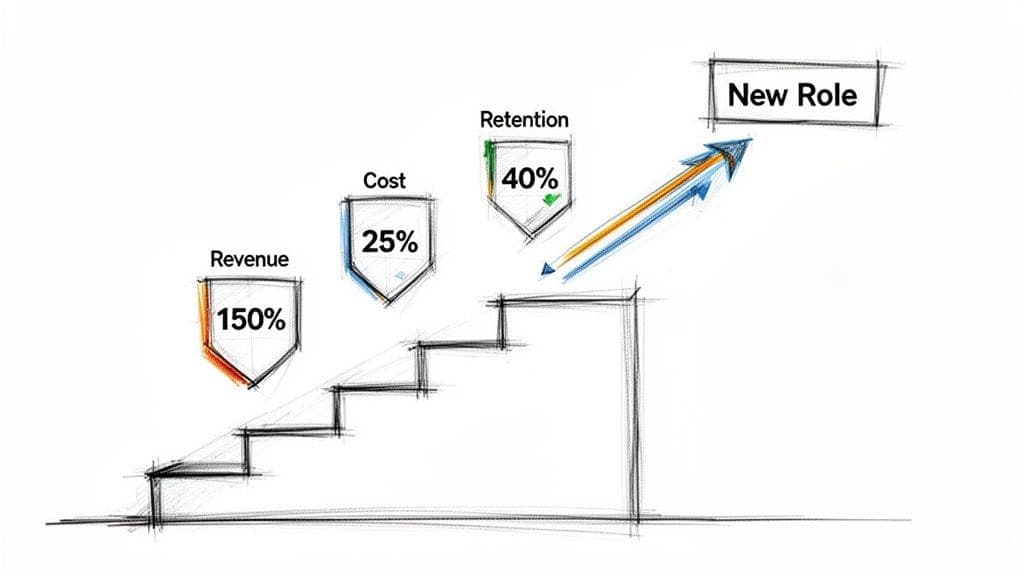
This approach immediately establishes your credibility by leading with hard data. It moves the conversation from "what tasks have you done?" to "what results have you produced?". By demonstrating a history of delivering measurable value, you position yourself as a low-risk, high-reward candidate.
For instance, a sales executive moving to tech sales can cite "exceeded quota by 150% and grew territory from £2M to £5M," directly showing their ability to drive revenue. An operations manager entering supply chain consulting could highlight "a 25% cost reduction and a 99.2% on-time delivery rate," proving their efficiency and process mastery. These specific, powerful metrics make your potential contribution tangible. For more inspiration, you can review some top examples of accomplishments to put on a resume to get ideas.
How to implement this strategy
- Lead with your best metric: Start your letter by stating the role and immediately connecting it to your most impressive, relevant accomplishment.
- Structure with STAR: In the body paragraphs, use the Situation-Task-Action-Result (STAR) method to give context to your achievements. Briefly describe the situation and your task, then detail the action you took and the quantifiable result.
- Translate the value: Don't assume the recruiter will connect the dots. Explicitly state why your past achievement matters in the new role. For example, "This 40% improvement in team retention demonstrates my ability to build the kind of engaged, stable engineering team you are seeking."
- Focus on impact: Your tone should be that of a business partner discussing potential ROI. You are not just a job applicant; you are a solution to the company's problems. This mindset transforms how your career change cover letter is perceived.
4. The Complementary-Skills Cover Letter
The Complementary-Skills approach is one of the most strategic career change cover letter examples, framing your previous experience not as irrelevant, but as a source of unique, advantageous skills for the new role. Instead of just bridging transferable skills, you argue that your distinct background provides a fresh perspective and cross-industry expertise that other candidates lack. It repositions your career change as a deliberate move that brings tangible value.
Why this method is effective
This strategy shows a deep understanding of the target industry by identifying what's missing and how your background fills that gap. It's a confident play that appeals to forward-thinking companies looking for innovation. For instance, an architect moving into UX design can argue their training in spatial logic and human-centred building design offers a unique advantage in creating intuitive digital products.
Similarly, a nurse transitioning to healthcare tech brings invaluable clinical workflow knowledge and patient empathy, ensuring software is practical and user-friendly. This method is about proving your different perspective is a commercial asset, not a liability. It's inspired by the idea popularised by authors like David Epstein that a diverse range of experiences fosters better problem-solving.
How to implement this strategy
- Research company challenges: Identify the company's pain points or strategic goals. Frame your unique skills as a direct solution to one of these problems.
- Show, don't just tell: Clearly state what your background offers. A musician moving into sound design could write, "My classical training provides a technical ear for harmonic balance that is directly applicable to creating immersive audio environments."
- Connect to innovation: Use your letter to show how your unconventional expertise can drive creativity and new solutions, making you a more valuable hire than a candidate with a traditional background.
- Be specific about the value: Explain why your different approach is better. For example: "While many product developers focus on features, my clinical nursing experience centres the patient's journey, which will help us reduce user friction and improve adoption rates."
5. The Education-and-Preparation Cover Letter
This format is specifically for career changers who have actively retrained through bootcamps, certifications, or formal education. The Education-and-Preparation letter showcases your commitment to the new field, proving you have invested time and effort to build the foundational knowledge required. It directly addresses a hiring manager's concern that you are merely testing the waters or unprepared for the role's technical demands.
This approach is one of the most compelling career change cover letter examples because it highlights intentionality. It frames your career switch not as a sudden leap, but as a carefully planned and executed strategy. It's particularly effective for those moving into technical fields like software development after completing a coding bootcamp, or aspiring cloud architects who have recently earned an AWS certification.
Why this method is effective
This letter provides tangible proof of your readiness. Instead of relying solely on translating past experiences, you present recent, relevant qualifications and projects that align directly with the target industry's standards. It demonstrates initiative, a strong work ethic, and a genuine passion for the new career path, reassuring employers that you are a serious and well-prepared candidate.
For instance, a professional who completes the Google UX Design Certificate can write a letter that references specific portfolio projects and the design thinking principles they applied. Similarly, a career switcher applying for a junior developer role after a General Assembly bootcamp can discuss the full-stack applications they built, mentioning the specific technologies used.
How to implement this strategy
- Lead with your new qualifications: Open your letter by mentioning your recent certification or training programme and the role you are targeting. This immediately establishes your relevance.
- Connect learning to application: Don't just list the courses you took. Explain how you have applied your new knowledge. Reference specific projects, coursework, or freelance work that directly relates to the job description's requirements.
- Show, don't just tell: Include a link to your portfolio, GitHub profile, or a specific project. This gives the recruiter concrete evidence of your skills and allows them to see your work firsthand.
- Acknowledge your transition confidently: Be upfront about your career change but frame it as a positive. For example, "After a successful career in marketing, I decided to pursue my passion for user-centred design by completing a comprehensive UX bootcamp, where I developed skills in..." This demonstrates self-awareness and confident planning.
6. The Niche-Expertise Cover Letter
The Niche-Expertise cover letter is a specialised format for career changers whose deep domain knowledge from a previous career is a major asset in a new industry. This approach positions you as an expert who understands a critical, often complex, aspect of the target role that typical candidates may lack. It's one of the most compelling career change cover letter examples UK professionals can use because it transforms a non-traditional background from a potential weakness into a unique selling point.
Why this method is effective
This method works by highlighting how your specialised knowledge directly addresses specific pain points or opportunities within the new industry. It demonstrates a level of insight that can't be taught quickly, giving you an immediate competitive advantage. This approach shows you're not just switching careers, but bringing a valuable perspective that can drive success in the new role.
For instance, a commercial airline pilot transitioning into aerospace engineering can offer unparalleled real-world operational knowledge that pure engineers might not possess. Similarly, a banking compliance officer moving into a fintech startup brings indispensable expertise in navigating complex regulatory environments, a crucial factor for the company's long-term viability. This strategy proves your career change is a calculated move that offers the employer distinct benefits.
How to implement this strategy
- Pinpoint your unique value: Identify one or two core areas of expertise that set you apart. A documentary filmmaker entering the non-profit sector, for example, should focus on their proven ability to craft compelling narratives that drive engagement and donations.
- Connect to company challenges: Research the company to understand its specific problems or goals. Explain exactly how your niche background provides a solution or helps achieve a key objective.
- Translate your expertise: Describe your specialised knowledge in clear, accessible language, but use just enough industry-specific terminology to establish your credibility. The goal is to be understood, not to overwhelm.
- Show, don't just tell: Use metrics and specific examples to demonstrate the impact of your expertise. Instead of saying you have "regulatory knowledge," state that you "developed a compliance framework that successfully passed three regulatory audits with zero findings."
7. The Portfolio-Driven Cover Letter
The Portfolio-Driven cover letter is a concise, visually-supported format ideal for creative career changers. It acts as a compelling gateway to your work, acknowledging that for roles in design, writing, or development, a portfolio often speaks louder than a lengthy letter. This approach uses the cover letter to briefly introduce your ambition and guide the recruiter directly to your curated work samples, which demonstrate your capabilities far more effectively than words alone.
Why this method is effective
This format is powerful because it respects the hiring manager's time and focuses on what truly matters in creative fields: tangible proof of skill. Instead of describing your abilities, you are showing them. It builds immediate credibility and allows your work to make the primary argument for your candidacy.
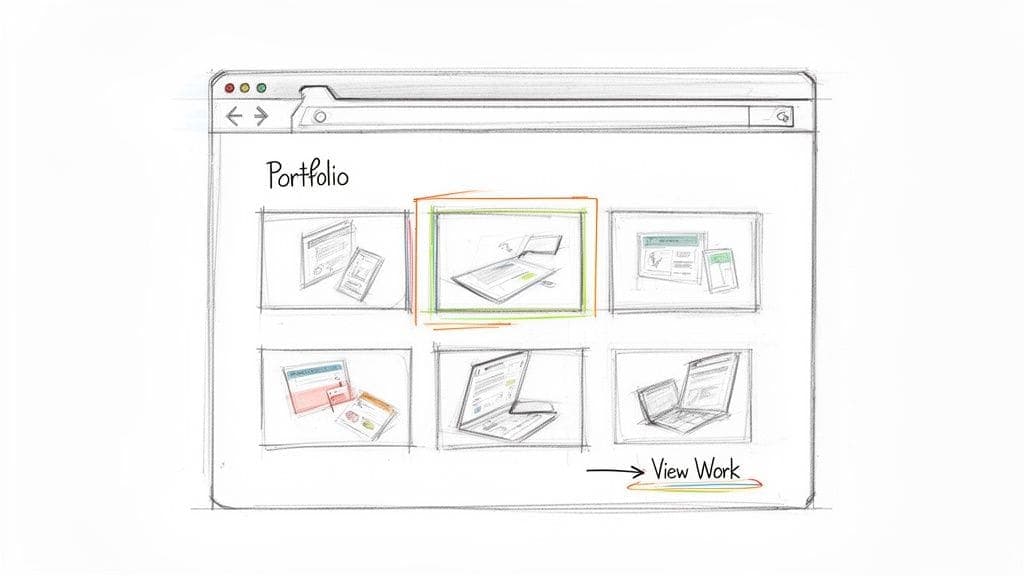
For instance, a corporate communications professional pivoting to copywriting can present a portfolio of compelling blog posts and marketing copy. An accountant transitioning to graphic design can showcase freelance projects and polished work from design courses. This tactic is one of the most direct career change cover letter examples for proving your new skills without a traditional background.
How to implement this strategy
- Keep it brief: The letter should be very short, around 2-3 paragraphs. Its main job is to introduce you and point to your portfolio.
- Curate your portfolio: Do not include everything. Select 5-7 of your strongest pieces that are directly relevant to the role you're targeting. Highlight one or two projects that specifically demonstrate your career transition journey.
- Provide context: For each piece in your portfolio, write a brief description explaining your role, the project's goal, your process, and the final outcome. This shows your strategic thinking.
- Ensure accessibility: Double-check that all links to your portfolio are active and that the site displays correctly on both desktop and mobile devices. A broken link is an immediate red flag.
- Frame the transition: Your opening paragraph should state your career change and immediately link to your portfolio as evidence of your new, proven skills. Your tone should be confident, presenting your work as the main event.
8. The Story-Arc Cover Letter
The Story-Arc is a narrative-structured cover letter that frames your career change as a compelling three-act story. This approach humanises your professional journey by outlining your past success (Act 1), the turning point that inspired a new direction (Act 2), and your vision for the future in this new role (Act 3). It presents your transition as a logical progression, demonstrating self-awareness and purpose rather than erratic job-hopping.
Why this method is effective
This method connects with the reader on an emotional level while maintaining professional credibility. By telling a story, you make your application more memorable and provide a clear, logical "why" behind your career change. It's a highly effective way to explain your motivations without appearing apologetic or directionless.
Consider a financial analyst who excelled in their quantitative role but realised their work lacked personal meaning. The story-arc letter would briefly touch on their success, describe a specific moment or realisation (the 'wake-up call') that drove them to seek impact, and finally connect this to their new passion for a role in climate tech. This format provides a powerful narrative, making it one of the most engaging career change cover letter examples for purpose-driven roles. For more foundational advice on structure, you can explore our complete guide to writing a cover letter.
How to implement this strategy
- Act 1 - Establish Credibility: Start by briefly mentioning your previous career and a key success. This should only be one or two sentences; you want to establish competence without dwelling on the past.
- Act 2 - The Turning Point: Explain what prompted your change. Be genuine and specific. Instead of saying, "I wanted more fulfilling work," describe the project, volunteer experience, or personal insight that clarified your new direction.
- Act 3 - The Inevitable Conclusion: Connect your story directly to the role you are applying for. Explain how this position is the logical and exciting next step in your professional narrative and how your unique journey makes you a strong candidate.
- Maintain Authenticity: Have a trusted mentor review your letter to ensure your story feels authentic and impactful. Your narrative must be believable to be effective.
9. The Industry-Research-Backed Cover Letter
The Industry-Research-Backed cover letter is a data-driven approach that positions your career change as a well-informed strategic decision. Instead of simply stating your interest, you prove it by demonstrating a deep understanding of the target industry, its market trends, and the specific challenges and opportunities facing the company. This method is especially potent for analytical career changers, as it showcases serious commitment and intellectual engagement with the new field.
Why this method is effective
This format immediately signals to a hiring manager that you are not a casual applicant but a dedicated professional who has invested time to understand their world. It answers the unspoken question: "Why us, and why now?". By citing specific data points, you build a compelling narrative that your pivot is a calculated move, not a guess. This is one of the strongest career change cover letter examples for roles in strategy, finance, or competitive tech sectors.
For instance, an operations expert moving into cleantech could cite specific market projections for solar panel efficiency and reference the company's recent sustainability initiatives. A financial analyst targeting a healthcare innovation role might mention a competitor's recent acquisition or relevant funding trends in the biopharmaceutical space. This approach demonstrates analytical skill and commercial awareness before you even reach the interview stage.
How to implement this strategy
- Dedicate research time: Start your research at least a week before applying. Use tools like Crunchbase, industry-specific databases, and company investor relations pages to gather insights.
- Cite specific, relevant data: Integrate one or two powerful insights concisely. Instead of a data dump, connect your findings directly to the role. For example, "Noting the industry-wide push to reduce customer acquisition costs, my background in optimising marketing funnels can directly support your growth objectives."
- Connect research to your value: Explicitly link your insights to how your unique skills can help the company navigate the trends you've identified. Show them you've already started thinking like a member of their team.
- Maintain a confident tone: Your research is your proof of commitment. Present your findings as the foundation for your application, framing your career change as a logical next step that benefits their organisation. For more guidance on structuring your letter, our advice on general UK cover letter examples provides a solid framework.
10. The 'Bringing Solutions' Cover Letter
The 'Bringing Solutions' cover letter is a proactive format that demonstrates immense commercial awareness and strategic thinking. Instead of focusing solely on your skills, this approach identifies a specific problem or gap within the target company and positions your unique background as the direct solution. It powerfully shifts the narrative from 'why should we hire a career changer?' to 'how can this person's distinct experience solve our real-world challenges?'.
Why this method is effective
This approach shows you've done your homework and understand the business beyond the job description. It elevates you from a candidate asking for a job to a potential partner offering tangible value. This is one of the most sophisticated career change cover letter examples because it frames your lack of direct experience as a source of fresh, problem-solving perspective.
For instance, a logistics manager moving into healthcare technology could highlight the lack of supply chain optimisation in hospital operations and position their background as the key to improving efficiency. Similarly, a manufacturing engineer pivoting to a sustainability role might identify specific energy efficiency gaps in a company's public reports and frame their engineering expertise as the solution.
How to implement this strategy
- Research deeply: Go beyond the job spec. Analyse the company's recent news, investor presentations, or even social media commentary to identify genuine challenges or growth areas they are facing.
- Connect your background directly: Identify one or two core problems and link your specific skills to solving them. For example, a customer service professional moving into healthcare could highlight patient experience challenges and connect their empathy and communication skills as the solution.
- Use diplomatic language: Frame your observations tactfully. Instead of saying, "You need to fix your inefficient processes," use phrases like, "I noticed a potential opportunity to strengthen X, and my background in Y could contribute to this."
- Propose a conversation: End your letter by framing your insights as an exploratory conversation starter, not a rigid prescription. This shows collaborative spirit and respect for the company's internal expertise.
Top 10 Career-Change Cover Letter Comparison
| Cover Letter Type | Implementation Complexity 🔄 | Resource & Time Required ⚡ | Expected Results / Impact 📊 | Effectiveness / Quality ⭐ | Ideal Use Cases & Tips 💡 |
|---|---|---|---|---|---|
| The Skills-Bridge Cover Letter | Moderate — structured mapping of transferable skills | Low–Medium — self-audit and job research | Better ATS keyword fit; reduces "lack of experience" concern | ⭐⭐⭐⭐ — reliable for clear skill overlap | 💡 Use concrete examples and align 3–4 skills to JD; open confidently |
| The Passion-and-Purpose Cover Letter | Moderate — narrative crafting and balance required | Low–Medium — personal reflection + company research | Creates emotional connection; signals commitment | ⭐⭐⭐ — strong for values-driven roles | 💡 Be authentic and brief; pair emotion with concrete capability evidence |
| The Achievement-Focused Cover Letter | Medium–High — requires metric selection and translation | Medium — gather quantifiable results and context | Demonstrates measurable impact; builds credibility quickly | ⭐⭐⭐⭐ — highly persuasive for data-driven hires | 💡 Lead with 3–5 metrics and explain the "so what" for the new role |
| The Complementary-Skills Cover Letter | Moderate — requires clear framing of cross-industry value | Medium — research company needs and examples | Positions background as unique advantage; encourages creative fit | ⭐⭐⭐ — effective for innovation-focused teams | 💡 Identify 2–3 genuine cross-domain assets and tie to company problems |
| The Education-and-Preparation Cover Letter | Low–Medium — emphasize training and projects | Medium–High — time invested in courses/certifications | Removes foundational knowledge objections; shows commitment | ⭐⭐⭐⭐ — effective for technical/regulatory transitions | 💡 Highlight reputable training and capstone projects; link to JD |
| The Niche-Expertise Cover Letter | High — deep domain translation and credibility building | Medium — document domain impact and relevance | Creates unique positioning; attracts niche roles | ⭐⭐⭐⭐ — powerful when expertise is rare and relevant | 💡 Focus on 1–2 niche strengths and show clear application to role |
| The Portfolio-Driven Cover Letter | Low — short, directive, portfolio-focused | Medium — curate and maintain portfolio assets | Lets work samples demonstrate capability; fast screening | ⭐⭐⭐⭐ (for creatives) — excellent when portfolio is strong | 💡 Keep letter to 2–3 paragraphs; link curated 5–7 pieces with brief context |
| The Story-Arc Cover Letter | High — requires strong narrative structure and restraint | Medium — craft three-act story; review for authenticity | Memorable and cohesive explanation of pivot; builds trust | ⭐⭐⭐ — effective for leadership/client-facing roles | 💡 Keep Act 1 short, make turning point specific, end with clear vision |
| The Industry-Research-Backed Cover Letter | High — rigorous company/market research needed | High — time-consuming research per application | Signals serious commitment and analytical fit; impresses technical hiring | ⭐⭐⭐⭐ — strong for strategy, analyst, and consulting roles | 💡 Cite 1–2 concise insights and tie them directly to how you add value |
| The "Bringing Solutions" Cover Letter | High — requires problem identification + tailored solution | Medium–High — research + strategic framing | Shifts focus to value creation; positions you as problem-solver | ⭐⭐⭐⭐ — effective across seniority when problem is real | 💡 Identify a real, researched problem and propose how your background helps (humble, specific tone) |
Your Next Move: Turning Examples Into Interviews
We have explored a wide range of career change cover letter examples, each demonstrating a distinct strategy for connecting your past experience to a new professional future. From the directness of the Skills-Bridge Letter to the compelling narrative of the Story-Arc Letter, you now possess a full toolkit for tackling your career pivot with assurance. These examples prove that a successful transition isn't about apologising for your non-linear path; it's about confidently articulating its unique value.
The central lesson from these detailed breakdowns is one of strategic reframing. Your previous roles, regardless of the industry, have equipped you with a distinct set of skills, perspectives, and achievements. The task is to build a convincing bridge between that history and the specific needs of your target role. Whether you're highlighting transferable achievements, showcasing deep industry research, or focusing on your passion for the new field, every element of your letter must answer the hiring manager's core question: "Why are you, with your unique background, the best person for this job?"
Master the Core Principles of a Career Change Letter
Beyond the specific templates, remember the fundamental principles that make these career change cover letter examples effective. Each one succeeds because it is:
- Forward-Looking: It acknowledges the past but focuses on future contributions. The emphasis is on what you will do for the company, not just what you have done.
- Evidence-Based: Claims are not made in a vacuum. They are supported by quantifiable achievements, specific project examples, or clear evidence of research and preparation.
- Deeply Personalised: Every letter is meticulously tailored to the company and the role. It speaks their language, addresses their pain points, and demonstrates a genuine understanding of their mission and challenges.
- Strategically Aligned: Keywords from the job description are woven in naturally, ensuring the letter gets past Applicant Tracking Systems (ATS) and resonates with the human reader. This shows you've done your homework and understand what matters most.
From Theory to Action: Your Next Steps
Viewing these examples is just the beginning. The real work starts now, and it involves turning these insights into your own powerful application document. Don't simply copy and paste a template; instead, use it as a structural guide for telling your personal story.
Your first step is to conduct a thorough self-audit. Identify your core transferable skills, your most impressive achievements, and the genuine reasons behind your desire to change careers. Next, select the cover letter strategy from this article that best aligns with your personal narrative and the roles you are targeting. Are you driven by a deep-seated passion, or is your strength in the unique combination of skills you bring?
Once you have your strategy, begin drafting. Focus on a powerful opening paragraph that hooks the reader and immediately establishes your value proposition. Use the middle paragraphs to build your case with concrete evidence, always connecting your skills back to the employer's needs. Remember the power of a strong closing, where you reiterate your enthusiasm and clearly state your call to action: securing an interview. By applying these methods, you transform from just another applicant into a compelling candidate who offers a valuable and distinct perspective. Your journey through these career change cover letter examples has prepared you to take that confident next step.
Ready to stop guessing and start building a cover letter that gets results? The CV Anywhere platform is designed to make this process seamless. Use our JD Fit Checker to instantly see how your skills align with the job description and our Smart CV Builder to craft a perfectly formatted, professional story. Turn the strategies you've learned today into a powerful application with CV Anywhere.