This guide provides eight proven UK cover letter examples, broken down by industry and career stage. We analyse exactly why each one works, from structure and tone to ATS compatibility, so you can adapt these strategies for your own job search. Forget generic advice; these templates are tailored for the UK market, highlighting the specific conventions that hiring managers expect. You'll get a strategic breakdown of how to structure your narrative, quantify your achievements, and align your skills directly with the job description. Each example is designed to pass through modern Applicant Tracking Systems (ATS) and capture the attention of a human reader.
1. Graduate Entry-Level Cover Letter
A graduate entry-level cover letter is your strategic bridge from academia to the professional world. With limited formal work history, this type of letter pivots the focus onto your potential, transferable skills, and academic achievements. It's designed to persuade a hiring manager that your enthusiasm and relevant university experience make you a strong candidate, even without years on the job.

This approach is essential when applying for graduate schemes, internships, or entry-level roles where employers actively seek fresh talent. For instance, a recent Business graduate applying to a commercial banking programme would highlight a dissertation on financial modelling and a high mark in a corporate finance module. Similarly, a STEM graduate targeting an engineering firm like Jaguar Land Rover would detail their final-year project on aerodynamic efficiency.
Why This Cover Letter Works
The power of a graduate cover letter lies in its ability to translate academic success into commercial value. It demonstrates self-awareness and a proactive attitude by connecting specific university experiences directly to the requirements listed in the job description.
Strategic Insight: This letter isn't about apologising for a lack of experience. It's about confidently presenting your academic journey and extracurricular activities as a direct and relevant form of preparation for the role.
By showing you understand the company's challenges and can apply your theoretical knowledge to solve them, you position yourself as a low-risk, high-potential hire.
Actionable Takeaways & Tailoring Notes
To craft a compelling graduate cover letter, focus on precision and relevance.
- Quantify Achievements: Don't just mention your degree; state your classification (e.g., "achieved a First-Class Honours in Economics") or specific high-scoring modules relevant to the job.
- Connect Modules to Job Duties: Explicitly link your university projects to the role's responsibilities. For example: "My final-year project in software development, where I utilised Python to analyse data sets, has prepared me for the data analysis tasks mentioned in your job description."
- Show Commercial Awareness: Reference a recent company project, a market trend, or a core company value to prove you have done your research and are genuinely invested in their mission.
- Emphasise Transferable Skills: Highlight skills like research, data analysis, teamwork (from group projects), and time management (from balancing studies and part-time work).
This format allows you to build a strong narrative around your potential. For more guidance on structuring your application, explore our detailed advice on how to write a compelling recent graduate CV that complements your cover letter.
Turn this example into your own cover letter
Add the job description and create a draft for the role. Review the wording and check every claim before sending.
A starting draft you can edit in your own voice.
2. Career Change Cover Letter
A career change cover letter is a narrative-driven document designed to convince a hiring manager of your value despite a non-traditional career path. Unlike standard letters, its primary goal is to address the "why" behind your transition and build a compelling "skills bridge" from your past experience to your future role. This letter proactively tackles potential employer concerns, framing your career shift as a deliberate and well-researched move.

This approach is crucial for anyone making a significant professional pivot. For example, a marketing manager moving into user experience (UX) design would focus on their experience with customer research and data-driven campaigns, connecting these directly to UX principles. Similarly, a financial analyst transitioning to sustainability consulting would highlight their quantitative analysis skills and frame them as essential for measuring environmental impact.
Why This Cover Letter Works
The effectiveness of a career change cover letter is rooted in its persuasive storytelling. It doesn't hide the career transition; it owns it, turning a potential weakness into a unique strength. By explicitly connecting the dots for the recruiter, you control the narrative and demonstrate strategic thinking.
Strategic Insight: This letter isn't just about listing transferable skills. It's about creating a compelling argument that your unique background provides a fresh perspective and a valuable, diverse skill set that other candidates lack.
By directly addressing your motivation and showcasing relevant upskilling, you reassure the employer of your commitment and reduce the perceived risk of hiring someone from a different field.
Actionable Takeaways & Tailoring Notes
To write an impactful career change cover letter, you must be direct, confident, and strategic.
- Create a Clear 'Skills Bridge': Don't make the recruiter guess. Explicitly state how your skills transfer. For example: "My decade of experience in client relationship management has honed my ability to understand user needs, a core requirement for a successful UX Designer."
- Lead With Motivation: Start your letter by addressing the career change head-on. Explain your passion for the new field and what prompted the move, showing genuine commitment.
- Showcase New Learning: Mention any recent certifications, courses, or self-study projects (e.g., "completed a Google UX Design Professional Certificate") to prove you are actively and seriously investing in this new path.
- Demonstrate Industry Knowledge: Reference industry-specific trends, challenges, or key players to show you've done your homework and are not just testing the waters.
This format allows you to reframe your experience and present yourself as an agile and motivated candidate. For personalised advice on navigating this transition, our experts can provide guidance on crafting your career change narrative and preparing for interviews. Learn more about how a career coach can support your transition and help you succeed.
3. Executive/Senior Management Cover Letter
An executive or senior management cover letter is a high-impact document crafted for C-suite, director, or senior leadership positions. Unlike conventional letters that detail job duties, this format focuses on strategic achievements, leadership credentials, and quantifiable business impact. It adopts a consultative and results-driven tone, reflecting the decision-making authority and executive presence expected at this level.

This approach is essential when targeting roles where the stakes are high and the hiring decisions are often made at board level. For instance, a Chief Financial Officer applying to a FTSE 250 company would lead with their experience in securing a £50 million funding round or improving EBITDA by 15%. Similarly, a VP of Operations seeking a COO role would highlight their success in orchestrating a supply chain transformation that saved millions in operational costs.
Why This Cover Letter Works
The power of an executive cover letter lies in its ability to speak the language of the boardroom: results, strategy, and financial performance. It immediately positions the candidate as a peer who understands the high-level challenges the organisation faces, rather than just another applicant seeking a job. It demonstrates strategic foresight and commercial acumen from the very first sentence.
Strategic Insight: This letter is less of an application and more of a business proposal. It frames your candidacy as a strategic investment that will deliver a significant return for the company, addressing top-line growth, profitability, or market positioning.
By focusing on leadership impact and aligning your past successes with the company's future goals, you present yourself as an indispensable asset capable of steering the organisation towards its objectives.
Actionable Takeaways & Tailoring Notes
To craft a compelling executive cover letter, prioritise brevity, authority, and impact.
- Lead with Quantifiable Impact: Start with your most powerful achievement. For example: "In my capacity as Managing Director at [Previous Company], I spearheaded a market entry strategy that captured a 10% market share within 24 months, delivering £20M in new revenue."
- Use an Executive Summary Style: Keep the letter concise and to the point, ideally under one page. Use short paragraphs or bullet points to highlight key achievements related to revenue, profit, and efficiency.
- Demonstrate Market Awareness: Show you understand the industry's current challenges and opportunities. Reference market trends or competitive pressures to prove you are a strategic thinker.
- Align with Corporate Goals: Directly connect your leadership experience to the strategic priorities mentioned in the company's annual report or investor relations communications.
This format ensures your application commands attention and is perfectly complemented by a well-structured CV. For further guidance, explore these professional curriculum vitae examples designed for senior leaders.
4. NHS and Healthcare Professional Cover Letter
An NHS and healthcare professional cover letter is a highly specialised document designed for roles within the UK's National Health Service and the wider private healthcare sector. It goes beyond a standard application by demonstrating a deep understanding of patient-centred care, clinical governance, and the core values of the NHS Constitution. It's a vital tool for showcasing your clinical competence, adherence to professional standards, and commitment to public health.
This approach is non-negotiable when applying for roles from a newly qualified nurse position in a major NHS trust to a GP role in a local surgery. For instance, a nurse seeking a Ward Manager role would need to highlight their leadership experience and knowledge of CQC (Care Quality Commission) standards. Similarly, an Allied Health Professional applying for a community rehabilitation post would detail their experience with multidisciplinary teams and patient discharge planning.
Why This Cover Letter Works
The effectiveness of a healthcare cover letter is rooted in its ability to blend clinical expertise with genuine compassion and an understanding of the system's pressures. It proves you are not just technically proficient but also aligned with the ethical and professional frameworks governing UK healthcare, such as the 6 Cs (Care, Compassion, Competence, Communication, Courage, and Commitment).
Strategic Insight: This letter must communicate that you see your role as more than a job; it's a vocation. It requires you to directly connect your skills and experiences to specific NHS trust priorities or patient outcomes, proving you can contribute meaningfully from day one.
By referencing specific NHS targets (e.g., reducing waiting times) or trust values, you show you are an informed and dedicated candidate ready to tackle current challenges.
Actionable Takeaways & Tailoring Notes
To write a powerful NHS or healthcare cover letter, focus on evidence and alignment.
- State Your Registration: Prominently include your professional registration details (e.g., NMC Pin or GMC/HCPC number) near the beginning of your letter.
- Align with NHS Values: Explicitly mention and provide examples of how you embody the core NHS values. For example: "My commitment to patient dignity aligns with the NHS value of 'Respect', which I demonstrated by leading a project to improve patient privacy on the ward."
- Reference Trust-Specific Goals: Show you've done your research by mentioning a specific objective from the NHS Trust's latest annual report or quality improvement plan.
- Highlight Clinical & Digital Skills: Detail your experience with relevant clinical procedures and systems, such as electronic patient records (EPR) like Cerner or EMIS. For healthcare professionals, mastering clear communication extends beyond cover letters; improving professional writing skills in healthcare, such as when writing patient notes, can also enhance your overall professional communication.
This targeted approach ensures your application resonates with clinical hiring managers. For more help building your application, our specialised healthcare CV templates can provide the ideal foundation.
5. Academic and University Role Cover Letter
An academic and university role cover letter is a highly specialised document crafted for positions like lecturer, research fellow, or professor within UK higher education. Unlike corporate applications, this letter prioritises your research credentials, publication record, teaching philosophy, and specific contributions to your academic discipline. It must demonstrate a deep understanding of academic hierarchies and the UK's research assessment frameworks, such as the Research Excellence Framework (REF).
This letter is essential when applying for any academic post advertised on platforms like jobs.ac.uk or FindAPostDoc. For instance, a postdoctoral researcher applying for a lectureship in Physics at a Russell Group university would lead with their high-impact publications and detail how their research on quantum computing aligns with the department's strategic goals. Similarly, an established academic seeking a Professorship would emphasise their success in securing substantial grants from UK Research and Innovation (UKRI).
Why This Cover Letter Works
The effectiveness of an academic cover letter lies in its ability to present a compelling narrative of scholarly excellence and future potential. It goes beyond a simple list of achievements to articulate a clear vision for your research and teaching, and how that vision will enhance the university's reputation and research output.
Strategic Insight: This letter must prove you are not just a capable researcher or teacher, but a future leader in your field whose work will attract funding, top-tier students, and international prestige to the institution.
By directly addressing the university's research strategy and departmental needs, you position yourself as a valuable and synergistic addition to their academic community.
Actionable Takeaways & Tailoring Notes
To create a powerful academic cover letter, focus on evidence-based claims and strategic alignment.
- Lead with Research Impact: Begin by highlighting your most prestigious publications, mentioning key journals. If impressive, state your h-index or significant citation metrics.
- Quantify Funding Success: Reference specific grants you have secured, naming the funding body (e.g., Wellcome Trust, Leverhulme Trust) and the amount awarded.
- Show Departmental Fit: Demonstrate you have researched the department thoroughly. Mention specific academics you wish to collaborate with or how your research complements existing strengths.
- Articulate Your Teaching Philosophy: Briefly outline your approach to teaching and student mentorship, providing examples of innovative course design or curriculum development you have led.
This approach ensures your application speaks the language of academia and addresses the core priorities of hiring committees. To ensure your credentials are presented effectively, pair this letter with a meticulously structured CV using our guide on the academic CV template.
6. Tech and Software Development Cover Letter
A tech and software development cover letter is your primary tool for showcasing technical expertise alongside professional drive. It moves beyond a simple skills list, demonstrating how your coding proficiency, project experience, and problem-solving mindset align with a company's specific technological stack and business goals. This format is designed to prove you can not only write clean code but also contribute meaningfully to a collaborative, agile environment.

This approach is crucial for roles ranging from a full-stack developer at a London FinTech startup to a data scientist at a major firm like Amazon UK. For example, a cybersecurity specialist applying to a defence technology firm would highlight a specific project where they identified and patched a critical vulnerability, while a developer would link to their GitHub repository showcasing a relevant project built with React and Node.js.
Why This Cover Letter Works
The strength of a tech cover letter is its direct, evidence-based approach. It provides tangible proof of your skills through links to portfolios, GitHub profiles, or technical blogs, allowing recruiters to see your work firsthand. It effectively translates technical jargon into business value, showing how your contributions can improve system performance, enhance user experience, or solve complex commercial problems.
Strategic Insight: This letter isn't just a list of programming languages. It's a curated presentation of your most relevant projects and achievements, demonstrating a deep understanding of the company's tech stack and challenges.
By connecting your technical projects to the job's requirements, you position yourself as a practical problem-solver who is ready to contribute from day one.
Actionable Takeaways & Tailoring Notes
To create a powerful tech cover letter, focus on specificity and impact.
- Link Your Work: Always include hyperlinks to your GitHub profile, a live portfolio website, or a relevant technical blog post. Make it easy for them to see your skills in action.
- Match the Tech Stack: Mirror the language in the job description. If they need a developer with Python, Django, and PostgreSQL experience, highlight a project where you used that exact stack.
- Quantify Your Impact: Use metrics to demonstrate success. For instance, "Contributed to a project that reduced API response time by 15%" or "Developed a feature that increased user engagement by 10%."
- Show Collaborative Skills: Mention your experience with agile methodologies, Scrum, or pair programming. This counters the stereotype of solitary coders and shows you are a team player.
- Reference Open-Source Contributions: If you have contributed to open-source projects or won a hackathon, mention it. This shows passion and community involvement beyond your day-to-day work.
7. Creative Industry and Marketing Cover Letter
A creative industry cover letter is a specialist tool used to break into sectors like marketing, advertising, graphic design, and PR. Unlike more traditional formats, it allows for greater personality and creative flair, reflecting the nature of the industry itself. This letter acts as a showcase, blending professionalism with a demonstration of your creative thinking, brand awareness, and campaign successes. It's one of the most dynamic UK cover letter examples for professionals in creative fields.
This approach is crucial when applying for roles where a unique brand voice and innovative thinking are paramount. For example, a digital marketer applying to a disruptive fintech startup might open with a bold statistic from a successful social media campaign they led. Similarly, a graphic designer targeting a top branding agency could subtly incorporate the agency's colour palette into the letter's design, showing initiative and a keen eye for brand identity.
Why This Cover Letter Works
The effectiveness of a creative and marketing cover letter lies in its ability to embody the very skills it describes. It's not just a document; it's the first piece of creative work a potential employer sees. It demonstrates an innate understanding of branding, storytelling, and audience engagement by applying those principles to your own personal brand.
Strategic Insight: This letter should be a "show, don't just tell" exercise. Instead of merely listing your creative skills, your letter's tone, structure, and even visual presentation should serve as direct evidence of your capabilities and your fit with the company's culture.
By proving you can market yourself effectively, you give employers confidence that you can do the same for their brand.
Actionable Takeaways & Tailoring Notes
To make your creative cover letter stand out, you need to balance originality with professional clarity.
- Lead with Impact: Start with a powerful hook, such as a standout campaign achievement or a key quantifiable result. For instance: "Driving a 300% increase in organic engagement for a leading UK retailer taught me that..."
- Show Brand Alignment: Demonstrate that you have researched and understand the company's brand voice and creative direction. Reference a recent campaign you admired and explain why it resonated with you.
- Link Your Portfolio: Make it easy for them to see your work. Include a clear, prominent link to your online portfolio, Behance, or Dribbble profile.
- Quantify Creative Success: Back up your creative claims with hard data. Use metrics like conversion rates, audience growth, ROI on ad spend, or media placements to prove your value.
- Inject Personality: Let your genuine passion for the industry shine through. A conversational yet professional tone can be more effective than a stiff, corporate one in these sectors. This is a key differentiator in UK cover letter examples for marketing roles.
8. Finance and Accounting Professional Cover Letter
A finance and accounting professional cover letter is a precise, data-driven document that showcases technical expertise, professional qualifications, and quantifiable achievements. Unlike more creative letters, this format prioritises accuracy, regulatory knowledge, and tangible financial impact. It is engineered to demonstrate your value in a sector where numbers and compliance are paramount, making it one of the most specialised UK cover letter examples.
This approach is non-negotiable when applying for roles in corporate finance, investment banking, or at accountancy firms like Deloitte or PwC. For example, a Chartered Accountant (ACA) applying for a Finance Manager role would lead with their qualification and immediately quantify achievements, such as "reduced month-end closing time by 15%." Similarly, a CFA charterholder targeting an analyst role would highlight their expertise in financial modelling and valuation techniques.
Why This Cover Letter Works
The effectiveness of a finance cover letter hinges on its ability to build immediate trust and credibility. By front-loading professional qualifications (like ACA, ACCA, or CIMA) and using precise, industry-specific language, you signal to the hiring manager that you are a serious, competent professional who understands the financial landscape.
Strategic Insight: This letter acts as a financial proof of performance. Instead of describing your duties, you are presenting a mini-audit of your past successes, using hard data to prove your ability to manage risk, enhance profitability, and ensure compliance.
It moves beyond a simple list of responsibilities to provide evidence of your direct contribution to a company's financial health, positioning you as a valuable asset rather than just a candidate.
Actionable Takeaways & Tailoring Notes
To construct a powerful finance and accounting cover letter, focus on precision, quantification, and relevance.
- Lead with Qualifications: Place your key qualifications (e.g., "ACA-qualified accountant") in the opening paragraph to establish your credibility instantly.
- Quantify Everything: Use metrics to demonstrate impact. Instead of "managed budgets," write "managed a £5M departmental budget, delivering a 10% cost saving through strategic vendor negotiations."
- Specify Technical Skills: Mention specific financial software (e.g., Sage, Xero, SAP), modelling techniques, and familiarity with standards like IFRS or UK GAAP.
- Show Regulatory Awareness: Reference your understanding of relevant regulations, such as MiFID II or recent changes from HMRC, to show you are commercially aware and up-to-date.
- Align with Company Goals: Connect your skills to the company's financial objectives. For instance: "My experience in M&A due diligence aligns with your firm's recent expansion strategy as reported in the Financial Times."
UK Cover Letters — 8-Role Comparison
| Cover Letter Type | Implementation Complexity 🔄 | Resource Requirements ⚡ | Expected Outcomes ⭐ | Ideal Use Cases 💡 | Key Advantages 📊 |
|---|---|---|---|---|---|
| Graduate Entry-Level Cover Letter | 🔄🔄 (moderate — academic focus) | ⚡⚡ (low — transcripts, internships) | ⭐⭐⭐ (good for entry roles) | Recent graduates; graduate schemes; internship-to-role conversions | Highlights potential and academic strengths; shows enthusiasm and coachability |
| Career Change Cover Letter | 🔄🔄🔄 (high — narrative + bridging skills) | ⚡⚡⚡ (medium — upskilling, certifications) | ⭐⭐⭐ (variable; strong if transition is well justified) | Mid-career pivots; re-skilling into new industries | Positions transferable skills as assets; controls transition story |
| Executive / Senior Management Cover Letter | 🔄🔄🔄🔄 (high — concise, board-level tailoring) | ⚡⚡⚡⚡ (high — measurable metrics, references) | ⭐⭐⭐⭐ (high when tightly tailored) | C‑suite, director, VP, board-level roles | Demonstrates strategic impact and leadership; supports compensation negotiation |
| NHS & Healthcare Professional Cover Letter | 🔄🔄🔄 (high — must reference regs/values) | ⚡⚡⚡⚡ (high — registrations, CPD, clinical evidence) | ⭐⭐⭐⭐ (strong within healthcare when compliant) | NHS trusts, clinical roles, allied health positions | Shows clinical competence and values alignment; builds trust with regulators |
| Academic & University Role Cover Letter | 🔄🔄🔄🔄 (high — research/teaching evidence) | ⚡⚡⚡⚡ (high — publications, grants, teaching portfolio) | ⭐⭐⭐⭐ (high for research/teaching-fit candidates) | Lecturer, research fellow, professor positions | Demonstrates scholarly authority, grant success, and teaching impact |
| Tech & Software Development Cover Letter | 🔄🔄🔄 (moderate — project/stack emphasis) | ⚡⚡⚡ (medium — portfolio, GitHub, demos) | ⭐⭐⭐⭐ (high — demonstrable skills are valued) | Developers, data scientists, cybersecurity, cloud roles | Portfolio/GitHub provides tangible proof; high market demand |
| Creative Industry & Marketing Cover Letter | 🔄🔄🔄 (moderate — creative voice + examples) | ⚡⚡⚡ (medium — portfolio, campaign samples) | ⭐⭐⭐ (variable; strong if portfolio resonates) | Design, advertising, PR, digital marketing roles | Allows personality and creative presentation; showcases campaign results |
| Finance & Accounting Professional Cover Letter | 🔄🔄🔄🔄 (high — precise, compliance-focused) | ⚡⚡⚡⚡ (high — professional qualifications, systems experience) | ⭐⭐⭐⭐ (high for qualified candidates) | Accounting, financial analysis, investment banking roles | Emphasises quantifiable financial impact and regulatory competence |
Transform Your Application from Good to Great
Throughout this guide, we've dissected a diverse range of UK cover letter examples, from graduate entry-level roles to senior executive positions. We've moved beyond generic templates to reveal the strategic thinking that transforms a standard application into a compelling pitch that lands interviews. Each example, whether for a career changer, a tech professional, or an NHS applicant, is built on the same foundational principles: personalisation, relevance, and impact.
The core lesson is this: a successful cover letter is not a summary of your CV; it is a targeted argument for your candidacy. It demonstrates not just what you've done, but how your unique skills and experiences directly address the specific challenges and requirements outlined in the job description. The strongest applications create a clear, logical bridge between the employer's needs and your proven ability to deliver results.
Your Strategic Blueprint for Success
To synthesise the key takeaways from the examples provided, focus on these three critical pillars for every cover letter you write:
Context is King: Always begin by acknowledging the specific role and organisation. Show you've done your research. A brief mention of a recent company achievement, a specific project that excites you, or an alignment with their company values immediately sets you apart from candidates sending out generic, copy-pasted letters. This was a common thread in all our successful UK cover letter examples.
The 'P-A-R' Narrative: Structure your key arguments using the Problem-Action-Result framework. Instead of just listing a skill like "project management," describe a specific Problem you faced, the Action you took to solve it, and the quantifiable Result you achieved. This turns a passive claim into a powerful, evidence-backed story of your competence.
UK-Specific Conventions Matter: Adherence to professional formatting, correct salutations (e.g., 'Dear [Hiring Manager's Name]' or 'Dear Hiring Team'), and a formal yet confident tone are non-negotiable. Ensure your spelling and grammar are impeccable, utilising UK English conventions ('organise', 'analyse', 'colour'). These details signal your professionalism and attention to detail before a recruiter even reads the first paragraph.
Putting Knowledge into Action
You are now equipped with the strategic insights needed to craft a superior cover letter. The next step is execution. Avoid the common pitfall of sending a well-written but poorly-targeted letter. Each application must be meticulously tailored. This process, while demanding, is what separates successful candidates from the rest.
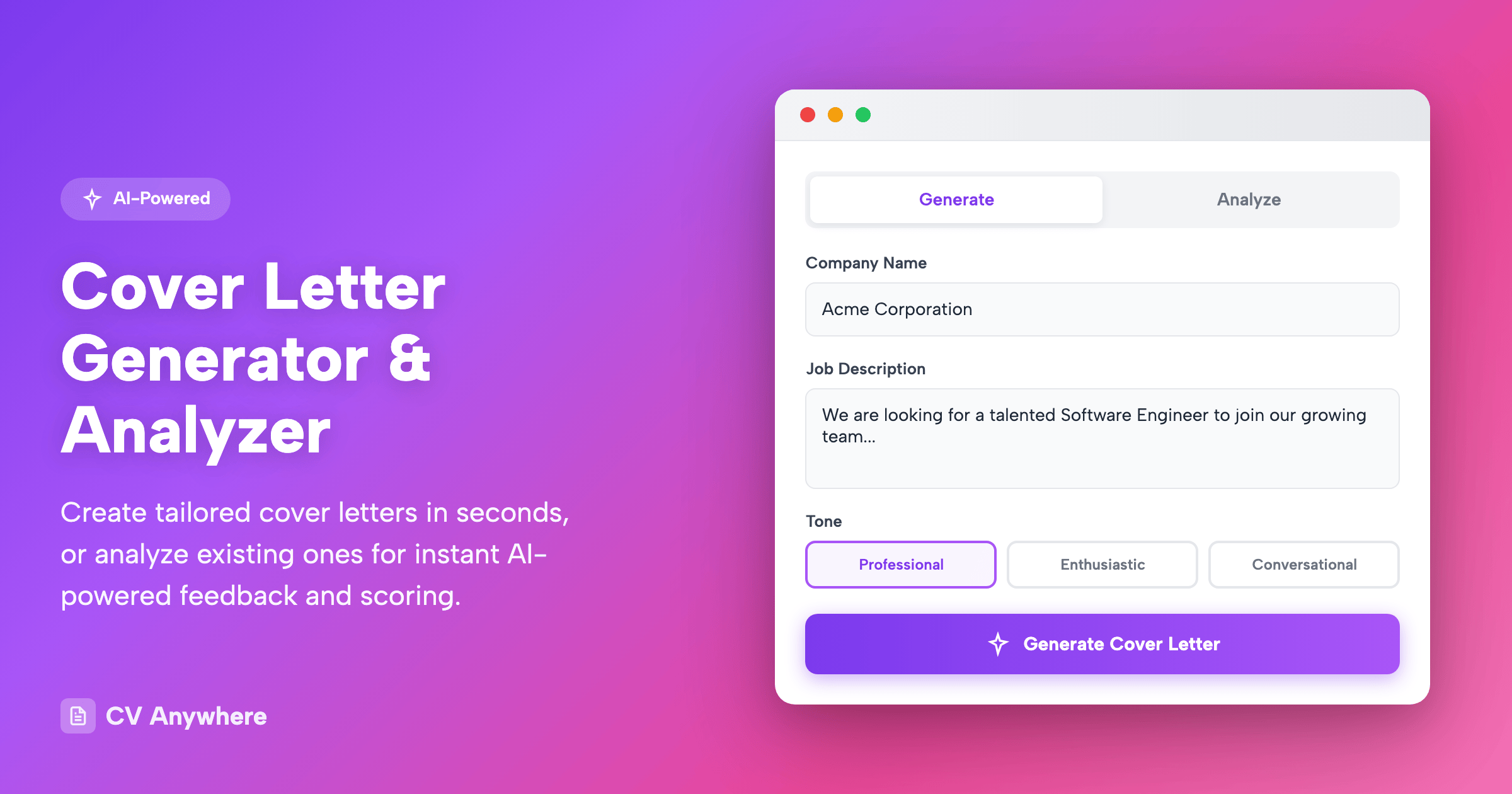
To enhance your application further and streamline the writing process, consider utilising an AI Cover Letter Generator for crafting personalised drafts. These tools can help you generate a strong first version that you can then refine using the strategic principles we've covered, ensuring your final document is both efficient to create and highly effective.
Ultimately, the goal is to make the hiring manager's job easy. By presenting a clear, persuasive, and well-researched argument, you are not just applying for a job; you are positioning yourself as the ideal solution to their problem. Embrace this mindset, apply the tactics from the UK cover letter examples we've explored, and you will significantly increase your chances of securing that crucial first interview.
Ready to stop guessing and start applying with confidence? CV Anywhere provides the tools you need to turn these examples into your reality. Use our JD Fit Checker to instantly analyse how your skills match any job description, then craft a perfectly tailored application with our Smart CV Builder and integrated cover letter tools. Try CV Anywhere for free and build an application that truly stands out.