Writing effective cover letters for receptionist roles in the UK is crucial for standing out in a competitive job market. The key is to create a concise, tailored document (around 250-400 words) that immediately showcases why you are the perfect fit. Instead of just listing duties, highlight 2-3 specific achievements with measurable results that directly address the employer's needs stated in the job advert. This approach demonstrates genuine interest and proves you have the essential skills, such as communication, organisation, and attention to detail, making it your best strategy for securing an interview in 2026.
Your Essential First Impression On UK Hiring Managers
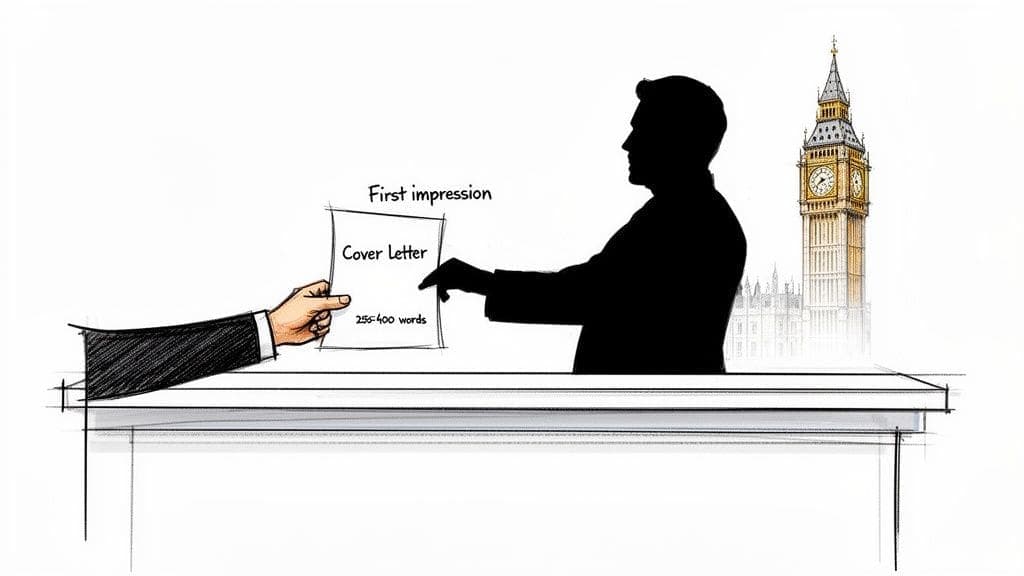
In any front-of-house position, first impressions are everything. Long before a hiring manager in the UK even opens your CV, your cover letter has already said a great deal about your professionalism, communication style, and eye for detail. It's not a mere formality; it's your opening move.
Think of it as the handshake before the interview. A well-written, personalised letter is like a firm, confident handshake—it builds instant rapport. A generic, copy-pasted one? That's a limp handshake, creating a poor impression before you've even introduced yourself properly.
Why Your Cover Letter Carries So Much Weight
It's a common myth that cover letters are optional extras that busy recruiters just skip over. For client-facing roles where communication is paramount, the opposite is true. Hiring managers absolutely depend on them to get a feel for a candidate's personality and writing skills—two non-negotiable assets for any top-tier receptionist.
The numbers from the UK job market in 2026 tell a clear story. A huge 83% of UK hiring managers either always or frequently read them, with a staggering 45% admitting they read the cover letter before even glancing at the CV. This is especially true in sectors like corporate law, high-end hospitality, and private healthcare, where flawless interpersonal skills are a must.
Your cover letter is the only part of your application where your personality can truly shine. It's your chance to tell a story that a CV can't, connecting your skills directly to the company's specific needs and culture.
This single document does more than just say hello. It proves:
- Genuine Interest: A letter tailored to the company shows you've done your homework and you're serious about this role, not just any role.
- Communication Prowess: Your ability to write clearly and professionally is on full display, offering solid proof that you can handle client correspondence with class.
- Attention to Detail: A letter that is perfectly formatted and free from typos shows you have the meticulous nature required for managing diaries, bookings, and important records.
Core Components Of A High-Impact Receptionist Cover Letter
To help you structure your letter effectively, here's a quick-reference table outlining the essential elements UK recruiters look for in 2026. Following this framework ensures you cover all the bases while keeping your message concise and powerful.
| Component | Purpose | UK Best Practice |
|---|---|---|
| Contact Info & Date | Professional formatting. | Your name, address, phone, email. Recipient's name, title, company address. Current date. |
| Salutation | Personalisation. | Address the hiring manager by name (e.g., "Dear Ms. Davies"). Avoid "To Whom It May Concern." |
| Opening Paragraph | Grab attention immediately. | State the role you're applying for and one key achievement or skill that makes you a great fit. |
| Body Paragraphs | Provide evidence. | Two short paragraphs showcasing 2-3 achievements with measurable results that align with the job ad. |
| Closing Paragraph | Reiterate interest & call to action. | Express enthusiasm for the company and suggest the next step (e.g., "I am eager to discuss..."). |
| Sign-off | Professional closing. | Use "Yours sincerely" if you used their name, or "Yours faithfully" if not. Type your full name. |
This table acts as your checklist. By ensuring each component is present and serves its purpose, you create a document that's easy for recruiters to scan and score.
Aligning Your Skills with Employer Needs
To make that knockout first impression, you have to understand the core duties for front desk receptionist roles and show how your skills are a direct solution to their needs. A hiring manager isn't just looking for someone to answer the phone; they're hunting for the central hub of their office's efficiency.
For instance, don't just say you have "good organisational skills." Give them proof. Mention how you "managed a complex diary for a team of four solicitors, coordinating client meetings and court dates without a single scheduling conflict." A concrete example like that brings your abilities to life. The best cover letters for receptionist positions are packed with these small but powerful proofs of your competence.
Using a tool like CV Anywhere's JD Fit Checker right from the start gives you a huge advantage. Just paste the job description into the tool, and you'll instantly see the key skills and keywords the employer has prioritised. This lets you strategically weave those exact terms into your letter, making sure your application immediately speaks their language. To learn more about what catches their eye, check out our guide on what recruiters look for in resumes.
Ultimately, your cover letter sets the stage. It's your single best opportunity to prove you are the organised, articulate, and welcoming face their company has been searching for.
Turn this example into your own cover letter
Add the job description and create a draft for the role. Review the wording and check every claim before sending.
A starting draft you can edit in your own voice.
Structuring Your Letter For Readability And Impact
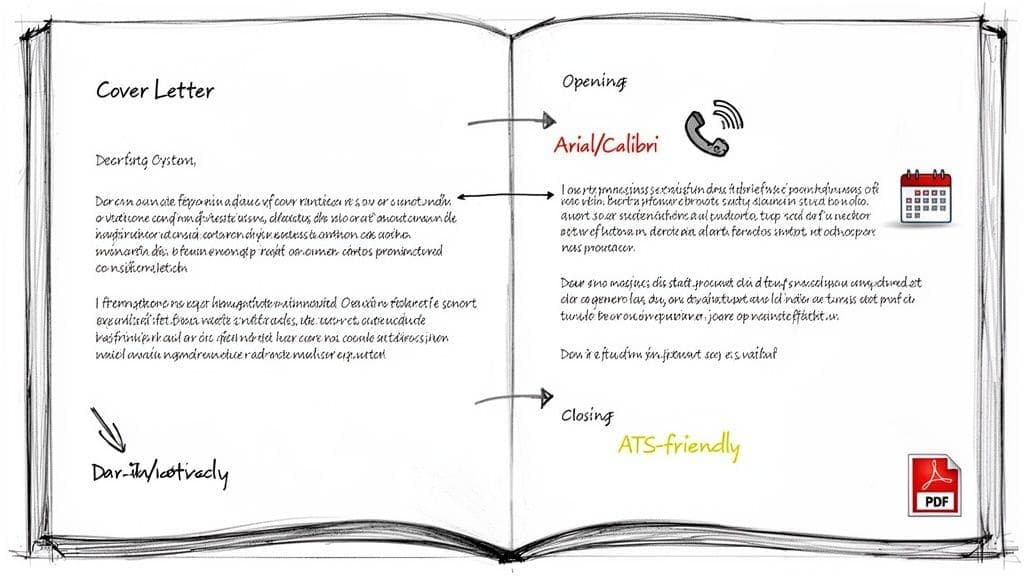
Think of your cover letter as the first impression you make. It's the professional, organised welcome a visitor gets when they step into a top-tier office. A clear structure isn't just about looking neat; it's about guiding the hiring manager through your best points, making it impossible for them to miss why you're the right person for the job.
The best structure tells a compelling story in three short acts. It starts with a strong opening that grabs their attention, moves to a body that proves your value with real evidence, and finishes with a confident closing that tells them what to do next. Every part has a purpose. Get this right, and you'll have the foundation for effective cover letters for receptionist roles in the competitive 2026 UK market.
Your Contact Information And The Salutation
Before you even think about the main content, get the header right. This small detail is the first test of your attention to detail, a non-negotiable skill for any receptionist.
- Your Details: Put your full name, address, phone number, and a professional email address at the top right of the page.
- The Date: Add the current date just below your contact information.
- Recipient's Details: On the left-hand side, below the date, add the hiring manager's name, their job title, the company name, and the full company address.
Your salutation is where you make it personal. Always try to find a name, like "Dear Ms. Sharma,". A quick search on LinkedIn or the company's "About Us" page usually does the trick. If you genuinely can't find a name, "Dear Hiring Manager," is a perfectly safe and modern alternative to the dated "To Whom It May Concern."
Crafting A Powerful Opening Paragraph
Your opening paragraph is your hook. You have about ten seconds to grab the reader's attention and convince them to keep reading. Don't waste this prime space with obvious statements like, "I am writing to apply for the receptionist position." They already know that.
Instead, lead with genuine enthusiasm and one of your key qualifications. Name the specific role and immediately connect it to a core strength or a major achievement that makes you a perfect fit.
Example Opening: "I was thrilled to see the opening for a Front of House Receptionist at Sterling Legal, as my six years of experience managing multi-line phone systems and coordinating client diaries in a fast-paced legal environment align perfectly with the requirements of this role."
This kind of opening immediately signals that you're a serious contender who has read the job description and understands what the business needs.
The Body Proving Your Value
The middle paragraphs are where you back up your claims. Think of this as the evidence section. It should be made up of one or two short paragraphs, each focused on proving what you stated in your opening. This is your chance to shine by linking your experience directly to the duties listed in the job description.
But don't just list what you did. You need to show the impact you made. Use numbers to show what you achieved.
- Instead of: "I answered phones and managed bookings."
- Try: "At my previous role, I implemented a new digital booking system that reduced scheduling errors by 30% and improved client satisfaction scores by 15% in six months."
This simple shift shows you aren't just a doer; you're a problem-solver who delivers real, measurable results. We offer more tips on this in our complete guide on the best format for a cover letter for job application.
The Confident Close And Call To Action
Your final paragraph needs to wrap things up with confidence and a clear call to action. Reiterate your strong interest in the role and the company, and then confidently state that you are keen to discuss your experience in an interview.
You're not asking for permission; you're proposing the logical next step. Finish with a professional sign-off like "Yours sincerely," followed by your typed name.
Remember to keep it brief. With up to 340 applicants per role in the 2026 UK market, hiring managers are swamped. Your letter needs to be between 250-400 words and strictly on one page. Data shows that 48% of managers spend less than two minutes on each application, so precision is key. As highlighted in ResumeLab's 2026 guide on how to write a cover letter, a concise, well-structured letter is far more likely to get the attention it deserves.
Personalising Your Message To Stand Out
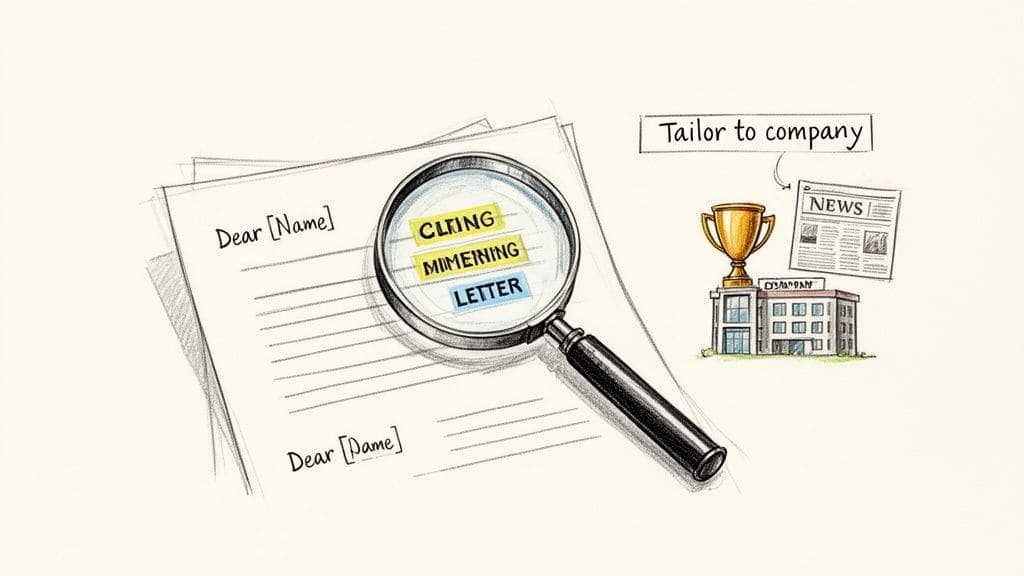
Let's be blunt: a generic "To Whom It May Concern" is a waste of everyone's time. Hiring managers are drowning in applications, and a one-size-fits-all letter is the fastest way to the 'no' pile. It signals you aren't that bothered about this job, just any job.
Making your cover letter feel personal is what separates you from the crowd. It's about showing the hiring manager you've put in the effort, that you understand their company, and that you're speaking directly to them. This isn't just about swapping out the company name. It's about connecting your unique skills to their world, proving you're a thoughtful problem-solver, not just another applicant.
Going Beyond The Job Description
A great cover letter proves you've done your homework. Before you even think about writing, invest ten minutes in some quick research. It's a small step with a massive payoff.
Here's what you're looking for:
- Company Values: Does their website mention "exceptional client care" or "a collaborative spirit"? Use their exact words. Show how your past experiences align with what they already care about.
- Recent News: Did the hotel just win an award for service? Did the law firm launch a new community project? Mentioning this shows you're paying attention and are genuinely interested in what they do.
- The Specific Role: The demands on a receptionist vary wildly. For a high-end spa, you'd talk about creating a serene, welcoming atmosphere. For a busy GP surgery, you'd highlight your ability to stay calm, organised, and empathetic under pressure.
This research lets you frame your skills in a way that resonates. Instead of a bland "I have excellent communication skills," you can write something specific like, "My ability to communicate with empathy and discretion would be a great asset in upholding the confidential, client-first ethos of [Company Name]."
Personalisation proves you're not just looking for a job, but this job. It shows respect for the employer's time and immediately elevates you above candidates who sent a one-size-fits-all letter.
In the competitive UK job market of 2026, this isn't just good advice—it's essential. Personalised cover letters for receptionist positions have an 11.94% higher response rate than generic ones. When you're up against an average of 340 applicants per role—a figure that has shot up by 182% since 2021—tailoring is your single biggest advantage. If you want to write a great cover letter with these UK examples, this is the place to start.
Connecting Your Background To Their Needs
Your personal history is your greatest asset, whether you're fresh out of university, a seasoned pro, or changing careers. The trick is to translate your experience into the language of a receptionist.
- Recent Graduate: You might not have direct receptionist experience, but you have relevant skills. Did you organise a university society event? That shows planning and coordination. Did you handle enquiries in a part-time retail job? That's client service and problem-solving.
- Experienced Professional: Get specific with your achievements. Don't just say you "managed a diary." Say you "coordinated a complex calendar for four executives across different time zones, resulting in a 100% on-time meeting record." Numbers grab attention.
- Career Changer: This is your chance to highlight your transferable skills. Coming from sales? You have exceptional interpersonal and client relationship skills. From an admin background? Your organisational abilities are second to none.
Your goal is to build a clear bridge from your past to their future. Show them exactly how your background makes you the perfect person to step into their front-of-house role and make a difference from day one. It's a crucial step, but so many people get it wrong—we've seen countless examples of why generic cover letters fail to impress modern AI analysers.
Using Tools To Find The Right Words
To make this whole process faster and more effective, you can use technology to your advantage. A tool like CV Anywhere's JD Fit Checker, for instance, is designed for this exact task.
By pasting the job description into the analyser, you instantly see the key skills and keywords the employer cares about most. This lets you align your language with theirs, ensuring your cover letter speaks directly to their needs. It takes the guesswork out of personalisation and turns your application from a shot in the dark into a targeted, compelling pitch.
Example Letters For Every Receptionist Scenario
Theory is one thing, but seeing it in action is what makes it click. Sometimes, the best way to grasp how to write a great cover letter is to see a finished one that works.
Let's break down three complete, annotated examples built for the most common receptionist job-seeking scenarios in the 2026 UK market. Think of these not as rigid templates to copy, but as strategic blueprints you can adapt.
Whether you're fresh out of university, have years on the front desk, or are switching careers entirely, these examples will show you how to frame your skills for maximum impact. The goal is to show a hiring manager you're the perfect fit, not just tell them.
Entry-Level Receptionist (Recent Graduate)
This is a classic situation: you have the brains and the drive, but no direct "receptionist" experience on your CV. The key here is to lean into your enthusiasm and translate skills from education and part-time work into receptionist competencies.
What makes this work:
- The opening is direct and shows genuine interest in the company, not just any job.
- The body paragraphs smartly connect transferable skills. Organisation is demonstrated through university projects, and customer service comes from a retail job.
- It uses concrete phrases like "coordinating group projects" and "handling customer queries" to make the experience feel relevant.
- The closing is confident but humble, expressing a desire to learn—a very attractive quality for an entry-level candidate.
Example Letter:
Dear Ms. Thompson,
I was excited to discover the Junior Receptionist opening at Innovate Solutions on LinkedIn. As a recent Business Administration graduate from the University of Manchester, my proven organisational skills and passion for creating positive client experiences align perfectly with your company's forward-thinking ethos.
During my degree, I was responsible for coordinating group projects with multiple deadlines, which honed my ability to manage schedules and ensure clear communication across the team. In my part-time role at a busy high-street retailer, I greeted hundreds of customers daily, managed the point-of-sale system, and resolved queries with a consistently friendly and professional attitude.
I am a quick learner, proficient in the entire Microsoft Office Suite, and eager to apply my strong work ethic and dedication to this role. I am confident I can quickly master your internal systems and become a valuable, welcoming first point of contact for Innovate Solutions.
I am keen to discuss how my skills can benefit your team and am available for an interview at your earliest convenience.
Yours sincerely, [Your Name]
Experienced Receptionist
When you have the experience, your cover letter needs to do more than list duties. It needs to showcase your impact and prove you're ready for the next step.
What makes this work:
- It starts with a powerful, quantifiable achievement to grab immediate attention (reducing wait times by 15%). This isn't just experience; it's a result.
- It names specific systems like CRMs and multi-line phones, which helps with keyword matching for both ATS and human readers.
- It highlights progression by mentioning the responsibility of training new staff, proving that a previous employer trusted them with leadership tasks.
- This example of a cover letter for a receptionist role frames experience as a series of positive business impacts, not just a list of things they did.
Example Letter:
Dear Mr. Chen,
With over seven years of experience as a Senior Corporate Receptionist, I was immediately drawn to the Front of House Manager position at Apex Legal. At my previous role, I streamlined the visitor check-in process, reducing average wait times by 15% and earning a company award for client service excellence.
I am highly proficient in managing multi-line phone systems, complex digital diaries, and various CRM platforms. In addition to handling all front-desk duties for a busy firm of 20 solicitors, I was also tasked with training two junior receptionists, developing onboarding materials that are still in use today.
My background has equipped me with an exceptional ability to maintain professionalism and discretion in high-pressure environments, a skill I know is paramount at a respected firm like Apex Legal. I am confident my leadership abilities and commitment to efficiency would make me a significant asset to your team.
I am eager to bring my expertise to your firm and would welcome the opportunity to discuss my qualifications further in an interview.
Yours sincerely, [Your Name]
Career Changer To Receptionist
Moving into a receptionist role from another field can feel daunting. The secret is to show the hiring manager that your existing skills are not just relevant, but highly valuable.
What makes this work:
- It's transparent about the career change but frames it as a deliberate, positive step towards a new goal.
- The focus is on high-level transferable skills that every great receptionist needs, like client relationship management and problem-solving.
- It masterfully connects past achievements (increasing customer retention) to the core goals of a receptionist (creating a welcoming, efficient environment). This proves you understand what the job truly entails.
To help you reframe your own experience, here's how skills from other common professions translate directly to the front desk.
Transferable Skills For Career Changers
| Previous Role/Skill | How It Applies To Reception | Example Phrase for Your Cover Letter |
|---|---|---|
| Retail Management | Managing staff schedules, handling customer complaints, overseeing stock. | "My experience in managing staff rotas and resolving client issues has prepared me to handle complex scheduling and maintain a calm front desk." |
| Sales Executive | Building client rapport, managing a CRM, meeting targets. | "My background in building strong client relationships and meticulously maintaining a CRM database directly translates to providing exceptional front-of-house service." |
| Personal Assistant | Diary management, travel booking, acting as a gatekeeper. | "As a PA, I was responsible for complex diary management and acting as the primary gatekeeper, skills that are essential for an efficient receptionist." |
Thinking about how your past duties align with these examples is the first step. For an even deeper dive into crafting your own letters, you can find more detailed UK cover letter examples in our dedicated guide.
Using AI to Supercharge Your Cover Letter Writing
Let's be honest: tailoring a cover letter for every single receptionist job you apply for is a grind. You know you need to personalise each one to stand out, but when you're sending out multiple applications, it's easy to get bogged down. In the 2026 UK job market, efficiency is everything.
This is where using AI as your expert assistant can be a game-changer. I'm not talking about letting a robot write a generic, soulless letter for you. Instead, think of it as a tool to handle the heavy lifting—the research and the optimisation—so you can focus your energy on adding the human touch that actually gets you the interview.
A platform like CV Anywhere is built for exactly this. It helps you dissect job adverts in seconds, figure out what a hiring manager really wants, and make sure your cover letter hits all the right notes. It's all about working smarter, not harder.
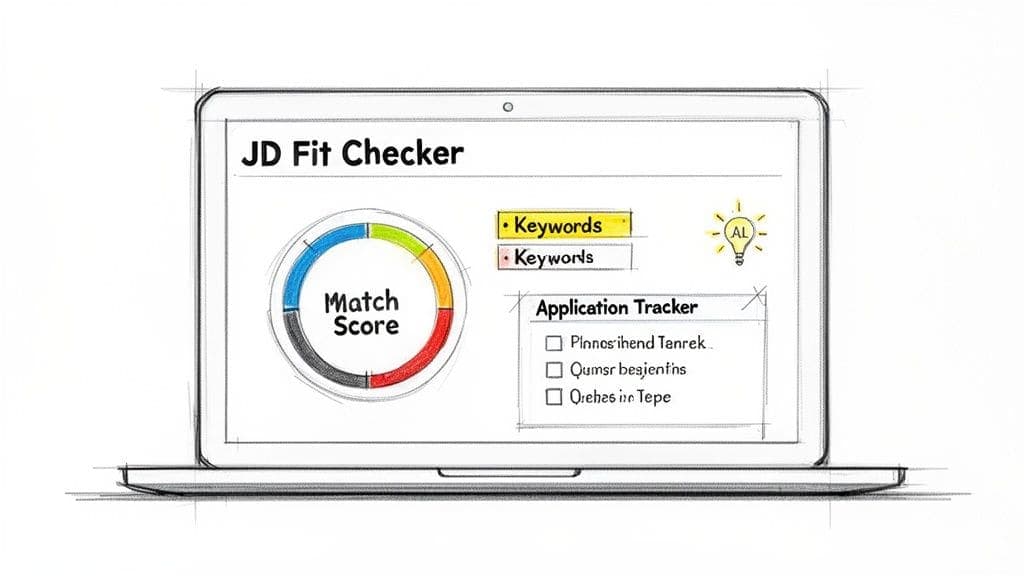
The image above shows CV Anywhere's JD Fit Checker in action. It gives you an instant match score and pulls out the key skills from a job description. This kind of immediate feedback shows you exactly where your application is strong and where it needs a bit of work before you even start writing.
Instantly Analyse Job Adverts with the JD Fit Checker
A powerful cover letter starts with understanding the job advert inside and out. The CV Anywhere JD Fit Checker is your secret weapon for this. Just copy and paste the entire job description for the receptionist role into the tool.
Within seconds, you get a clear breakdown:
- A Match Score: This percentage gives you a quick snapshot of how well your current CV aligns with what the employer is looking for.
- Keyword Analysis: The tool extracts the most critical skills and qualifications, like "diary management," "Salesforce," or "excellent communication." These are the exact terms the hiring manager is scanning for.
- Skill Gap Identification: It flags any key requirements from the job ad that are missing from your documents. This tells you precisely which skills you need to highlight in your cover letter.
With this analysis in hand, you can strategically weave these exact keywords and skills into your letter. It's the fastest way to make sure your application gets past any screening software and grabs the attention of a real person.
Adapt AI Summaries for a Powerful Opening
A consistent application is a convincing one. If you've used the AI features in the Smart CV Builder to create a professional summary for your CV, don't just leave that great content sitting there.
That AI-generated summary is already packed with keywords and highlights your biggest strengths. By adapting it for your cover letter's opening paragraph, you create a powerful, consistent message right from the start. It shows the hiring manager that you're organised and that your professional story is clear and compelling. For a deeper dive, our article on how to use AI to write a resume has some great tips.
The real power of AI in job searching isn't about replacing your voice, but amplifying it. Use these tools to handle the repetitive, analytical tasks so you can focus your energy on crafting a personal story that connects with the employer.
Of course, the goal is to make sure your writing still sounds like you. For some practical advice on this, check out this guide on how to use AI to write a letter that doesn't sound like a robot.
Stay Organised with an Application Tracker
When you're applying for several receptionist roles, it's easy to lose track. Did you mention that company award in your letter to Firm A or Firm B? Mixing up details is an embarrassing mistake that can cost you an opportunity.
This is where an Application Tracker becomes indispensable. Forget messy spreadsheets; a built-in tracker helps you:
- Save every job you apply for in one place.
- Attach the exact cover letter and CV version you sent.
- Set reminders to follow up.
- Keep notes on each application, like who you spoke to.
This level of organisation keeps your job search professional and stops you from making avoidable errors. It means that when you finally get that call for an interview, you'll have all the right information at your fingertips, ready to go.
Common Questions About Receptionist Cover Letters
As you get to the final stages of writing your application, a few tricky questions can pop up and slow you down. It's normal. Finalising cover letters for receptionist roles often brings up queries about etiquette, especially when you're in a slightly awkward situation like not having a contact name or direct experience.
Let's get those questions answered so you can send your application off with confidence. The best approach is always to be direct, professional, and honest—it shows you're a proactive problem-solver, a key trait for any top-tier front-of-house professional.
How Should I Address The Letter Without A Name?
First off, always try to find the hiring manager's name. A quick search on LinkedIn or the company's "About Us" page usually does the trick and shows real initiative.
But sometimes, a name is genuinely impossible to find. If that's the case, avoid the outdated "To Whom It May Concern" or "Dear Sir/Madam." They feel impersonal and can make your application seem generic right from the first line.
Instead, for 2026, use one of these modern, professional alternatives:
- "Dear Hiring Manager": This is the safest and most common choice. It's direct, respectful, and gets straight to the point.
- "Dear [Department] Team": For instance, "Dear Front of House Team" or "Dear Administration Team." This shows you've at least thought about who will be reading your letter.
Your greeting sets the initial tone. Using a modern salutation like "Dear Hiring Manager" when a name isn't available sends a subtle but important signal: you understand current business etiquette. For a receptionist, that's a small win before they've even read your first paragraph.
What If I Have No Direct Experience?
This is a very common spot to be in, whether you're a recent graduate or changing careers. The secret is to shift the focus from direct, titled experience to your transferable skills and genuine enthusiasm.
Never start by apologising for what you don't have. Instead, confidently show what you do bring to the table. Think about it this way:
- Retail or Hospitality Work? Talk about your customer service skills, how you handled payments, and your ability to thrive in a fast-paced setting.
- Volunteering or University Projects? Mention your organisational skills from planning an event, your communication skills from presenting to a group, or your time management from juggling tight deadlines.
- Personal Qualities? Emphasise your strong work ethic, your knack for learning new systems quickly, and your real passion for creating a positive, welcoming environment for visitors.
By showcasing these skills, you're proving you have the core abilities needed to excel as a receptionist, even if your previous job title was different.
When And How Should I Follow Up?
Following up after you've applied is a great professional touch. It shows you're still interested and organised. But timing and tone are everything.
- Wait at least one week after the application deadline has passed. If there was no deadline listed, give it one to two weeks from the day you applied.
- Send a brief, polite email. A phone call can come across as too pushy or intrusive, whereas an email is respectful of the hiring manager's time.
- Keep it simple and direct. Reiterate your interest in the position, mention one key reason you're a great fit, and politely ask about the next steps.
By thinking through these common questions, you can make sure your final cover letter is polished, professional, and ready to make a great impression. This level of attention to detail is exactly what hiring managers across the UK are looking for.
Ready to build a cover letter that gets noticed? With CV Anywhere, you can instantly analyse job descriptions, find the right keywords, and create a perfectly tailored application every time. Stop guessing and start getting interviews with CV Anywhere today.