How Do I Write a CV in the UK? A 2026 Guide
Struggling with how do I write a CV for the UK job market? Our 2026 guide shows you how to craft a document that beats ATS and impresses recruiters.

So, you're asking yourself, "how do I write a CV that actually gets me noticed in the UK?" It's the big question, and the answer for 2026 is about creating a sharp, focused marketing document that proves your value in less than eight seconds. To write a CV that wins interviews, you must structure it for a quick scan, focus on quantifiable achievements over simple duties, and tailor it with keywords from the job description to beat both automated filters and human recruiters. This guide will show you exactly how.
Think of it this way: your CV is your highlight reel, not the full game tape.
The Modern UK CV Blueprint for 2026
Before you even think about opening a document, you need to understand the new rules of the game. Your CV isn't a historical archive; it's a sales pitch aimed at a very busy, very specific audience. And their attention span is brutal.
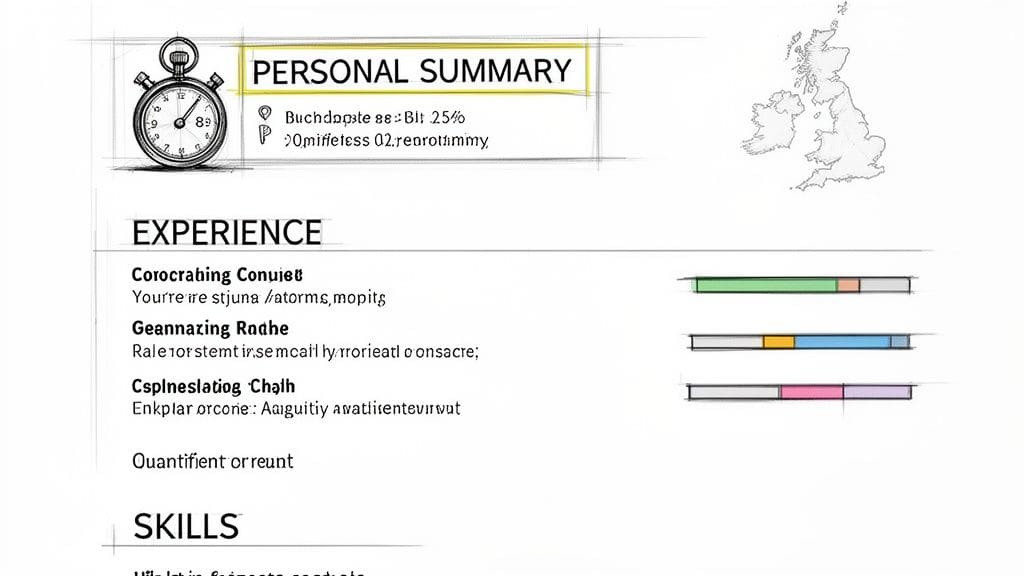
In the UK job market right now, recruiters give a CV a lightning-fast scan—we're talking a mere 6-8 seconds—before deciding if it's a 'yes' or a 'no'.
Eye-tracking studies show they spend about 80% of that time locked on just a few key details: your name, current and previous job titles, company names, start/end dates, and your education. That's it. Get those wrong, and you're out.
Your CV Structure for the 8-Second Scan
This table breaks down exactly what sections you need and what recruiters are looking for during that first, crucial glance. It's your blueprint for survival.
| CV Section | What It Achieves | What Recruiters Scan For |
|---|---|---|
| Contact & Personal Summary | Immediately states who you are and the top-line value you bring. | Your name, location, and a 3-line pitch matching their needs. |
| Work Experience | Provides evidence of your career progression and impact. | Job titles, company names, and employment dates. Are they relevant? |
| Achievements | Shows how you made a difference, using numbers and results. | Scannable bullet points with strong action verbs and metrics. |
| Education & Skills | Confirms your qualifications and technical abilities. | Key qualifications, certifications, and essential software skills. |
This structure is your best defence. It puts the most important information exactly where a recruiter's eyes will land, making their job easier and getting you into the 'yes' pile.
The Foundation of a Winning CV
The best format for almost every professional in the UK is the reverse-chronological CV. Recruiters know it, Applicant Tracking Systems (ATS) love it, and it tells a clear story of your career path by putting your most recent—and most relevant—experience right at the top.
But a good format is useless without the right content. You need to master two things:
- Nail the personal summary. This is your 3-4 line 'elevator pitch' at the very top. It's not a fluffy objective about what you want. It's a hard-hitting summary of the value you offer, packed with your top skills and biggest wins. This is your one shot to hook them in.
- Talk about achievements, not duties. Stop listing what was in your job description. Start framing your experience around the impact you made. Instead of "Managed the company's social media accounts," try, "Grew social media engagement by 45% in six months by launching a new content strategy." One is a task; the other is a result.
Your CV's first job is simple: survive the 8-second scan. It has to be so clear and compelling that it buys you a full read. It has to convince the recruiter that you are the solution to their problem.
Knowing how to write a CV that works is all about understanding this psychology. It needs to be clean, scannable, and loaded with the right keywords from the job description to get past both the software filters and the human gatekeepers.
For a deeper dive into different formats and a more detailed breakdown, our complete guide to UK CVs has you covered. Get this foundation right, and you'll be building a CV that opens doors.
Build a CV that actually gets interviews
Start from your current CV — or from scratch — with step-by-step guidance so you do not get stuck.
Free. No blank page. No templates to wrestle with.
Crafting Each Section of Your CV for Impact
Right, let's get down to the nuts and bolts. We're moving from theory to the practical task of building your CV, section by section. This isn't about just filling in boxes on a template; it's about telling a strategic story.
Every part of your CV has a job to do. Get them right, and you'll have a document that's compelling, focused on your achievements, and built for the modern UK job market.
The Personal Summary: Your Hook
Think of your personal summary—sometimes called a profile—as the 'trailer' for your career. It's the first thing a recruiter sees, and it has about five seconds to answer their main question: "Why should I care?"
A weak summary is vague and talks about what you want. A strong one is a tight, 3-4 line pitch that shows the value you bring, tailored to the job you're applying for.
Before (Vague & Weak): A motivated and enthusiastic professional seeking a challenging role in marketing where I can utilise my skills and grow with the company.
After (Powerful & Specific): A data-driven Digital Marketing Manager with over 6 years of experience specialising in B2C e-commerce. Proven success in boosting online sales by *35%* year-on-year through targeted PPC campaigns and SEO optimisation. Seeking to apply expertise in customer acquisition to drive growth at a forward-thinking brand.
See the difference? The 'After' example is packed with specifics, uses a hard metric, and speaks directly to what a hiring manager wants to see. It's a confident statement of your value proposition.
Work Experience: The Heart of Your Story
This section is where you prove you can do the job. Here's the single most important piece of advice: don't just list your duties. A list of responsibilities tells a recruiter what you were supposed to do, not what you actually did.
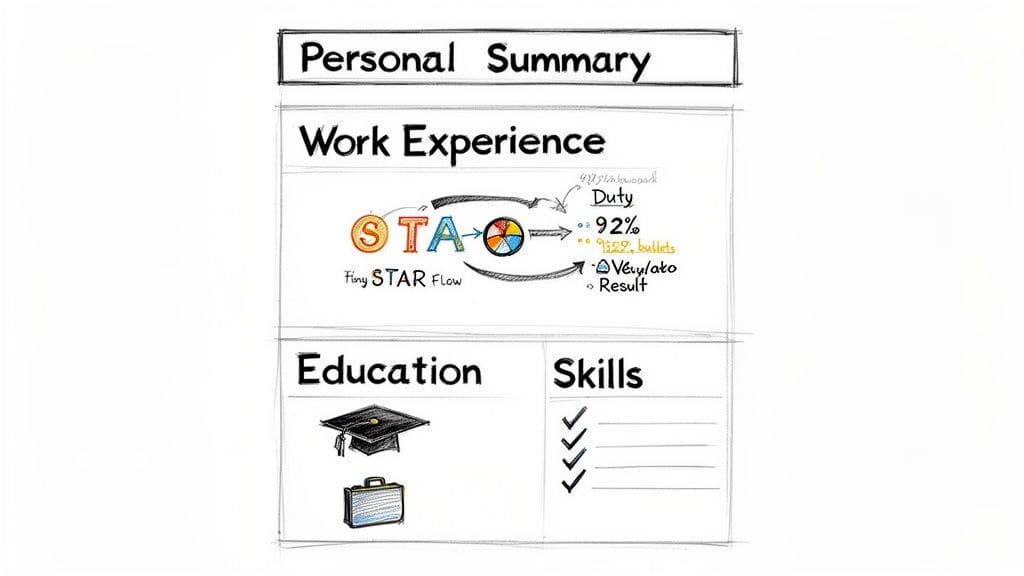
To turn a boring duty into a powerful accomplishment, you need to use the STAR method for every bullet point.
The STAR framework gives your achievements structure:
- Situation: Briefly set the scene. What was the problem or context?
- Task: What was your specific goal or responsibility?
- Action: What specific steps did you take? Start with strong action verbs.
- Result: What was the outcome? This is where you add numbers.
The Result is what separates a good CV from a great one. Metrics like percentages, monetary values, and time saved provide concrete proof of your impact. They cut through the noise.
Let's look at how this works in practice.
Example 1: Junior Retail Assistant
- Weak duty: "Responsible for handling customer complaints."
- Strong STAR bullet: "Resolved an average of 15+ customer issues daily, improving the store's satisfaction score by 10% within three months by implementing a new feedback logging system (Action & Result)."
Example 2: Senior Project Manager
- Weak duty: "Managed a team to deliver a software project."
- Strong STAR bullet: "Led a cross-functional team of 8 developers and designers to deliver a new CRM system 2 weeks ahead of schedule (Result), resulting in a 15% improvement in sales team efficiency (Result)."
Mastering this is key to answering "how do I write a CV that stands out?"
Education: Showcasing Your Foundations
Where you put your education section—and how much detail you include—depends entirely on where you are in your career.
- For Recent Graduates: Your education is a key asset, so place it right before your work experience. Include your degree, university, graduation date, and any relevant modules or high-level academic awards (like First-Class Honours).
- For Experienced Professionals: Your track record speaks for itself. Put this section after your work experience and keep it brief: your degree, university, and graduation year are all you need.
The Skills Section: Proving Your Capabilities
Your skills section is a quick, scannable checklist for recruiters and a goldmine for Applicant Tracking Systems (ATS). The software is programmed to hunt for specific keywords, and this is where you make its job easy.
The key is to organise your skills into clear categories. It makes the information much easier to digest.
Example Skills Section
- Technical Skills: Python, SQL, Tableau, Google Analytics, Microsoft Azure
- Languages: English (Native), Spanish (Professional Proficiency)
- Certifications: Prince2 Practitioner, Certified ScrumMaster (CSM)
One quick tip: avoid listing soft skills like "good communicator" or "team player" here. Anyone can claim them. Instead, prove you have these skills through the STAR-based examples in your work experience.
Optional Sections: Adding Extra Value
Depending on your field, adding an extra section or two can be the thing that makes you stand out from other qualified candidates. Think of these as another layer of proof.
- Projects: Absolutely essential for anyone in a technical or creative role. Briefly describe the project, what you did, the tech you used, and always link to your portfolio or GitHub.
- Publications/Presentations: A must-have for academics, researchers, or industry specialists. Just be sure to use a standard citation format.
- Volunteer Experience: This is great for showing commitment and can be a fantastic place to demonstrate skills like leadership or event planning, especially if your paid work history is a bit thin.
By carefully putting together each of these sections, you stop just listing facts about yourself. You start building a powerful narrative that shows you're the right person for the job.
Getting Your CV Past the Robots and Recruiters
Here's a hard truth about the modern UK job market: your CV has two audiences, and you have to win over the robot before you ever get a chance with the human.
That robot is an Applicant Tracking System (ATS), and getting past it is non-negotiable. Most large companies use this software to scan, sort, and rank every single application they receive. If your CV isn't optimised for it, you could be the perfect candidate and still get rejected without a human ever seeing your name.
This isn't a niche problem. A staggering 70% of large UK firms use ATS software that automatically filters out incompatible applications, a figure that jumps to 99% for Fortune 500 companies.
Understanding the Applicant Tracking System
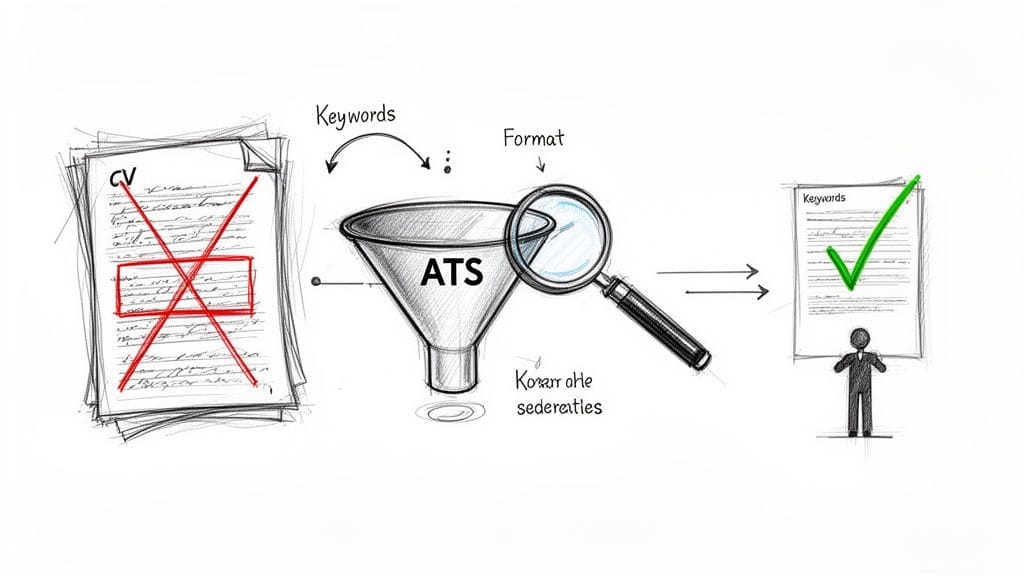
An ATS isn't some super-intelligent AI trying to judge your character. Think of it more like a search engine for CVs. It scans your document for the specific keywords, job titles, skills, and qualifications that a hiring manager has told it are essential.
It then gives your CV a score based on how well it matches those must-haves. Only the top-scoring CVs get passed along for a human to review. Your entire goal at this stage is to make your CV as easy as possible for that software to read and understand.
This means you need a two-pronged attack: one focused on your content (the keywords you use) and the other on your structure (how you format the document).
Using the Right Keywords to Beat the Bots
Keyword optimisation isn't about just stuffing your CV with buzzwords. It's about speaking the same language as the employer. The ATS is programmed to hunt for the exact terms used in the job description, so you need to mirror them.
Here's a simple process I always follow:
- Dissect the Job Description: Read the job advert from top to bottom. Use a highlighter to mark every key skill, responsibility, qualification, and piece of software they mention. These are your target keywords.
- Group Your Keywords: Sort them into hard skills (like "SQL," "Prince2," or "Adobe Photoshop") and soft skills (like "stakeholder management" or "team leadership").
- Weave Them In Naturally: Sprinkle these keywords throughout your CV. The most critical places are your Personal Profile, your Work Experience bullet points, and your dedicated Skills section.
For example, if the job description mentions "agile methodologies" three times, make sure that exact phrase appears in a relevant project or role description on your CV. Don't just list it; show how you applied it.
Pro Tip: Don't forget synonyms, but prioritise the original phrasing. An ATS might be programmed for "Project Manager," but could also recognise "Project Lead" or "PM." If the job ad uses "Project Manager," you should too. Use variations to add depth, not as a replacement.
Formatting That the Algorithm Can Actually Read
While the words you use are critical, poor formatting can be the single mistake that gets an otherwise perfect CV thrown in the digital bin. Complex designs with fancy fonts, columns, and graphics can completely confuse an ATS, making your CV unreadable.
Simplicity and clarity are your best friends here.
Follow these rules to create a 'robot-proof' CV that sails through the system:
- Use Standard Headings: Stick to universally recognised section titles like "Work Experience," "Education," and "Skills." Avoid creative alternatives like "My Professional Journey" or "Where I've Been." The software is looking for the classics.
- Choose a Clean Font: Opt for something simple and readable like Arial, Calibri, or Times New Roman. Script fonts or heavily stylised typefaces are a recipe for disaster.
- No Tables or Columns: Many ATS programs, especially older ones, read a document from left to right, line by line. Columns and tables can scramble your information completely. A single-column layout is always the safest bet.
- Ditch the Graphics: Don't include a photo (unless the industry or country specifically requires it), logos, or those little star-rating icons for your skills. The software can't interpret images, and they can corrupt the file.
- Submit the Right File Type: Unless the application says otherwise, always save and send your CV as a .docx or .pdf file. These formats are the industry standard and are accepted by virtually all ATS platforms.
To really get ahead, it helps to understand how AI in talent acquisition is changing the entire hiring game, from initial screening right through to final selection. Ultimately, mastering your CV for an ATS isn't about being creative; it's about being clear and compatible.
The Art of Tailoring Your CV for Each Application
Sending the same generic CV for every job is the fastest way to get ignored. If you want to know how do I write a CV that actually works, the single most important skill to learn is tailoring. It's the difference between being just another applicant and being the right applicant.
This isn't about just swapping a few keywords. It's about reframing your experience, reordering your skills, and rewriting your summary to speak directly to the hiring manager's problems. You want them to feel like you wrote this CV specifically for them. Because you did.
The data backs this up. UK CV trends for 2026 show 83% of recruiters prioritise a tailored CV over a generic one. And with recruiters spending just 7.4 seconds on their first scan, a CV that immediately mirrors their job advert is your only shot.
A Practical System for Efficient Tailoring
The thought of rewriting your CV for every role sounds exhausting, but there's a system that makes it manageable. The secret is to create a "master CV".
This is a comprehensive document, probably several pages long, that lists every single role, responsibility, project, and accomplishment from your entire career. Think of it as your private career database, with no length limit.
From now on, tailoring becomes a simple "copy, paste, and refine" job. For each application, you'll just pull the most relevant bits from your master CV and sharpen them to fit the specific role.
Deconstructing the Job Description
First, you need to play detective. Print out the job description and get a highlighter. Your mission is to find and mark up the essentials.
- Must-Have Skills: Look for terms like "required skills," "essential criteria," or "key responsibilities." These are your non-negotiables.
- Desirable Skills: Note anything listed as "nice-to-have" or "preferred qualifications." These are what will set you apart from other qualified candidates.
- Company Language: Pay close attention to the specific words and tone the company uses. Do they talk about "clients" or "customers"? "Stakeholders" or "partners"?
This gives you a clear blueprint of the ideal candidate. It's the foundation for every change you're about to make.
Reframing Your Experience to Match
With your highlighted job description in one hand and your master CV in the other, it's time to connect the dots.
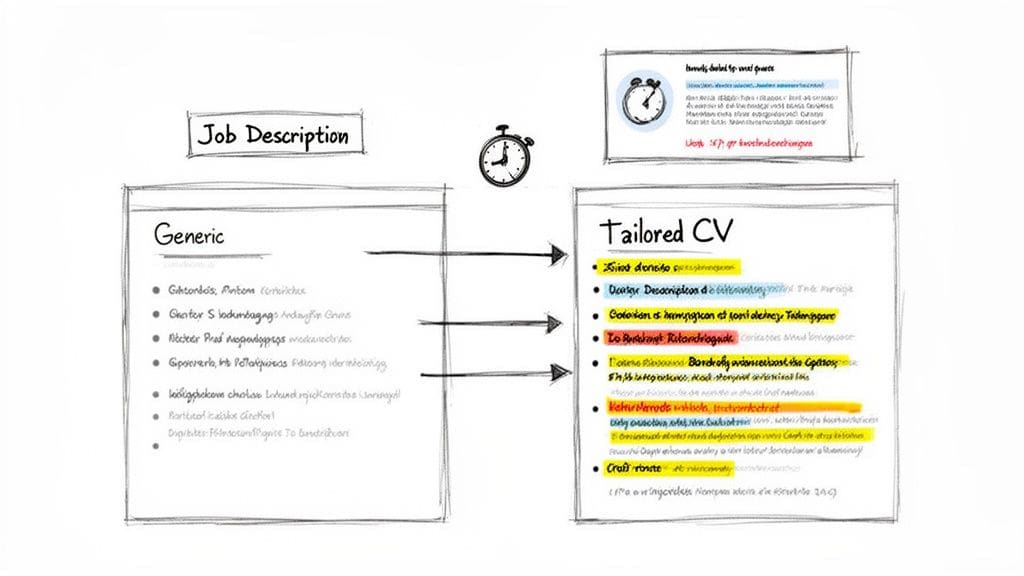
Rewrite Your Personal Summary: Your opening paragraph needs to be completely bespoke. If the advert asks for a "data-driven marketer with SEO experience," your summary must say you are a data-driven marketer with SEO experience. Make it obvious.
Reorder Your Bullet Points: Go through your work history. Find the achievement that most closely matches the top priority in the job description and make it your first bullet point for that role. Lead with your most relevant evidence.
Adapt Your Language: Mirror the employer's terminology. If they ask for "stakeholder engagement," use that exact phrase instead of "client communication." This is crucial for getting past Applicant Tracking Systems (ATS) and building rapport with the human reader.
By tailoring your CV, you're not just showing a recruiter what you've done. You're showing them how what you've done solves their specific problems. You're making their decision to interview you an easy one.
This targeted approach turns your CV from a simple record of your past into a persuasive argument for your future. If you want to dive deeper into this crucial step, read our detailed walkthrough on how to tailor your CV to any job description.
Common CV Mistakes That Lead to Rejection
You've poured hours into crafting the perfect CV. The last thing you want is for a tiny, avoidable error to get it thrown straight in the bin. This section is your final line of defence, covering the common blunders I've seen time and again that trip up even the most qualified candidates in the UK job market.
The most lethal mistakes are often the smallest. A single typo or grammatical slip can make a recruiter question your attention to detail. In fact, a recent study found 77% of recruiters will reject a CV for this reason alone. It sends a clear message: carelessness. And that's a red flag for any role.
Before you even think about hitting 'send', run your CV through a tool like Grammarly. Then, read it out loud to catch any clunky phrasing. The final step? Get a trusted colleague or friend to read it. A fresh pair of eyes will always spot the mistakes you've gone blind to.
Using Passive Language and Clichés
Your CV is your professional highlight reel. It needs to project confidence and action. But tired, generic phrases and passive language do the exact opposite, making your achievements sound limp and uninspired.
- Clichés to Ditch: Words like "team player," "results-oriented," "hard-working," and "responsible for" are just filler. They are completely meaningless without hard evidence to back them up.
- Passive vs. Active Voice: Passive voice sounds weak ("was involved in," "was responsible for"). Active voice puts you in the driver's seat, starting with a powerful verb that shows what you did.
Let's see this in action. We'll take a standard, duty-focused bullet point and turn it into something that screams achievement.
Before (Passive & Vague): Responsible for managing the monthly client newsletter which was sent to over 5,000 subscribers.
After (Active & Specific): Grew newsletter open rates by *25%* in six months by redesigning the layout and A/B testing subject lines for a 5,000+ subscriber list.
The 'after' version is infinitely better. It kicks off with a strong verb ("Grew"), delivers a concrete metric (25%), and shows how the result was achieved. It's proof, not just a promise.
Formatting and Professionalism Traps
Your CV's presentation speaks volumes before a recruiter reads a single word. A sloppy format can instantly undermine your credibility and signal a lack of professional savvy.
The goal is to make your CV as easy as possible for a busy recruiter to scan. Any element that distracts, confuses, or looks amateurish works against you. This includes everything from your email address to your file name.
Here are some of the most common formatting own-goals:
- Unprofessional Email: An ancient email address like
partyboy2008@email.comis a deal-breaker. Set up a new, simple one:firstname.lastname@email.com. It takes two minutes. - Including a Photo: Unless you're an actor or model, never include a headshot on your CV in the UK. It's seen as unprofessional and can open the door to unconscious bias.
- Exceeding Two Pages: A CV is a concise summary, not your life story. For most professionals, two pages is the absolute limit. If you have under 10 years of experience, one page is often even better.
- Using Complex Designs: Fancy graphics, charts, and elaborate multi-column layouts might look clever, but they often get scrambled by Applicant Tracking Systems (ATS). To learn more about how these bots read your CV, check out our guide on common ATS CV mistakes and how to avoid them.
By steering clear of these common pitfalls, you give your CV the professional polish it deserves. You ensure that your impressive accomplishments have a clean, clear platform to shine from.
Answering Your Top CV Writing Questions
Even with the best guide in hand, a few nagging questions always pop up once you actually start writing. You know the ones – the small details that can feel like the difference between landing an interview and getting ghosted.
This final section tackles those common sticking points head-on. We'll give you clear, straightforward answers based on what UK recruiters and hiring managers are actually looking for. Let's get those last few uncertainties ironed out.
Should I Include a Cover Letter with My CV in the UK?
Yes, almost always. The only time you shouldn't is if the job advert explicitly says not to.
Think of it like this: your CV is the evidence, the hard data that proves you can do the job. The cover letter is your chance to tell the story behind that data. It's where you connect your skills directly to that company's specific problems and show you genuinely want this role, not just any role. For many UK recruiters, it's still a critical tie-breaker.
What Is the Difference Between a CV and a Resume?
In the UK job market, there's practically no difference. The terms 'CV' and 'resume' are used interchangeably to mean a concise, 1-2 page document that summarises your professional life.
This is a major point of confusion for people familiar with the US system, where a 'CV' is a long, exhaustive academic document that can run for many pages. If a UK job ad asks for either a CV or a resume, they want the same thing: the tailored, powerful document we've been building throughout this guide.
In the UK market, the substance of your application matters far more than whether it's labelled a 'CV' or a 'resume'. Both terms point to the same goal: a powerful, 1-2 page summary of your professional value.
How Far Back Should My Work Experience Go?
A good rule of thumb is to focus on the last 10-15 years. This is the experience that's most relevant and will carry the most weight with a hiring manager.
If you have significant roles older than 15 years, you don't have to delete them entirely. You can create a brief section at the bottom called 'Previous Experience' and simply list the job title, company, and location, without any bullet points. This keeps the reader focused on your recent impact.
For those just starting out, include everything relevant—internships, volunteer work, and even part-time jobs that show responsibility or customer-facing skills.
Is a Creative or Infographic CV a Good Idea?
This is a classic "it depends" scenario, and the answer hinges entirely on your industry. If you're a graphic designer, a UX/UI specialist, or a brand marketer, a visually creative CV can be a brilliant way to showcase your skills before they even see your portfolio.
However, for the vast majority of corporate roles—in finance, law, tech, or the public sector—a traditional, professional format is not just safer, it's expected. More importantly, most creative CVs are completely unreadable by Applicant Tracking Systems (ATS). Your beautifully designed application could be rejected by a machine before a human ever has the chance to see it.
When in doubt, always stick with a clean, ATS-friendly design. After perfecting your CV, the next crucial step is to actively find remote jobs that align with your skills and career aspirations.
Ready to stop guessing and start building a CV that truly works? The CV Anywhere platform gives you all the tools you need in one place. Use our Smart CV Builder to create a polished, ATS-friendly document, analyse any job with the JD Fit Checker, and manage all your applications with our tracker. Start building for free and take control of your job search today at https://cvanywhere.com.
Tags
Related articles
How to Write a UK CV That Gets You Hired in 2026
To write a CV for the UK job market in 2026, you need a sharp, two-page document that sells your value to recruiters. The key is to use a reverse-chronological format, tailor it to the specific role b...
How to Write a CV Quickly: A 60-Minute Guide
You’re probably here because a job has landed in your inbox and you need to write a CV quickly without sending something sloppy. The good news is that speed isn’t the problem. Bad priorities are. A fa...
How to Improve My CV: A Step-by-Step UK Guide for 2026
If you're searching "improve my CV", you probably already know something's off. Your CV may look busy but say very little, or it may list plenty of duties without showing why anyone should interview y...
Create a CV Fast: A 60-Minute UK Workflow
Need to create a CV fast because a role closes soon, you've got three tabs open, and your old CV still talks about the wrong job. The quickest way isn't typing faster. It's using a focused workflow th...
Popular Articles
To write a CV for the UK job market in 2026, you need a sharp, two-page document that sells your value to recruiters. The key is to use a reverse-chronological format, tailor it to the specific role b...
You’re probably here because a job has landed in your inbox and you need to write a CV quickly without sending something sloppy. The good news is that speed isn’t the problem. Bad priorities are. A fa...
If you're searching "improve my CV", you probably already know something's off. Your CV may look busy but say very little, or it may list plenty of duties without showing why anyone should interview y...
Need to create a CV fast because a role closes soon, you've got three tabs open, and your old CV still talks about the wrong job. The quickest way isn't typing faster. It's using a focused workflow th...