How to Write a UK CV That Gets You Hired in 2026
Learn how to write a CV that lands interviews in the UK's 2026 job market. Our guide covers ATS optimisation, quantifiable achievements, and expert tips.

To write a CV for the UK job market in 2026, you need a sharp, two-page document that sells your value to recruiters. The key is to use a reverse-chronological format, tailor it to the specific role by including keywords from the job description, and focus on achievements backed by numbers, not just a list of duties. A compelling professional summary at the top should summarise your key skills and experience, grabbing the hiring manager's attention immediately. By following these steps on how to write a CV, you'll create a powerful document that gets past automated systems and impresses human decision-makers.
This guide will teach you exactly how to write a CV that stands out for all the right reasons. We're moving beyond the basics to show you how to turn your past experience into a powerful story of achievement that clicks with UK hiring managers.
The Foundation of a Winning UK CV
Think of your CV as your professional highlight reel. Its one and only job is to get you an interview. With recruiters spending just seconds scanning each application, your CV must be sharp, focused, and instantly clear. Forget listing every single duty you've ever had. Today, it's all about demonstrating your impact.
Why Your CV's Structure Matters
The structure of your CV is far more than a style choice; it's a critical part of how your story is understood. A messy or confusing document can trip up both Applicant Tracking Systems (ATS) and human readers, often leading to a quick rejection.
In the UK, the reverse-chronological format is what recruiters expect and prefer. It puts your most recent—and most relevant—experience right at the top, which is exactly where hiring managers look first. This creates a logical and easy-to-follow narrative of your career. To make sure your document hits the mark, take a look at our detailed guide on the correct UK CV format.
A great CV doesn't just list what you did; it proves what you accomplished. Instead of saying you 'managed social media,' state that you 'Grew social media engagement by 45% over six months.' This shift from responsibility to result is the most powerful change you can make.
Core Components for Success
Every high-impact CV is built on a few essential sections. Once you nail these, you'll have a solid foundation that you can easily tailor for any role.
Here's a quick rundown of the must-have components:
- Contact Information: Keep it clean, professional, and easy to spot.
- Professional Summary: A short, punchy pitch right at the top.
- Work Experience: Focus on your achievements, not just your duties.
- Education: Your relevant qualifications and academic background.
- Skills: A targeted list of your most valuable abilities.
Knowing how each of these sections builds on the others is key. By optimising every part, you create a document that is far more than the sum of its parts, positioning you as the perfect candidate before you even walk into the interview.
Build a CV that actually gets interviews
Start from your current CV — or from scratch — with step-by-step guidance so you do not get stuck.
Free. No blank page. No templates to wrestle with.
Your Contact Details and Professional Summary
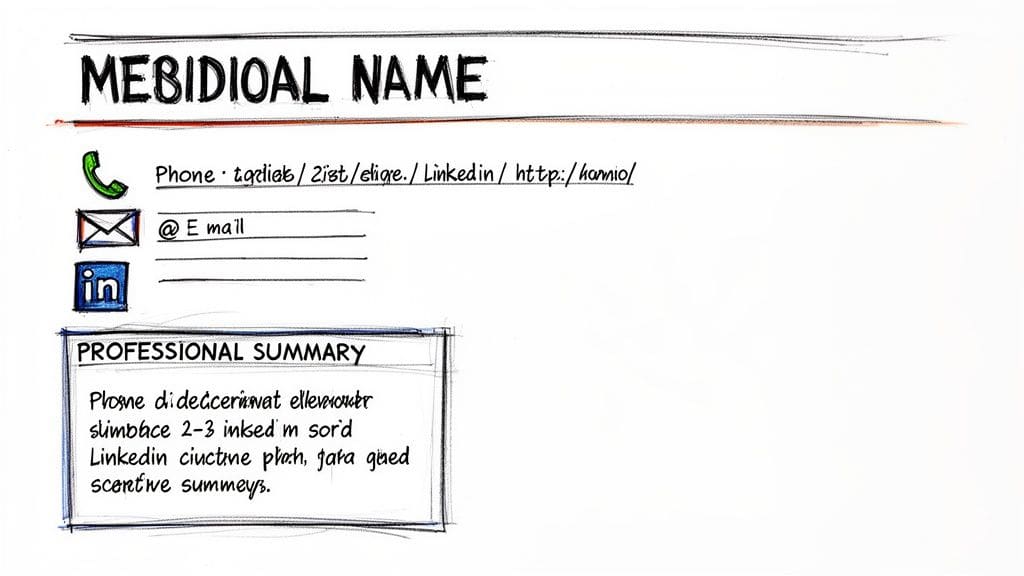
The very top of your CV is the most valuable real estate on the page. With recruiters spending just seconds on their initial scan, this section has to work hard. It must instantly confirm you're a professional and signal that you're a strong fit for the role.
This isn't just about listing your name; it's your thirty-second elevator pitch on paper. Getting this right is a huge part of learning how to write a CV that actually gets you noticed. It all starts with spotless contact details followed by a professional summary that grabs the hiring manager's attention and makes them want to keep reading.
Essential Contact Information
Your contact details need to be clear, professional, and impossible to miss right at the top of the page. The entire goal is to make it effortless for a busy recruiter to get in touch. Anything less is a wasted opportunity.
Keep it simple and focused. In the UK, you don't need to include your full postal address, date of birth, or a photograph. Stick to the essentials.
Your header should include:
- Full Name: Use a slightly larger, bold font so it stands out.
- Phone Number: Your main mobile number is all you need.
- Professional Email Address: Ditch old, unprofessional email addresses. The standard
firstname.lastname@email.comformat is always a safe bet. - LinkedIn URL: Customise your LinkedIn URL (e.g.,
linkedin.com/in/yourname). It looks cleaner and shows you're digitally aware.
A polished contact section sets a professional tone from the first glance. It's a small detail that signals you're a serious candidate who pays attention to the little things.
Crafting a Compelling Professional Summary
Right below your contact information sits your professional summary. This is, without a doubt, one of the most important parts of your CV. It's a short, three-to-four-line paragraph that sums up your key skills, experience, and career goals, all tailored specifically to the job you're applying for.
You need to forget vague clichés like "hardworking team player" or "results-oriented professional." These phrases are filler and waste precious space. Your summary must be specific, packed with value, and speak directly to what the employer needs.
Think of your professional summary as the trailer for your career. It needs to highlight the best parts and leave the recruiter wanting to see the full movie—the rest of your CV.
A powerful summary is built on a simple formula: Who you are + What you offer + Your career aim.
Let's see how this works for different people:
- For a recent graduate: "A first-class Marketing graduate from the University of Manchester with hands-on experience in social media campaign management and data analysis from a three-month internship. Eager to apply my skills in content creation and SEO to help drive engagement for a forward-thinking tech company."
- For a career changer: "An accomplished project manager with 8+ years of experience delivering complex projects on time and under budget in the construction sector. Now seeking to apply proven leadership, stakeholder management, and strategic planning skills to a Technical Project Manager role within the software industry."
- For a seasoned expert: "A CIM-certified Senior Marketing Manager with over 12 years of experience leading high-performing teams in the B2B SaaS sector. Specialises in developing data-driven marketing strategies that have consistently increased lead generation by over 40% year-on-year. Seeking to bring strategic vision and commercial acumen to a Head of Marketing role."
Each example is specific, uses numbers to show impact, and aligns perfectly with a target job. Nailing this section is a critical skill for anyone learning how to write a CV for the modern UK job market in 2026.
Turning Job Duties into Compelling Achievements
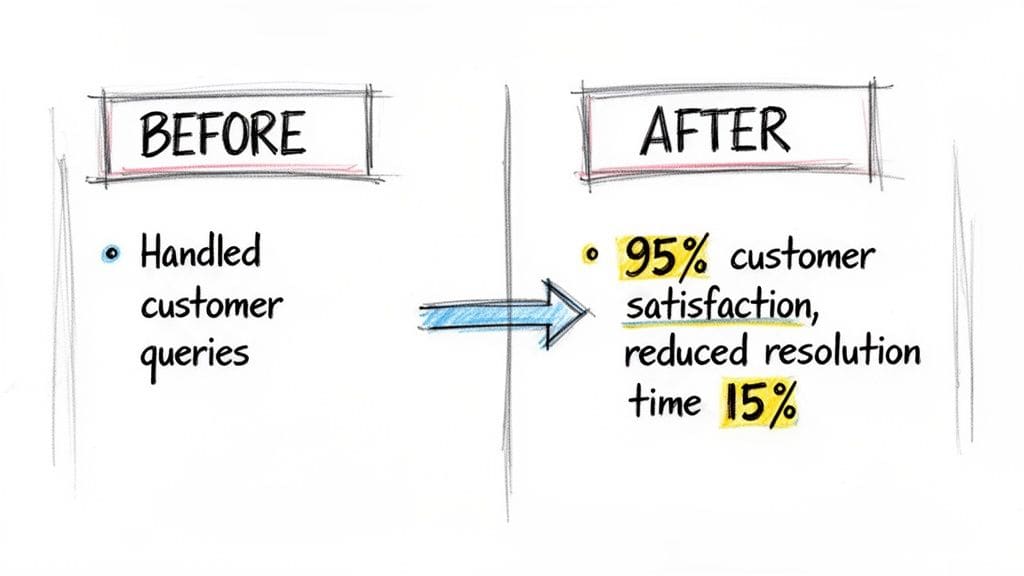
This is the part of your CV where you can truly leave your competition behind. Most people just list what they were responsible for. You're going to show what you actually accomplished. It's all about shifting your mindset from passively listing duties to actively showcasing your impact.
The secret? Strong action verbs backed by hard numbers. Instead of a flat statement like "handled customer queries," you frame it as an achievement: "Achieved a 95% customer satisfaction rating and reduced ticket resolution time by 15%." In a crowded market, metrics cut through the noise and prove you deliver results.
The Power of Quantifying Your Impact
So, why are numbers so crucial? Because they provide concrete proof of your value. A list of duties tells a hiring manager what your job was. A list of quantified achievements shows them how well you did it.
Think about it. Anyone can say they "managed a team." It's a vague claim that blends into the background. But what if you said you "Led a team of 5 junior developers, improving project delivery times by 20% and cutting bugs by 30% through new agile methodologies"? Now you're painting a vivid picture of your leadership and competence.
This is especially vital in the UK job market. With the cost of skill shortages hitting businesses, recruiters are desperate for candidates who can prove their worth. Providing clear metrics is a non-negotiable part of writing a CV that gets noticed.
Instead of thinking, "What were my job duties?" ask yourself this: "What problems did I solve? What did I improve? How did I make things better for my employer?" The answers are your achievements.
This is exactly what CV Anywhere helps you with. Our Smart CV Builder prompts you to rephrase responsibilities as achievements, while the JD Fit Checker helps you pinpoint the metrics that will resonate most with a specific job advert.
From Passive Duties to Active Achievements
The change is simple but powerful. It comes down to two things: a strong action verb to start the sentence and a specific metric to prove your point.
Let's look at a few before-and-after examples.
Before (Passive Duty):
- Responsible for company social media accounts.
After (Active Achievement):
- Grew Instagram follower count by 3,000+ (a 50% increase) in six months by launching a targeted content strategy and a weekly live Q&A series.
Before (Passive Duty):
- Involved in sales and outreach.
After (Active Achievement):
- Exceeded quarterly sales targets by 15% for three consecutive quarters, securing £50,000 in new business from cold outreach campaigns.
Finding Your Numbers
Figuring out your metrics can feel like the hardest part, especially if you think your role doesn't involve numbers. But almost every job has quantifiable aspects if you know where to look.
Here are a few areas to dig into for your data:
- Time: Did you make a process faster? (e.g., "streamlined the reporting process, saving 5 hours per week").
- Money: Did you help increase revenue, cut costs, or handle a budget? (e.g., "managed a £25,000 marketing budget, delivering a 150% ROI").
- Volume: How many customers did you help, tickets did you close, or projects did you complete? (e.g., "resolved 50+ customer support tickets daily").
- Percentages: Did you improve a key metric like efficiency, satisfaction, or error rates? (e.g., "improved data accuracy by 99.5%").
Even if you don't have precise figures, you can still frame your achievements effectively. Use words like "over," "approximately," or "more than" to make honest and compelling estimates. For more ideas on how to phrase your wins, check out these helpful examples of accomplishments for your CV. Mastering this skill is fundamental if you're learning how to write a CV that truly stands out in 2026.
Optimising Your CV for Applicant Tracking Systems
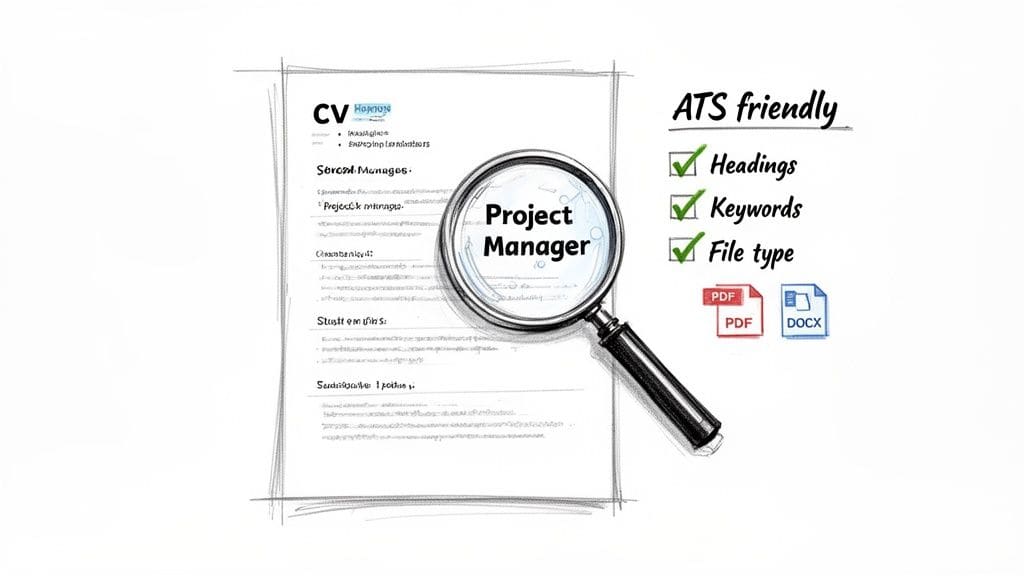
You've polished your CV, hit 'apply'… and it vanishes into a black hole. Sound familiar? You're likely falling foul of the silent gatekeeper of modern recruitment: the Applicant Tracking System (ATS).
These software bots are the first to read your application, scanning it to decide if you're a good match for the job. If your CV isn't written in a way they can understand, it will be rejected before a human ever sees it. Getting this right isn't just a good idea anymore; it's essential.
By 2026, it's expected that over 90% of medium and large UK companies will use an ATS. It's not about tricking the system. It's about giving your qualifications the best possible chance to be seen.
How an ATS Actually Thinks
Think of an ATS as a search engine for recruiters. It doesn't "read" your CV like a person does; it scans and filters it for data. The system looks for specific keywords, skills, and qualifications that match the job description.
It also hunts for standard section headings like "Work Experience" and "Education" to piece together your career story. That's why simple, predictable formatting always wins. Complex designs, graphics, and weird fonts just confuse the software, which can lead to an instant rejection.
Your CV is your professional story, but for an ATS, it's a data-matching exercise. You need to give it the right data points to prove you're a match.
This is exactly why we built CV Anywhere with ATS compliance at its core. Every CV you create is automatically structured for clean parsing, so you can stop worrying about the technical side and focus on showcasing your achievements.
Keyword Matching: Your Secret Weapon
The single most important factor for getting past an ATS is keyword alignment. The system is programmed to find the exact words and phrases from the job description in your CV. If the advert calls for "stakeholder management," "data analysis," and "agile methodologies," then your CV had better include those precise terms.
This doesn't mean you should cram keywords into every sentence. The trick is to weave them naturally into your professional summary and work experience bullet points.
Here's a quick way to nail it:
- Analyse the Job Description: Copy the text from the job advert into a word cloud generator or simply go through it with a highlighter. Pull out all the key skills, tools, and qualifications that the employer mentions repeatedly.
- Create a Master List: Group these terms into logical categories. For example, technical skills (like Python, Salesforce), soft skills (like leadership, communication), and qualifications (like PRINCE2, CIM).
- Integrate Naturally: Review your CV and find opportunities to add these keywords where they make sense. For example, if a job requires "budget management," make sure an achievement bullet point reflects this, like: "Managed a £50,000 project budget, delivering the project 10% under forecast."
This shows the ATS — and the eventual human reader — that you haven't just skimmed the job description, but that your experience is genuinely relevant.
Critical Formatting Rules for ATS Success
Even a CV packed with perfect keywords can be instantly rejected if the formatting is wrong. ATS software struggles with complex layouts, so sticking to a clean, simple design is non-negotiable.
The table below breaks down the simple do's and don'ts to keep your CV in the "yes" pile. Following these rules removes the risk of your CV being misread or discarded because of a simple formatting error.
ATS Formatting Do's and Don'ts
| Guideline | Do (ATS-Friendly) | Don't (Risk of Rejection) |
|---|---|---|
| File Type | Submit as a .docx or .pdf file. | Avoid JPG, PNG, or other image files. |
| Fonts | Use standard fonts like Arial, Calibri, or Times New Roman. | Don't use decorative or script fonts. |
| Section Headings | Use simple, standard titles: "Professional Experience," "Skills." | Don't use creative titles like "My Journey" or "What I Do." |
| Layout | Use a clean, single-column layout. | Don't use tables, columns, text boxes, or graphics. |
| Contact Info | Place contact details in the main body, not the header/footer. | Don't put crucial info in the header or footer area. |
| Bullet Points | Use standard round or square bullet points. | Don't use fancy symbols, icons, or checkmarks. |
Getting these basics right is a simple but powerful step. It ensures the machine can accurately interpret all the great content you've written.
And remember, your CV is just one part of your professional brand. A strong online presence reinforces the story you tell. It's well worth learning about optimising your LinkedIn profile for UK roles to ensure you're making a great impression everywhere recruiters look.
Final Touches: Education, Skills, and the All-Important Proofread
The last few details on your CV are often what separate a 'yes' from a 'maybe'. Getting these final sections right—education, skills, and proofreading—shows a recruiter you're a true professional who pays attention to detail.
A single typo can undo all the great work you've put into your experience section. So, let's make sure your document is flawless, credible, and ready to make a powerful first impression on UK employers.
Presenting Your Education Effectively
How you frame your education all comes down to your career stage. A recent graduate's approach will be worlds apart from a seasoned professional with 15 years under their belt. The trick is giving this section just the right amount of real estate.
If you're a recent graduate or have limited work history, your education is a primary asset. It belongs right at the top of your CV, just after your professional summary.
In this scenario, you'll want to add some detail:
- University and Dates: List the institution and the years you attended.
- Degree and Grade: Be specific, e.g., "BA (Hons) History – First-Class Honours".
- Relevant Modules: Cherry-pick a few high-scoring modules that tie directly into the job you're after.
- Dissertation or Key Projects: Briefly mention your dissertation if the topic is relevant to the industry.
For an experienced professional, however, your work history is the main event. Your education section should be moved towards the bottom of the CV. Keep it short and sweet.
Experienced Professional Example: University of Leeds (2008 – 2011) BA (Hons) Business Management – 2:1
This keeps the spotlight on your proven track record. For a closer look at different strategies, you can explore our guide on how to feature education on your CV.
Creating a Powerful Skills Section
Think of your skills section as a rapid-fire summary of your capabilities. It's a scannable snapshot that helps both ATS bots and human recruiters quickly tick their boxes.
Avoid vague terms like "hard-working." Instead, create a clean, organised list that reinforces the achievements you've already detailed in your work experience.
Categorising your skills makes them much easier to scan. Common categories include:
- Technical Skills: List programming languages (Python, Java), software (Salesforce, Adobe Creative Suite), or tools (Google Analytics, Jira).
- Soft Skills: Leadership, Communication, Teamwork, Problem-Solving, Stakeholder Management.
- Languages: State your proficiency level clearly (e.g., French – Professional Working Proficiency).
Just make sure every skill you list has a backup. If you claim Project Management, ensure your work history includes a project you actually managed.
The Final Proofreading Checklist
This is non-negotiable. A CV riddled with typos or grammatical errors screams a lack of care—a massive red flag for any employer. Even if you're a pro, knowing how to write a CV that's perfect requires one last, meticulous check.
Don't just trust your spell checker. It won't catch everything.
Here's a checklist to run through before hitting 'send':
- Read it Aloud: This simple trick forces you to slow down. You'll catch awkward sentences and typos that your brain would normally skim over.
- Check for Consistency: Are all your dates formatted the same way (e.g., "2022 – 2024")? Are your headings styled consistently? Is the font and font size the same throughout?
- Verify Your Details: A single typo in your phone number or email address means a recruiter can't reach you. Double-check them.
- Get a Fresh Pair of Eyes: Ask a trusted friend or mentor to read it over. After staring at a document for hours, you become blind to your own mistakes.
- Read it Backwards: Start from the very last word and read your way to the beginning. This breaks the natural flow, helping you focus on individual words and spot spelling mistakes more easily.
Your Top CV Writing Questions Answered
Even after you've nailed the main sections, a few nagging questions can stall your progress. When you're trying to figure out how to write a CV that feels just right, it's the small details that often cause the most debate. Let's clear up the most common sticking points for UK job seekers.
We'll tackle the big ones: ideal length, the great photo debate, and whether your weekend hobbies have a place on your CV. Getting these final details right will give you the confidence to hit 'send'.
How Long Should a UK CV Be?
For almost everyone in the UK, a two-page CV is the gold standard. It gives you enough room to show your value without making the recruiter sift through a novel. They're used to this length and know exactly where to look for key information.
Of course, there are a couple of exceptions to the rule:
- Recent graduates and early-career professionals (with less than five years of experience) should aim for a punchy one-page CV. It keeps the focus sharp and avoids fluff.
- Academics, doctors, or very senior executives might need a longer CV (three pages or more) to list extensive publications, research, or a career's worth of major projects. This is rare, so don't do it unless you're in this specific camp.
For the vast majority of UK roles, sticking to two pages is your safest and most effective bet. It shows you know how to be concise and that you respect the reader's time.
Should You Put a Photo on Your CV?
Let's make this simple: No. In the UK, you should not put a photograph on your CV. This isn't a personal preference; it's a professional standard designed to prevent unconscious bias during the screening stage.
Adding a photo is one of the most common mistakes we see. Many employers will automatically discard CVs with pictures to keep their hiring process fair and compliant with equal opportunity best practices. Save your professional headshot for your LinkedIn profile—that's where it belongs.
What Is the Difference Between a CV and a Resume?
While you might hear the terms used interchangeably, they mean different things depending on where you are in the world. Getting this right shows you've done your homework.
In the United Kingdom, the document you send for a job is always called a CV (Curriculum Vitae). It's the comprehensive two-page document we've been building throughout this guide.
In the United States, the definitions are different:
- A resume is a short, targeted summary of your experience, almost always one page.
- A CV is a much longer, multi-page document used almost exclusively for academic, medical, and scientific roles.
Bottom line: if you're applying for a job in the UK, call it a CV and stick to the two-page format.
Is It Necessary to Include Hobbies or Interests?
This is entirely optional, and it can be a double-edged sword. A well-chosen interest can add personality, but a generic one just wastes precious space. The only thing that matters here is relevance.
Ask yourself one question: does this hobby prove a skill the employer wants?
- Good examples: Captaining your local football team (leadership), contributing to an open-source project (technical skill, passion), or running a blog about your industry (expertise, communication).
- Bad examples: Vague interests like "watching films," "socialising," or "reading." These add zero value and can make your application feel generic.
If you're fighting to keep your CV under two pages, the hobbies section is the very first thing to cut. Your professional results should always be the star of the show.
Stop wrestling with confusing templates and second-guessing your content. CV Anywhere's Smart CV Builder and JD Fit Checker guide you through every step, ensuring your document is polished, professional, and perfectly tailored to land your next interview. Start building your winning CV today.
Tags
Related articles
How Do I Write a CV in the UK? A 2026 Guide
So, you're asking yourself, "how do I write a CV that actually gets me noticed in the UK?" It's the big question, and the answer for 2026 is about creating a sharp, focused marketing document that pro...
How to Write a CV Quickly: A 60-Minute Guide
You’re probably here because a job has landed in your inbox and you need to write a CV quickly without sending something sloppy. The good news is that speed isn’t the problem. Bad priorities are. A fa...
How to Improve My CV: A Step-by-Step UK Guide for 2026
If you're searching "improve my CV", you probably already know something's off. Your CV may look busy but say very little, or it may list plenty of duties without showing why anyone should interview y...
Create a CV Fast: A 60-Minute UK Workflow
Need to create a CV fast because a role closes soon, you've got three tabs open, and your old CV still talks about the wrong job. The quickest way isn't typing faster. It's using a focused workflow th...
Popular Articles
So, you're asking yourself, "how do I write a CV that actually gets me noticed in the UK?" It's the big question, and the answer for 2026 is about creating a sharp, focused marketing document that pro...
You’re probably here because a job has landed in your inbox and you need to write a CV quickly without sending something sloppy. The good news is that speed isn’t the problem. Bad priorities are. A fa...
If you're searching "improve my CV", you probably already know something's off. Your CV may look busy but say very little, or it may list plenty of duties without showing why anyone should interview y...
Need to create a CV fast because a role closes soon, you've got three tabs open, and your old CV still talks about the wrong job. The quickest way isn't typing faster. It's using a focused workflow th...