
Figuring out how to write a resume for a teenager can feel daunting, especially with little to no work experience. The key is to create a one-page document that highlights your potential by focusing on skills from school, volunteer work, sports, and even hobbies. You'll want to use a professional summary to grab attention, choose a resume format (like a combination format) that showcases your skills over job history, and quantify your achievements with numbers whenever possible to prove your impact.
Your first resume for a US job market should be a clean, sharp snapshot of your strengths. This guide will walk you through exactly how to translate your unique experiences into professional language that will catch a hiring manager's eye and land you that first job.
Building Your First Teen Resume in 2026
Let's shift your perspective. That feeling of having "no experience" is completely normal, but it's also not entirely true. Your experiences—whether from a tough group project, leading a club, or your part-time babysitting gig—are full of skills employers want. The real work is learning how to translate those moments into professional language that a hiring manager will understand and respect.
This guide will show you exactly how to frame your unique background to catch an employer's eye. We'll walk through how to prove you're a capable, enthusiastic candidate who's ready for that first real job, even without a formal employment history.
What Makes a Teen Resume Successful
A great teen resume isn't just a list of stuff you've done. It's a marketing tool selling your potential. To make it land, you have to focus on what employers are really looking for in someone just starting out.
They're looking for signs of these three things:
- Demonstrated Responsibility: Did you show up on time for soccer practice all season? Meet every deadline for that big history paper? Manage a schedule for the kids you babysit? That's proof you're dependable.
- A Willingness to Learn: Highlighting relevant coursework, online certifications, or even personal coding projects shows you're proactive and eager to grow.
- Basic Professionalism: A clean, error-free resume with a professional email address (think
firstname.lastname@email.com, notsk8rboi2008@email.com) signals maturity and attention to detail.
Your resume is your first professional handshake. Its goal is to show an employer not just what you've done, but what you can do for them. Think of it as telling a compelling story about your skills, ambition, and readiness to contribute.
As you start pulling this together, it's helpful to see how these core principles work in different contexts. For example, a guide on how to create a resume for startup jobs often focuses on showcasing potential and impact over a long list of job titles, which is a perfect mindset for a first-time job seeker.
Framing Your Limited Experience
Your mission is to pack your potential into a single, powerful page. Forget a generic objective statement; a punchy professional summary can set a much more confident tone right from the start. From there, you'll highlight your education and then dive into experiences from all corners of your life.
For some inspiration on how this looks in practice, check out these excellent student resume examples to see how others have successfully framed their skills. This guide will take you through each section, step-by-step.
Does your resume clearly show results for each role?
Turn a weak resume into a stronger one
Upload your resume → get stronger wording instantly → fix the weakest parts first.
No need to rewrite. Start with your current resume.
Choose a Resume Format That Highlights Your Strengths
Picking the right resume format isn't just about looks—it's about strategy. For a seasoned professional, the standard chronological resume makes perfect sense. It shows a clear career progression. But for a teen, that same format can scream, "I don't have much paid experience!"
That's a trap you want to avoid.
Instead, you need a format that puts your skills, potential, and drive front and center. That's what hiring managers actually want to see from a first-time job seeker. This is where functional and combination formats come in.
What Are Your Format Options?
Think of your resume's format as the blueprint for your professional story. You have three main choices, and picking the right one is crucial.
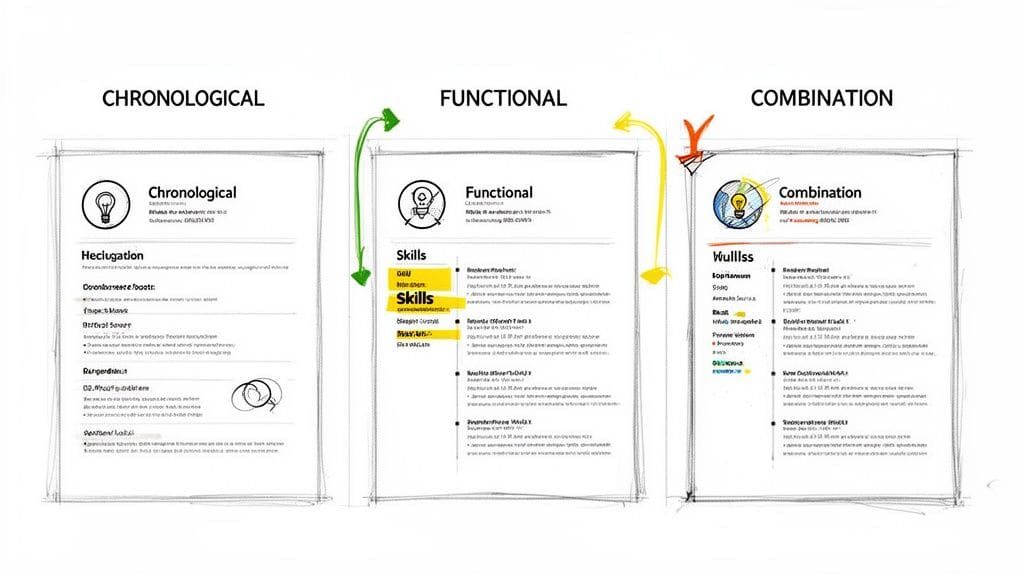
The Chronological Format: This is the classic, listing your work history from most to least recent. It's great for showing career growth but can look pretty empty if you only have a summer job or two. For most teens, this is the weakest option.
The Functional Format: This format flips the script. It leads with a detailed skills section, grouping your abilities into categories like "Communication" or "Problem-Solving." You pull evidence from school projects, volunteering, and even team sports. It's perfect for showing what you can do, regardless of where you learned it.
The Combination Format: This is a hybrid, and it's arguably the best choice for most teens. It kicks off with a strong summary and skills section, then follows up with a brief, blended experience section that includes both paid jobs and significant unpaid roles.
To help you decide which structure will make you look best, here's a quick comparison.
Resume Formats for Teens Compared
This table breaks down the three main formats to help you decide which one best showcases your unique skills and experience.
| Format Type | Best For | Primary Focus |
|---|---|---|
| Chronological | Teens with 2+ relevant jobs or internships. | Work history and career progression. |
| Functional | Teens with no formal work history but strong skills. | Transferable skills and abilities. |
| Combination | Most teens; balances skills with some experience. | Skills and potential, backed by key experiences. |
Ultimately, the combination format gives you the most flexibility to play to your strengths. If you'd like to explore this further, our guide on choosing the right resume format breaks down the pros and cons of each in more detail.
Why the One-Page Rule Is Non-Negotiable
You might hear that multi-page resumes are becoming more common, but that advice is for people with decades of experience. For you, the one-page rule is still golden.
In fact, a recent study found that 73% of recruiters prefer a one-page resume for any candidate with less than 10 years of experience. You can see more insights on resume trends for 2026 on Monster.com.
Sticking to one page forces you to be ruthless with your editing. It's a creative challenge that makes you focus only on your most impressive and relevant qualifications. This isn't a limitation; it's a tool to make your resume more powerful.
A single, well-crafted page ensures every word has a purpose. It respects the hiring manager's time and proves you know how to communicate what matters most—a skill every employer values. Your goal is a resume packed with value, not just filled with words.
Turning Everyday Experiences Into Professional Achievements
The biggest hurdle most teens face is the feeling that they have "no experience." It's a complete myth. You're sitting on a goldmine of experience; it just doesn't look like a traditional 9-to-5 job.
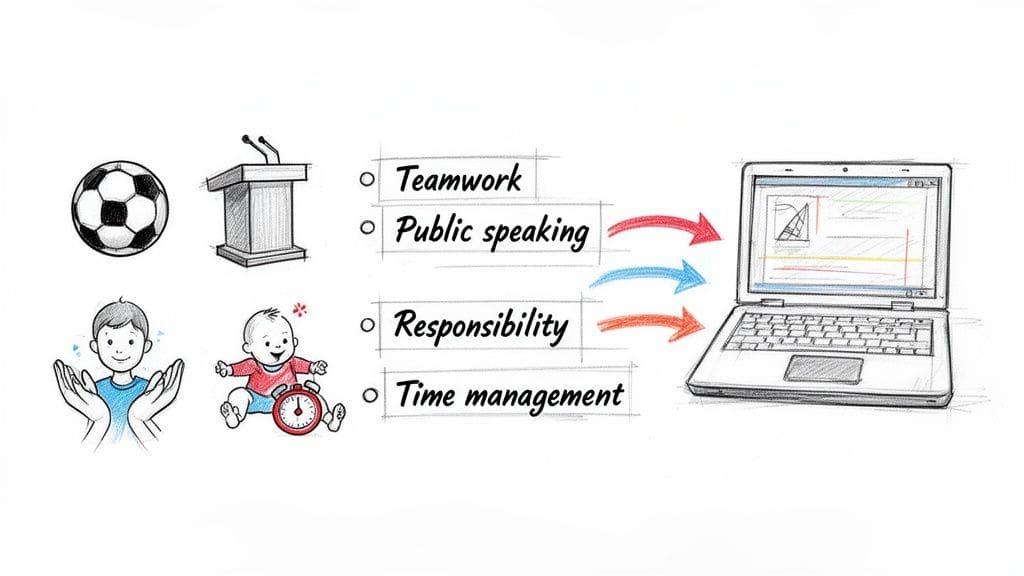
The real trick is learning how to translate your everyday life—school projects, sports, volunteer work, even your weekend babysitting gig—into professional achievements that catch a hiring manager's eye. They aren't looking for a future CEO. They're looking for proof of responsibility, a solid work ethic, and a willingness to learn. Your life is already full of it.
Brainstorm Your Hidden Experience
Let's find where your most valuable experiences are hiding. Nothing is too small at this stage. Just grab a notebook and start listing everything you've been involved with over the last couple of years.
- Academic Work: Did you lead a big group project? Spend a month on a research paper? Build something for a science fair or enter a coding competition?
- Extracurricular Clubs: Think debate team, yearbook, robotics club, or student government. What was your role?
- Sports Teams: Being on a team is a masterclass in discipline, teamwork, and time management. Did you help with equipment, lead warm-ups, or mentor younger players?
- Volunteering: Have you walked dogs at the local shelter, stocked shelves at a food bank, or helped set up a community event?
- Informal Gigs: Don't discount babysitting, mowing lawns, pet-sitting, or tutoring. These are real jobs that prove people trust you to be responsible.
Once you have this raw list, we can start shaping these activities into accomplishments. This is the single most important part of learning how to write a resume for a teenager when you don't have a formal job history.
Use Action Verbs to Show Impact
The secret to making these experiences sound professional is starting every bullet point with a strong action verb. Get rid of passive phrases like "Was responsible for" or "Duties included." Lead with words that show you actually did something.
Think about the difference here:
- Instead of: "Was on the debate team."
- Write: "Collaborated with a 4-person team to research and present compelling arguments, improving public speaking and critical analysis skills."
Your goal is to show, not just tell. Connect your action to a skill and, if you can, a result. This transforms a simple activity into a concrete example of your capabilities.
Here are a few powerful action verbs to get your brain working:
- Organized
- Coordinated
- Managed
- Led
- Developed
- Created
- Assisted
- Communicated
- Trained
- Resolved
By using dynamic language, you're not just listing tasks. You're building a story that proves you're competent and have initiative. If you get stuck, our article on examples of accomplishments for your resume has plenty more ideas to borrow.
Real-World Examples for Common Teen Experiences
Let's put this all together. Here's how you can rephrase common teen activities to highlight the skills employers are actually looking for.
Example 1: Babysitting
- Weak Description: Babysat for neighbors.
- Strong Description: Managed schedules and provided responsible care for two children aged 5 and 8, ensuring a safe and engaging environment. Communicated daily updates with parents on activities and progress.
Example 2: School Group Project
- Weak Description: Did a group project for history class.
- Strong Description: Collaborated with a team of three students to research and create a 20-page report on American history. Coordinated project timelines and delegated tasks to meet all deadlines.
See the difference? These examples prove that your everyday life has already given you the material you need. Mastering this translation is the core of how to write a resume for a teenager that gets you noticed.
Use Numbers to Show Your Impact
Hiring managers see hundreds of resumes, and most of them are filled with vague descriptions. You can make yours jump off the page by using numbers. Numbers give concrete proof of what you accomplished, turning a decent resume into a seriously impressive one.
This is a game-changer, especially when you're just starting out. You don't need a formal job to have a measurable impact. Think about it. Did you help your club's social media account grow? Did you volunteer for a fundraiser? Did you figure out a smarter way to get a group project done ahead of schedule? Those are all moments you can measure.
Turn Vague Phrases into Powerful Metrics
The trick is to learn how to translate what you did into numbers, percentages, or even dollar amounts. This instantly makes your contributions feel more professional and real. It's one of the most important parts of knowing how to write a resume for a teenager that actually gets noticed.
Let's look at a few common examples of how to do this:
- Before: "Helped increase our club's social media presence."
After: "Increased Instagram followers by 15% over three months by posting consistent, engaging content."
- Before: "Participated in the school's annual food drive."
After: "Collected over 200+ canned goods as part of a 5-person team, contributing to a school-wide total that fed 50 local families."
- Before: "Was a camp counselor for a summer program."
- After: "Supervised and led activities for a group of 10 children aged 8-10, ensuring safety and engagement for 8 hours daily."
See the difference? The "after" versions give the manager a clear picture of the scale and context of your work. They prove your impact in a way a simple description never could.
The Small Details That Make a Huge Difference
Adding numbers is a major step up, but all that hard work can be undone by simple mistakes. While 2026 research shows that resumes with quantified results are 40% more likely to land a callback, that advantage vanishes if the basics are wrong.
A shocking 77% of resumes are rejected because of typos, and 35% are immediately tossed for using an unprofessional email address like coolguy99@email.com. You can dig into more resume statistics for 2026 on ResumeFast.io.
Getting these details right shows you're mature and pay attention. A professional email (like
firstname.lastname@email.com) and proofreading your resume at least twice are non-negotiable. These small steps put you way ahead of the competition.
Focusing on the little things is a crucial lesson when learning how to write a resume for a teenager. It proves to an employer that you take the opportunity seriously and can be trusted with real responsibility, no matter how much formal experience you have.
Optimizing Your Resume for Automated Screening Systems
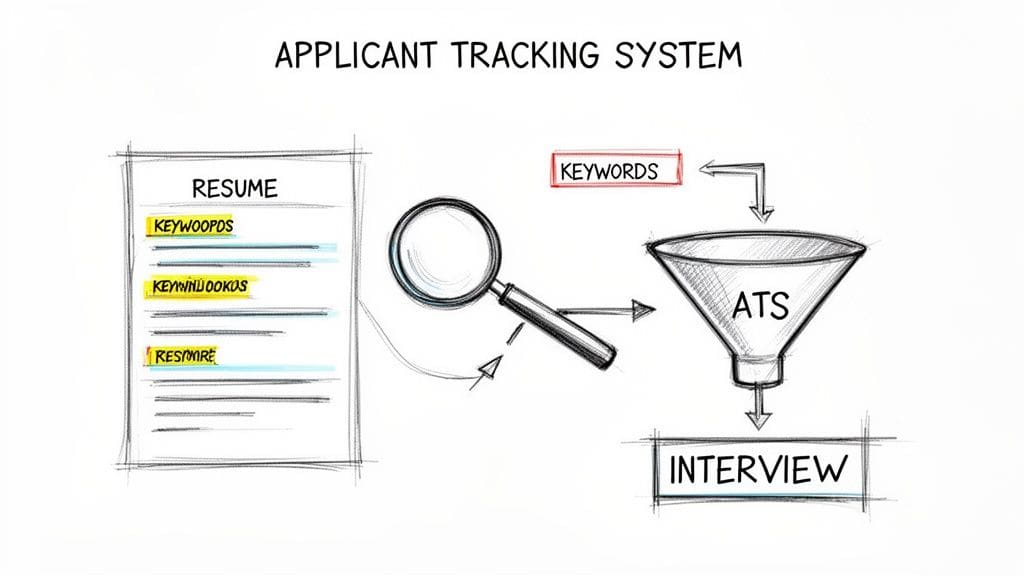
Before a person ever lays eyes on your resume, it has to pass its first test: the robot. It's a reality of the modern job hunt. Most companies use software called Applicant Tracking Systems (ATS) to do the initial heavy lifting, scanning every resume that comes in and filtering out the ones that don't seem like a fit.
This is the biggest digital gatekeeper you'll face. A jaw-dropping 98% of Fortune 500 companies use ATS, and it's estimated that these systems toss out 75% of all resumes before a human ever sees them. Learning to write for these systems is just as important as writing for a person. It's a non-negotiable part of knowing how to write a resume for a teenager that actually gets results.
Weaving in the Right Keywords
So, how do you get past the bot? You have to speak its language. The ATS is programmed to look for specific keywords and phrases that match what the company is looking for. If those words aren't in your resume, the system scores you low and you're out of the running.
The best place to find these keywords is the job description itself. Read it carefully. What words or skills do they keep mentioning? Those are your clues.
- If the job ad says: "Seeking a responsible team player with strong communication skills."
Your resume should include: "responsible," "teamwork," "collaboration," and "communication" in your summary or skills section.
- If the job ad says: "Experience with cash handling and customer service a plus."
- Your resume should include: "cash handling" and "customer service" if you've done anything like it—even managing money for a school club or helping people at a bake sale counts.
Don't just cram keywords where they don't belong. The goal is to naturally work them into your summary, skills list, and the bullet points describing your experience. You need to show both the ATS and the eventual human reader that you're a perfect match.
Formatting Your Resume for Robots
An ATS has no appreciation for cool graphics, fancy fonts, or creative layouts. In fact, that stuff usually just confuses the software and can get an otherwise great resume kicked to the reject pile.
To make sure a machine can read your resume, you have to keep it simple. Think clean, clear, and logical.
You can also learn more by reading our guide on how to optimize your resume for ATS.
Here are the unbreakable rules for ATS-friendly formatting:
- Use Standard Fonts: Stick to the classics. Arial, Calibri, or Times New Roman are always safe bets.
- Avoid Complex Layouts: Forget about tables, columns, or text boxes. A simple, single-column format is the gold standard.
- Stick to Standard Headings: Use obvious section titles the robot will recognize, like "Education," "Experience," and "Skills."
- Save as the Right File Type: Unless the application specifically asks for something else, save and submit your resume as a .docx or .pdf file. They are universally readable.
Following these guidelines ensures all the hard work you put into writing your resume doesn't go to waste just because a machine couldn't understand it.
Polishing and Submitting Your Application
Alright, you've put in the work and built your resume. But don't hit "send" just yet. The final polish is what makes your resume actually get noticed. This isn't just about spell-checking; it's about making sure every word earns its place.
Here's a trick that works every time: read your resume out loud. Seriously. It forces you to slow down, and you'll immediately catch awkward sentences or typos your brain would otherwise skim right over.
Once you've done that, get a fresh pair of eyes on it. Ask a teacher, a trusted coach, or a parent to give it a final look. They'll spot things you've been staring at for so long you can no longer see.
Tailor Your Resume for Every Job
This is the single most important part of the application process. Sending the same generic resume to every job is a fast track to the "no" pile. Instead, you need to make small, smart tweaks for each specific role you apply for.
Focus on your summary and skills section. Your goal is to mirror the exact language you see in the job description. This isn't cheating; it's showing the hiring manager you've actually read their ad and understand what they need.
Tailoring your resume is the single most effective way to signal to an employer that you are not just looking for any job, but that you are specifically interested in their job. It shows initiative and a keen eye for detail.
For example, if you're applying for a camp counselor job that emphasizes "leadership" and "safety," you need to make sure those exact keywords show up in your resume. Tools like CV Anywhere's Smart CV Builder can speed this up, helping you quickly align your resume with job requirements. If you want a pro to check your work, you can always get an expert resume review to make sure it's perfect.
As you get ready to apply, don't forget to clean up your online presence. Many employers will do a quick search for you online. A professional-looking LinkedIn profile can be a huge asset. It's easy to learn how to add your resume on LinkedIn to make sure your profile is complete and supports your application.
A Few Final Questions You Might Have
Even after you've put in the work to build your resume, a few nagging questions always seem to pop up. Nailing these final details can be the thing that pushes your resume from the "maybe" pile to the "yes" pile. Let's tackle some of the most common ones I hear from teens.
What Is the Best Length for a Teenager's Resume?
One page. That's it.
Seriously, for any student or anyone with less than 10 years of experience, a single page is the non-negotiable standard. Recruiters love it because it proves you can be concise and focus only on what truly matters. It forces you to highlight your most relevant achievements instead of rambling.
Should I Include My GPA on My Resume?
This one's a classic "it depends." A good rule of thumb is to include your GPA only if it's 3.5 or higher. A strong GPA can be a great signal to an employer that you're smart and have a solid work ethic.
If your GPA is lower than that, don't sweat it. Just leave it off. Your resume's job is to sell your best self, so let your experience, skills, and extracurriculars do the talking instead.
Is It Okay to Use a Creative Resume Template?
For the kinds of jobs most teens are applying for—like retail, food service, or a first office gig—it's best to play it safe. Stick with a clean, professional, and traditional format.
Why? Because those simple layouts are much easier for both hiring managers and Applicant Tracking Systems (ATS) to scan quickly. Save the fancy, design-heavy templates for when you're applying for a job in a creative field like graphic design.
Ready to create a polished, professional resume that gets noticed? The CV Anywhere Smart CV Builder helps you craft an ATS-friendly document, highlight your skills, and tailor it for any job in minutes. Start building your future today at https://cvanywhere.com.