The best resume for a retail job uses a reverse-chronological format, features a strong professional summary, and quantifies achievements with numbers. It must be tailored with keywords from the job description to pass Applicant Tracking Systems (ATS) and grab a hiring manager's attention in seconds. This guide provides step-by-step instructions and examples to build a resume that lands interviews.
The Structure That Gets You Noticed
Your retail resume needs to do two jobs at once: get past the automated applicant tracking systems (ATS) and then immediately grab the attention of a human reader. This means focusing on three non-negotiable sections: a targeted summary, a keyword-rich skills list, and an experience section that proves your impact.
This layout puts your most important qualifications right where a hiring manager expects to see them.
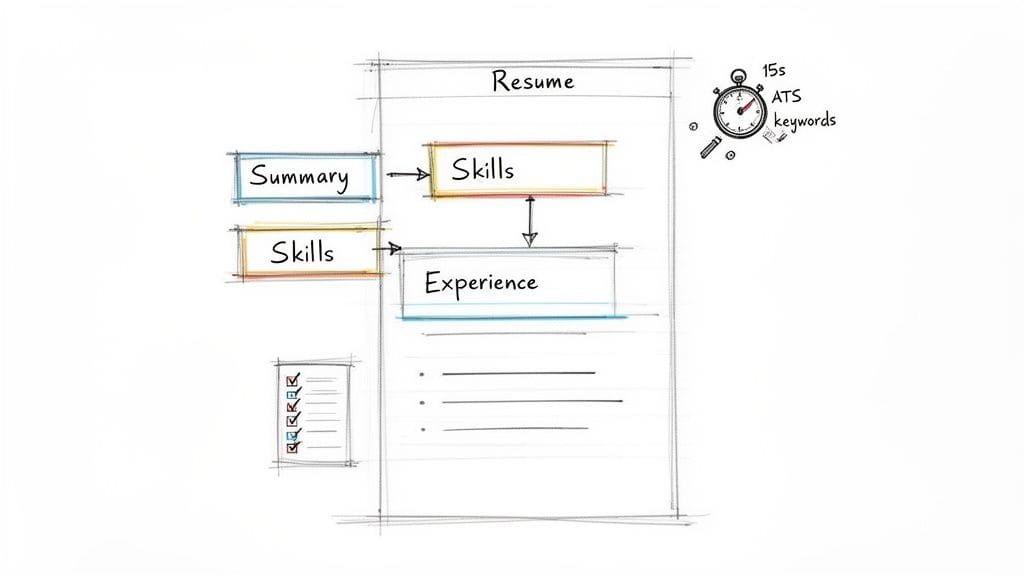
Retail hiring moves fast. Managers sift through dozens, sometimes hundreds, of applications. By putting your most recent and relevant experience first, you instantly answer their main question: "Can this person do the job now?"
According to the National Retail Federation, 71% of hiring managers view retail roles as positive experience on a resume. Your time on the floor has taught you valuable skills in customer service, sales, and operations.
Key Sections of a Retail Resume
Here's a breakdown of the essential sections and what each one is meant to accomplish.
| Resume Section | Primary Goal | What to Include |
|---|---|---|
| Professional Summary | Grab attention with your top 2-3 qualifications and a key achievement. | 3-4 sentences showing your experience level and a career highlight. |
| Skills | Pass ATS scans and showcase your most relevant abilities. | A mix of hard skills (POS systems, inventory) and soft skills (communication). |
| Work Experience | Prove your impact with numbers and results, not just duties. | Bullet points with action verbs and metrics (e.g., sales figures, satisfaction scores). |
| Education | Provide foundational background and relevant training. | Your highest degree, certifications, or relevant coursework. |
These sections work together to tell a compelling story about your professional value, quickly and effectively. While a solid resume is the foundation, you can also showcase projects or visual merchandising skills in an electronic portfolio examples. For a deeper dive, our guide on the essential components of a resume is a great next step.
Is your resume actually getting responses?
Your resume might be missing something important
Upload your resume → see its weakest areas → fix them, one by one.
Free. Takes less than 2 minutes.
How to Write a Professional Summary That Gets Noticed
Think of your professional summary as your 30-second elevator pitch. It's the first thing a hiring manager sees on your resume for a retail job, and you have just a few seconds to convince them to keep reading. Forget generic lines like "hard-working individual." Instead, mirror the language in the job description and spotlight your biggest career wins right from the start.
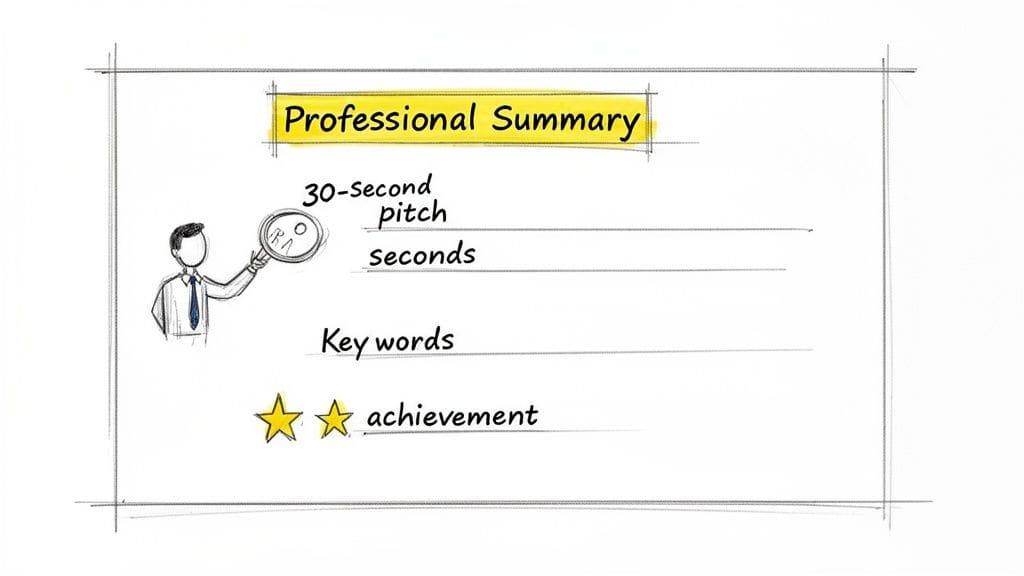
Your goal is a targeted, 3-4 sentence paragraph that blends your experience level, a key accomplishment, and keywords from the job posting.
Professional Summary Examples
For an Entry-Level Retail Associate: Focus on enthusiasm, transferable skills, and eagerness to learn.
- Example: "Enthusiastic and reliable individual with a strong foundation in customer service from volunteer and academic roles. Eager to apply excellent communication and problem-solving skills to a fast-paced retail environment. Seeking to contribute to a positive customer experience and grow into a knowledgeable sales associate."
For an Experienced Retail Professional: Lead with experience, specific skills, and an achievement backed by numbers.
- Example: "Dedicated retail associate with 5+ years of experience in high-volume environments. Proven ability to exceed sales targets, achieving 115% of quarterly goals through consultative selling and strong product knowledge. Seeking to leverage expertise in POS systems and customer relationship management to drive team success."
A strong summary acts as the headline for your entire resume. Want to dive deeper? Our detailed article on how to write a powerful resume summary breaks it down even further.
Showcasing Your Experience with Powerful Metrics
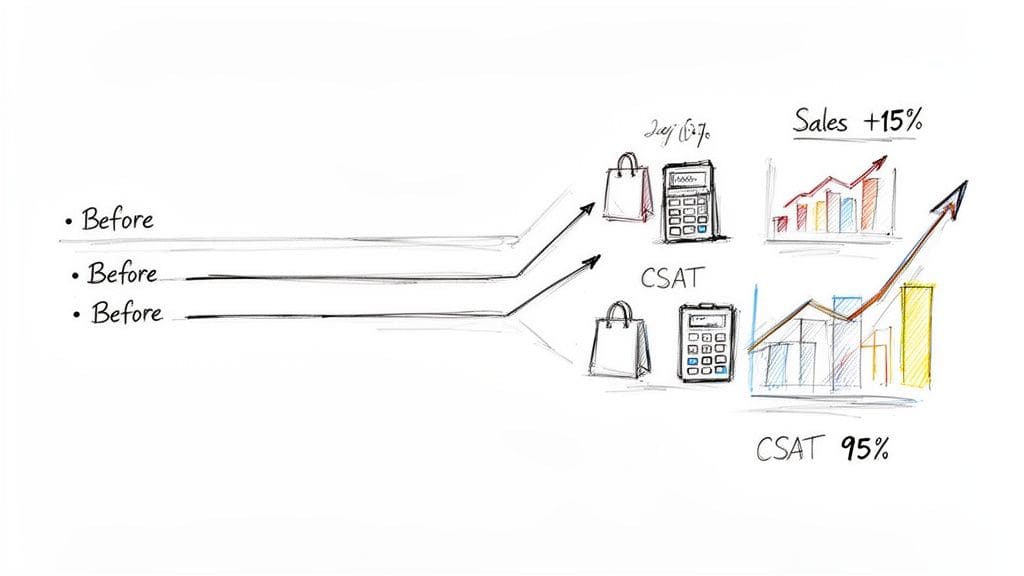
Your experience section is where you stop telling a hiring manager what you did and start showing them the value you delivered. Don't just list duties—that's a job description. Your goal is to transform responsibilities into active, compelling achievements that prove your impact. The secret is using numbers.
Metrics provide hard proof of your skills. Even if your role didn't involve formal KPIs, the numbers are there.
Turning Duties into Achievements
Let's see this in action by re-framing work to focus on the outcome.
Before:
- Helped customers in the store.
After:
- Assisted 50+ customers daily, using deep product knowledge to boost average transaction value by 15% through strategic upselling.
The "After" example is specific, active, and packs in two powerful metrics. It tells a story of a proactive and effective employee. Candidates who include two to three quantified metrics per job see a significantly higher engagement rate from recruiters.
How to Find Metrics in Your Retail Role
- Sales Performance: Did you hit daily targets? By what margin? How many loyalty program sign-ups did you secure?
- Customer Satisfaction: How many positive reviews did you receive? Did you help maintain a high team score on surveys, like a 95% satisfaction rating?
- Inventory and Operations: What volume of stock did you manage? Did you help reduce shrinkage by a certain percentage? How many items did you restock per hour?
- Team Collaboration: How many new hires did you train or mentor? Did you contribute to a team goal that resulted in a win like "Store of the Month"?
By digging into these areas, you can turn every bullet point into a small case study of your effectiveness. For more ideas, check out our guide on examples of accomplishments for your resume.
Highlighting the Right Retail Skills
A well-crafted skills section passes ATS scans and serves as a quick-scan guide for a busy hiring manager. You need a strategic mix of technical know-how (hard skills) and people-centric abilities (soft skills).
Hard Skills: These are the practical abilities that prove you can handle the job from day one.
- Point of Sale (POS) Systems: Name the systems you've mastered, like Square, Shopify POS, or NCR.
- Inventory Control: Mention experience with stock management, cycle counts, or using an RF scanner.
- Visual Merchandising: Highlight your ability to execute planograms or create eye-catching product showcases.
Soft Skills: In the competitive retail world of 2026, your people skills are what seal the deal.
- Communication: Frame it with context: "Adept at active listening to de-escalate customer complaints and find a positive resolution."
- Problem-Solving: Give a micro-example: "Proactively identified and corrected pricing discrepancies on the sales floor, preventing customer confusion."
- Teamwork: Show, don't just tell: "Collaborated with a team of 5 to execute a full store reset ahead of a high-volume holiday sale."
If you're aiming for a role with leadership potential, highlighting experience with tasks like employee scheduling for retail and hospitality signals you're ready for more responsibility. For a complete masterclass on perfecting this section, check out our guide on how to build a resume skills section with examples.
Retail Resume Examples for Different Experience Levels
A great resume for a retail job must be tailored to your specific journey. The trick is to frame your experience to show a hiring manager you're the solution they've been looking for. Let's break down two real-world examples.
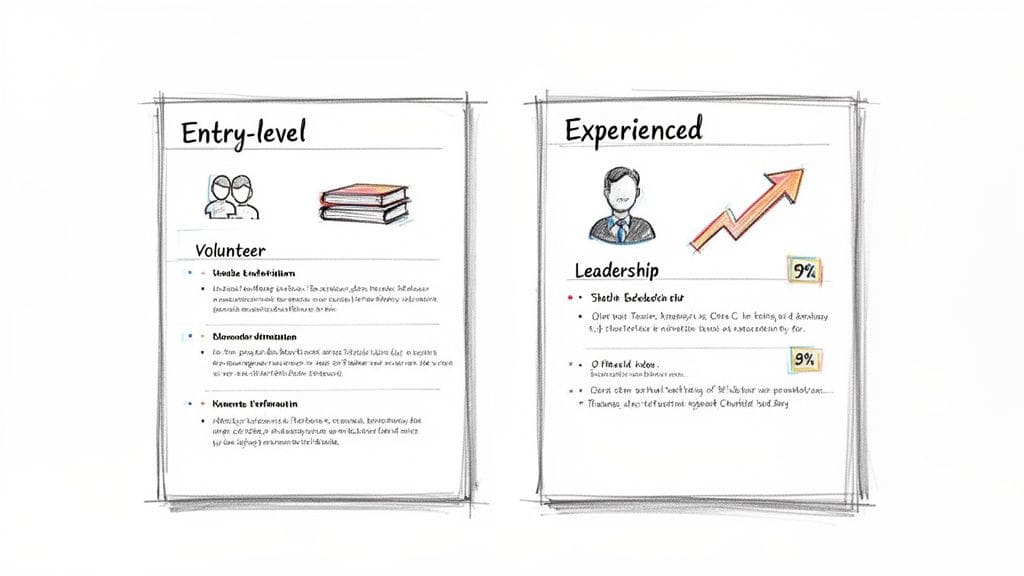
Example 1: Entry-Level Retail Resume
With no official retail experience, your resume is about potential. Prove you have core traits like customer service, reliability, and a can-do attitude by drawing from volunteer work or part-time jobs.
Why This Example Works:
- Laser-Focused Summary: It highlights transferable skills like communication and problem-solving.
- Action-Packed Experience: It uses powerful action verbs and numbers. "Assisted over 30 patrons per shift" is more concrete than "helped people."
- Relevant Skills: It features keywords like Cash Handling and Team Collaboration that ATS and hiring managers look for.
Example 2: Experienced Retail Associate Resume
With sales floor experience, your resume must shift from showing potential to proving impact. Focus on career growth, leadership, and hard numbers.
Why This Example Works:
- Achievement-First Summary: It opens with a bang: years of experience followed by a huge win (115% of sales goals).
- Metrics in Every Bullet: Each point connects a responsibility to a measurable result, like "Trained 5 new hires" or "Maintained 98% inventory accuracy."
- Specific Tech Skills: It names specific systems like Shopify POS and NetSuite, showing you can hit the ground running.
For more inspiration, check out these other professional resume examples.
Common Mistakes to Avoid on Your Retail Resume
Getting the details right can be the difference between a polished resume and one that gets ignored. Here are some common mistakes to avoid.
- Generic, Vague Language: Avoid phrases like "team player" or "hard worker" without providing proof. Instead of saying you are good with customers, show it: "Resolved 99% of customer issues at the first point of contact."
- Listing Only Duties: A resume is not a job description. Focus on your accomplishments, not just your responsibilities.
- One-Size-Fits-All Applications: Always tailor your resume to the specific job description. Use their keywords and highlight the skills they are asking for.
- Typos and Grammatical Errors: Proofread your resume multiple times. A single error can make you look unprofessional and careless.
Frequently Asked Questions (FAQ)
How long should a retail resume be?
One page. A single, focused page forces you to highlight only your most relevant accomplishments. The only exception is for very senior roles (e.g., Regional Director) with 10+ years of extensive leadership experience.
Do I need a cover letter for a retail job?
Yes. Even if it's optional, a cover letter is a huge opportunity to show genuine interest in the brand and explain why you're a great fit for their team culture. It proves you're willing to put in the extra effort.
What if I have no direct retail experience?
Focus on transferable skills from other jobs, volunteer work, or school projects. Highlight abilities like customer service, communication, teamwork, reliability, and problem-solving. Use your summary to show your excitement for learning the retail business.
How do I list my availability on a resume?
You don't. It's best not to put your specific hours on your resume. Including your availability adds clutter and could get you screened out prematurely. Save that conversation for the application form or the interview.
Ready to create a retail resume that truly stands out? The CV Anywhere Smart Builder crafts polished, ATS-friendly resumes in minutes, with AI-powered summaries and skill suggestions tailored to your target job. Stop guessing and start getting interviews. Try CV Anywhere for free today