The best resume templates for career change use a combination (or hybrid) format, which leads with a powerful summary and a dedicated skills section to highlight your transferable abilities. This strategic layout immediately shows hiring managers how your past experience is relevant to their open role, making it the most effective way to reframe your work history for a successful pivot. A well-chosen template helps you translate skills like project management or client relations into the language of your new industry, ensuring your resume gets past automated screening systems and captures a recruiter's attention.
Switching careers is a bold move, and your resume needs to be just as bold. A resume that just lists your past jobs in order won't cut it. In fact, it can actually hurt your chances. Why? Because a US hiring manager spending six seconds on your resume will see a list of seemingly irrelevant jobs and move on. That's where a strategic shift in your resume is non-negotiable. For a career pivot, your resume isn't just a history log; it's a marketing document designed to connect the dots for the recruiter. It has to clearly and quickly show them why your unique background is the perfect fit for their role, even if it's not obvious at first glance.

This document is a cornerstone of your new professional identity. It's one of the first and most critical steps in building a personal brand for your new career for your new field.
The New Rules for Career Changers
Let's face it: the "job for life" is a relic of the past. The modern career is all about movement and growth. In 2026, a massive number of US professionals are actively looking for new jobs, signaling a huge shift in how we view our career paths.
For anyone changing careers, this new reality means your resume has to work a lot harder. It needs to tell a compelling story about your future, not just your past.
This means your career change resume must accomplish a few key things:
- Spotlight Transferable Skills: It needs to immediately grab the reader's attention with skills like project management, data analysis, or client relations that are valuable everywhere.
- Downplay Irrelevant History: Your past roles are evidence, not the main event. The focus should be on the skills you gained, not the job titles you held.
- Build a Cohesive Narrative: It has to create a clear storyline that explains your pivot and demonstrates your genuine commitment to the new field.
- Get Past the Robots: The template and wording must be optimized for Applicant Tracking Systems (ATS) so a real person actually gets to see it. Our library of ATS-friendly resume templates is designed specifically for this.
A killer career change resume is your bridge from where you've been to where you're going. It convinces an employer that your diverse experience isn't a weakness—it's their secret weapon.
Choosing The Right Resume Format For Your Pivot
When you're switching careers, the structure of your resume is everything. It's the very foundation of your strategy. Sticking with the old-school chronological format can be a huge mistake—it just shines a spotlight on a work history that might look totally unrelated to where you want to go.
This is why picking the right format isn't just a small detail; it's the most important first step. For most people making a pivot, the combination or functional format is the clear winner. Why? Because it puts your transferable skills front and center, immediately showing a recruiter what you bring to the table.
This isn't just about looks; it's about controlling the story. You want a hiring manager's first thought to be, "Wow, this person has the skills we need," not, "Why is a former teacher applying for a project management job?" Your resume's format decides which story they read first.
The Three Core Resume Formats Unpacked
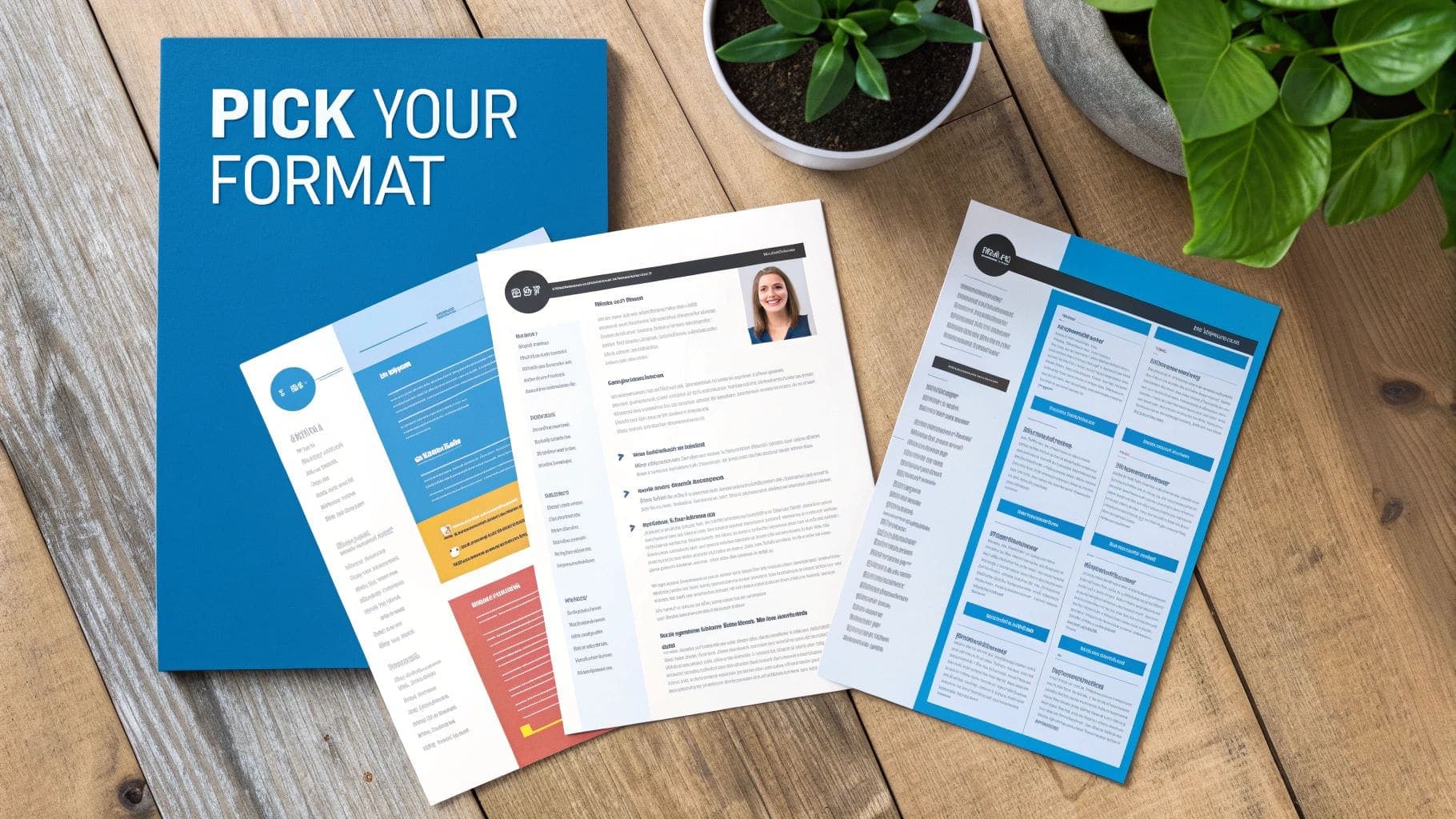
As a career changer, you've got three main formats to choose from. Each one tells a different story about your professional journey, and understanding their pros and cons is key to making the right call for your pivot.
1. The Chronological Resume
This is the classic format everyone knows. It lists your jobs in reverse-chronological order, starting with your most recent one.
- Who It's For: Professionals with a straight, predictable career path in one industry.
- Why It Fails for Changers: It leads with job titles and company names instead of your actual skills. If your past titles don't match the new role, your resume could be tossed aside in seconds.
For a career changer, this format basically forces you to lead with your biggest perceived weakness—a lack of direct experience. It puts all the pressure on the recruiter to connect the dots, and that's a gamble you can't afford to take.
2. The Functional Resume
This one completely flips the script. It focuses almost entirely on your skills, grouping your accomplishments under headings like "Project Management," "Client Relations," or "Data Analysis."
- Who It's For: Career changers with a ton of skill overlap but very different job titles, or anyone with employment gaps.
- Why It's a Strong Contender: It lets you showcase your most relevant abilities right at the top, immediately aligning your resume with the job description.
The only catch? Some recruiters get a little suspicious of this format because it can hide a candidate's work timeline. That potential downside is what makes our third option the go-to choice for most career changers.
Key Takeaway: While the functional format is a powerful way to highlight skills, it can sometimes raise red flags for hiring managers who want to see a clear work history. It's a bold move that pays off best when your past job titles are worlds away from your target role.
The Combination (Hybrid) Resume: Your Best Bet
The combination, or hybrid, resume gives you the perfect balance for a career change. It kicks off with a powerful skills summary section, then follows up with a streamlined chronological work history. You get the best of both worlds.
This is the structure that most modern resume templates for career change are built on. You can grab a recruiter's attention instantly with your most impressive transferable skills, but you also give them the clear work history they're expecting to see.
Here's why it works so well for a pivot:
- Skills First, Always: It leads with your strongest assets, showing the employer exactly what you can do for them.
- Provides Crucial Context: The work history section that follows offers the proof of where and when you honed those skills.
- Builds a Cohesive Narrative: It helps you tell a compelling story of intentional growth, connecting your past experiences to your future goals.
Imagine a marketing manager trying to move into product management. They could use a combination format to create a "Product & Strategy Skills" section right at the top, highlighting wins like, "Led cross-functional team to launch a new feature, resulting in a 15% user adoption increase." That powerful accomplishment is then backed up by their Marketing Manager role listed below, providing the context that makes it believable.
Choosing the right structure is a critical first step. For a deeper dive into each style, you can explore our complete guide to resume formats and figure out which one tells your story best. This decision sets the stage for everything that follows, from tailoring your content to beating the ATS bots.
Build a resume that actually gets interviews
Start from your current resume — or from scratch — with step-by-step guidance so you do not get stuck.
Free. No blank page. No templates to wrestle with.
How To Spotlight Your Transferable Skills
If you're changing careers, your past experience is a goldmine. The trick is knowing how to dig. Think of your transferable skills as the bridge connecting where you've been to where you want to go. Simply listing old job duties is the fastest way to get your resume tossed. You have to reframe your history and translate your accomplishments into the language of your new target role.
This means getting intentional. You need to identify, quantify, and showcase skills like project coordination, client relations, and data analysis so they resonate with your future boss. A powerful 'Professional Profile' or 'Skills Summary' right at the top of your resume isn't just nice to have; it's non-negotiable. It's your elevator pitch, packed with keywords from the job description to prove your value before a recruiter even glances at your work history.

Uncovering Your Hidden Assets
First things first: you need to do a skills audit. Don't just think about what you did. Focus on how you did it. A retail manager didn't just "manage a store." They handled complex logistics, trained and developed a team, analyzed sales data to forecast inventory, and delivered top-notch customer service under pressure.
These are the assets you need to excavate. Break down your previous roles into core competencies that apply anywhere.
- Project Coordination: Ever planned an event, rolled out a new process, or managed a task from start to finish with multiple moving parts? That's project coordination.
- Client & Stakeholder Management: Dealt with difficult customers, collaborated with other departments, or presented ideas to leadership? That's stakeholder management.
- Data Analysis: Tracked sales figures, monitored website traffic, or built budget spreadsheets? That's data analysis.
This shift in perspective is everything. It's how you build a resume that speaks to your future potential, not just your past job titles.
From Retail Manager To Tech Project Coordinator
Let's walk through a real-world example. Imagine a retail manager wants to pivot into a tech project coordinator role. Their old resume is probably filled with industry-specific bullet points.
Before:
- Managed daily store operations and staff scheduling.
- Handled customer complaints to ensure satisfaction.
- Oversaw inventory and ordering of new stock.
This language screams "retail." It does nothing to show they're ready for a tech environment. Now, let's translate those experiences into transferable skills for the new role.
After:
- Coordinated daily operational workflows for a team of 15, ensuring all project deadlines were met consistently.
- Served as the primary point of contact for client escalations, resolving 98% of issues within 24 hours.
- Analyzed sales data to forecast inventory needs, reducing overstock by 15% quarter-over-quarter.
See the difference? We swapped generic duties for action verbs relevant to project management (Coordinated, Analyzed) and added hard numbers. This reframing makes the experience instantly relevant.
Key Insight: Your goal isn't to hide your past career but to re-contextualize it. Show a hiring manager that while the "what" of your job was different, the "how" aligns perfectly with their needs.
The current US job market is seeing a huge wave of these pivots. For these competitive shifts, using the right resume templates for career change is critical, especially as resumes have grown to accommodate these more complex career stories.
Crafting A Powerful Skills Summary
Once you've identified and translated your skills, you need to put them front and center. A combination or functional resume format is perfect for this, as it lets you create a dedicated 'Skills Summary' or 'Professional Profile' section at the top.
Think of this section as your highlight reel. It should be a mix of hard skills (software, technical abilities) and soft skills (leadership, communication) that are pulled directly from the job description. For a deeper dive, check out our guide on the most impactful skills to add to your resume.
Here's a simple way to structure it:
- Start with a strong headline: "Marketing Professional Transitioning to Product Management" or "Client Relations Expert with a Passion for User Experience."
- Use 3-5 bullet points: Each bullet should showcase a key skill backed by a quantifiable achievement.
- Mirror job description language: If the posting asks for "agile methodologies" and you used a similar process in a past role, use that exact phrase.
This targeted approach ensures your resume immediately passes the recruiter's "six-second test" and convinces them to keep reading. By effectively spotlighting your transferable skills, you make it easy for them to see you as a capable and exciting candidate for the new role.
Customizing Your Template to Beat the Bots
Here's a hard truth: before a hiring manager ever sees your resume, a robot gets to it first. That robot is the Applicant Tracking System (ATS), and it's the digital gatekeeper of the modern hiring world. A staggering number of resumes get tossed into the digital void by these systems before a human even knows they exist. So, that visually stunning resume template you spent hours perfecting? It might be completely invisible to the bots.
This is a make-or-break moment in your job search. Your resume has to pull double duty—it needs to impress a human and speak the simple, direct language an ATS understands. This means focusing on clean formatting, standard fonts, and smart keyword use over funky design elements that just confuse the software.
The CV Anywhere Smart CV Builder is designed specifically for this challenge. It helps you build a resume that's clean, readable, and ready to get past the first hurdle.
A clean layout isn't just about looking good; it's about making sure the ATS can actually read and understand every part of your experience. That's the first step to getting shortlisted.
Formatting Do's and Don'ts for ATS Compliance
When it comes to the ATS, simplicity is your superpower. I've seen countless creative resumes with fancy graphics, columns, and tables get scrambled into nonsense by these systems. Your best bet is always a clean, single-column layout.
Here are the essential rules I tell every career changer:
- Do Use Standard Fonts: Stick to the classics like Arial, Calibri, or Times New Roman. They're universally recognized and won't cause any parsing issues.
- Don't Use Tables or Text Boxes: An ATS often reads tables line by line, left to right, turning your beautifully organized sections into a jumbled mess.
- Do Use Standard Section Headers: Call a spade a spade. Use clear, simple headings like "Work Experience," "Education," and "Skills." Avoid clever titles like "My Professional Journey" that the bots won't recognize.
- Don't Include Graphics or Logos: Images, charts, and personal logos are invisible to an ATS and can cause parsing errors that get your resume immediately rejected.
Your resume has two audiences: the bot and the human. To reach the second, you have to satisfy the first. Clean, simple formatting is the key that unlocks the door.
Weaving In Keywords Without Sounding Robotic
Once your format is clean, it's time to align your content with the job you want. The ATS is programmed to scan for specific keywords—skills, qualifications, and industry terms—that match the role description. A high keyword match score is what earns your resume a ticket to the human review pile.
Start by dissecting the job posting. Pull out the key skills and requirements you see mentioned over and over. Those are your golden keywords. For a deeper dive into this, you can learn how to optimize your resume for ATS with our specialized guide.
Your goal is to sprinkle these phrases naturally throughout your resume. They should feel at home in your professional summary, skills section, and especially in your work experience bullet points.
Before and After: A Real-World Example
Let's look at this in action. Here's a bullet point from a teacher's resume, before it was optimized for a corporate trainer position she was targeting.
Before (Not ATS-Friendly):
- "Created engaging lesson plans for a diverse group of 30+ students, fostering a positive classroom environment."
This is a great bullet point for a teaching job, but it's missing the corporate language an ATS would be hunting for in a training role.
Now, let's rework it for ATS compliance and keyword alignment, keeping the format simple and parsable.
After (ATS-Optimized):
- "Designed and delivered training programs and instructional materials for diverse audiences, improving learning engagement and knowledge retention."
See the difference? This version uses keyword phrases like "training programs" and "instructional materials," which are directly relevant to a corporate trainer role. It's a simple change, but it's the kind of tweak that makes a world of difference to an automated system. By making these small but critical adjustments to your resume templates for career change, you give your unique skills and experience a fighting chance to be seen by a human reader.
Telling Your Career Change Story With Impact
Your resume isn't just a list of jobs you've had. It's a marketing document, and right now, the product you're selling is your potential. This is even more true when you're changing careers. You have to build a bridge between where you've been and where you want to go.
The goal is to frame your unique background as a powerful asset, not a confusing detour. This means crafting a powerful summary that grabs a recruiter's attention and turning your past duties into achievements that prove your value—no matter the industry.
Crafting a Compelling Career Change Summary
A hiring manager sees your summary first. This is your prime real estate, your one chance to explain your pivot, connect your skills to the new role, and make your ambition clear. Don't waste it.
A knockout summary for a career changer needs to do three things, fast:
- State your pivot clearly: Get straight to the point. Something like, "Accomplished Hospitality Manager transitioning expertise in team leadership and client satisfaction to the tech industry as a Customer Success Manager."
- Highlight 2-3 key transferable skills: Pull the most important skills directly from the job description and showcase them with a quick, confident statement.
- Show your value proposition: Finish by declaring what you bring to the table and how it solves their specific problems.
This approach immediately answers the recruiter's biggest question: "Why is this person applying?" It turns potential confusion into a clear statement of intent.
From Vague Duties to Powerful Achievements
The real heart of your story is in your bullet points. Bland descriptions of your responsibilities will get your resume tossed in the 'no' pile. You have to translate every task into a tangible, quantified achievement. This is how you prove your skills deliver real results, regardless of where you learned them.
Think about the problems you solved, the value you created, or the processes you improved. Even if a task feels purely qualitative, there's almost always a way to measure its impact.
Pro Tip: I always tell people to use the "Problem-Action-Result" (PAR) framework. What Problem did you face? What Action did you take to solve it? And what was the measurable Result? This simple formula is a game-changer for turning a boring duty into a compelling achievement.
This strategy is absolutely crucial in today's job market. Many Americans are planning a complete career shift, chasing better pay, more flexibility, or a role in a growing field. You can read more about recent career change trends to see why a resume that screams "results" is no longer optional.
Transforming Your Experience in Practice
Let's make this real. The biggest struggle for career changers is seeing how a past role connects to a new one. It's all about translation. For more specific, industry-by-industry examples, check out our collection of successful career change resume examples.
To get you started, the table below shows how to reframe common responsibilities into achievement-driven bullet points that truly demonstrate your impact.
Transforming Responsibilities into Achievements
| Generic Responsibility | Impactful Achievement Bullet Point |
|---|---|
| Answered customer emails. | Managed a daily queue of 75+ customer inquiries, achieving a 95% satisfaction rating and reducing average response time by 30%. |
| Planned company events. | Orchestrated a 200-attendee corporate conference on a $15,000 budget, negotiating with vendors to save 10% on projected costs. |
| Managed social media accounts. | Grew social media engagement by 45% across three platforms in six months by implementing a data-driven content strategy. |
| Trained new employees. | Developed and led a new hire onboarding program that decreased ramp-up time for new team members by 25% within the first quarter. |
See the difference? By focusing on metrics, percentages, and tangible outcomes, you're not just listing tasks—you're building a powerful story of your success. You're proving your skills aren't just theoretical; they deliver real, measurable results. That's the story that gets you noticed.
Got Questions About Your Career Change Resume? We've Got Answers.
Pivoting your career is a huge step, and it's completely normal to have a dozen questions swirling around your head about your resume. How do you explain that gap year? Is a two-page resume career suicide? What on earth do you write when you have zero direct experience? It can feel like you're trying to solve a puzzle with half the pieces missing.
Let's clear up the confusion. We're going to tackle the most common worries career changers face, one by one. The goal is to turn those so-called "weaknesses" into genuine strengths, giving you the confidence to build a resume that opens doors. With the right strategy and a smart resume template for career change, these hurdles are smaller than they appear.
How Do I Handle an Employment Gap?
First, take a deep breath. Employment gaps are incredibly common, and by 2026, recruiters have seen it all. They're far more understanding than you might think. The absolute worst thing you can do is fudge the dates to try and hide it—that's a massive red flag and a quick way to get your resume tossed.
Honesty is the best policy, but make it strategic. Instead of leaving a blank space, frame that time off in a positive light. You can add a short, dedicated section like "Professional Development" or "Personal Sabbatical" to your resume.
Here's what you could include:
- Upskilling & Certifications: This is your best move. If you were taking courses or getting certified in your new target field, list them here. It shows you were actively and intentionally preparing for this exact pivot.
- Volunteer or Freelance Gigs: Did you take on any side projects? Any volunteer work? This is proof that you kept your skills sharp and stayed engaged professionally, even if you weren't in a full-time role.
- Personal Projects: Maybe you finally built that website you'd been dreaming of, managed a complex personal project (like a home renovation), or even got a small side hustle off the ground. All of this is valuable experience that demonstrates real-world initiative.
A functional or combination resume format works wonders here. It shifts the focus away from a strict, linear timeline and puts the spotlight right where you want it: on your skills and capabilities.
Is It Okay to Have a Two-Page Resume?
The old "one-page-only" rule is officially outdated, especially for experienced professionals making a career change. If you have over 10 years of experience that directly supports your career pivot, a two-page resume is not only acceptable but often necessary.
The most important rule is relevance, not length. Your resume should be as long as it needs to be to tell a compelling and relevant story, and not a word longer. Prioritize impact over brevity.
That said, you have to be strategic about it. All of your most critical, attention-grabbing information absolutely must live on the first page. Think professional summary, your most transferable skills, and your most relevant work experience. A recruiter should get the gist of who you are and what you offer in the first 15 seconds, without ever needing to flip to page two. Good resume templates for career change are designed with this in mind, offering two-page layouts that keep the most important info front and center.
What if I Have No Direct Experience in My New Field?
Welcome to the central challenge every career changer faces. The good news? It's completely solvable. Your entire goal is to prove that while you might not have the exact job title they're looking for, you absolutely have the skills and abilities to crush the role.
This is all about highlighting transferable skills and backing them up with quantifiable proof.
- Write a Killer Professional Summary: This is your secret weapon. Your summary is the very first thing a recruiter reads, so use it to state your career change goal directly. Connect the dots for them by explaining how your past accomplishments in one field directly translate to the needs of this new one.
- Showcase Relevant Projects: Dig up everything you've got—academic projects, volunteer work, personal endeavors—that relates to your new field. This isn't just filler; it's concrete evidence of your passion and your ability to do the work.
- Let the Job Description Be Your Guide: Print out the job description and grab a highlighter. Identify the key skills and responsibilities they're asking for. Now, go back through your entire work history and find every single instance where you've performed a similar function, even in a different context. For example, a teacher's "classroom management" is easily reframed as "stakeholder coordination and training" in a corporate environment.
Choosing the right resume template for a career change—especially a combination format—is non-negotiable here. It lets you lead with a powerful, dedicated skills section, proving your worth before a recruiter even glances at your past job titles.
Ready to put these strategies into action? The CV Anywhere Smart CV Builder is designed specifically to help career changers create powerful, ATS-friendly resumes that tell a compelling story. Start building your future-proof resume today.