How to Write a Job-Winning CV for Care Assistant
Learn how to write a job-winning cv for care assistant. This step-by-step guide includes examples, key skills, & ATS tips for UK care jobs. Start now.

You're probably looking at a blank document and wondering what a cv for care assistant should include, beyond “compassionate” and “hardworking”. From a recruiter’s side, the answer is simple. We want a CV that shows you can provide safe, person-centred care, follow procedure, communicate clearly, and document your work properly. The strongest care assistant CVs do that with clear structure, job-specific keywords, and bullet points that show impact rather than a list of routine duties.
Table of Contents
- The Essential Structure for a Care Assistant CV
- Writing a Compelling Personal Profile
- Showcasing Experience with Action-Oriented Bullet Points
- Essential Skills and Keywords for Your CV
- Formatting Your CV for Readability and ATS
- Common Mistakes That Weaken a Care Assistant CV
- Frequently Asked Questions for Care Assistant CVs
Is your CV actually getting responses?
Your CV might be missing something important
Upload your CV → see its weakest areas → fix them, one by one.
Free. Takes less than 2 minutes.
The Essential Structure for a Care Assistant CV
A care CV fails fast when the layout is chaotic. Recruiters in care settings often scan first, then read properly if the structure is sensible. If headings are clear and the order is familiar, your experience gets a fair chance.
Use a straightforward UK CV layout in reverse chronological order. Put the most relevant and recent information where it’s easy to find.
Contact details
Start with your full name, mobile number, professional email address, and location. Town and county are enough. You don’t need your full postal address.
If you drive and the role involves domiciliary care, add that clearly. If you have the right to work in the UK, you can include that too where relevant.
Personal profile
This sits at the top and acts as your opening pitch. Keep it short. A recruiter should understand your care setting, your strengths, and the type of role you’re targeting within a few lines.
Key skills
Use a compact skills section near the top. This helps both recruiters and ATS spot core terms such as safeguarding, personal care, mobility support, care plans, medication support, and record keeping.
Practical rule: If a hiring manager can’t see your main care skills within seconds, your CV is harder to shortlist than it needs to be.
Work experience
This is the section that carries the most weight. List each role with:
- Job title
- Employer name
- Location
- Employment dates
- Bullet points focused on actions and outcomes
For most applicants, this should sit above education. If you’re brand new to care and have limited work history, you can place education earlier.
Education
Keep this clean and factual. Include school, college, NVQ, diploma, or other relevant qualifications. Health and social care qualifications should be easy to spot.
Certifications and checks
This section is optional, but in practice it’s useful. Include items such as moving and handling training, safeguarding training, first aid, medication training, or an enhanced DBS check if you already hold one.
Don’t overstate compliance. If something is in progress, say that plainly.
Volunteering and additional information
Volunteering matters in care because it shows service, reliability, and comfort working with vulnerable people. This can be especially helpful if you’re moving into care from retail, hospitality, childcare, or family support roles.
If you want a broader guide to the full layout, this step-by-step guide on how to write a CV is a useful companion.
Writing a Compelling Personal Profile
Most care assistant profiles are too vague. They say the candidate is caring, enthusiastic, and passionate about helping others. That doesn’t separate you from the next applicant.
A strong profile tells me what kind of care work you’ve done, what you’re trusted with, and what sort of employer you want to join.
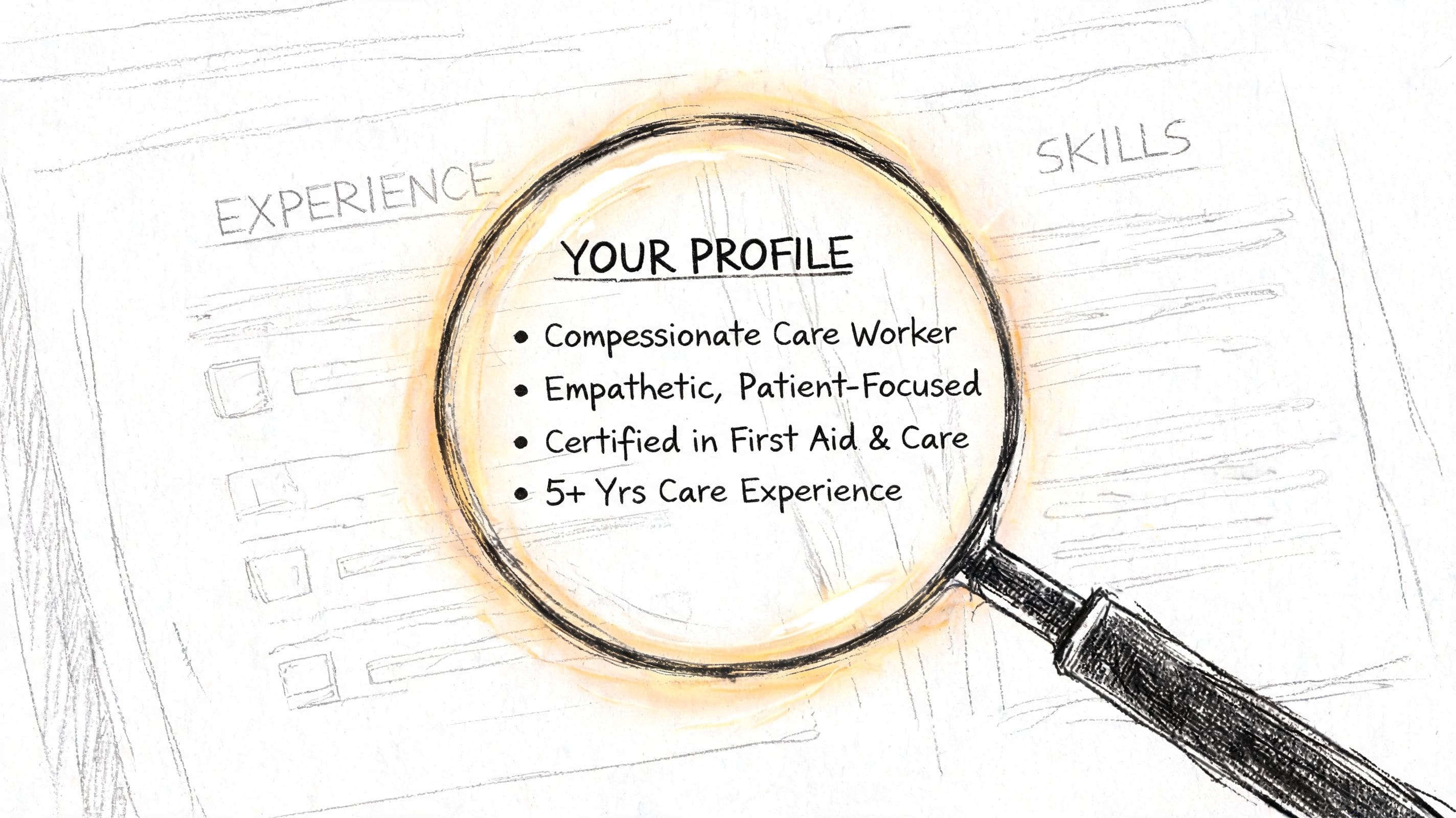
What a recruiter wants to see first
Your profile should answer three questions quickly:
- What role do you do
- What care environments or client groups do you know
- What value will you bring
That value can be practical. Safe personal care, accurate notes, calm communication with families, reliable attendance, or confidence following care plans.
A weak profile versus a strong one
Weak example
Caring and hardworking individual looking for a care assistant role. Good with people and able to work in a team. Passionate about helping others and making a difference.
This says almost nothing. It could belong to anyone.
Stronger example
Compassionate care assistant with experience supporting adults in residential and home care settings. Skilled in personal care, mobility support, record keeping, and building respectful relationships with residents and families. Known for staying calm under pressure and following care plans carefully. Seeking a care assistant role with a provider that values safe, person-centred care.
The second version gives a recruiter something to hold onto. It sounds like a real candidate, not a generic template.
A simple formula that works
Use this formula:
Job title + care setting or client group + key skills + professional value
For example:
- Entry-level applicant: Care-focused candidate with volunteering and customer-facing experience, confident supporting daily routines, communicating clearly, and working with patience and empathy.
- Experienced applicant: Care assistant with experience in dementia support and residential care, skilled in personal care, documentation, and safeguarding awareness.
Keep it to three or four sentences. Don’t list every skill you have. Don’t mention hobbies here. Don’t waste space saying references are available on request.
If you want more examples and wording options, this guide to a CV personal statement helps with profiles that sound specific rather than copied.
Showcasing Experience with Action-Oriented Bullet Points
The fastest way to weaken a care CV is to turn your experience section into a duty list. Recruiters already know a care assistant helps with washing, dressing, meals, and companionship. The key question is how well you did the job.
The best bullet points show judgement, consistency, and outcomes. They make routine work sound professional without exaggerating it.
Why duties alone don’t secure interviews
Compare these two bullets:
- Weak: Helped residents with personal care.
- Stronger: Supported residents with personal care in line with individual care plans, preserving dignity, choice, and comfort during daily routines.
The second version sounds more credible because it reflects how good care is delivered.
There are times when a measurable outcome makes your CV far stronger. One care assistant CV example highlights implementing personalised care plans that increased resident satisfaction by 20%, and that kind of evidence stands out because it aligns with person-centred care expectations under CQC standards, as shown in this care assistant CV example.
Recruiters don’t shortlist you for being near care. They shortlist you for what you improved, protected, supported, or handled well.
Using STAR without sounding robotic
You don’t need to write “Situation, Task, Action, Result” on the page. Just build each bullet around that logic.
A practical care example:
- Situation: A resident was becoming distressed during morning care.
- Task: You needed to complete support safely while maintaining dignity.
- Action: You adapted your approach, used calm communication, and followed the resident’s known preferences.
- Result: Care was completed more smoothly and the resident felt more settled.
Turn that into a bullet:
- Adapted personal care routines to reflect individual preferences and reduce distress, using calm communication and consistent support to maintain dignity.
That sounds natural, and it shows skill.
Examples for different care settings
Residential care
- Delivered person-centred support with washing, dressing, continence care, and meals, following individual care plans and reporting changes promptly.
- Maintained accurate daily notes, handover updates, and incident records to support safe continuity of care.
- Supported residents with mobility and transfers using correct moving and handling techniques.
Home care
- Provided one-to-one support in clients’ homes, helping with personal care, medication prompts, meal preparation, and household tasks.
- Built trusted relationships with clients and families through punctual visits, respectful communication, and reliable follow-through.
- Observed changes in presentation or routine and escalated concerns appropriately to senior staff.
Hospital or clinical support environment
- Assisted patients with hygiene, comfort, feeding, and movement while following ward routines and infection control procedures.
- Worked closely with nurses and wider staff to ensure timely updates on patient needs and wellbeing.
- Promoted a calm, reassuring environment for patients who were anxious, confused, or in discomfort.
If you have limited direct care experience
Use transferable evidence:
- Supported vulnerable customers with patience and clear communication in a public-facing role, resolving concerns calmly and respectfully.
- Managed detailed records and confidential information accurately in line with workplace procedures.
- Worked long shifts in a demanding environment, staying organised and responsive when priorities changed.
If you want more examples of bullet structure and wording, this article on stronger resume bullet points is useful even if you’re writing a UK CV. The principle is the same. Show action, context, and result.
Essential Skills and Keywords for Your CV
Many care employers use ATS or simple keyword screening before a recruiter reviews applications properly. That doesn’t mean you should stuff your CV with terms. It means your wording needs to match the role you’re applying for.
If a vacancy asks for personal care, safeguarding, manual handling, and communication, those terms should appear naturally in your CV where they are true.
What ATS is actually looking for
ATS usually isn’t “judging” your personality. It’s scanning for relevance. In care recruitment, that often means:
- Core care tasks
- Compliance-related terms
- Client group or setting
- Training and certifications
- Documentation and communication skills
If the advert says “care plans” and your CV says “helped residents every day”, you may have the experience but not the language match.
Key skills for a care assistant CV
| Hard Skills (Examples) | Soft Skills (Examples) |
|---|---|
| Personal care | Empathy |
| Moving and handling | Patience |
| Safeguarding awareness | Communication |
| Medication support | Reliability |
| Record keeping | Resilience |
| Care plan support | Teamwork |
| Infection control | Respect for dignity |
| Meal preparation | Adaptability |
| Mobility support | Calm under pressure |
| Observation and reporting | Professional boundaries |
Don’t dump this whole list into your CV. Select the skills that fit the vacancy and prove them in your experience section.
For roles involving medicine support, it’s worth understanding what safe practice looks like in everyday settings. These actionable medication management tips are useful background reading if you want to describe medication-related responsibilities more accurately.
How to pull keywords from the job advert
Read the advert once for meaning, then again with a pen. Mark the exact phrases used for:
- Client group such as elderly residents, adults with dementia, or people receiving home care
- Tasks such as personal care, repositioning, meal support, or recording observations
- Standards such as dignity, safeguarding, confidentiality, or person-centred care
- Requirements such as DBS, weekend availability, driver status, or mandatory training
Then place those terms in the right sections of your CV. Use them in your profile, skills, and bullet points where they are true.
One practical option is CV skills examples and keyword guidance. If you’re tailoring applications at scale, CV Anywhere’s Fit Checker can analyse a job description and flag match terms and missing skill language so you can adjust your wording before you apply.
Formatting Your CV for Readability and ATS
A badly formatted CV creates work for the recruiter. In care hiring, that usually means it gets skimmed, not studied. Clean formatting tells me you’re organised and understand professional standards.
The safest choice is a plain, structured document that reads well on screen and parses cleanly in ATS.
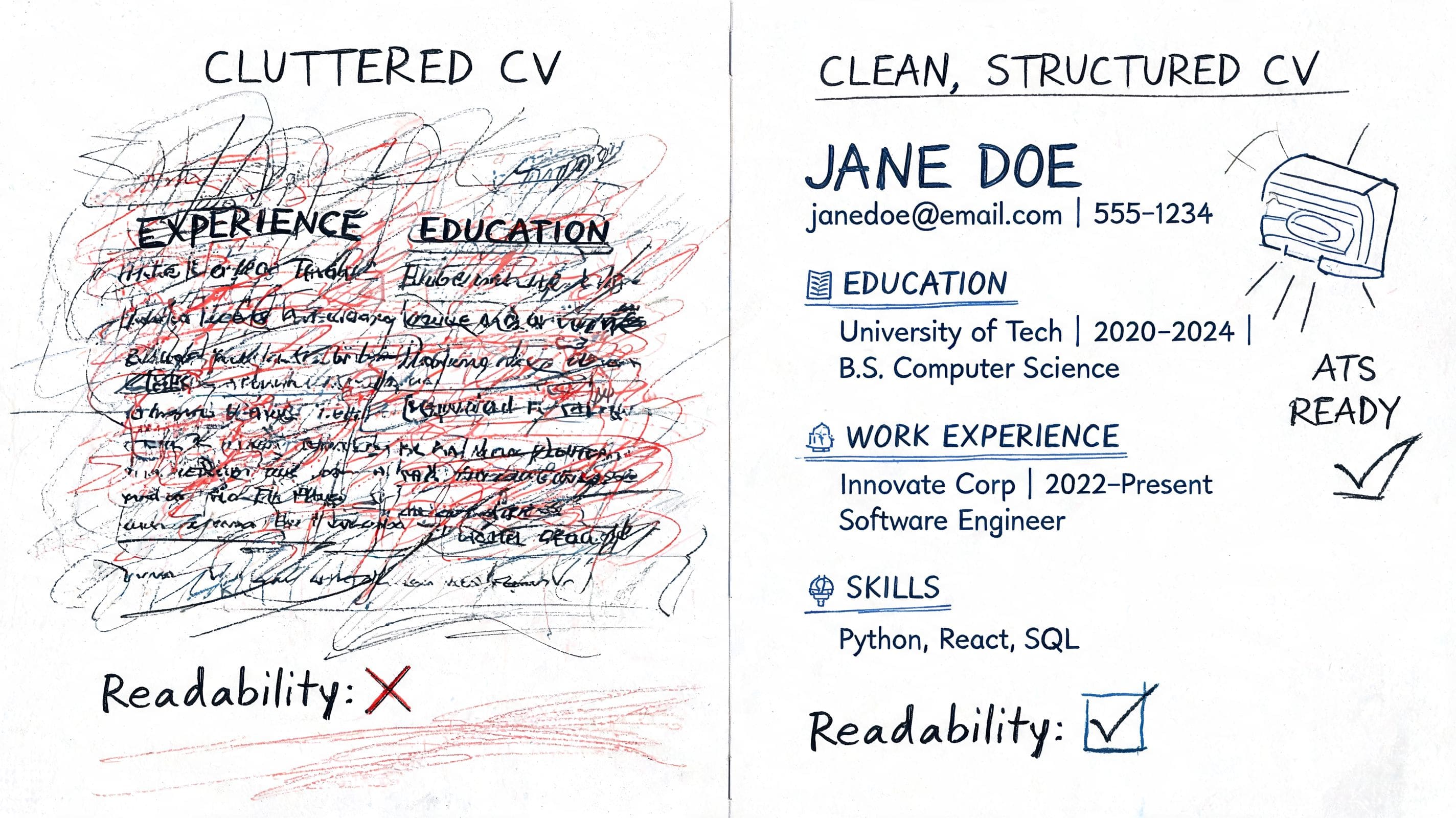
What clean formatting looks like
Use a standard font such as Arial, Calibri, or another simple sans serif or readable serif. Keep section headings obvious. Leave enough white space so the page doesn’t feel cramped.
Avoid text boxes, icons, rating bars, and multi-column layouts. They often look clever and read badly.
Readability test: If someone can’t find your last two jobs, key skills, and qualifications quickly, the design is getting in the way.
Formatting checklist
Do
- Use clear headings so each section is easy to scan
- Keep dates consistent with one format throughout
- Use bullet points for experience rather than dense paragraphs
- Save as PDF if the application method allows it
- Keep the layout simple so ATS can read it accurately
Don’t
- Use graphics for skills such as star ratings or progress bars
- Add a headshot unless specifically requested
- Shrink text to fit more in because it becomes tiring to read
- Overdecorate the page with colours, shapes, or visual effects
For a deeper guide to layout choices that work with screening systems, read this advice on creating an ATS-friendly CV in the UK.
Common Mistakes That Weaken a Care Assistant CV
I see the same problems repeatedly. Most aren’t about lack of experience. They’re about weak presentation.
Mistakes recruiters spot quickly
- Generic profiles that could apply to any job, not care work specifically
- Duty-heavy bullet points with no sign of judgement, responsibility, or quality
- Missing care language from the advert, which makes the CV look less relevant
- Spelling and grammar errors that suggest poor attention to detail
- Unclear employment dates that create avoidable questions
- Overclaiming training, checks, or responsibilities you can’t support at interview
A common assumption is that kindness alone sells a care application. It doesn’t. Kindness matters, but recruiters hire people who can combine compassion with safe practice, record keeping, and consistency.
What to do instead
Use plain, specific wording. Replace “helped clients” with the actual support you gave. Replace “good communicator” with examples of calm handovers, family updates, or accurate reporting.
Check your CV against the vacancy before you send it. If the role is in domiciliary care, make sure travel, lone working, punctuality, and home-based support appear where relevant. If it’s in a residential home, make sure care plans, teamwork, and shift-based care are visible.
A weak CV usually doesn’t fail because the applicant lacks value. It fails because the value is hidden under vague language.
Also remove anything that doesn’t help your case. Old unrelated roles can stay, but they don’t need six bullets each. Give more space to the work that supports your care application.
Frequently Asked Questions for Care Assistant CVs
How do I write a care assistant CV with no experience
Use transferable experience. Customer service, childcare, hospitality, community volunteering, family support, and support work all contain relevant skills if you describe them properly.
Focus on patience, communication, reliability, confidentiality, handling difficult situations calmly, and supporting people with dignity. If you’ve completed any training, place that prominently.
How long should a care assistant CV be
Usually one or two pages. If you’re early in your career, one full page can be enough. If you have several relevant care roles, two pages is normal.
Don’t stretch it with empty wording. Give the space to your most relevant experience.
Should I include a photo on my CV
No. In the UK, a photo usually isn’t needed for a care assistant CV. It takes up space and doesn’t help demonstrate your suitability.
Use that space for your profile, key skills, or a stronger experience section.
Should I mention a DBS check on my CV
Yes, if you already hold one or you’re on the update service. Put it in a certifications or additional information section and state it accurately.
If you don’t have one yet, don’t try to imply that you do. You can say you’re willing to complete the required DBS process.
If you want to turn rough notes into a clean, customized care assistant CV, CV Anywhere can help you build an ATS-friendly CV, compare it against a job description, and keep track of each application in one place.
Tags
Related articles
How to Write a Resume for a Job (Step-by-Step Guide)
Most CVs fail before their content gets a fair reading. Research analysing 125,000+ resumes found candidates include only 51% of relevant keywords from the job description, and 75% of resumes are reje...
Customer Service CV: A Step-by-Step Guide with Examples
Most customer service CVs don’t fail because the candidate lacks people skills. They fail because the document is hard for software to read and too vague for recruiters to trust. In the UK, 76% of CVs...
How to Write a CV Quickly: A 60-Minute Guide
You’re probably here because a job has landed in your inbox and you need to write a CV quickly without sending something sloppy. The good news is that speed isn’t the problem. Bad priorities are. A fa...
How to Improve My CV: A Step-by-Step UK Guide for 2026
If you're searching "improve my CV", you probably already know something's off. Your CV may look busy but say very little, or it may list plenty of duties without showing why anyone should interview y...
Popular Articles
Most CVs fail before their content gets a fair reading. Research analysing 125,000+ resumes found candidates include only 51% of relevant keywords from the job description, and 75% of resumes are reje...
Most customer service CVs don’t fail because the candidate lacks people skills. They fail because the document is hard for software to read and too vague for recruiters to trust. In the UK, 76% of CVs...
You’re probably here because a job has landed in your inbox and you need to write a CV quickly without sending something sloppy. The good news is that speed isn’t the problem. Bad priorities are. A fa...
If you're searching "improve my CV", you probably already know something's off. Your CV may look busy but say very little, or it may list plenty of duties without showing why anyone should interview y...