Recruiters spend just 6 to 8 seconds on the first pass of a CV, and the fastest way to improve your odds is to fix four things first: use a clean single-column layout, match your top skills to the job description, rewrite your summary to mirror the role, and run one final spelling check. If you're looking for last minute CV help, don't rewrite everything. Make surgical changes that improve readability and keyword match before you submit.
If you're applying tonight, the mistake is trying to perfect the whole document. A rushed full rewrite usually creates new problems. The smarter move is triage. Fix what gets scanned first, what gets parsed by ATS software, and what proves relevance quickly.
Your Emergency CV Action Plan
It is 9:10 p.m. You found a role worth applying for, the deadline is tonight, and your CV still reflects a different target job. Treat the next hour like triage, not a rewrite. The goal is to improve the parts that decide whether your CV gets read, parsed, and shortlisted.
Recruiters often scan fast on the first pass, and one live advert can attract 250 resumes, with 98% rejected outright (StandOut CV resume statistics). Under that kind of pressure, small fixes in the right places matter more than polishing every line.
Here is the fastest sequence I recommend when time is tight.
Set a 45 to 60 minute limit
Deadlines create bad editing decisions. A fixed limit stops you rewriting old roles that will not affect this application.Pull the job advert beside your CV
Highlight the repeated terms, core skills, and any required tools or qualifications. Those are the words your CV needs to reflect, especially near the top.Use AI for targeted fixes only
Ask it to compare your CV against the job description, spot missing keywords, tighten your summary, and suggest stronger metric-based bullets. Do not ask for a full rewrite unless your current CV is unusable. Full rewrites under pressure often add vague claims, wrong details, or a generic tone that sounds nothing like you.Prioritise the top third of page one
Name, contact details, title, summary, and your most relevant recent experience usually decide whether a recruiter keeps reading. Get those right first.Replace weak bullets with proof
One bullet with a result is worth three bullets listing duties. If you cannot add exact numbers yet, add scope, speed, size, or frequency.Leave lower-value edits until last
Old roles, formatting preferences, and minor wording changes can wait if the deadline is close.
A rushed CV fails for predictable reasons. It aims too broadly, buries the match to the role, and wastes time on sections that do not change the outcome. Good last-minute CV help is selective. You are improving relevance, clarity, and evidence fast enough to submit with confidence.
If you need a quick check against UK hiring norms, 8 Essential UK CV Writing Tips is a useful reference. If you already keep a base CV, this quick CV method helps you tailor the right sections quickly instead of starting again.
Is your CV actually getting responses?
Your CV might be missing something important
Upload your CV → see its weakest areas → fix them, one by one.
Free. Takes less than 2 minutes.
Instantly Improve Your CV Layout and Readability
The first ten minutes should go into presentation. Before anyone reads your experience, your format tells them whether your CV will be easy to process.
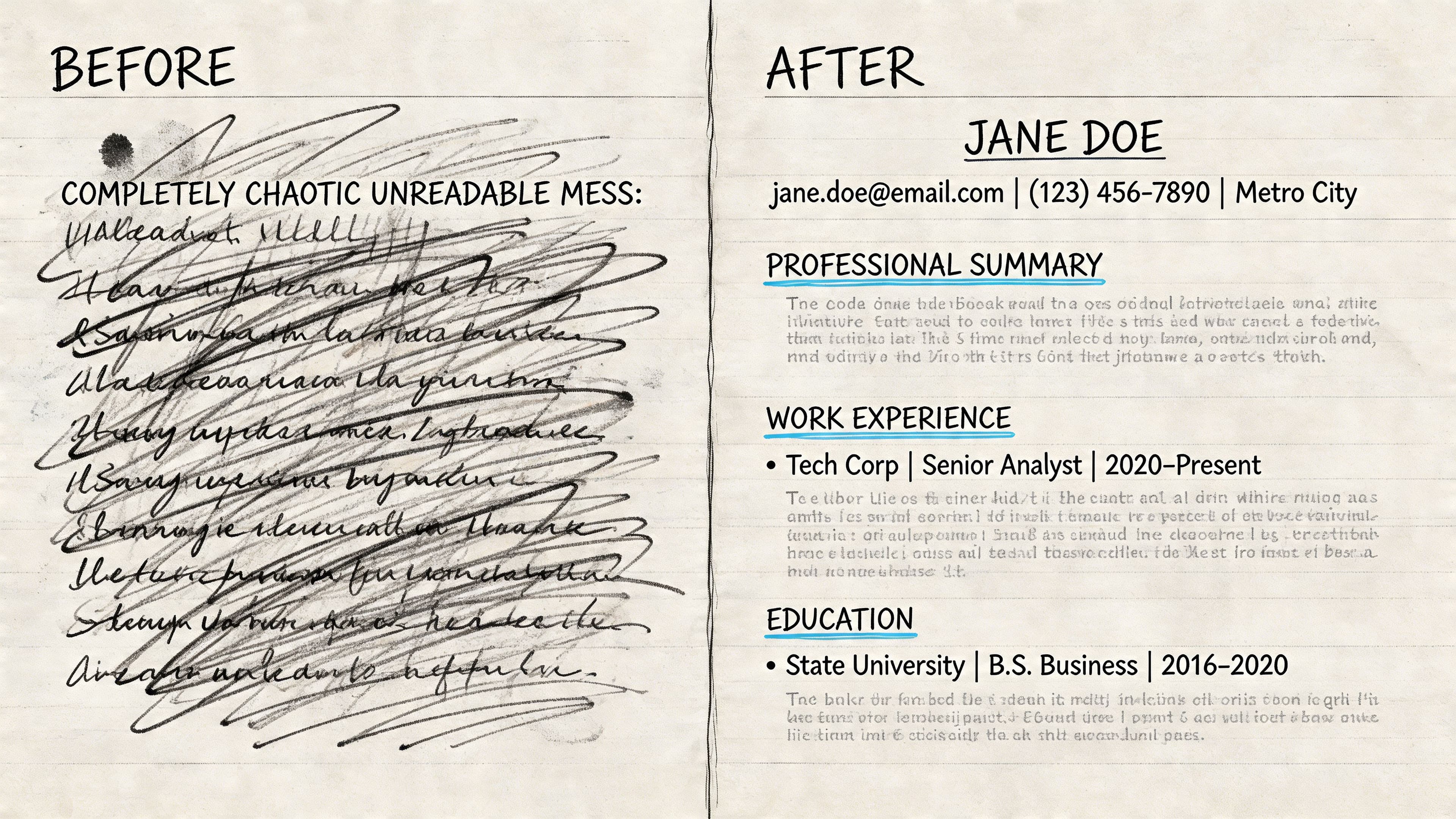
A messy CV usually has the same problems: multiple columns, odd text boxes, weak section headings, crowded bullet points, and too many visual extras. These choices slow human readers down and can also confuse applicant tracking systems.
What to remove immediately
Photos and logos
They take up space and add no value for most UK job applications.Tables and text boxes
They often break parsing and make content harder to extract.Decorative graphics
Skill bars, icons, and coloured shapes rarely help. They often distract.Tiny fonts
If you had to shrink the text to fit everything in, the content needs editing, not the font.
What to standardise
Use one professional font throughout, such as Arial or Calibri. Make section headings bold and obvious. Keep job titles, employers, and dates aligned in a consistent pattern. If your bullets are full sentences in one role and fragments in another, choose one style and make it consistent.
A simple layout should include:
| Section | What it should do |
|---|---|
| Contact details | Let the recruiter reach you quickly |
| Professional summary | Show fit for this specific role |
| Core skills | Surface relevant keywords fast |
| Work experience | Prove impact and relevance |
| Education and certifications | Support suitability without taking over the page |
A recruiter should be able to identify your target role, recent experience, and strongest skills within seconds.
If your formatting needs more than a quick clean-up, use an ATS-friendly template rather than trying to rebuild the document manually. A resume layout guide is helpful here because it shows what to keep and what to strip out before submission.
Align Your CV with the Job Description in Minutes
You have 40 minutes left before the deadline. This is not the moment for a full rewrite. The fastest win is to align your CV with the advert so the right terms appear in the right places.
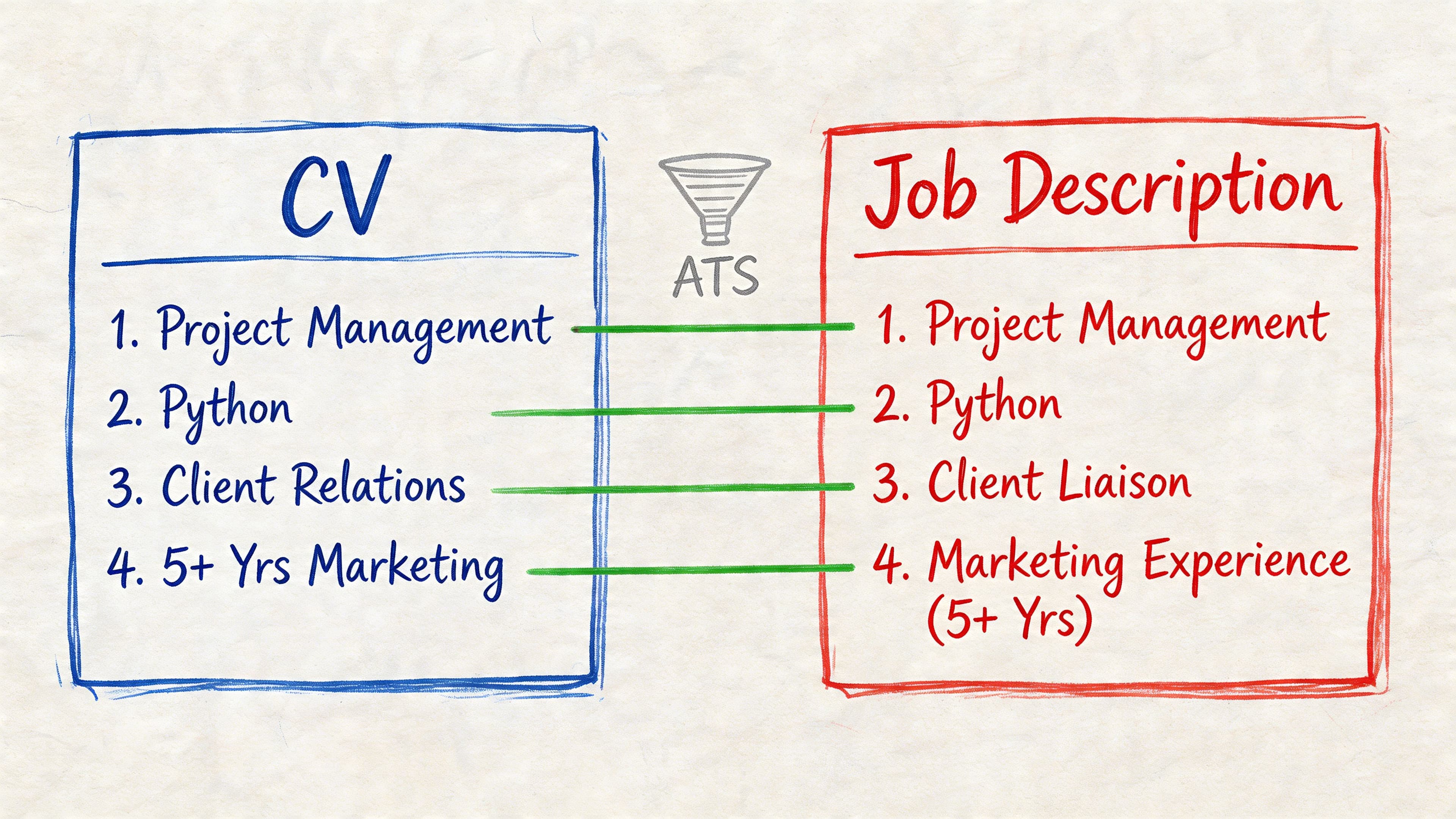
ATS screening is blunt. Recruiters are under time pressure too. If your CV uses different language from the job description, even when your experience fits, that fit can be missed. Matching your CV title to the target role can materially improve response rates, with one analysis reporting up to a 3.5x increase in interviews when the title alignment is accurate (how to tailor a resume to a job description).
Manual matching versus faster matching
When I review rushed CVs, I usually see two failure points. The first is vague wording that never matches the advert closely enough. The second is forced keyword stuffing that reads badly and creates obvious credibility problems.
The right approach sits between those extremes.
| Approach | What you do | Trade-off |
|---|---|---|
| Manual method | Mark repeated skills, tools, responsibilities, and phrasing in the job advert, then mirror the relevant language in your CV | More precise, but slower |
| AI-assisted method | Paste the job description and CV into a checker to spot missing terms, then edit only the gaps that matter | Faster, but needs judgement to keep the wording truthful |
The fastest way to tailor well
Start by scanning the advert for repeated language in four places:
- Core skills such as stakeholder management, forecasting, project coordination
- Tools and systems named explicitly
- Seniority signals such as assistant, manager, lead, specialist
- Context words such as regulated, customer-facing, cross-functional, fast-paced
Then make surgical edits. Do not try to touch every line.
Target title
Use the job title, or the closest accurate version of it, near the top of the CV.Core skills section
Move the most relevant terms up. Cut lower-value skills that do not help with this role.Recent experience bullets
Replace generic verbs and broad phrases with wording that reflects the advert, as long as it matches work you did.Top third of the page
Prioritise the summary, latest role, and skills list first. Those areas do most of the work in a rushed application.
A quick example. If the advert asks for "client onboarding, CRM accuracy, and cross-functional coordination", do not leave your CV saying "helped customers", "updated systems", and "worked with different teams". Tighten the language so the match is visible.
Match the employer's terminology where it is true. Invent nothing. A close, honest match beats a broad, impressive-sounding one.
If you use AI here, use it for triage, not autopilot. A tool like CV Anywhere's JD Fit Checker can help identify likely keyword gaps in seconds. Your job is to decide which ones belong, then rewrite only the lines that affect fit most.
Craft a High-Impact Professional Summary Fast
You have about 30 minutes left, your work history is a bit mixed, and the top of your CV still says nothing specific. Fix the summary first. It is one of the few places where you can explain fit fast, especially if your experience does not line up neatly on paper.
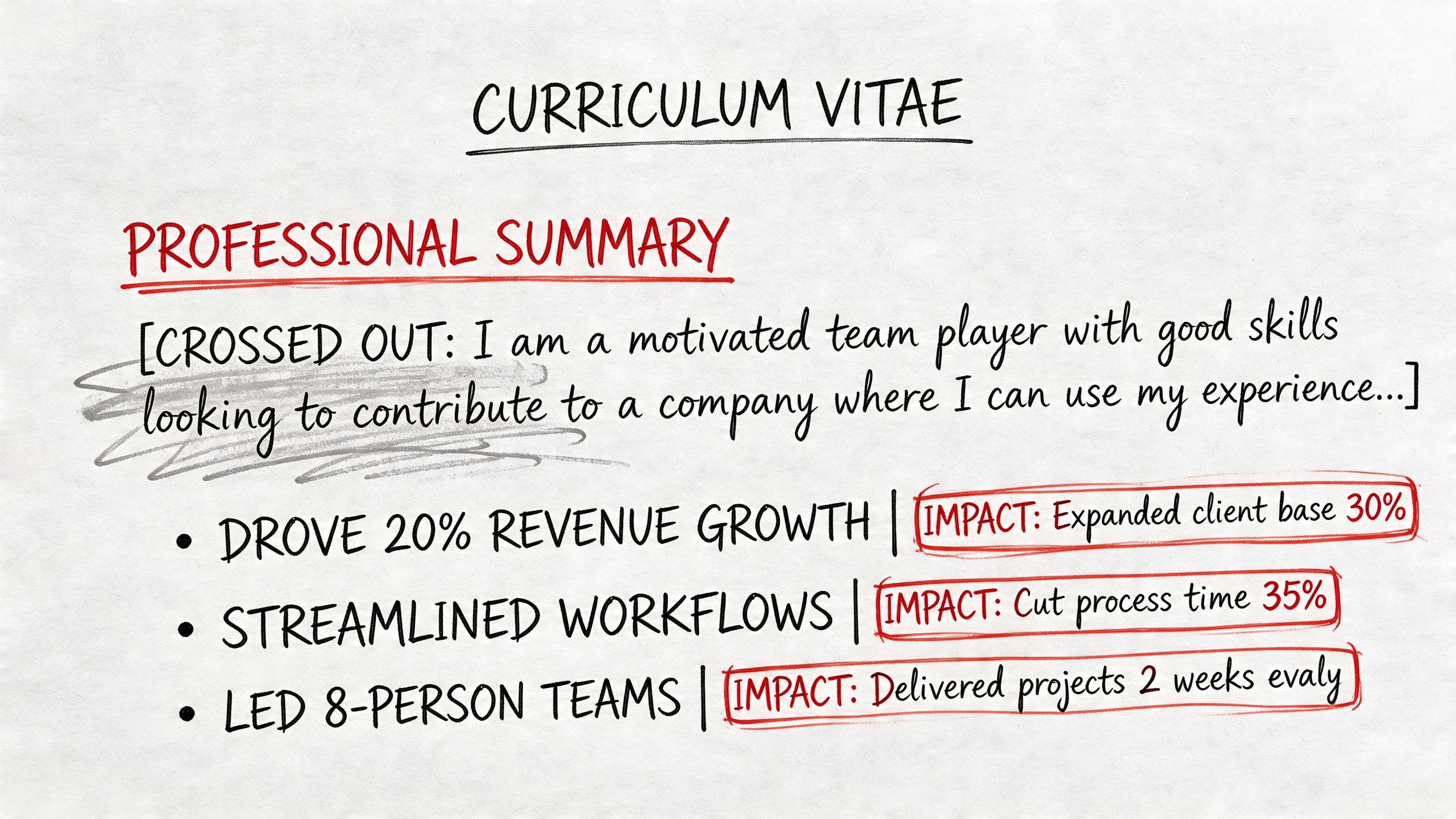
Hiring managers spend less than 7.4 seconds scanning a CV, according to ATS-friendly narrative advice from CV Anywhere. Under that kind of time pressure, a clear summary helps them place you quickly. It gives context to the rest of the page and stops a scattered background from reading like a mismatch.
A weak summary usually sounds like this:
Weak summary
Motivated professional with strong communication skills looking for a new opportunity to grow and contribute to a successful organisation.
It says nothing about role, level, or evidence.
A stronger version does three jobs at once:
Stronger summary
Customer-focused sales professional with experience in client relationships, product education, and CRM-based pipeline management, now targeting entry-level customer success roles. Brings experience handling objections, supporting retention, and turning customer needs into clear next steps.
That works because it names the candidate's current value, shows the target role, and explains the pivot without wasting space.
For last minute CV help, use a simple three-part structure:
Professional identity
Your current role or closest relevant profileRelevant strengths
Two or three skills tied to the vacancyFit statement
One line that explains why your background makes sense for this job
Keep it to three or four lines. Longer summaries usually turn into repetition.
If you are using AI, use it as an editor, not a writer. Paste in the job advert, your current summary, and your last two roles. Ask for three rewritten versions that keep your facts, match the role language, and stay under 60 words. Then choose the one that sounds true and specific. This is triage. The goal is not a polished career autobiography. The goal is to make the top of the CV credible within minutes.
If you are stuck, answer these four prompts in short phrases, then turn them into sentences:
- What role am I applying for?
- Which parts of my background transfer directly?
- Which skills from the advert can I honestly claim?
- What is the shortest honest explanation for any career pivot?
If your experience looks uneven, the summary is where you explain it cleanly. For extra examples and phrasing patterns, use this guide to writing a strong resume summary.
Quickly Add Metrics That Get You Noticed
With limited time, focus on the bullets that will carry the decision. Usually that means three to five bullets from your most recent or most relevant role.
Quantified achievements tend to perform better with recruiters. In one set of resume statistics on quantified achievements from High5, CVs with hard metrics and quantified achievements achieved approximately 40% higher interview rates. The reason is simple. Numbers show scale fast.
Use a fast rewrite formula:
Action verb + task + measurable result
The measurable part does not have to be revenue. Under time pressure, pull numbers from any of these:
Volume
Number of customers, calls, tickets, orders, accounts, or projectsSpeed
Turnaround time, response time, delivery time, or deadlines hitScope
Team size, locations covered, budget handled, systems managed, or campaign reachChange Increased, reduced, improved, optimised, launched, trained, or resolved
Here is what a quick upgrade looks like.
Admin role
Managed calendars and meetings
Improved: Coordinated diaries, meetings, and travel for 4 senior managers, helping the team maintain full weekly schedules and hit priority deadlinesRetail role
Helped customers and handled sales
Improved: Served 60 plus customers per shift, processed transactions accurately, and supported peak trading periods while maintaining service standardsGraduate marketing role
Wrote social media content
Improved: Produced 3 to 5 social posts per week across multiple channels, supporting regular publishing and consistent brand messaging
Do not make numbers up. If you cannot verify a figure, use frequency, range, scope, or ownership instead. "Supported a team of 12" is stronger than "responsible for team support." "Handled 30 to 40 enquiries a day" is better than "managed enquiries."
AI can speed this up if you give it the right inputs. Paste in your current bullets and ask it to rewrite only the ones tied to the target role, adding measurable detail based on scale, frequency, deadlines, or outcomes without inventing facts. Then check every line against what you can defend in an interview.
If you need ideas, these examples of accomplishments for a resume are useful for turning duties into evidence fast.
The Final Checklist Before You Hit Send
The last five minutes matter because avoidable mistakes still undo strong edits.
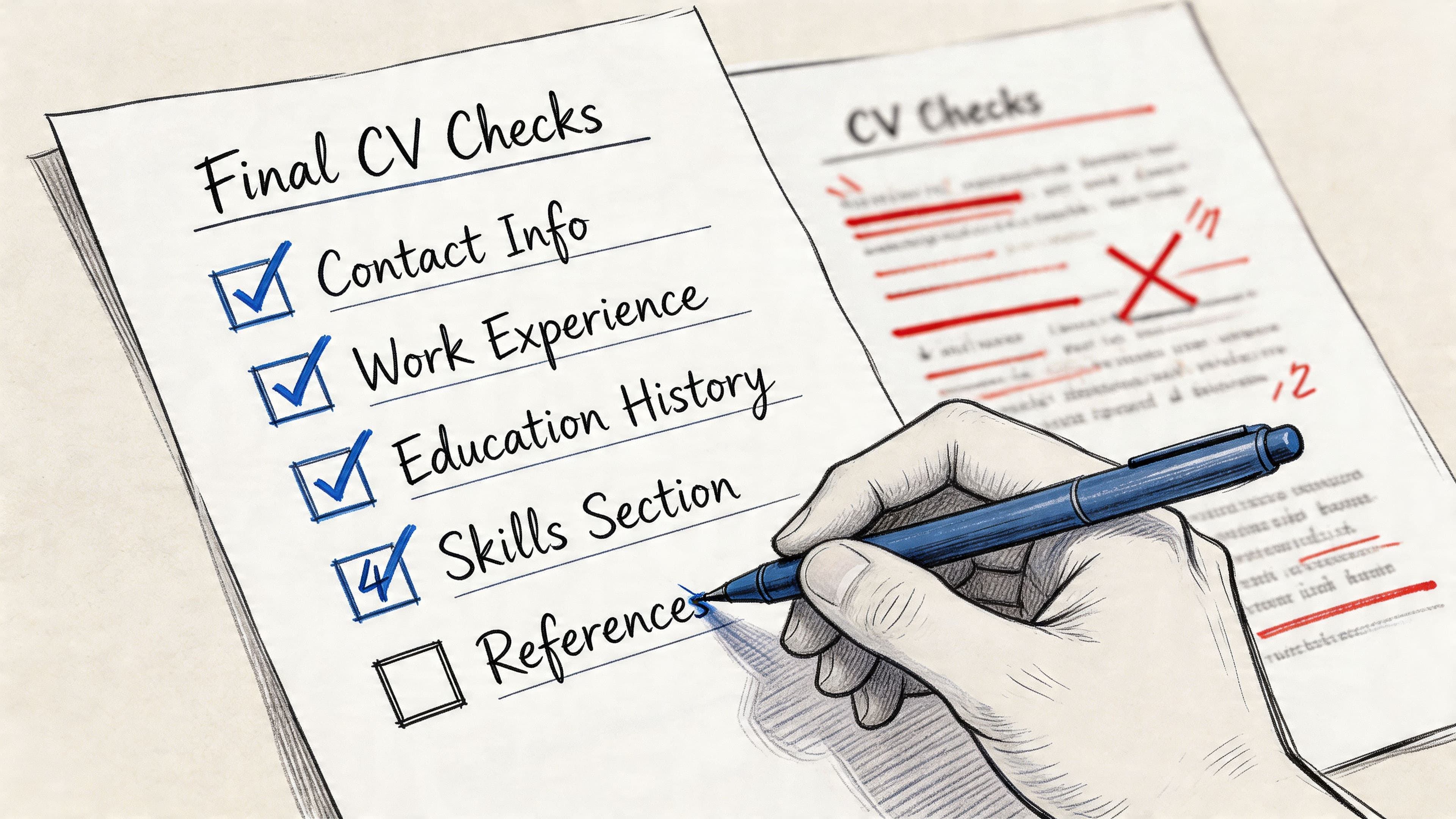
Read the CV once for meaning and once for errors. Those are two different checks. The first catches awkward wording. The second catches spelling, punctuation, date mismatches, and formatting slips.
Your pre-send check
Contact details
Make sure your phone number, email, and LinkedIn link work and are currentFile format
Save as PDF so the layout stays intactFile name
Use a professional name such as Firstname-Surname-CV-CompanyDates and titles
Check that nothing overlaps incorrectly and every role is labelled consistentlySpelling and grammar
Use a checker, then read it aloud once
One more point. If the employer asks for a cover letter, send one. If it's optional and you have time for a short personalized note, it's still worth doing. Keep it brief and specific.
Frequently Asked Questions About Last Minute CVs
How long should a last-minute CV be?
Keep it tight. For most candidates, two pages is a sensible maximum. If you're early in your career, one strong page can be enough. The test is simple. If a section doesn't help you get this interview, cut it.
Should I still send a cover letter if I'm short on time?
Yes, if the role asks for one. If it doesn't, a short customized note can still help. It doesn't need to be long. It does need to match the role.
What's the biggest mistake in a rushed application?
Sending a generic CV with obvious errors. Poor tailoring and typos are the combination that hurts most. A shorter, cleaner document that matches the job is better than a detailed one that misses the point.
Can AI help with a last-minute CV?
Yes, if you use it for diagnosis and editing rather than blind copy-paste. A tool such as the AI Resume Checker can help you spot weak phrasing and missed issues quickly, but you still need to make sure the final wording sounds like you and reflects your real experience.
What if my background doesn't match perfectly?
Then your summary and bullet selection matter more. Focus on transferable skills, relevant projects, and a clear explanation of why your experience fits this role now.
If you need to go from rough draft to submission-ready quickly, CV Anywhere combines CV building, job description matching, and application tracking in one place so you can edit the right parts fast and keep your applications organised.