No Experience Cover Letter Guide with UK Examples 2026
No experience cover letter - Need to write a no experience cover letter? Our UK-focused guide gives you a step-by-step structure, examples, and templates to

You’re likely staring at a job advert thinking the same thing most first-time applicants think: “I match the attitude, I match the interest, but I don’t have the experience.” A no experience cover letter solves exactly that problem. It gives you space to turn university work, volunteering, part-time jobs, society roles, and personal projects into evidence that you can do the role.
The formula is simple. Open with why this job and this employer. Prove relevant skills with specific examples from non-work experience. Close with a confident next step. That approach matters because 78% of UK recruiters said a well-crafted cover letter significantly influences shortlisting for entry-level roles, even when no professional experience appears on the CV, according to a 2025 Reed.co.uk survey cited in CV Anywhere’s cover letter guide.
Table of Contents
- How to Write a Cover Letter with No Experience
- The Core Structure of a Winning No Experience Cover Letter
- Finding Your 'Experience' When You Have None
- No Experience Cover Letter Examples for Different Scenarios
- How to Tailor Your Letter to Any Job Description
- Common Mistakes That Instantly Disqualify Your Application
- Frequently Asked Questions
Is your resume actually getting responses?
Your resume might be missing something important
Upload your resume → see its weakest areas → fix them, one by one.
Free. Takes less than 2 minutes.
How to Write a Cover Letter with No Experience
A strong no experience cover letter doesn’t try to hide your lack of direct employment. It replaces it with proof of potential. That means showing how your studies, extracurricular work, volunteering, placements, freelance tasks, or self-directed projects match what the employer needs.
Use a simple three-part structure:
- Hook. Say which role you want, why you’re applying, and what makes you a credible early-career candidate.
- Evidence. Pick two or three examples that prove useful skills such as organisation, communication, teamwork, research, customer service, analysis, or initiative.
- Call to action. End with interest, professionalism, and a clear invitation to discuss your application.
Practical rule: Never write “I know I lack experience, but…”. Start with value, not apology.
In the UK market, this matters because recruiters often use cover letters to judge motivation and communication when a CV is still light on formal experience. If your CV is thin, your letter has to do more heavy lifting.
Keep the tone professional, direct, and specific. You’re not trying to sound experienced. You’re trying to sound ready.
The Core Structure of a Winning No Experience Cover Letter
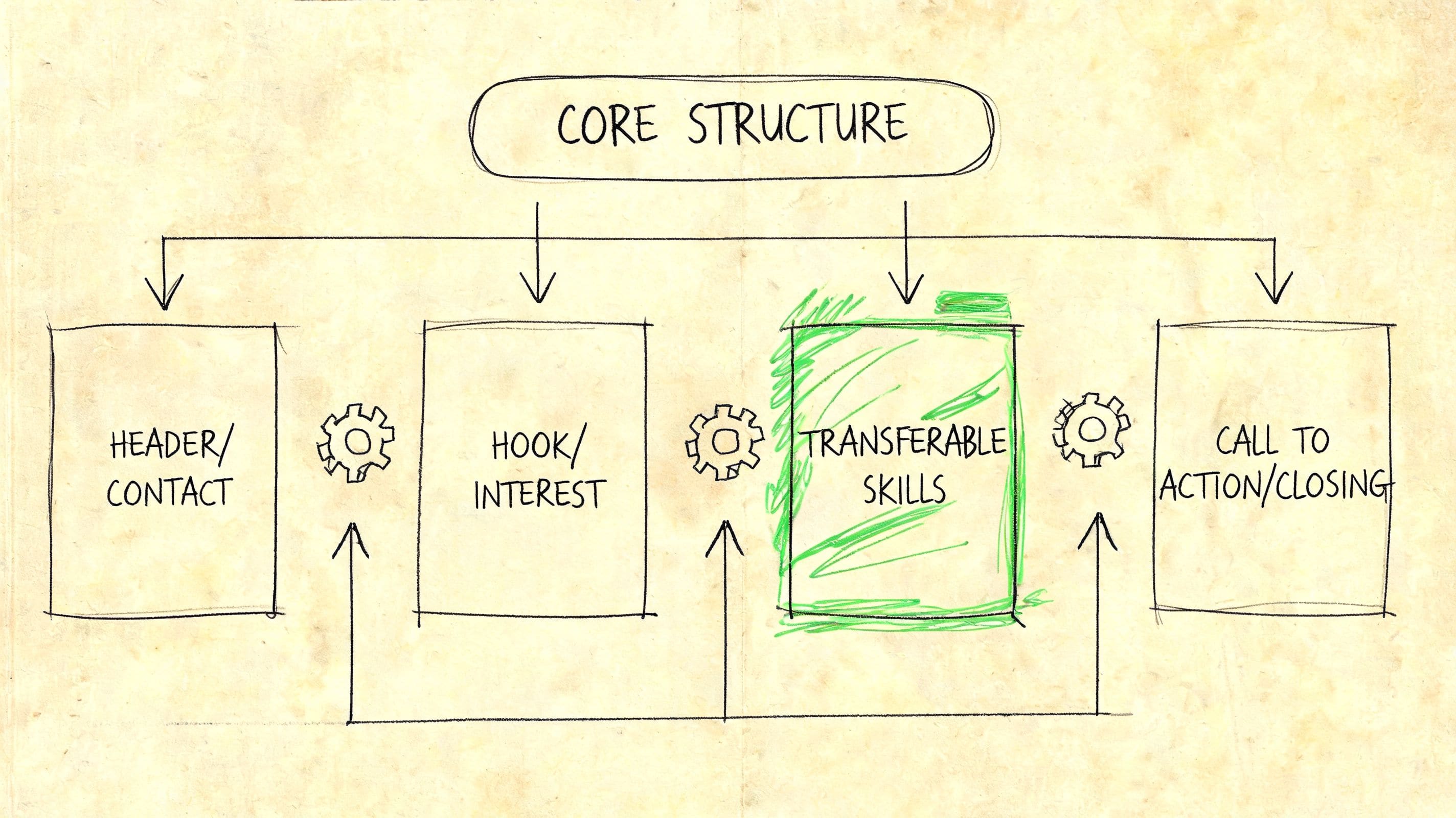
Most weak cover letters fail for one of two reasons. They either repeat the CV, or they ramble about enthusiasm without proof. A winning letter is tighter than that. It has four parts: header, opening, body, and closing.
If you need a layout reference for the page itself, use a standard UK business letter format like the one shown in this guide to cover letter formatting for job applications.
Start with a focused opening
Your opening paragraph should do three jobs in a few lines:
- Name the role you’re applying for
- Show genuine interest in the employer or sector
- Signal relevance even without direct experience
A clean template looks like this:
Dear Hiring Manager, I am applying for the Graduate Operations Assistant role at [Company]. As a recent [degree] graduate with experience leading university projects and coordinating volunteer activity, I’m drawn to this position because it combines organisation, teamwork, and client-facing communication.
That works because it doesn’t waste space on generic statements like “I am writing to express my interest”. Recruiters already know why you’re writing. Use the first lines to place yourself in the role.
A stronger opening also sounds customized. Mention a team, project area, service, or company value if it’s truly relevant. One concrete detail beats three vague compliments.
Build the middle around proof
The body is where most applicants lose control. They list soft skills with no evidence. Don’t write “I am hardworking, motivated and a great team player” unless you’re immediately proving it.
Use a Claim, Example, Result pattern.
| Part | What to write | Weak version | Stronger version |
|---|---|---|---|
| Claim | Name the skill | “I have leadership skills.” | “I’ve built leadership and coordination skills through academic and extracurricular work.” |
| Example | Give a real example | “I led a group project.” | “In my final-year module, I coordinated a four-person research project, set deadlines, and divided tasks.” |
| Result | Show outcome or value | “It went well.” | “We submitted ahead of schedule and delivered a presentation that was praised for clarity and structure.” |
Use that pattern for two body paragraphs. That’s enough for most entry-level applications.
Here are useful evidence areas for a no experience cover letter:
- University projects. Good for research, teamwork, presenting, time management, analysis.
- Volunteering. Good for initiative, reliability, service, organisation, empathy.
- Part-time work. Good for customer service, problem-solving, pace, professionalism.
- Societies and committees. Good for event planning, coordination, communication, leadership.
- Personal projects. Good for self-direction, technical learning, creativity, consistency.
A recruiter doesn’t need you to have done the exact job before. They need to see that you’ve done work that demanded similar behaviours.
One reason this section matters so much is that strong letters can compensate for a weaker CV. 83% of hiring managers report that a strong cover letter can earn an interview even when a CV appears insufficient on its own, according to Resume Genius cover letter statistics.
Close like someone worth interviewing
The final paragraph shouldn’t fade out. It should reinforce fit and ask for the next step without sounding pushy.
Use a closing like this:
I’d welcome the opportunity to discuss how my academic project work, volunteering experience, and strong interest in [field] would allow me to contribute to your team. Thank you for your time and consideration. I look forward to hearing from you.
Keep these UK sign-off rules in mind:
- Use “Yours sincerely” if you’ve addressed a named person.
- Use “Yours faithfully” if you’ve used “Dear Hiring Manager”.
A simple structure you can copy
If you want a quick drafting formula, use this:
- Paragraph 1. Role, employer, reason for applying
- Paragraph 2. First proof example linked to job needs
- Paragraph 3. Second proof example plus motivation
- Paragraph 4. Confident close and sign-off
That’s the core. Short enough to read. Specific enough to matter. Professional enough to submit.
Finding Your 'Experience' When You Have None
The biggest mental block isn’t writing. It’s believing you have nothing worth writing about. That’s usually false. Most early-career applicants have experience. They just don’t recognise it because it wasn’t paid, full-time, or listed under a formal job title.
In UK graduate hiring, applicants who include cover letters tend to progress to interviews more often than those who don’t. That’s because the letter gives you room to explain the value of non-work evidence. If you’re building that evidence, it helps to think beyond your CV and look at the wider picture of your background, including academic and informal work, as outlined in this guide on how to write a resume with no experience.
Translate activities into employer language
Recruiters don’t hire “someone who helped at events” or “someone who likes design”. They hire for outcomes and behaviours. Your job is to translate the raw activity into professional language.
Here’s what that sounds like in practice.
You didn’t just “do a group assignment”. You:
- coordinated work across a team
- managed deadlines
- presented findings clearly
- solved disagreements
- delivered a shared outcome
You didn’t just “help at a charity shop”. You:
- supported customers
- handled competing tasks
- maintained standards
- worked reliably in a service environment
You didn’t just “run an Instagram page for your society”. You:
- created content to a schedule
- adapted messaging for an audience
- tracked engagement patterns
- supported event promotion
That translation is what makes a no experience cover letter believable.
What counts as usable evidence
You want evidence that shows effort, responsibility, or results. It doesn’t need to come from a formal office role.
Good sources include:
- Coursework and dissertations if they involved research, data, writing, analysis, teamwork, or presenting
- Volunteering if you dealt with people, schedules, logistics, outreach, or admin
- Part-time jobs even if unrelated, because they often prove reliability, customer service, and resilience
- Student societies where you organised, led, promoted, or managed anything
- Hobbies and side projects if they show discipline or practical skill development
What doesn’t work is a bare statement with no substance. “I am passionate about marketing” means little. “I created promotional content for a student fundraiser and adjusted messaging to increase attendance” gives a recruiter something to evaluate.
Coach’s test: If a sentence could apply to almost anyone, it’s too generic to keep.
A simple translation table
Use this table to turn everyday experience into cover letter material.
| What you did | What employers hear | Better cover letter wording |
|---|---|---|
| Group coursework | Teamwork and organisation | “I worked in a team setting to plan, divide, and complete project tasks to deadline.” |
| Society committee role | Coordination and leadership | “As part of the society committee, I helped organise events, manage communications, and support member engagement.” |
| Retail or hospitality shift | Customer service and pace | “My part-time role developed my ability to stay organised, communicate clearly, and remain calm in busy environments.” |
| Volunteering | Initiative and responsibility | “Through volunteering, I built practical experience supporting others, following processes, and taking responsibility for consistent service.” |
| Personal portfolio or blog | Self-motivation and subject interest | “Outside formal study, I’ve developed my interest in the field through self-directed projects that required consistency and independent learning.” |
What strong evidence sounds like
Compare these two versions.
Weak
I have good communication skills from university and I am a hard worker.
Strong
During my final year, I presented research findings to tutors and peers, adapting complex information into a clear, structured summary. That experience strengthened both my written communication and my confidence speaking to different audiences.
The second version works because it gives context. It shows where the skill came from and how it was used.
Another example:
Weak
I am good at teamwork.
Strong
While organising a student society event, I worked with other committee members to split responsibilities, keep planning on track, and respond quickly when last-minute changes affected the schedule.
That’s how you turn “no experience” into evidence of employability.
No Experience Cover Letter Examples for Different Scenarios
Seeing a finished example is usually what makes the advice click. The key is not to copy these word for word. Borrow the structure, tone, and way each one translates non-work evidence into professional value.
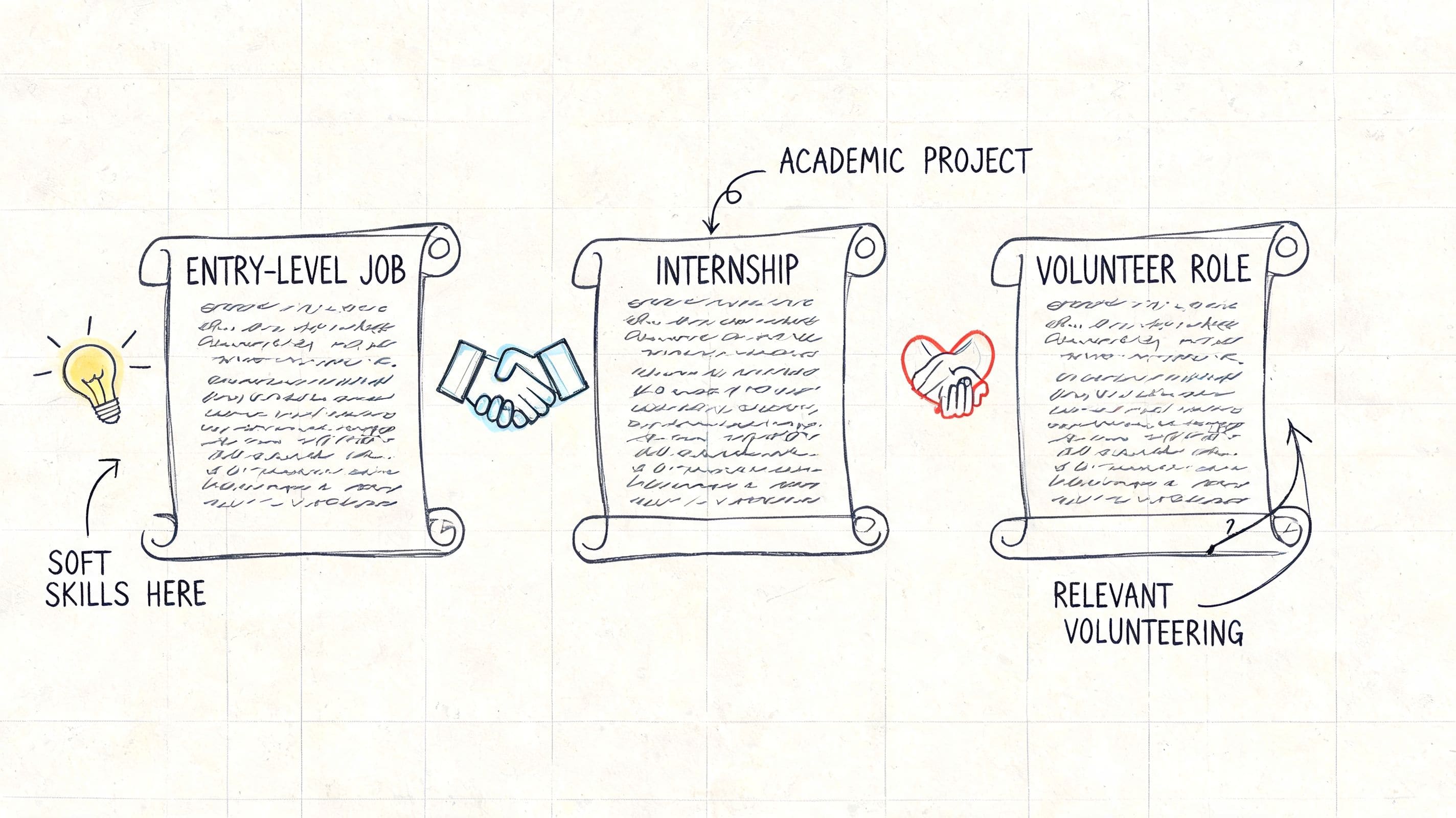
If you want more sample formats after reading these, compare them with broader UK cover letter examples for different industries and levels.
Example 1 recent graduate applying for a graduate scheme
Dear Graduate Recruitment Team,
I am applying for the Graduate Analyst role at Brightstone Advisory. As a recent Economics graduate, I’m attracted to the role’s focus on research, problem-solving, and clear communication. My academic work and society leadership experience have given me a strong base in analysing information, working collaboratively, and presenting ideas in a structured way.
In my final year, I completed a research project that required me to interpret complex data, identify key patterns, and present recommendations in a concise written report. That process strengthened my analytical thinking and my ability to communicate findings clearly to a non-specialist audience. I’m particularly interested in bringing that skill into a client-focused environment where accuracy and clarity matter.
Alongside my studies, I served on the committee of a university finance society, where I helped coordinate events, communicate with guest speakers, and support event delivery. That role taught me how to stay organised, work reliably with others, and represent a group professionally. It also confirmed that I enjoy fast-moving environments where preparation and attention to detail make a visible difference.
I’m drawn to Brightstone Advisory because of your focus on developing early-career talent and your work across multiple sectors. I would welcome the opportunity to discuss how my academic training, initiative, and strong interest in analytical work would allow me to contribute to your graduate programme. Thank you for your time and consideration.
Yours faithfully,
Aisha Khan
Why this works
- The opening identifies the role and gives a credible reason for applying.
- The first body paragraph translates academic research into analyst-ready skills.
- The second body paragraph adds teamwork and professionalism from a society role.
- The closing connects the candidate’s motivation to the employer.
Example 2 career changer moving from retail to office work
A career changer often thinks, “My experience doesn’t count because it’s in the wrong sector.” It often counts more than they think. Retail, hospitality, and frontline service work can produce excellent evidence for admin, operations, customer support, and office-based roles.
Dear Hiring Manager,
I am applying for the Administrative Assistant position at Westbridge Property Services. Although my background is in retail, I’m now looking to move into an office-based role where I can use the organisational, communication, and customer service skills I’ve developed in a more administrative setting.
In my current role, I manage customer queries, handle transactions accurately, and balance competing demands during busy periods. This has taught me how to stay calm under pressure, communicate clearly, and maintain a high standard of service throughout the day. I’ve also regularly supported stock organisation and shift handovers, which has strengthened my attention to detail and my ability to follow process consistently.
Outside work, I recently completed an online course in office administration and have been actively improving my skills in spreadsheets, email communication, and document handling. I’m making this change deliberately and have taken practical steps to prepare for it. What appeals to me about Westbridge Property Services is the opportunity to support a team in a role where organisation and reliability are central.
I would welcome the chance to discuss how my customer-facing experience and strong work habits could transfer effectively into this position. Thank you for considering my application.
Yours faithfully,
Daniel Morris
This example works because it doesn’t apologise for the career change. It frames retail experience as proof of discipline, service, and organisation.
Why this works
| Sentence choice | Why it helps |
|---|---|
| “Although my background is in retail…” | Honest, but not defensive |
| “I’m now looking to move into an office-based role…” | Shows direction and intent |
| “I’ve taken practical steps to prepare” | Reduces employer risk |
| “customer-facing experience and strong work habits” | Connects old experience to new role |
Example 3 student applying for an internship
Internship applications are often crowded with candidates who all have similar academic profiles. Your letter has to make your motivation and evidence feel real.
Dear Ms Patel,
I am writing to apply for the Summer Marketing Internship at North & Vale. I am currently studying English Literature and have developed a strong interest in brand communication, audience engagement, and digital content through both my coursework and extracurricular projects.
As communications officer for a student society, I write event promotions, schedule social media posts, and help shape messaging for different audiences. That experience has shown me how small changes in wording and timing can affect audience response, and it has made me more attentive to tone, clarity, and consistency. I’ve enjoyed translating ideas into content that encourages people to take action.
My degree has also strengthened my research and writing skills. Through essays and presentations, I’ve learned how to build a clear argument, adapt my communication to the audience, and work to tight deadlines without sacrificing quality. I’m keen to apply those skills in a practical setting and learn how a professional marketing team develops campaigns.
I’m particularly interested in North & Vale because of your work with education and charity clients, and I’d value the opportunity to contribute while learning from your team. Thank you for your time and consideration. I would be pleased to discuss my application further.
Yours sincerely,
Sophie Reed
Why this works
- It uses a relevant society role instead of pretending there is formal marketing experience.
- It links degree skills to commercial skills without overstating them.
- It shows genuine interest in the employer’s client base.
What to borrow from these examples
Don’t copy the exact wording. Copy the mechanics:
- Name the role early
- Use one or two evidence sources well
- Translate activities into work behaviours
- Explain why that employer makes sense
- Close with calm confidence
A no experience cover letter is strongest when it sounds grounded. Not inflated. Not timid. Grounded.
How to Tailor Your Letter to Any Job Description
A generic cover letter is usually obvious by the second sentence. Recruiters can see when the same draft has been sent to ten employers with only the company name swapped out. That’s a problem because even when a posting says the letter is optional, many hiring managers still expect one, according to the same Resume Genius data cited earlier.
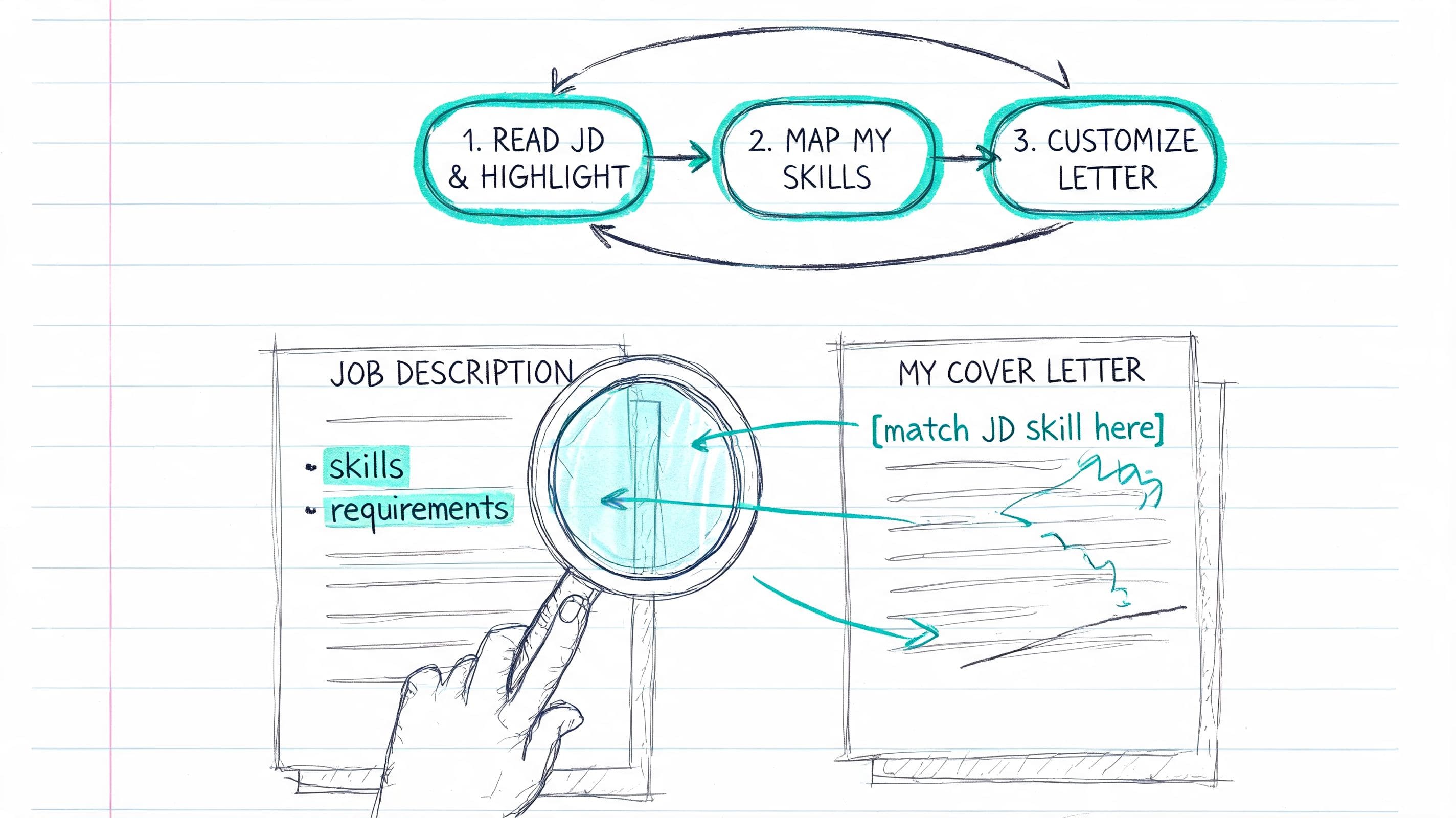
Step 1 pull out the real requirements
Read the job description once for the overall role, then a second time with a highlighter mindset. Look for:
- Repeated skills such as communication, organisation, research, customer service, teamwork
- Core tasks such as supporting projects, handling enquiries, preparing reports, scheduling, writing content
- Signals about culture such as fast-paced, collaborative, detail-oriented, public-facing
Ignore filler terms at first. Focus on what the employer will judge.
Step 2 build an evidence map
Next, make a simple two-column note.
| Job requirement | Your evidence |
|---|---|
| Strong communication | Presentation work, society communications, customer-facing part-time job |
| Organisation | Event planning, coursework deadlines, admin support in volunteering |
| Teamwork | Group assignments, committee work, shift work |
| Initiative | Self-directed project, independent learning, process improvement idea |
This is the step most applicants skip. They try to write from memory. The result is vague. A quick evidence map gives you raw material that’s relevant before you draft a single paragraph.
Step 3 write to the role not to yourself
Now choose the two or three pieces of evidence that best match the advert. Not your entire life story. Not every achievement. Just the evidence with the tightest fit.
A practical workflow looks like this:
- Lift 5 to 7 core competencies from the advert.
- Match each one to coursework, volunteering, projects, part-time work, or society roles.
- Use the employer’s language naturally in your letter without copying whole phrases.
- Save as PDF unless the employer asks for a different format.
For this kind of tailoring, tools can help speed up the matching process. One option is CV Anywhere’s Job Description Fit Checker, which analyses a job description and highlights match areas and gaps so you can align your letter and CV more efficiently.
A tailored cover letter doesn’t mean rewriting from scratch every time. It means keeping the structure and changing the proof.
Common Mistakes That Instantly Disqualify Your Application
Applicants often think the main risk is “not having enough experience”. It usually isn’t. The bigger risk is sounding generic, careless, or passive. That’s why this part matters so much. Research cited by TeamStage’s resume statistics roundup notes that 36% of CVs are rejected for being too generic. In a cover letter, that problem is worse because specificity is the whole point.
If you want a deeper breakdown of this issue, read why generic cover letters fail AI analysis.
Red flags recruiters spot fast
Apologising for your background
“I know I don’t have the experience you want” tells the reader what’s missing before you’ve shown any value.Repeating your CV line by line
A cover letter should interpret your experience, not duplicate it.Using clichés instead of proof
Phrases like “hardworking team player” say nothing unless attached to a specific example.Writing one draft for every role
Generic language signals low effort and low interest.Forgetting the employer’s needs
Many applicants talk only about what they want to learn. Employers also want to know what you can already contribute.
A weak cover letter sounds like it was written to get any job. A strong one sounds like it was written for this job.
A better swap for each mistake
| Mistake | Replace it with |
|---|---|
| “I have no experience” | “My experience comes from academic, volunteer, and project-based work that has built relevant skills for this role.” |
| “I am hardworking” | One brief example showing reliability or initiative |
| Listing every module studied | One or two modules or projects linked directly to the role |
| “Please find my CV attached” opening | A direct statement about the role and your fit |
| Weak ending | A clear, polite invitation to discuss your application |
Proofread carefully. If a letter contains the wrong company name, obvious typos, or vague filler, it doesn’t look inexperienced. It looks rushed.
Frequently Asked Questions
How long should a no experience cover letter be
Keep it to half a page to one page. That’s enough room to make your case without turning it into an essay. Most strong letters land at three or four short paragraphs plus sign-off.
Should I mention that I have no experience
Not directly. Don’t centre the gap. Centre the evidence you do have. You can acknowledge that you’re at an early stage, but the focus should stay on transferable skills, motivation, and relevant examples.
What if I don’t know the hiring manager’s name
Use Dear Hiring Manager if no name is given and you can’t find one through the company website or LinkedIn. That’s better than guessing. If you do find a name, make sure it’s correct.
Should I use the same cover letter for every job
No. Reuse the structure, not the content. Your opening, examples, and closing should all shift to match the job description and employer.
What file format should I send
Send it as PDF unless the application instructions ask for a different format. PDF usually preserves layout and is commonly accepted in online applications.
If you want to turn rough experience into a stronger application faster, CV Anywhere can help you build an ATS-friendly CV, compare your application against a job description, and keep track of each role in one place so your job search stays organised.
Tags
Related articles
How to Write a Standout TA Cover Letter for UK Schools in 2026
To write a great TA cover letter for a UK school, you must move beyond listing duties and instead showcase your tangible impact on student achievement and classroom success. Your letter should be a di...
How to Write a Cover Letter for an Internship in the UK [2026 Guide]
A great cover letter for an internship is your single best chance to make a powerful first impression and secure an interview in the competitive UK market. To write one that stands out, you must follo...
How to Write an Expression of Interest Letter That Gets Noticed in the UK
An expression of interest letter is a proactive letter sent to a UK company you want to work for, even if they haven't advertised a job opening. Its purpose is to showcase your skills, express your ad...
How to Write a UK Cover Letter That Gets You Hired in 2026
To learn how to write a cover letter for the UK job market, you need to turn your CV from a dry list of facts into a compelling story that connects your skills directly to the employer's needs. The pe...
Popular Articles
To write a great TA cover letter for a UK school, you must move beyond listing duties and instead showcase your tangible impact on student achievement and classroom success. Your letter should be a di...
A great cover letter for an internship is your single best chance to make a powerful first impression and secure an interview in the competitive UK market. To write one that stands out, you must follo...
An expression of interest letter is a proactive letter sent to a UK company you want to work for, even if they haven't advertised a job opening. Its purpose is to showcase your skills, express your ad...
To learn how to write a cover letter for the UK job market, you need to turn your CV from a dry list of facts into a compelling story that connects your skills directly to the employer's needs. The pe...