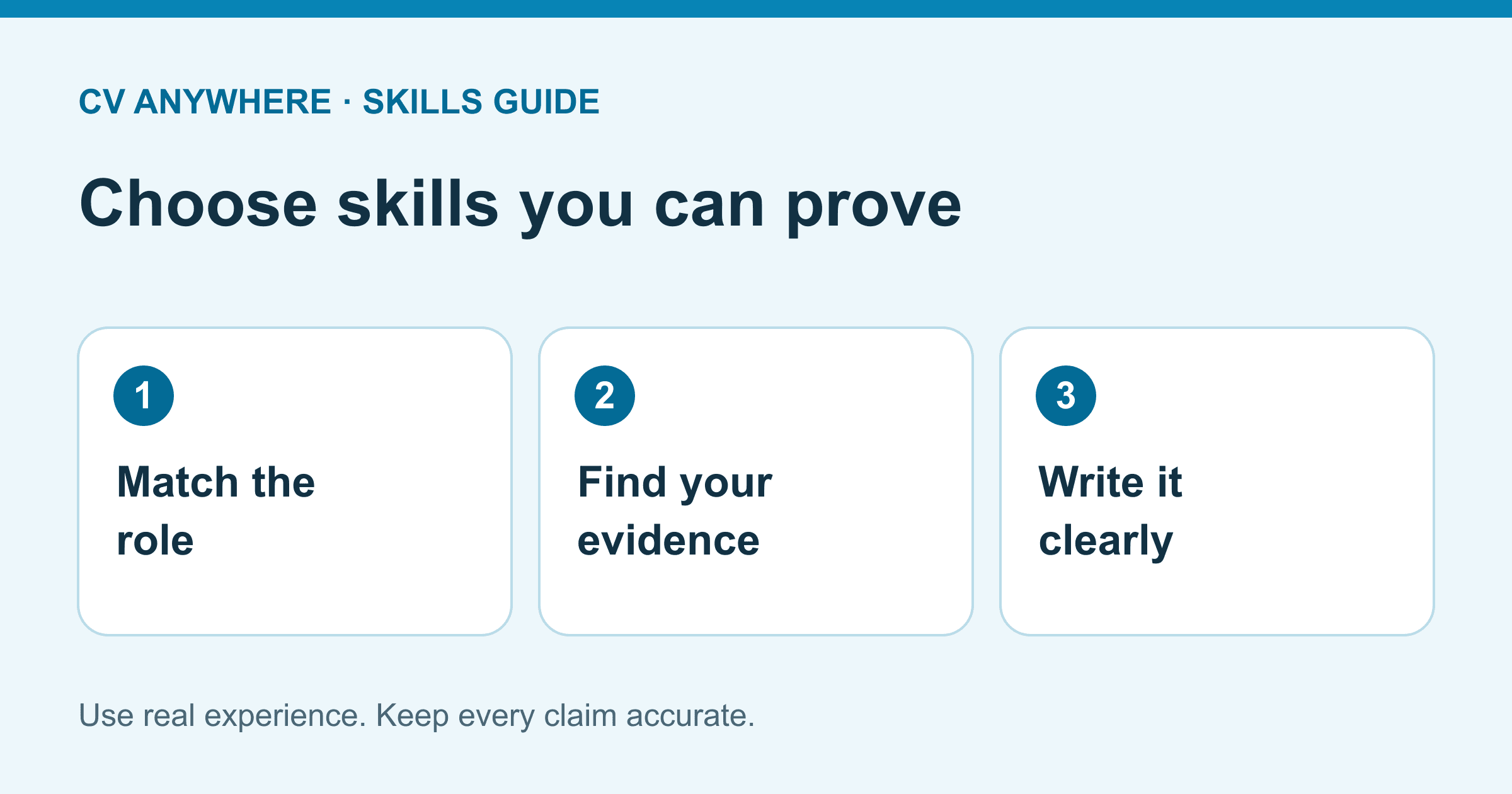
Choose skills that matter to the vacancy and that you can demonstrate. A useful resume skills list is a shortlist of relevant abilities, not an inventory of every tool you have opened. Start with the job description, then check each proposed skill against something you have actually done.
This guide helps you choose what to include. For ready-to-adapt wording, use our CV skills examples; for arranging the list, see resume skills section formats.
Build your shortlist in four steps
- Underline the tasks, tools and qualifications in the advert. Separate essential requirements from desirable ones.
- Next to each requirement, record an example from paid work, study, a project or volunteering.
- Identify your level of responsibility: observed, practised with support, completed independently or taught others.
- Choose the strongest relevant matches. Leave out requirements you cannot yet support rather than copying the entire advert.
A missing essential qualification cannot be replaced by repeating its name. Check whether the employer accepts equivalent experience, or choose a role that fits your present level.
Is your resume actually getting responses?
Your resume might be missing something important
Upload your resume → see its weakest areas → fix them, one by one.
Free. Takes less than 2 minutes.
Skills to consider by role
These are possibilities to check against a real vacancy, not a universal ranking of desirable skills.
| Role | Relevant tasks or tools to consider | Evidence to look for |
|---|---|---|
| Customer service | Resolving enquiries, case notes, order systems, escalation | An enquiry you owned and how you recorded the resolution |
| Administration | Diary coordination, document control, Excel, invoice checks | A process you kept accurate or organised |
| Retail | Stock checks, till use, returns, customer assistance | A shift task you performed and the procedure you followed |
| Software development | Languages, testing, version control, accessible interfaces | A feature you built and how you checked it |
| Marketing | Campaign reporting, content editing, email tools | Your contribution to a campaign and the evidence available |
| First job | Teamwork, planning, research, practical digital tasks | A school, club, volunteering or personal project |
For a first application, see the complete first-job CV example. You do not need to pretend that a class assignment was paid employment.
Use a selection worksheet
The following example is fictional. Copy the structure, not the candidate's experience.
| Advert asks for | My evidence | Decision |
|---|---|---|
| Excel reporting | Updated a weekly order workbook using filters and SUMIF | Include those functions and the reporting task |
| Customer communication | Answered delivery questions and logged changes | Include customer enquiries; support it with an experience bullet |
| SQL | Watched introductory lessons but have not completed a query project | Leave off the main skills list; practise before claiming competence |
| Team leadership | Helped a colleague learn one routine | Describe the support accurately; do not claim management responsibility |
Describe your level through tasks
“Advanced Excel” is difficult to assess without context. “Excel: pivot tables, XLOOKUP and monthly reconciliation” gives a reader something specific to discuss. If your experience is limited to training, say so: “SQL coursework: SELECT queries, joins and grouped summaries.”
Use the employer's terminology when it accurately describes your work. Spell out an unfamiliar acronym once. Do not add hidden keywords, repeat a skill in every section or claim that a particular word guarantees an ATS pass.
Pair the list with evidence
A fictional administrative candidate might write:
Skills: Outlook diary coordination; Excel filters and SUMIF; invoice checks; customer enquiry handling.
Their experience could then support one of those claims:
Checked supplier invoices against purchase records and flagged missing references before the weekly payment review.
A truthful description of a completed task is useful even without a percentage improvement. Only add quantities or results you can substantiate. For personal qualities, use the self-description examples and the hard-versus-soft skills guide.
What to remove
Remove obsolete tools that do not matter to the vacancy, vague labels such as “computer literate”, duplicate synonyms and unearned proficiency claims. Keep relevant basic skills when the job actually requires them; an entry-level administrator may reasonably mention document formatting.
You do not need a fixed number of skills or an equal split between technical and interpersonal abilities. The advert and your evidence determine the balance. Read the final list aloud and ask whether you could explain a real example for every item.
When your selection is ready, organise it using the skills section examples or add it to your draft in the CV builder.