When a great job opportunity appears with a tight deadline, you need an urgent CV template that works fast. The best way to create a compelling CV in minutes is to use a strategic, proven format. Forget fancy designs; your goal is to submit a polished, effective document on time.
This guide gives you a simple, ATS-friendly urgent CV template and a rapid process to get your application ready in under 30 minutes. The key is a clean, single-column, reverse-chronological layout that recruiters and scanning software love.
The Best Urgent CV Template: A 30-Minute Plan
When time is short, you must prioritise. Your CV needs to hit the most critical points and leave the rest. Focus only on the essentials to get a strong draft done fast.
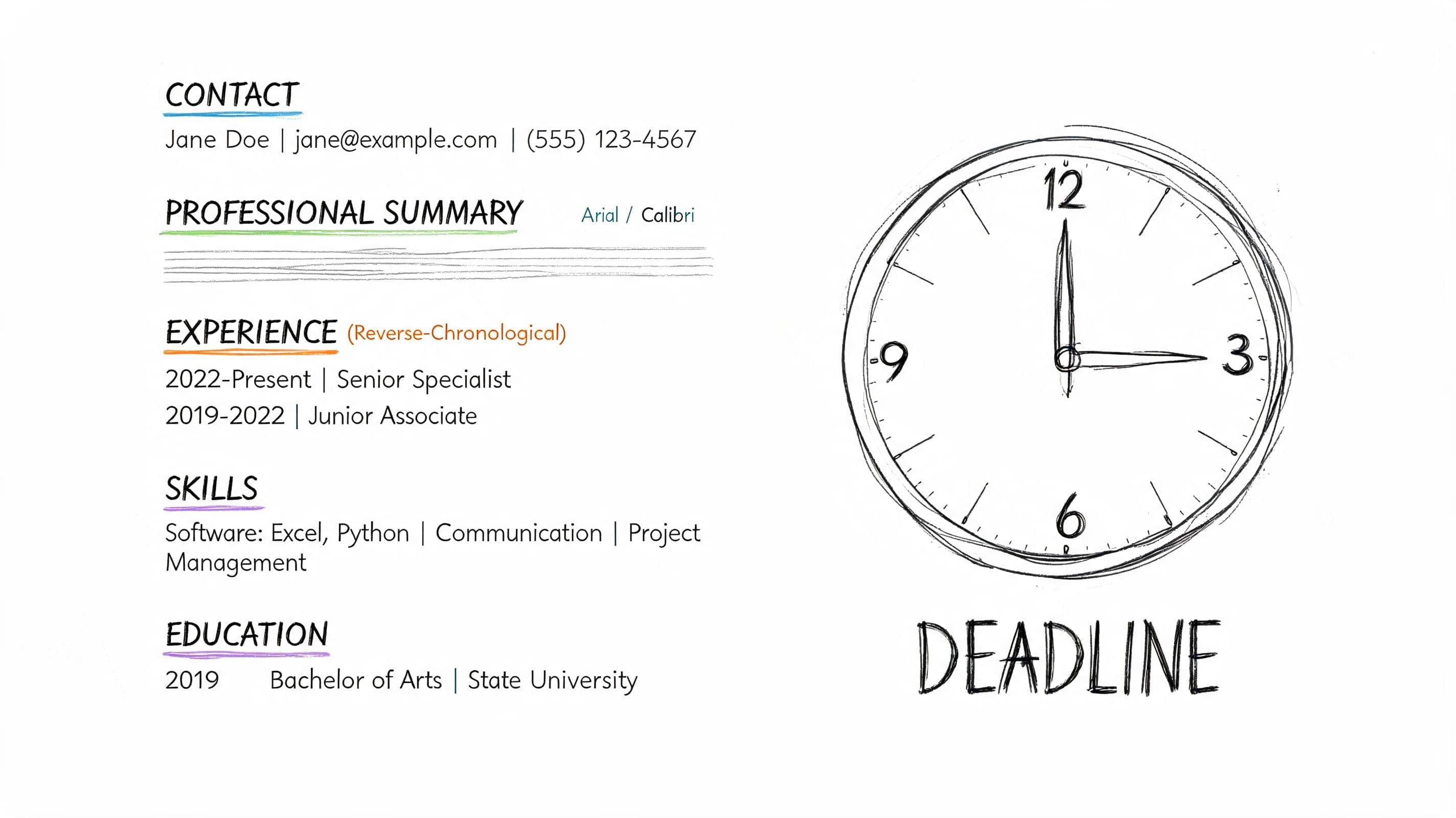
Think of it as creating a "minimum viable product" for your career. It must be good enough to get you through the door; you can add the bells and whistles later.
Urgent CV Content Priorities
| Priority | CV Section | What to Include (Briefly) | Time Estimate |
|---|---|---|---|
| High | Contact Details | Name, Phone, Email, LinkedIn URL (if updated) | 2 Mins |
| High | Personal Profile | A 2-3 sentence pitch tailored to this specific role. | 5 Mins |
| High | Work Experience | Your last 2-3 roles, with 3-4 bullet points each. Focus on achievements, not duties. | 15 Mins |
| Medium | Skills | A bulleted list of your most relevant technical and soft skills. | 5 Mins |
| Medium | Education | Your highest or most relevant qualification. | 2 Mins |
| Low | Hobbies, References, Full Project Lists | Skip these entirely for now. You can add them later if needed. | 0 Mins |
This lean approach ensures you cover the non-negotiables that recruiters look for first. Once you have these core sections, you have a solid document ready to go. The key is to resist the temptation to perfect every single word.
Key Takeaway: When you're in a rush, a simple, well-structured CV that gets submitted on time is infinitely better than a "perfect" one that misses the deadline. Done is better than perfect.
This rapid-fire approach is designed to get your CV out the door with confidence. For more time-saving strategies, check out our guide on how to make a CV in minutes to speed up the process even further.
Build a CV that actually gets interviews
Start from your current CV — or from scratch — with step-by-step guidance so you do not get stuck.
Free. No blank page. No templates to wrestle with.
How to Choose a Template for Speed and Impact
Not all CV templates are created equal, especially when you're against the clock. The wrong choice can land you in a world of formatting hell and get your application tossed by an Applicant Tracking System (ATS) before a human ever sees it. When you need a CV now, the right template is clean, professional, and dead simple to edit.
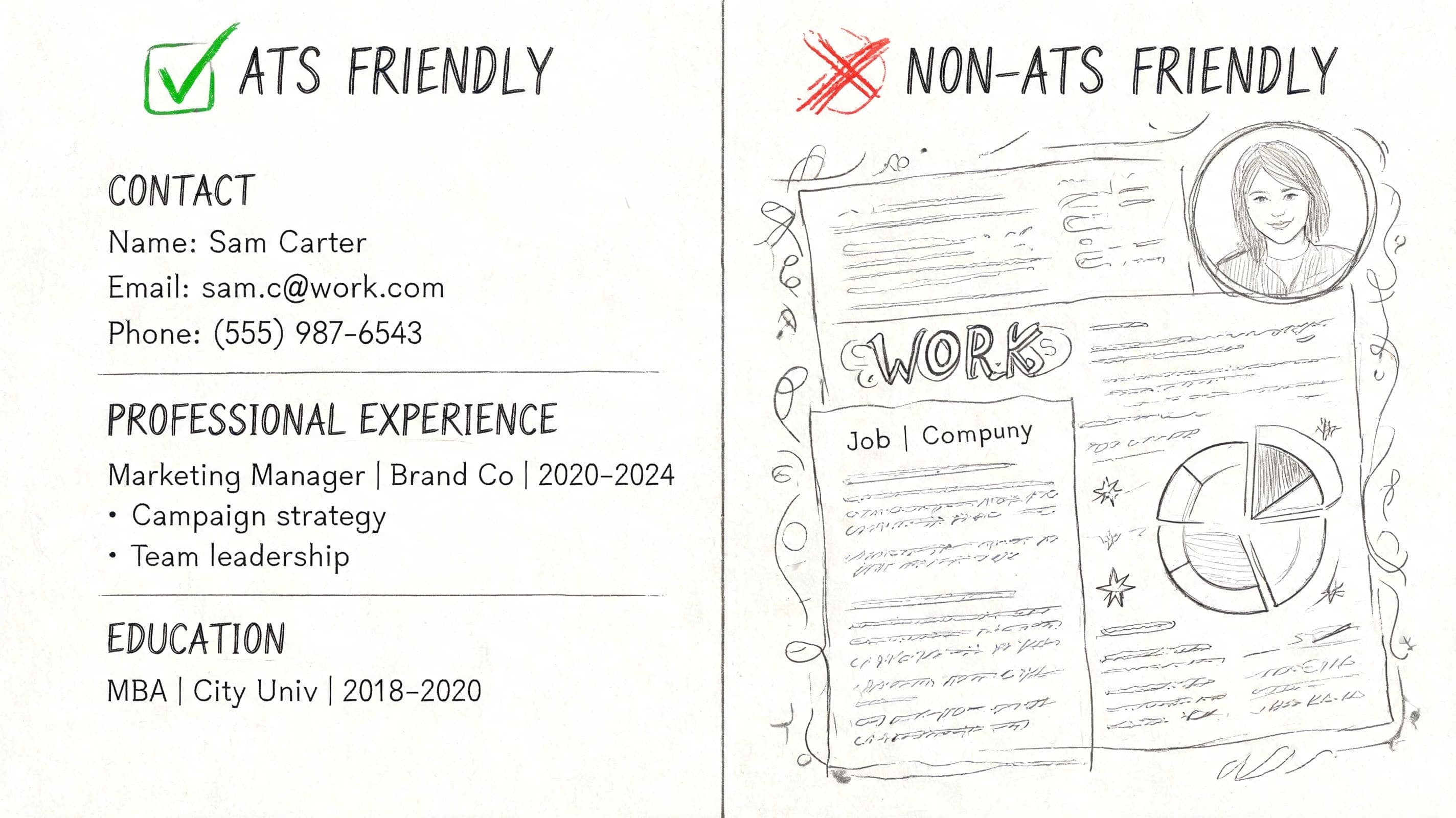
If time is short, steer clear of complicated designs packed with graphics, odd fonts, or multiple columns. They might look flashy, but they're notorious for confusing the automated systems that do the first pass on your application. With over 70% of larger companies using an ATS, making sure your CV is machine-readable isn't optional—it's essential.
Key Criteria for an Urgent Template
Your decision should hinge on three simple things: ATS compatibility, readability, and how easy it is to edit. A single-column layout is your safest bet. It lays out your career story in a logical flow that both software and human recruiters can follow without getting lost.
Stick to standard, professional fonts. Think Arial, Calibri, or Times New Roman. They are universally recognized and easy to read on any screen. You'll also want clear, simple section headings like "Work Experience" and "Skills" to make your CV easy to scan.
Expert Tip: The goal here is to focus on your content, not fight with text boxes. A simple template lets you drop in your details and tailor your achievements for the job. That's far more powerful than a fancy design.
Why Simplicity Wins in the UK Job Market
For most UK job applications, professionalism and clarity always win out over creative flair. The only exception is if you're applying for a role in a creative industry. A simple, well-structured document signals that you're organised, professional, and respect the recruiter's time.
Of course, expectations can differ depending on where you're applying. If your search takes you outside the UK, it pays to spend a few minutes understanding modern resume formats for different markets.
When you're under pressure, the best template is the one that gets out of your way and lets your accomplishments do the talking. Choose a straightforward design that helps you focus on what really matters: showing the employer the value you bring. For a deeper dive into picking the right structure, you might want to check out our complete guide to the best CV templates.
The Rapid Content-First Approach to Writing
When you're up against an urgent deadline, writer's block is a luxury you can't afford. Forget trying to perfect your CV section by section—that's a slow, frustrating path. Instead, you need a rapid, content-first approach. It's all about getting your raw career data down on the page first, then shaping it into a polished, high-impact document.
So, how do you do it? Open a plain text document. Don't even think about fonts, margins, or templates yet. Just create a few simple headings like "Work Experience," "Skills," and "Key Accomplishments" and start a brain dump.
List everything you can think of under each heading. Don't worry about fancy phrasing. Just get the core information out. A messy note like 'managed the sales team' or 'was responsible for project reports' is a perfect start. The goal here is pure speed—capture the substance of your career without the pressure of making it sound good just yet.
Refining Your Raw Data
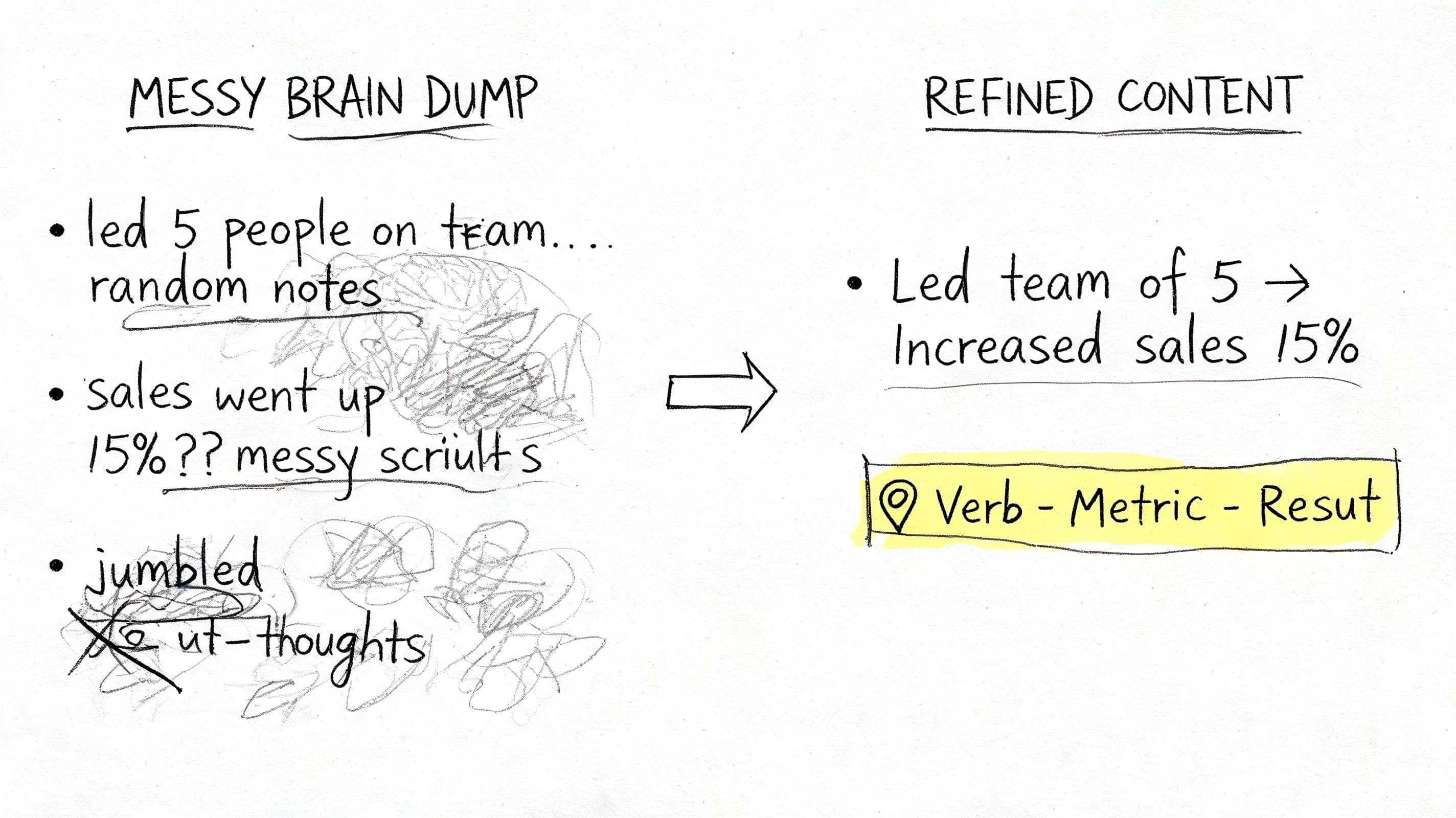
Once you have a messy but comprehensive list of your experiences, it's time to turn that raw data into powerful, attention-grabbing bullet points. This is where you move from listing passive duties to showcasing active accomplishments. We do this with a simple but incredibly effective formula: Verb-Metric-Result.
This formula transforms a dull statement into a compelling achievement.
- Verb: Start with a strong action verb (e.g., Led, Increased, Developed, Launched).
- Metric: Quantify your work with numbers, percentages, or scale.
- Result: Explain the positive outcome or impact of what you did.
Let's put it into practice. That quick note, 'managed a team,' becomes something a hiring manager can't ignore: "Led a team of 5 customer service agents to increase positive feedback scores by 15% in Q3." See the difference? One is a passive duty; the other is a quantified achievement.
Why This Approach Works Under Pressure
The content-first method helps you sidestep the paralysis that comes from staring at a blank page. It forces you to focus on what truly matters: your accomplishments. This is absolutely crucial in 2026, with data showing that employers now prefer CVs that are clearly customised for the specific role.
This kind of tailoring is much faster when you have a pre-built "bank" of well-defined achievements ready to go. You can pick and choose the most relevant ones for each application. When you're crafting these points, it also helps to think about your professional story and how to make your business bio stand out for extra impact.
Key Takeaway: By separating content creation from formatting, you can work much faster and more effectively. First, capture your value in raw notes. Then, polish those notes into high-impact bullet points that prove your worth to a hiring manager.
This method not only saves precious time but also creates a much stronger, achievement-focused CV. To move even faster, you can plug these polished points directly into a quick CV creator and have a professional document ready in minutes.
Urgent CV Examples You Can Adapt Now
When you're against the clock, theory goes out the window. You don't have time to second-guess your CV—you need to see what works and adapt it, fast.
Let's look at three common job-seeking scenarios in the UK and how a sharp, focused CV can make all the difference. These aren't just templates; they're annotated blueprints showing you why each choice was made and how to frame your own experience for maximum impact when every minute counts.
Pay close attention to how a Personal Profile is targeted, how skills are listed for Applicant Tracking Systems (ATS), and how experience is reframed when moving into a new industry. This is your shortcut to building a CV with speed and confidence.
Example 1: The Recent Graduate
For a recent graduate, the game is all about potential. With limited work history, you need to lean heavily on your academic wins, relevant projects, and transferable skills. It's about showing what you can do, not just what you have done.
Personal Profile: "A highly motivated and analytical recent BSc Economics graduate with a First-Class Honours from the University of Manchester. Eager to apply quantitative skills and a strong understanding of market trends to an entry-level Financial Analyst role at a forward-thinking firm."
- Why it works: It's direct and packed with value. It states the qualification, university, grade, and the exact role being targeted. This shows clear, focused intent.
Key Skills:
- Financial Modelling: Proficient in creating and analysing financial models using Excel.
- Data Analysis: Experience with Stata and R for statistical analysis and data visualisation.
- Communication: Presented a dissertation on macroeconomic forecasting to a panel of academics.
- Teamwork: Collaborated on a group project to develop a mock investment portfolio that outperformed the FTSE 100 by 8%.
Education: Always lead with your most recent and impressive achievement—in this case, the degree itself.
Example 2: The Career Changer
Changing careers is about building a bridge from your past to your future. Your CV has to do the heavy lifting, translating your existing skills into the language of your new target industry.
This example shows how a retail manager pivoting to a project coordination role adapts their CV.
The screenshot shows a clear, single-column CV format that highlights transferable skills, making it ideal for someone changing careers.
Personal Profile: "A results-driven manager with 8+ years of experience leading teams and overseeing complex store operations in the retail sector. Now seeking to apply proven project management, stakeholder engagement, and budget control skills to a Project Coordinator position. A certified PRINCE2 Practitioner dedicated to ensuring projects are delivered on time and within scope."
- Why it works: It acknowledges the past but immediately pivots to future value. The skills are framed for project management, and mentioning a key certification like PRINCE2 upfront adds instant credibility.
Experience (Reframed): Instead of a passive duty like "Managed shop floor," reframe it with impact: "Coordinated the end-to-end rollout of a new inventory system across five regional stores, completing the project 2 weeks ahead of schedule."
Example 3: The Experienced Professional
If you're an experienced pro, your CV should be a highlight reel of achievements. Forget listing responsibilities. Your job is to showcase a clear and compelling track record of high-impact results and leadership.
- Personal Profile: "A Senior Marketing Manager with over 12 years of experience in the UK tech sector, specialising in B2B SaaS growth. Proven track record of developing and executing strategies that have increased lead generation by over 200% and reduced customer acquisition costs by 30%. Seeking to bring strategic leadership and revenue-driving expertise to a Head of Marketing role."
- Why it works: The numbers do all the talking. It's crammed with metrics that instantly establish value and credibility, making it impossible for a recruiter to ignore.
Key Insight: Notice the common thread? Every strong example uses a highly targeted Personal Profile and quantifies achievements with hard numbers. This is the fastest way to signal your value to a busy recruiter scanning dozens of applications.
These examples should give you a solid foundation to build from. For more inspiration across different roles and industries, our library of CV examples and writing guides offers even more detailed insights.
Common Mistakes When Writing a CV Urgently
When rushing, it's easy to make mistakes that get your CV binned. Here are the most common errors to avoid:
- Sending a generic CV: Recruiters can spot a non-tailored CV instantly. Even five minutes of customisation makes a huge difference.
- Typos and grammar errors: These suggest a lack of attention to detail. Use a spell checker and read your CV out loud to catch mistakes.
- Using a fancy, unreadable format: Complex templates with graphics, tables, or multiple columns often fail ATS scans. Stick to a simple, single-column design.
- Forgetting to update contact details: A wrong phone number or a typo in your email means the recruiter can't contact you.
- Saving with a generic file name: Name your file professionally (e.g.,
YourName-CV.pdf), notCV-final-v3.docx. Always send as a PDF.
Avoiding these simple traps will put you ahead of many other last-minute applicants.
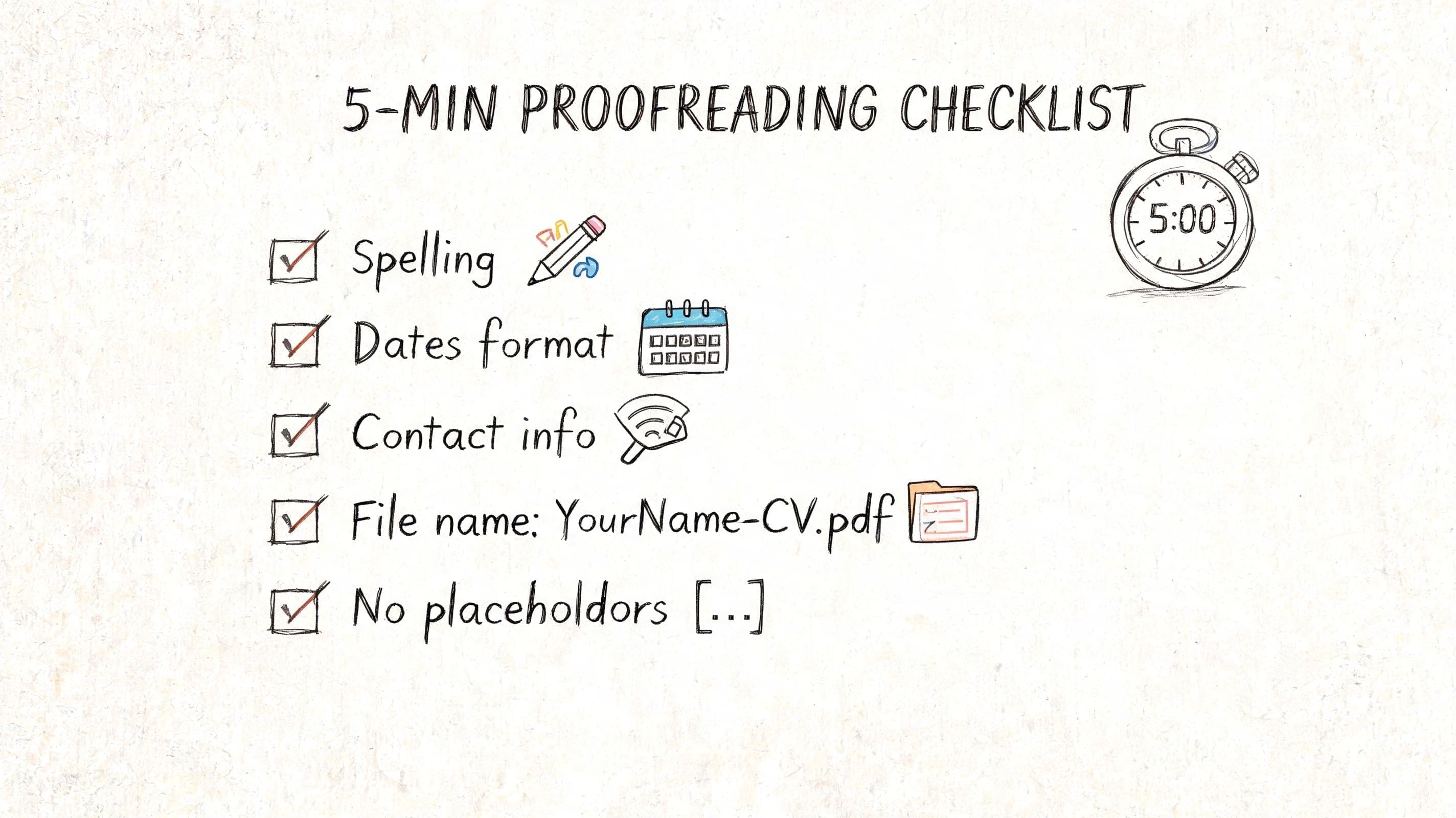
Your Final 5-Minute Proofreading Checklist
You've raced against the clock and your CV is almost ready. Before you hit that 'submit' button, stop. Take five minutes for one last, critical pass. When you're in a hurry, it's frighteningly easy to miss the small, glaring mistakes that get your application instantly binned. This final check is your safety net.
The Non-Negotiable Checks
Set a timer and focus. We're not skimming; we're hunting for specific, deal-breaking errors.
- Contact Details: Is your phone number 100% correct? Is there a typo in your email? Click your LinkedIn URL to make sure it works.
- Company and Role: Did you use the right company name and the exact job title from the advert? Spelling the company's name wrong is a classic, unforgivable mistake.
- Spelling and Grammar: Run a final spell check, but don't stop there. Read your CV backwards to force your brain to see words individually and catch typos.
- Date Formats: Are all your employment and education dates in the same format (e.g., "Jan 2026")? Consistency is key.
- Placeholder Text: Search (Ctrl+F) for
[to ensure you haven't left any template text like[Company Name]in your document.
FAQ: Urgent CV Template
Even with the best guide, a looming deadline can make you second-guess every decision. Here are straight answers to common questions about building a CV under pressure.
What is the best format for an urgent CV?
The best format is a reverse-chronological, single-column layout. It is the UK standard, easy for recruiters to scan, and fully compatible with Applicant Tracking Systems (ATS). This format places your most recent experience first, which is exactly what hiring managers want to see.
Is it OK to use a generic CV when I have no time?
No. Never send a generic CV. Even with only five minutes, you have enough time to tailor your personal profile and a few key bullet points to match the job description. This small effort shows you've read the advert and dramatically increases your chances of getting a callback.
How long should an urgent CV be?
Keep it to one page if you have less than 10 years of experience. If you are a senior professional with a long, relevant career, two pages are acceptable. The goal is to be concise and impactful, not to list everything you have ever done. Your urgent CV should focus only on what's relevant for the role.
Should I include a cover letter for a last-minute application?
Yes, if you can. A short, sharp cover letter can give you a real edge. Don't write a masterpiece; simply connect one or two key achievements from your CV directly to the role and company to show you are a perfect fit.
Ready to stop scrambling and start applying with confidence? The CV Anywhere Smart Builder turns your raw career data into a polished, ATS-friendly CV in minutes. Try it for free today and land the interview.