To write a cv for a builder, use a clean reverse-chronological format with a short profile, a focused skills section, work history built around measurable project results, and certifications such as CSCS and NVQs. That structure works because UK construction is a large, skills-based hiring market, and recruiters need to see site readiness fast.
Most builder CVs fail for a simple reason. They read like a tools list. Hiring managers don't shortlist someone just because they can use a mixer, cut blocks, or follow drawings. They shortlist people who show they can work safely, keep jobs moving, and deliver on site without creating problems. A strong builder CV translates hands-on work into proof.
Your Blueprint for a Job-Winning Builder CV
The UK construction sector contributed around £132 billion in Gross Value Added in 2023 and employs around 2.2 million people, reflecting a major labour-intensive industry as summarised by construction statistics published by the Office for National Statistics (ONS). That scale matters. A builder isn't applying into a small local niche. A builder is competing in a major labour market where employers compare candidates quickly and often through digital screening first.
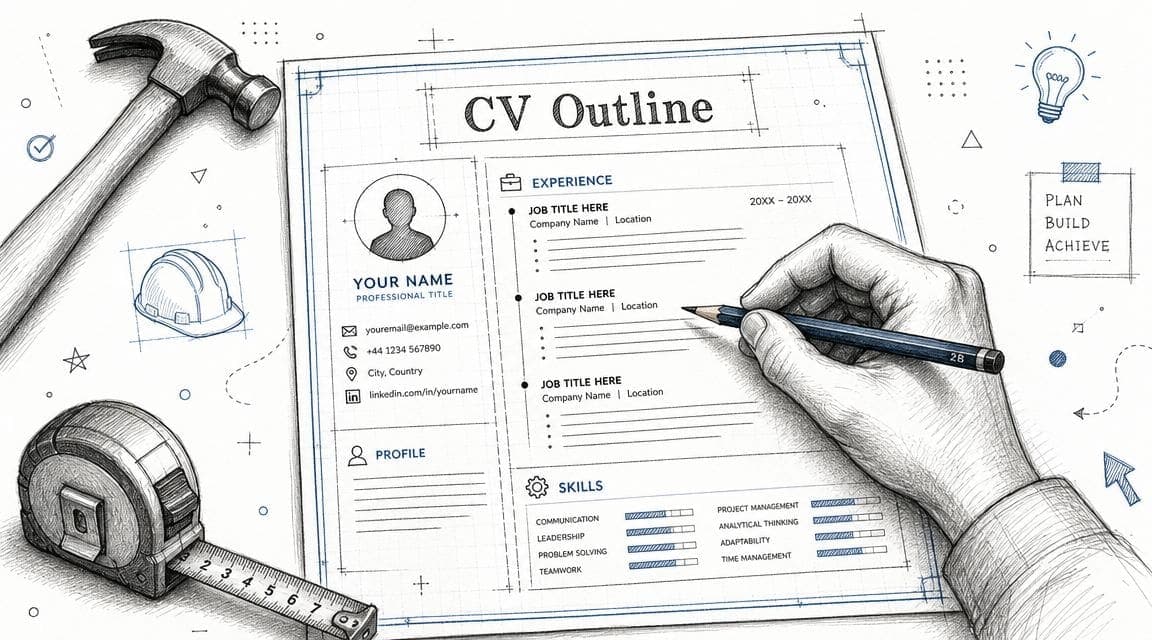
A good builder CV isn't about design flair. It's about making key information obvious within seconds. Site managers, recruiters, and office staff all scan for slightly different things, but they usually want the same core proof:
- Trade fit: bricklaying, carpentry, groundworks, plastering, roofing, snagging, finishing
- Site credentials: CSCS, NVQ, IPAF, PASMA, plant tickets, first aid
- Project context: housing, commercial fit-out, refurb, social housing, retrofit, maintenance
- Reliability signals: health and safety awareness, teamwork, supervision, client-facing conduct
What the strongest builder CVs do first
The best CVs front-load relevance. They don't make the reader dig through a page of vague claims.
A practical order looks like this:
- Contact details
- Personal profile
- Key skills
- Work experience
- Certifications and training
- Education or apprenticeship details
Practical rule: If the first half of page one doesn't show trade, tickets, and recent site experience, the CV is making the recruiter work too hard.
For a broader view of UK expectations, it also helps to review a complete guide to UK CVs. The same principles apply here, but a builder CV needs stronger evidence of practical competence and site readiness.
What doesn't belong near the top
Plenty of builders bury the useful bits under weak filler. That costs interviews.
Avoid opening with:
- Generic objectives: “Looking for a challenging role in construction”
- Buzzwords without proof: “Hardworking”, “motivated”, “team player”
- Long personal statements: full life story, unrelated hobbies, or broad claims with no site context
The opening should tell an employer what sort of builder this is, what environments they've worked in, and what they can be trusted to do.
Build a CV that actually gets interviews
Start from your current CV — or from scratch — with step-by-step guidance so you do not get stuck.
Free. No blank page. No templates to wrestle with.
Structuring Your CV for Readability and Impact
A builder CV gets judged fast. If a hiring manager cannot spot your trade, recent site history, and tickets within seconds, the document is underperforming.
Good structure does two jobs at once. It helps a recruiter scan the page quickly, and it helps ATS software read the content without missing key information. In practice, that means using a single-column layout, standard section headings, and plain text instead of tables, text boxes, graphics, or text placed inside images.
The format that works
Reverse-chronological order remains the strongest choice for a builder CV because it shows your latest site experience first. That matters in construction hiring. Employers usually want to know what type of work you have been doing recently, whether that is housing, fit-out, maintenance, refurb, or groundwork support.
Use these section headings:
- Contact Details
- Profile
- Key Skills
- Work Experience
- Certifications
- Education
This structure works because it matches how recruiters read. It also gives ATS systems the clearest chance of picking up the terms that affect shortlist decisions, such as CSCS, SSSTS, first fix, snagging, concreting, bricklaying, and refurb experience.
If you want a broader reference point, this guide to UK CV format for job applications sets out the standard layout expectations. A builder CV still needs more than clean formatting. It needs the right evidence in the right place.
Layout choices that help, not hurt
Plain formatting wins because it keeps the focus on the work.
| CV element | What works | What doesn't |
|---|---|---|
| Layout | Single column | Multiple columns |
| Headings | Standard labels | Unusual labels |
| Skills | Text-based bullet list | Icons or graphics |
| Experience | Reverse-chronological | Mixed or random project order |
| File appearance | Clean and consistent | Decorative or cluttered |
That last point gets overlooked. A polished CV is not the same as a designed CV. For builders, readability carries more weight than style because the reader is checking site relevance, not admiring formatting choices.
Why simple structure performs better
Construction recruiters do not spend long decoding a CV. They are checking for usable experience, site readiness, and fit for the vacancy. If the document hides that under visual clutter or awkward headings, it creates friction and costs attention.
A site manager hiring for a live project wants quick answers. What jobs has this builder worked on? What environments do they know? What cards, training, or supervisory tickets do they hold? Can they step onto site and be productive?
Simple structure helps answer those questions fast.
Use standard wording such as Work Experience rather than vague labels. Keep bullets tight, with one task, outcome, or result per line. Keep dates, tense, and punctuation consistent from top to bottom. Small formatting errors do not usually kill an application on their own, but they do make a CV look less controlled.
Build page one around proof
The first page should carry the strongest evidence, not general claims.
A solid page-one structure usually includes:
- Name and contact details
- A short profile of three to four lines
- A key skills section built around trade terms
- Your latest role with clear, measurable bullets
Many builder CVs often fall flat. They list duties, tools, and materials, but they do not show value. A better structure sets up the experience section so achievements are easy to spot. That could mean showing the scale of a housing site, the type of refurb completed, the pace of snagging close-outs, or the amount of work delivered to programme.
That is what gets attention. Tools tell the reader what you used. Measurable site outcomes tell them what you can do for the next employer.
Writing Each Section with Practical Examples
UK construction employers continue to report skill shortages, especially for workers who combine trade ability with site coordination, health and safety, and quality control, as noted in construction worker CV guidance published by careers resources. That's why a good builder CV has to show more than manual skill. It has to show control, judgement, and dependability.
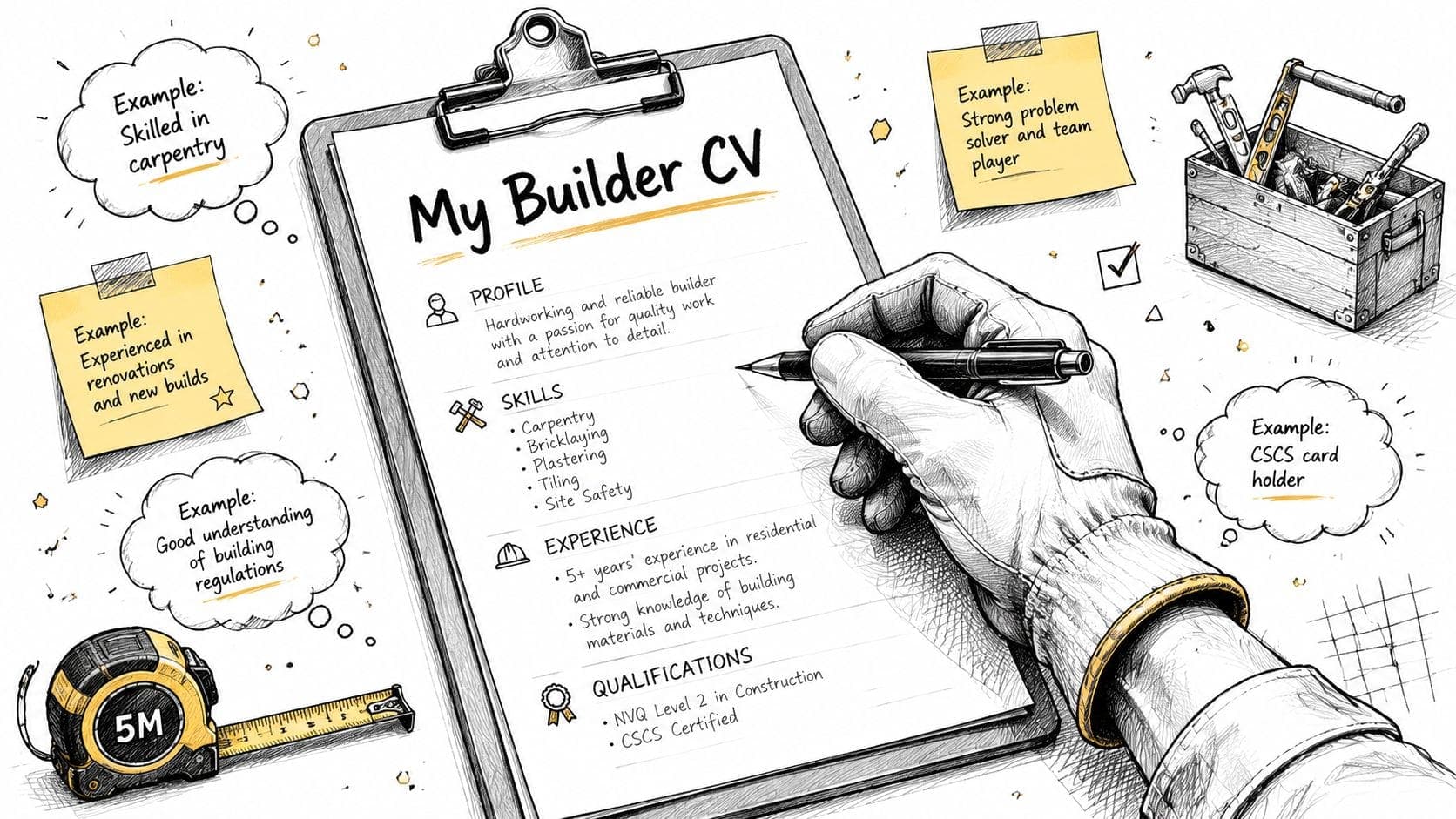
Personal profile example
This is the section often wasted. Keep it brief and specific.
Weak example
Hardworking builder with good experience in construction and a strong work ethic. Works well alone or as part of a team and is looking for a new opportunity.
That says almost nothing.
Better example
Reliable builder with experience across residential refurbishments, new-build housing, and general site work. Confident supporting brickwork, first-fix carpentry, snagging, and finishing tasks, with a strong focus on safe working, quality standards, and keeping to programme. Holds a valid CSCS card and works effectively with site managers, subcontractors, and occupants on live projects.
The second version gives trade context, project type, and site behaviour.
Key skills example
This section should be tight. Don't turn it into a giant keyword dump.
Use a mix of technical, compliance, and operational skills:
- Trade skills: bricklaying, blockwork, pointing, patch plastering, first-fix carpentry, fencing, concreting
- Site skills: reading drawings, setting out support, snagging, materials handling, working to programme
- Compliance: health and safety awareness, site housekeeping, PPE compliance, quality checks
- Tickets and tools: CSCS, IPAF, PASMA, abrasive wheels, power tools, cut-off saws, mixers
Hiring tip: A builder who shows quality control and site coordination often stands out ahead of someone who only lists hand tools.
Work experience example
Each role should answer four questions fast. What was the job, what kind of site was it, what did the builder do, and what came out of it?
Basic version
Builder
ABC Construction, Leeds
2023 to Present
- General building work
- Worked on residential properties
- Used tools and materials
- Helped on site
That won't carry much weight.
Improved version
Builder
ABC Construction, Leeds
2023 to Present
- Delivered general building and refurbishment work on occupied residential properties, including brick repairs, patch plastering, basic carpentry, and external maintenance
- Supported site supervisors with material coordination, daily task planning, and safe segregation of work areas in live environments
- Completed snagging and finishing tasks to handover standard, reducing call-backs through closer attention to finish quality
- Worked across mixed-trade teams to keep jobs moving on schedule and maintain tidy, compliant work areas
For more help shaping these bullets, this guide on CV work experience is a useful companion.
Certifications example
Trades employers often scan this section before they read the rest.
List certifications clearly:
- CSCS Card
- NVQ in Bricklaying / Carpentry / General Construction Operations
- IPAF
- PASMA
- Emergency First Aid at Work
- Asbestos awareness
- Manual handling
If a certification is current, say so. If it's expired, don't try to hide it. Renew it or leave it off and explain if asked.
How to Quantify Your On-Site Achievements
The biggest difference between an average builder CV and a strong one is this. Average CVs list duties. Strong CVs show outcomes.
That doesn't mean inventing figures. It means using real details from actual jobs. Site type. Scope of work. Number of units. Length of programme. Handover standard. Rework avoided. Safety record. Those details tell an employer how the candidate performs on the job.
With growing demand for retrofitting and upgrading existing UK housing stock, builders with experience in insulation, moisture control, and working in occupied homes have highly relevant skills, according to guidance on framing construction worker experience on a CV. That kind of work deserves proper framing on a CV, especially for self-employed and refurb-focused candidates.
Turn duties into evidence
Here are better ways to write common builder bullets.
| Weak bullet | Stronger bullet |
|---|---|
| Responsible for bricklaying | Completed brick and blockwork on residential and small commercial projects, working to drawings and keeping work areas safe and organised |
| Did refurbishment work | Carried out refurbishment and repair work on older properties, including patch repairs, finishing, and coordination with other trades to keep programme moving |
| Worked in customers' homes | Delivered repair and retrofit-adjacent work in occupied homes, maintaining clean work zones and communicating clearly with residents during live works |
| Self-employed builder | Managed own schedule, materials, and client communication across local building and maintenance projects, with repeat work supported by reliable delivery and finish quality |
What can be measured on a builder CV
Not every achievement needs a number. But where real numbers exist, use them accurately.
Good evidence includes:
- Project scale: number of units, property types, or areas covered
- Timeframe: completed within programme, fast turnaround, phased handover
- Quality: reduced snagging, fewer defects, cleaner finish
- Safety and compliance: followed site procedures, worked cleanly in occupied settings
- Breadth: worked across brickwork, carpentry, maintenance, finishing, or repairs
A useful model is action, task, result. This article on examples of accomplishments for resume writing applies well to trade CVs too, especially when duties need turning into evidence.
Builders often underestimate renovation and maintenance work. Employers don't. If someone can work neatly in older homes, adapt to changing conditions, and deal properly with occupants, that's valuable.
Self-employed builders need to show structure
Freelance and subcontract work can look messy on paper if it's listed job by job. A cleaner approach is to group it.
Example:
Self-Employed Builder
West Yorkshire
2021 to Present
- Delivered residential building, repair, and maintenance work across private homes and landlord properties
- Managed quotations, materials, scheduling, and on-site delivery
- Completed a mix of internal repairs, external patching, finishing, and general refurbishment tasks
- Built repeat client work through reliable attendance, tidy working practices, and clear communication
That reads as stable and credible.
Common Mistakes That Will Cost You the Interview
Many candidates still think a rough CV is acceptable for a hands-on role. It isn't. A large study found that CVs with spelling errors had an 18.5 percentage-point lower probability of receiving an interview, as shown in this resume error study.

That matters in construction because employers already have to judge reliability from limited information. If the CV is careless, they may assume the work is too.
Mistake one: listing tasks with no outcome
Bad CVs say things like:
- Worked on site
- Used tools
- Helped with bricklaying
- Did general labouring
Those bullets don't separate the candidate from anyone else. Replace them with specific project context and results.
Mistake two: sending the same CV for every role
A builder applying for a housing refurb role shouldn't lead with unrelated commercial groundworks experience unless that's the closest match available. The CV should be adjusted to fit the vacancy.
That usually means changing:
- The profile
- The order of key skills
- The most relevant bullets in recent roles
If ATS issues are a concern, this breakdown of ATS CV mistakes is worth reviewing before sending anything out.
Mistake three: hiding credentials in the wrong place
CSCS, NVQ, IPAF, PASMA, asbestos awareness, and first aid shouldn't be buried at the bottom of page two in a dense paragraph. Put them in a clear certifications section.
A recruiter shouldn't have to hunt for the card or ticket that determines whether the candidate can start on site.
Mistake four: poor proofreading
The final review should check:
- Spelling: especially trade terms, company names, and certificate titles
- Dates: no overlaps that can't be explained
- Formatting: consistent bullets, spacing, and tense
- Contact details: correct mobile number and email address
Mistake five: adding irrelevant personal detail
A builder CV doesn't need date of birth, marital status, or a photo. It needs proof of fit for the role.
Keep the document focused on work, not background noise.
Your Final Pre-Submission Checklist
A builder CV gets rejected for small misses. Wrong file name, buried tickets, weak top bullets, messy formatting. The final check is where shortlist decisions are often won or lost.
Read the CV the way a site manager, recruiter, or office admin will read it. Fast. They are checking whether this person can do this job, on this type of site, with the right cards, without wasting time.
Use this final pass before every application:
- Check the top third first: the profile, key skills, and latest role should show the trade focus, site type, and core tickets the vacancy asks for
- Keep the layout ATS-safe: single column, standard headings, and no tables, text boxes, or graphics replacing real text
- Lead with proof, not task lists: move the strongest bullets higher up, especially work tied to programme, quality, productivity, snag-free handover, or health and safety
- Make credentials easy to spot: CSCS, NVQ, IPAF, PASMA, asbestos awareness, first aid, and any machine tickets should be clear and correctly named
- Check the job title against the vacancy: if the role is for Bricklayer, Multi-Trader, Groundworker, or Carpenter, the CV should not undersell relevant experience under a vague title
- Proof dates and wording: fix overlaps, spelling errors, inconsistent tense, and trade terms that have been written incorrectly
- Save the file properly: use a clean file name with the candidate's name and target role
One trade-off matters here. Over-design makes a CV look polished, but it often makes ATS parsing worse. Plain formatting usually performs better because the system can read the content properly, and the hiring manager can scan it in seconds.
If the candidate is using a CV builder instead of formatting the document manually, check the output before sending. CV Anywhere is one example. The useful test is simple: can you tailor the CV for each job, keep standard headings, and export a clean file without formatting issues.
Frequently Asked Questions
How long should a builder CV be in the UK?
Usually one to two pages. A newer candidate can often keep it to one page. An experienced builder with several relevant roles, tickets, or specialist projects may need two. The key is relevance, not length.
Should a builder CV include a photo?
No. For most UK job applications, a photo isn't needed and can distract from the actual hiring criteria. Space is better used for certifications, site types, and project evidence.
How should employment gaps be shown?
Keep it straightforward. List the dates accurately and, if needed, use a brief explanation such as family responsibilities, recovery from injury, training, or self-employed work. Don't leave confusing gaps that make the timeline hard to follow.
What if the builder has mostly labouring experience?
That's fine if it's written properly. Focus on the kind of sites worked on, the trades supported, the level of responsibility taken on, and any signs of progression such as snagging, finishing, materials coordination, or trusted work without close supervision.
Should older jobs be removed?
If they're no longer relevant, yes. Keep enough history to show continuity and experience, but don't let outdated roles crowd out stronger recent work.
A builder CV gets shortlisted when it proves practical value quickly. CV Anywhere helps candidates build ATS-friendly CVs, tailor them to job descriptions, and track applications in one place so nothing gets missed during the job search.