
How to Write Your CV Work Experience Section in the UK (2026 Guide)
The best way to write your CV work experience section is to focus on achievements, not just duties. For each role, use 3-5 bullet points starting with a strong action verb, followed by a quantifiable result (using numbers, percentages, or specific outcomes) to prove your impact. This achievement-oriented approach is precisely what UK hiring managers look for in 2026, as it quickly demonstrates the value you can bring to their organisation. Crafting a compelling CV work experience section is the most critical part of your job application, as it provides concrete evidence of your skills and accomplishments.
Your Most Powerful Career Story Is in Your Work Experience
Think of your CV's work experience section as the heart of your professional story. It's not just a timeline of past jobs; it's the core evidence of what you can actually do. This is where you move beyond claims and provide solid proof of the value you bring to a business. For recruiters across the UK, this is often the make-or-break section that decides whether you get an interview.
A generic list of responsibilities just won't cut it anymore. Today's competitive market demands a narrative of impact. You need to transform every bullet point from a passive task into an active achievement that answers one crucial question for the hiring manager: "How will this person solve my problems and make my team better?"
The Importance of Impact Over Duties
Here's the difference. Anyone can write "Responsible for managing social media." What sets you apart is proving you "Increased social media engagement by 45% in six months by implementing a data-driven content strategy." The first is a duty; the second is a result. It's a game-changer.
This distinction is especially critical in the current UK job market. How you frame your CV work experience matters just as much as the experience itself. With UK job vacancies tightening, the market is tougher than ever. Under these conditions, a massive 88% of hiring managers point to work experience as the most important section, and 75% of them specifically want to see numbers and quantifiable achievements, not just a list of duties.
To give you a better idea of how to make this shift, let's look at a quick comparison.
From Passive Duty to Active Achievement
| Standard Duty (What to Avoid) | Impactful Achievement (What to Write) | Why It Works Better |
|---|---|---|
| Handled customer support tickets. | Resolved 120+ weekly support tickets, maintaining a 97% customer satisfaction rating. | It adds specific numbers (120+, 97%) that prove your efficiency and quality. |
| Responsible for email marketing. | Grew the email subscriber list by 25% in one quarter through targeted A/B testing campaigns. | It showcases growth (25%) and demonstrates strategic thinking (A/B testing). |
| Worked on team projects. | Collaborated with a cross-functional team of 6 to launch the new product feature 2 weeks ahead of schedule. | It highlights teamwork, efficiency, and a tangible, time-based outcome. |
See the pattern? The "after" examples are packed with action verbs, specific metrics, and clear outcomes that tell a much more powerful story.
Building Your Narrative
To make your work history truly compelling, you need to show a clear forward momentum. Did you get a promotion? Take on more responsibility? Learn a new skill? Highlighting these moments of growth shows you're ambitious and adaptable. Weaving in the essential resume skills that are most relevant to your industry will make your story even stronger.
This section is your chance to connect the dots for the hiring manager, creating a cohesive narrative that leads them to one conclusion: you are the right person for this job.
Key Takeaway: Your goal isn't just to list what you did. It's to demonstrate the positive impact of your actions. Think of every bullet point as a mini case study of your success, proving you're a professional who delivers results.
This guide will show you exactly how to frame your experience to make your contributions impossible to ignore. For more guidance on creating a complete and polished document, check out our guide on how to write a great CV.
Is your CV actually getting responses?
Your CV might be missing something important
Upload your CV → see its weakest areas → fix them, one by one.
Free. Takes less than 2 minutes.
Creating a Clean and Scannable Experience Layout

Here's a hard truth about the UK job market: recruiters spend mere seconds scanning each CV. If your layout is a cluttered mess, they'll simply move on.
A clean, scannable format for your work experience isn't just about looking good. It's about making your value instantly obvious to both the human eye and the Applicant Tracking Systems (ATS) that act as gatekeepers.
The undisputed gold standard in the UK is the reverse-chronological format. Start with your most recent job and work your way back. Recruiters expect this layout because it immediately shows your current level of expertise and career path without forcing them to hunt for it.
The Core Components of Each Job Entry
Every role you list should contain four key pieces of information, presented clearly and consistently. Stick to this structure for every single entry—it creates an easy-to-follow career timeline that makes perfect sense to the reader.
- Job Title: Use a standard, recognisable title. Ditch the internal jargon that an outside recruiter won't understand.
- Company Name and Location: State the full company name and the city (e.g., London or Manchester).
- Employment Dates: Be consistent. The standard format is Month Year – Month Year (e.g., Oct 2025 – Present).
- Achievement Bullet Points: Follow up with three to five powerful bullet points that showcase what you actually accomplished. We'll dig into how to write these in the next section.
This simple, predictable structure is the bedrock of a strong work experience section. For a deeper dive into arranging these elements cohesively, it's worth exploring the principles of a great CV layout to ensure every part of your document works together.
Formatting Examples for Different Career Stages
How you frame your experience will naturally change depending on where you are in your career. Let's walk through a few common scenarios.
For the Recent Graduate: At this stage, every bit of experience counts. Part-time jobs and relevant internships are your best friends. The goal here is to demonstrate potential and transferable skills.
Example:
Marketing Intern | Bright Spark Digital, Bristol Sep 2025 – Dec 2025
- Assisted in managing social media channels, contributing to a 15% increase in follower engagement on Instagram.
- Conducted market research for a new client campaign, compiling a competitor report that informed our final strategy.
- Supported the content team by proofreading and formatting five blog posts for the company website.
For the Career Changer: Your mission is to highlight transferable skills. You need to reframe past experiences to align with your new target industry. Notice how the focus shifts to broader skills like project management and communication.
Example:
Event Manager | Prestige Events Ltd, Birmingham Jun 2024 – Aug 2025
- Managed end-to-end project lifecycles for over 20 corporate events, from initial client briefing to post-event analysis.
- Coordinated with cross-functional teams, including vendors and marketing, to ensure seamless execution within strict timelines and budgets.
- Negotiated with suppliers to reduce event costs by an average of 12% without compromising on quality.
For the Seasoned Professional: With years of experience under your belt, the name of the game is concise, high-level impact. Focus heavily on your achievements in the last 10-15 years. You can summarise older, less relevant roles to save space.
Example:
Senior Product Manager | Innovate Tech plc, London Jan 2022 – Present
- Led the development and launch of three major product features, resulting in a 25% uplift in user adoption and £1.2M in new annual recurring revenue.
- Defined the product roadmap by analysing market trends and user feedback, aligning stakeholders across engineering, sales, and marketing.
- Mentored a team of three junior product managers, resulting in improved team efficiency and a promotion for one member within 18 months.
Handling Tricky Scenarios
Career paths aren't always a straight line, but you can present even complex situations with clarity.
Multiple Roles at One Company: If you earned a promotion, group the roles under a single company heading. Always list the most recent role first to proudly showcase your growth within the organisation.
Innovate Tech plc, London (2020 – Present)
Senior Product Manager (Jan 2022 – Present)
- Bullet point achievement...
- Bullet point achievement...
Product Manager (May 2020 – Dec 2021)
- Bullet point achievement...
- Bullet point achievement...
Freelance or Contract Work: Present your freelance work professionally. Instead of a long list of short, disconnected jobs, group your projects under a single, cohesive heading like "Freelance Consultant." This demonstrates continuous activity and expertise.
By taking this clean, strategic approach to your layout, you ensure that your experience shines through with maximum clarity and impact, no matter your career stage.
Turning Your Responsibilities Into Compelling Results

Let's get straight to the point: it's time to stop listing tasks and start demonstrating your real impact. The most common mistake job seekers make is treating their CV work experience section like a dull job description. To get noticed in 2026, you have to think like a hiring manager and show them the tangible results you delivered, not just the duties you were assigned.
Every bullet point is prime real estate to prove your value. How did your work save the company time or money? Did you boost revenue, streamline a clunky process, or improve customer satisfaction? Answering these questions with hard numbers is what turns a good CV into a great one. It's how you make your contributions impossible to ignore.
Uncovering Your Achievements
I get it—quantifying your accomplishments can feel tricky, especially if your role wasn't directly tied to sales targets or data analytics. But here's a secret: every single job, from retail to the civil service, produces measurable outcomes. You just need to know where to look.
Start by asking yourself "so what?" after every task you list.
- "I organised the team's weekly schedule." So what? This improved team efficiency by 15% by preventing double-bookings and clarifying project timelines.
- "I answered customer emails." So what? This led to resolving 50+ inquiries daily and helped maintain a 95% positive feedback score.
- "I trained new starters." So what? This reduced the new hire onboarding time from two weeks to one, getting them productive faster.
See the difference? These examples show how everyday responsibilities can be reframed into powerful, metric-backed achievements. This is the absolute core of writing a successful work experience section.
The Power of Strong Action Verbs
The very first word of each bullet point sets the tone. Weak, passive phrases like "Responsible for..." or "Involved in..." do nothing to showcase your proactive contributions. Instead, you need to kick off every achievement with a dynamic action verb.
Using strong verbs makes your experience sound more authoritative and engaging. It immediately tells the recruiter that you are a doer—someone who takes initiative and gets things done. For a deeper dive, our guide on crafting powerful CV bullet points offers more killer examples and techniques.
To help you get started, here's a hand-picked selection of verbs categorised by skill type.
Action Verb Bank for Impactful Descriptions
This table gives you a quick reference to swap out tired words for verbs that pack a punch.
| Leadership & Management | Creative & Innovative | Analytical & Technical | Communication & Teamwork |
|---|---|---|---|
| Orchestrated | Conceptualised | Assessed | Collaborated |
| Directed | Devised | Calculated | Liaised |
| Mentored | Pioneered | Diagnosed | Advocated |
| Supervised | Formulated | Engineered | Negotiated |
| Coordinated | Redesigned | Quantified | Presented |
Mix and match these to keep your descriptions fresh and dynamic.
Pro Tip: Never use the same action verb twice in one job entry. Mixing it up shows a wider range of skills and keeps the reader engaged. A varied vocabulary makes your experience feel far more dynamic.
Real-World Examples from UK Sectors
Let's put all this into practice with roles from different UK industries to see how it works.
Retail Sector Example (Sales Assistant)
- Before: "Helped customers and managed the stockroom."
- After: "Drove a 10% increase in average transaction value by proactively upselling complementary products at checkout."
- After: "Streamlined stockroom inventory management, reducing search times by 20% and minimising stock discrepancies."
UK Civil Service Example (Policy Advisor)
- Before: "Worked on policy documents and stakeholder meetings."
- After: "Authored a 30-page policy brief on digital skills which was adopted into the new departmental strategy."
- After: "Coordinated consultations with 15+ external stakeholders to gather evidence, ensuring policy recommendations were well-informed."
These transformations show that with the right framing, any responsibility can become a compelling achievement. This method of presenting your experience speaks directly to what employers are desperate to see: solid proof that you can make a positive difference.
How to Tailor Your Work Experience for Each Job
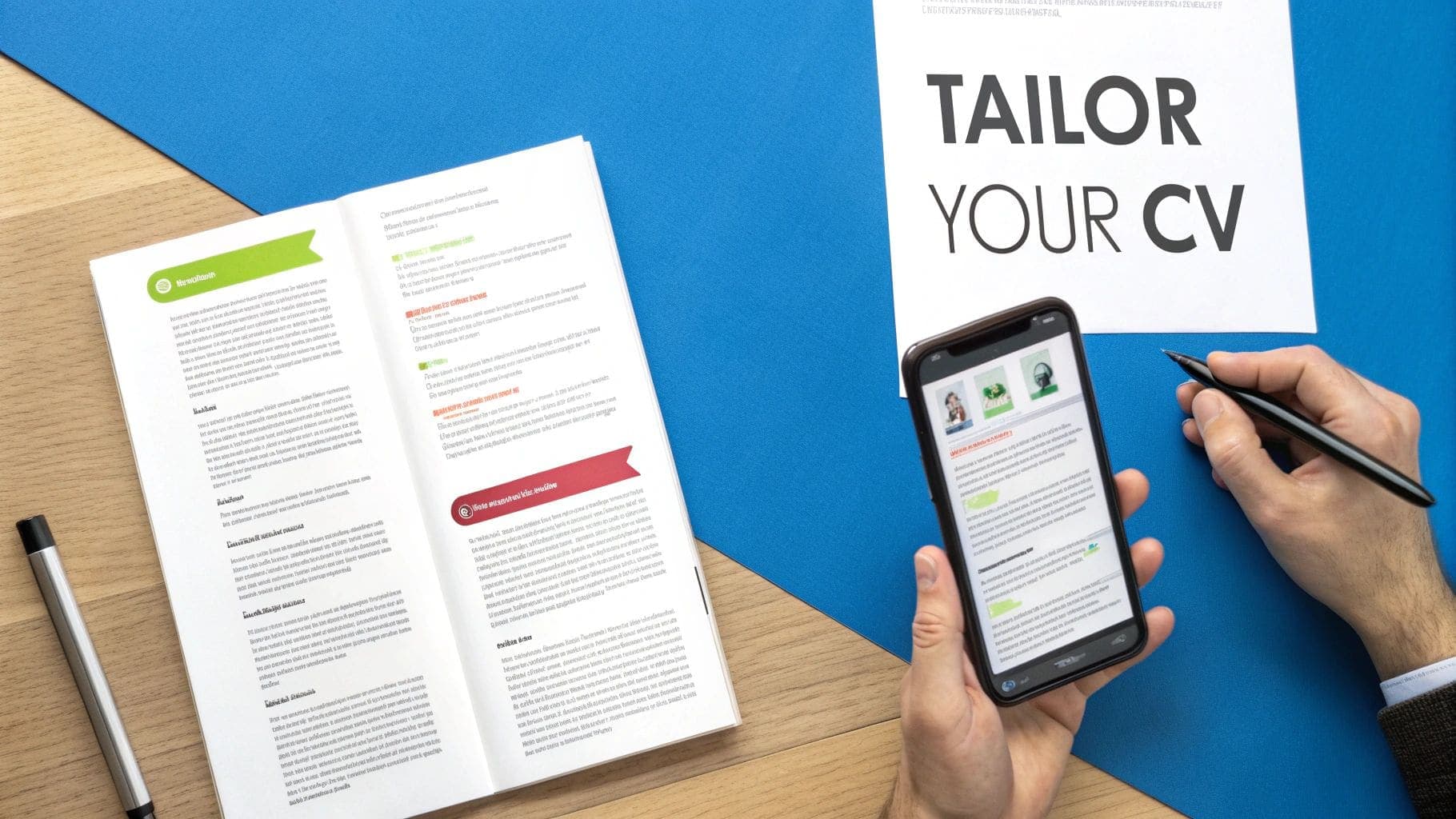
Sending the same generic CV out for every application is one of the fastest routes to the rejection pile. The real art of getting noticed—and getting interviews—lies in tailoring your CV work experience to each specific role.
This isn't about inventing new skills; it's about being a strategic editor. You need to dissect the job description, figure out what the employer really wants, and then reframe your achievements to perfectly mirror their needs. It's a targeted approach that shows you're not just looking for any job, you're the solution to their problem.
Customising your CV is also critical for getting past the Applicant Tracking Systems (ATS). These gatekeeper bots are programmed to scan for keywords and phrases straight from the job description. If your CV doesn't score a high enough match, a human recruiter might never even lay eyes on it.
Dissecting the Job Description
Before you touch a single word on your CV, you need to play detective. Grab the job description, print it out, or pull it up on your screen and get ready to highlight. Your mission is to uncover the employer's core needs.
Here's what to look for:
- Must-Have Skills: Make a note of any essential qualifications, software mentions (like "experience with Salesforce"), or specific methodologies (e.g., "Agile project management"). These are your non-negotiables.
- Key Responsibilities: Pay close attention to how the duties are ordered. If the very first bullet point is "managing client relationships," you can bet that's a top priority.
- Company Values: Skim the "About Us" section. Do they talk a lot about collaboration, innovation, or customer obsession? Weaving these themes into your descriptions shows you'll be a good cultural fit.
- Action Verbs and Keywords: Circle the specific verbs and nouns they use over and over. If they mention "analysing data" and "generating reports" multiple times, those exact phrases should find their way into your work experience section.
Once you've pulled all this out, you have a blueprint for what your CV needs to say.
Prioritising and Rephrasing Your Bullet Points
With your analysis done, it's time to put it into action. The idea is not to rewrite your history, but to adjust the order and emphasis of your existing accomplishments.
A great way to manage this is by keeping a "master CV" that lists every significant achievement you've ever had. Then, for each new application, you can just copy and paste the relevant role and tweak it.
Here's a simple process to follow:
- Reorder Your Bullets: Take the achievement that most closely aligns with the job's number one priority and move it to the very first bullet point under that role. Instant impact.
- Mirror Their Language: Swap your words for theirs. If the job ad asks for someone who "liaised with stakeholders," change your bullet from "talked to clients" to "liaised with key stakeholders." It's a small change that makes a big difference to an ATS.
- Cut the Fluff: An achievement about organising the office party is probably irrelevant for a project manager role. Get rid of it. This frees up precious space for more impactful, role-specific wins.
For a deeper dive, check out our comprehensive guide on how to tailor your CV to a job description, which breaks this down even further.
A Practical Tailoring Example
Let's see how this works in the real world. Imagine this is a 'master' bullet point for a Digital Marketing Manager:
Master Bullet: "Managed a £50k quarterly marketing budget, allocating funds across PPC, SEO, and social media channels to achieve brand goals."
Now, let's adapt this for two very different job ads.
Job Ad 1 (Focus on PPC and ROI):
- Tailored Bullet: "Strategically managed a £50k quarterly budget to drive a 25% increase in conversions through targeted PPC campaigns on Google Ads and LinkedIn."
Job Ad 2 (Focus on SEO and Content):
- Tailored Bullet: "Oversaw a £50k quarterly marketing budget, prioritising investment in SEO and content creation which resulted in a 40% growth in organic website traffic."
The core achievement—managing a £50k budget—is the same. But the emphasis shifts dramatically to align with what each employer cares about most. This is the secret sauce.
This kind of direct alignment is exactly what an ATS-driven JD fit checker is looking for. It wants to see a mirror image of the employer's needs reflected in your CV.
By taking this targeted approach to your work experience, you ensure your most relevant skills are front and centre, dramatically increasing your chances of landing that interview in 2026.
Tackling Career Gaps and Winding Career Paths
A gap in your employment history can feel like a glaring red flag on your CV. But it's time to ditch that mindset. In today's dynamic UK job market, career breaks are incredibly common and absolutely not something you need to hide.
The key is to own your story. It's all about framing those gaps positively and showing recruiters the valuable skills you picked up along the way.
It's not just a feeling, either—it's a statistical reality. By 2025, a staggering 32% of UK CVs showed an employment gap of at least six months. Even more telling? 24% of job seekers had a gap of a year or more. The data is clear: career breaks are the new normal. So, explaining them constructively is far more important than trying to sweep them under the rug.
Instead of leaving a mysterious void on your CV that lets a recruiter's imagination run wild, address the gap head-on. A brief, positive, and honest explanation is all you need.
How to Frame Your Time Away
Your goal is to show that your time off was productive, even if you weren't in a traditional 9-to-5. Focus on the transferable skills you were building during that break.
Here are a few common scenarios and how to spin them:
- Parental Leave or Caregiving: Don't just call it "time off." Emphasise the skills you honed, like project management (running a household is no joke!), budgeting, multitasking, and negotiation. These are gold in any professional setting.
- Travel: This isn't just a holiday. Highlight abilities like cross-cultural communication, meticulous planning, budgeting for a long-term trip, and quick-thinking problem-solving in unfamiliar situations.
- Further Education or Upskilling: This is one of the easiest gaps to explain because it shows ambition. Showcase the new qualifications, certifications, or specific knowledge you gained. It proves you were investing in your career.
- Personal Project or Freelancing: Detail what you were working on. What were the project's goals? What skills did you use (e.g., project management, client communication, web development)? Did you have any tangible results? Spell it out.
If you're using a career break to pivot or specialise, getting clear on different roles is a great first step. For instance, taking the time to differentiate between web design and web development career paths can help you focus your learning and define your goals.
Connecting the Dots of a Non-Linear Career
What if your career path looks more like a winding country road than a straight motorway? Plenty of us have a collection of jobs that seem completely unrelated on the surface. Your job is to find the common thread that ties them all together.
It all comes down to your transferable skills. Think about it. Did your weekend job in retail teach you customer relationship management skills that you now use in your tech sales role? Did your time as a busy barista hone your ability to perform under intense pressure—a skill vital for your current project management position?
Key Insight: Don't make the recruiter do the detective work. Your CV is your chance to build a clear and compelling narrative. Explicitly state how the skills from a previous, seemingly unrelated role directly benefit the new one you're applying for.
Think of yourself as the narrator of your career story. Your CV work experience section is the plot, and the theme is the consistent value you bring, no matter the job title. By weaving these different threads into a cohesive story built on a foundation of solid, transferable skills, you can turn an unconventional path into your greatest asset.
Common Mistakes That Weaken Your Work Experience Section
You've spent hours crafting what you think is the perfect work experience section. Before you hit send, though, there's one last crucial step: a final check for the common slip-ups that can undo all your hard work. A few simple mistakes can get your CV tossed aside in seconds. The biggest culprits are almost always the same: vague language, irrelevant details, and—of course—embarrassing typos.
Even a stellar career history can look weak if it's poorly presented. Think of this as the final polish. It's your chance to make sure every single bullet point is sharp, purposeful, and reinforces why you're the right person for the job.
Vague Language and Relying on Clichés
The fastest way to lose a recruiter's attention is with generic, uninspired descriptions. Phrases like "team player," "results-oriented," or the classic "responsible for" are essentially meaningless filler. They take up precious space on the page without telling anyone what you actually accomplished.
Before:
- Responsible for managing social media accounts.
- Assisted with team projects and was a good team player.
See how flat that feels? Now, let's inject some energy and proof.
After:
- Orchestrated a social media strategy that grew Instagram followers by 35% in six months.
- Collaborated with a five-person project team to deliver the new software feature two weeks ahead of schedule.
The difference is night and day. The "after" examples swap out passive duties for powerful action verbs and back them up with specific, quantifiable results. This is what turns a boring list of tasks into a compelling story of achievement.
Including Irrelevant Details
Your CV is a marketing tool, not your life story. Every single detail needs to earn its spot by being relevant to the job you're applying for right now. Including that part-time retail job from ten years ago is just noise if you're applying for a senior software developer role.
This kind of clutter only distracts from your most impressive qualifications and makes you look unfocused. You need to be ruthless here. If a past role or a specific bullet point doesn't directly support your case for this job, cut it. A shorter, more targeted work experience section is always more powerful than a long, rambling one. If you want to dig deeper into what to leave out, our guide on common ATS CV mistakes is a great place to start.
Final Check: Read your entire work experience section out loud. Seriously. You'll be amazed at how much easier it is to catch awkward phrasing and typos when you hear them spoken. This simple final step can be the difference between getting the interview and getting ignored.
Got Questions? We've Got Answers
Even with the best guide in hand, a few tricky questions always pop up when you're trying to get your CV just right. To clear up those common sticking points, we've put together some quick, straightforward answers to the queries we hear most from UK job seekers. Think of this as the final polish before you hit 'send'.
How Far Back Should My Work Experience Go on a UK CV?
For most professionals, the sweet spot is the last 10-15 years. This keeps your CV focused on your most recent, relevant experience.
If you've got a longer career history, don't feel like you need to detail every single role since you left school. You can bundle older, less relevant positions under a simple heading like "Previous Professional Experience" without any bullet points. Always lead with what's most recent and impressive.
Is It a Good Idea to Put Volunteer Work on My CV?
Absolutely. If the volunteer role is relevant to the job you want or it neatly fills an employment gap, it's incredibly valuable. Treat it just like you would a paid position: give yourself a proper title, name the organisation, and use those achievement-driven bullet points we talked about.
What recruiters really care about is relevant experience—whether you were paid for it is usually secondary.
Honestly, well-described volunteer work can be a real game-changer. I've seen it tip the scales for candidates, especially in the third sector or when they need to prove skills like project management or leadership.
What if I Have No "Real" Work Experience to Show?
If you're just starting out, the game is all about showcasing transferable skills. You might not have a long list of jobs, but you definitely have experience. Instead of a "Work Experience" section, simply title it "Experience."
Under this heading, you can feature things like:
- Internships or work placements
- Major university or college projects
- Part-time jobs (even if they feel unrelated!)
- Leadership roles in clubs or societies
Your goal here is to connect the dots for the hiring manager. Use specific examples from these experiences to prove you've got what they're looking for—teamwork, communication, problem-solving, you name it. This shows you're proactive and have potential, making your CV compelling even without a list of 9-to-5s.
--- Ready to build a CV that actually gets you noticed? CV Anywhere gives you the tools you need, from an AI-powered builder to a JD Fit Checker that makes sure every application is perfectly targeted. Stop guessing and start landing interviews. Try our smart CV platform today.