If you're asking how can i make my cv better, the short answer is this. Stop treating it like a job history and start treating it like evidence. A better CV shows what changed because you were there, makes that impact easy to scan, and is specifically designed for the role so both recruiters and ATS software can understand it quickly.
Most weak CVs fail in three places. They list duties instead of outcomes, open with a bland profile, and use the same version for every application. Fix those three things first and your CV will read like a serious professional document rather than a placeholder.
Transform Your Experience from Duties to Achievements
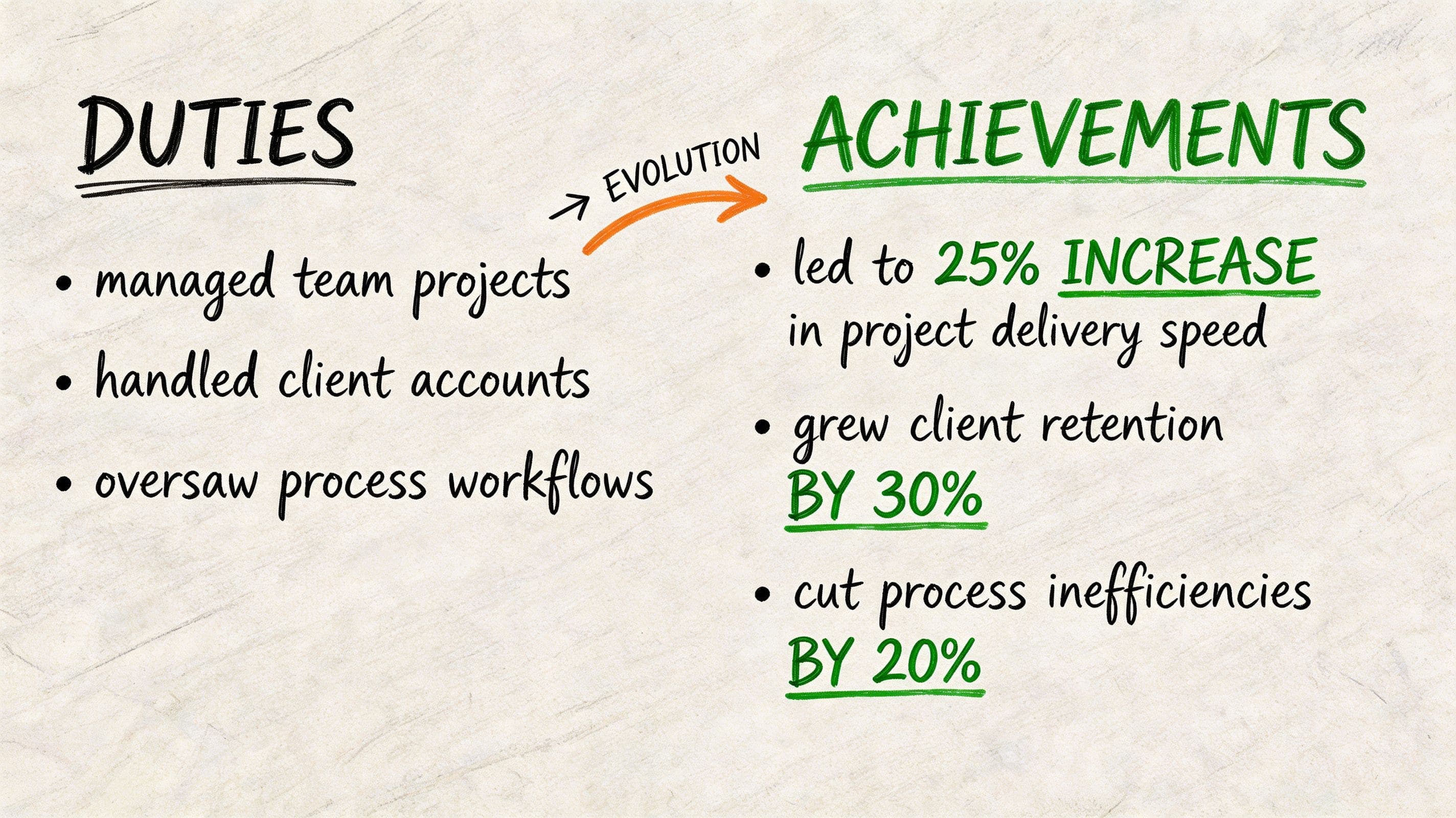
The biggest upgrade you can make is simple. Replace passive duty statements with achievement statements.
A recruiter doesn't need proof that you turned up and did the basic shape of the job. They want to know whether you improved something, handled real responsibility, or produced useful results. That matters because recruiters spend 7 to 10 seconds scanning CVs at first glance, and CVs with metrics can receive up to 40% more interview callbacks, according to Recruitment Junky's guidance on quantifying your CV.
Use the three-part bullet formula
Every strong bullet point follows the same logic:
Action verb + specific task + measurable result
That structure forces clarity. It also stops you writing vague lines like "responsible for admin support" or "helped with campaigns", which say almost nothing.
Try rewriting your bullet points in this order:
- Start with a sharp verb like managed, improved, coordinated, delivered, reduced, created, analysed, trained, launched.
- Name the task clearly so the reader knows what you did.
- Add a result, scale, or scope using a number, range, ranking, budget, frequency, team size, or workload.
If you don't have exact figures, use a truthful range or volume. That still gives the reader context.
Practical rule: If a bullet could apply to almost anyone in the same role, it isn't strong enough yet.
Before and after examples
Here's what this looks like in practice.
| Before | After |
|---|---|
| Responsible for diary management and admin support | Coordinated diary management, meeting logistics, and document preparation for a busy team, handling 15 to 20 client interactions every week |
| Helped customers on the shop floor | Assisted customers with product selection, tills, and stock queries, serving 15 to 20 customers per shift |
| Worked on marketing content | Produced marketing content across email and blog channels, editing five to seven blogs per week |
| Managed budgets | Managed a budget exceeding £25,000 and tracked spend against department priorities |
| Good sales performance | Ranked as the number one salesperson for three consecutive months |
Notice the difference. The "before" version describes a role. The "after" version proves contribution.
What counts as a useful metric
People get stuck here because they think every bullet needs a percentage. It doesn't.
Use whatever honestly shows scale:
- Money handled such as a budget exceeding £25,000
- Ranking or performance position such as being the number one salesperson for three consecutive months
- Volume and frequency such as served 15 to 20 clients every week
- Output such as edited five to seven blogs per week
- Growth or improvement such as oversaw a 37% growth in new client acquisition
That last example works well because it says exactly what improved. "Significantly increased client acquisition" sounds inflated. "Oversaw a 37% growth" sounds like something you could defend in an interview.
Better wording for common roles
A few quick rewrites by job type:
Administration
- Weak: "Responsible for office support"
- Better: Organised travel, scheduling, and document support for a multi-person team, keeping daily operations on track across competing priorities
Retail
- Weak: "Worked in a fast-paced environment"
- Better: Handled customer queries, tills, and stock replenishment during busy trading periods, serving high volumes of customers while maintaining accurate transactions
Marketing
- Weak: "Helped with social media"
- Better: Created campaign content and coordinated publishing across channels, supporting consistent weekly output and campaign delivery
Graduate or early career
- Weak: "Assisted with research"
- Better: Reviewed 40 to 50 articles per week and summarised findings for project stakeholders
If your work experience section still reads like a task list, start there. It usually gives the fastest improvement. For more examples of how to build this section properly, see this guide to writing stronger CV work experience.
Does your CV clearly show results for each role?
Turn a weak CV into a stronger one
Upload your CV → get stronger wording instantly → fix the weakest parts first.
No need to rewrite. Start with your current CV.
Write a Professional Profile That Hooks Recruiters
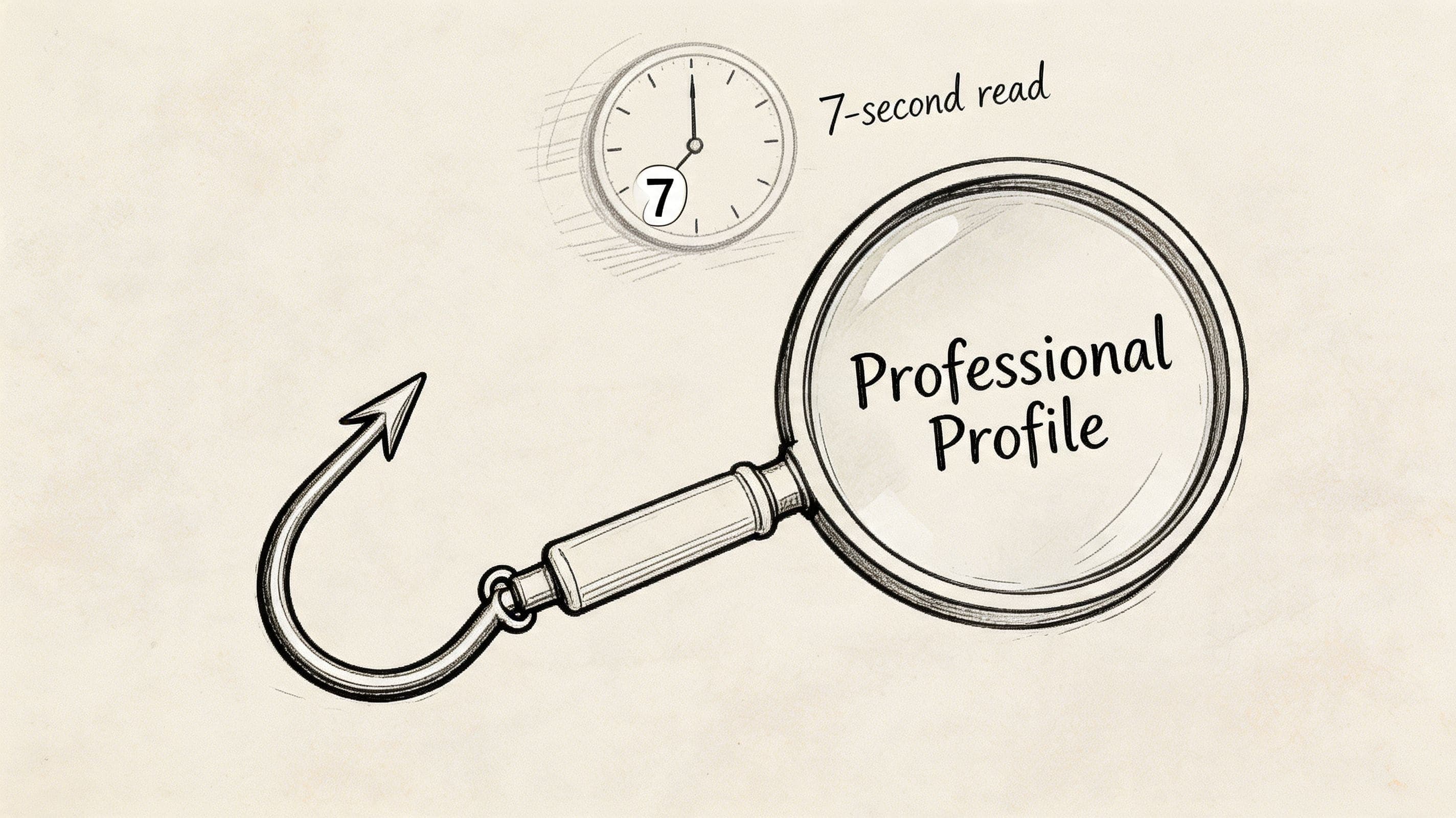
Your professional profile sits near the top of the page, which means it has one job. It must give the recruiter a reason to keep reading.
Recruiters scan CVs in an F-pattern, with heavy attention on the top section and your latest role, as explained in Valor Software's article on CV scanning patterns. That means a vague opening wastes premium space.
Use a three-sentence profile
A strong UK CV profile is usually three sentences.
Sentence one: who you are professionally
Sentence two: your strongest evidence
Sentence three: what role you're targeting and why you're a fit
This works because it gives identity, proof, and direction in very little space.
A profile should summarise your value, not repeat your job title and adjectives.
Example for a recent graduate
Before
Recent graduate looking for an opportunity to develop skills and gain experience in a professional environment.
After
Business graduate with experience in administration, research, and customer-facing support across university projects and part-time work. Reviewed 40 to 50 articles per week for academic research and supported busy teams with scheduling, customer queries, and written communications. Now targeting an entry-level operations or project support role where strong organisation and analytical skills are valued.
The second version is better because it sounds employable. It points to evidence and gives a credible direction.
Example for an experienced professional
Before
Hard-working manager with excellent communication skills and a proven track record of success.
After
Operations manager with experience leading service delivery, staff coordination, and process improvement in fast-moving environments. Managed a budget exceeding £25,000 and led teams while improving workflow efficiency and service standards. Seeking a senior operations role where commercial awareness, team leadership, and delivery discipline are central.
That profile tells the reader what kind of professional they're looking at within seconds.
What to leave out
Don't waste your profile on filler like this:
- "Hard-working team player". Every applicant says it.
- "Seeking a challenging position". That's about what you want, not what you offer.
- "Results-driven professional with excellent interpersonal skills". Empty unless you prove it straight after.
Keep it grounded. Use facts from your own experience. If you need help shaping the opening, this guide to writing a better CV personal statement is a good next step.
Optimise Your CV for Both Robots and Recruiters
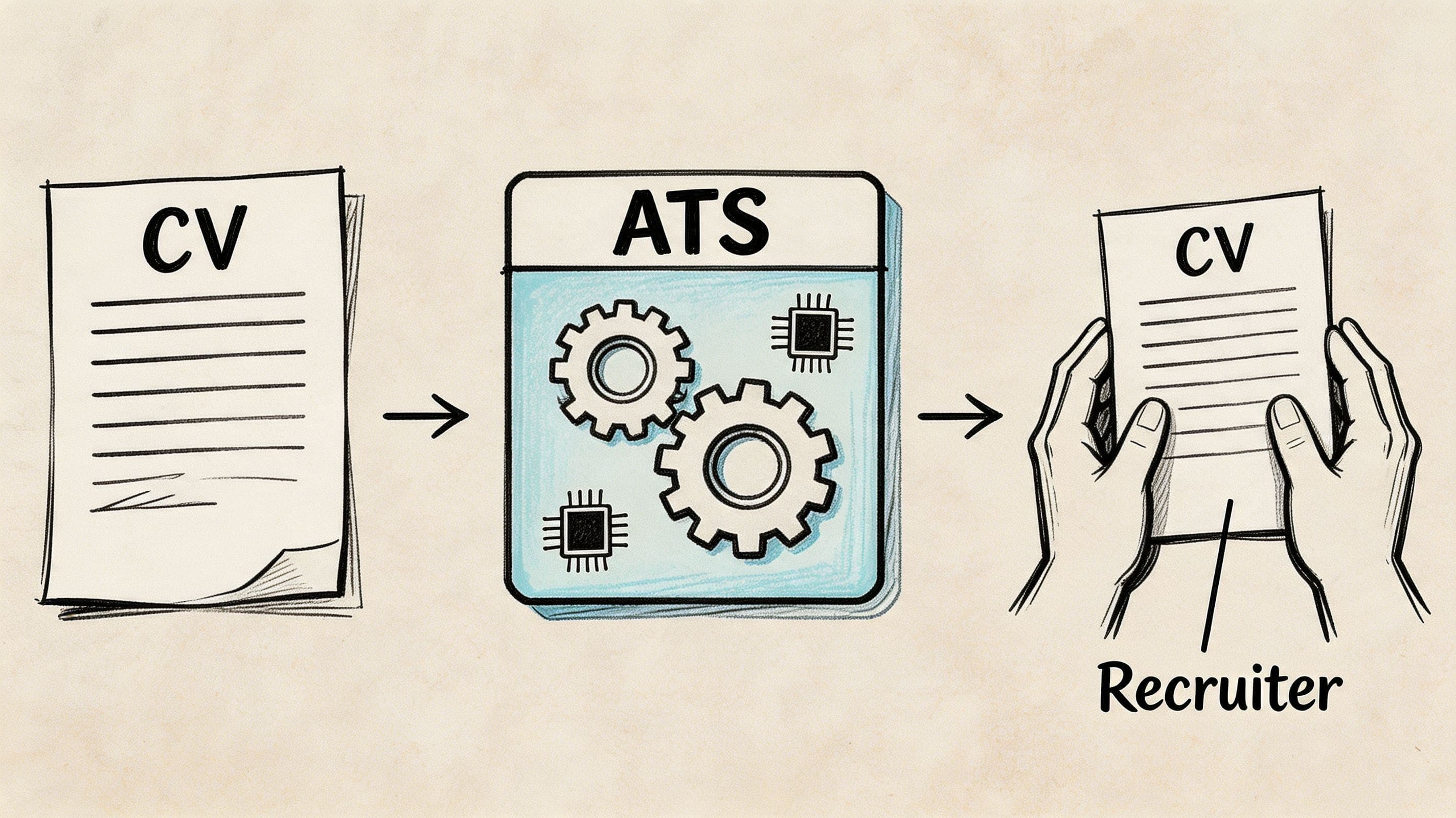
A better CV has to satisfy two audiences. First the software, then the person.
Most applicants focus only on the human reader. That's a mistake. Applicant Tracking Systems reject an estimated 75% of CVs due to missing keywords from the job description, while CVs adapted to the job can achieve up to 60% higher pass rates, based on Coursera's resume improvement guidance.
Read the job description like a filter
A job description tells you what the employer is likely to search for. Not just skills, but exact wording.
If the advert says:
- stakeholder management
- project coordination
- budgeting
- Excel
- reporting
- cross-functional collaboration
then your CV needs those ideas in plain language, assuming you have them. Don't hide them under softer alternatives like "worked well with different teams" if the employer is clearly using "cross-functional collaboration".
A manual tailoring workflow that actually works
It's often said to 'tailor your CV' and leave it at that. Here's the practical version.
- Paste the job description into a notes document.
- Highlight repeated skills, tools, and responsibilities.
- Pick the core terms that match your background.
- Update your profile so it reflects the role you're applying for.
- Reorder your bullets so the most relevant evidence appears first.
- Adjust your skills section to mirror the language in the advert.
Many applicants make an error here. They add keywords in a pile at the bottom. Recruiters don't read CVs that way, and ATS software often gives better results when important terms appear naturally across the document.
Use tools when manual matching becomes slow
Tailoring one CV is manageable. Tailoring ten in a week is where people start cutting corners.
That's where JD Fit Checkers can help. Instead of guessing whether your CV matches the advert, they compare the two and show you what you're missing. The same principle is used more broadly in AI for document processing, where software analyses structured and unstructured documents to identify patterns, gaps, and extractable information.
What works: using AI to identify mismatch and then applying human judgement to fix it.
What doesn't: letting AI spray generic buzzwords across your CV.
A good tool should help you spot missing terminology, not replace your judgement about what you've done.
Keep formatting machine-readable
ATS optimisation isn't only about words. Layout matters too.
Don't make the software guess. Keep your CV easy to parse with:
- Standard section headings such as Profile, Work Experience, Education, Skills
- Simple bullet points rather than graphics
- Single-column structure for core information
- Clear dates and job titles in a consistent format
Avoid tables, text boxes, icons, and decorative design tricks for important content. These often look polished to you and scrambled to software.
For a more detailed UK-specific checklist, read this guide to building an ATS-friendly CV in the UK.
Structure and Format Your CV for Instant Clarity
A good CV shouldn't need decoding. The reader should know where to look and what matters within seconds.
In the UK, the safest structure for most job seekers is reverse chronological order. Start with your current or latest experience and work backwards. That matches how recruiters usually scan and makes career progression easy to understand.
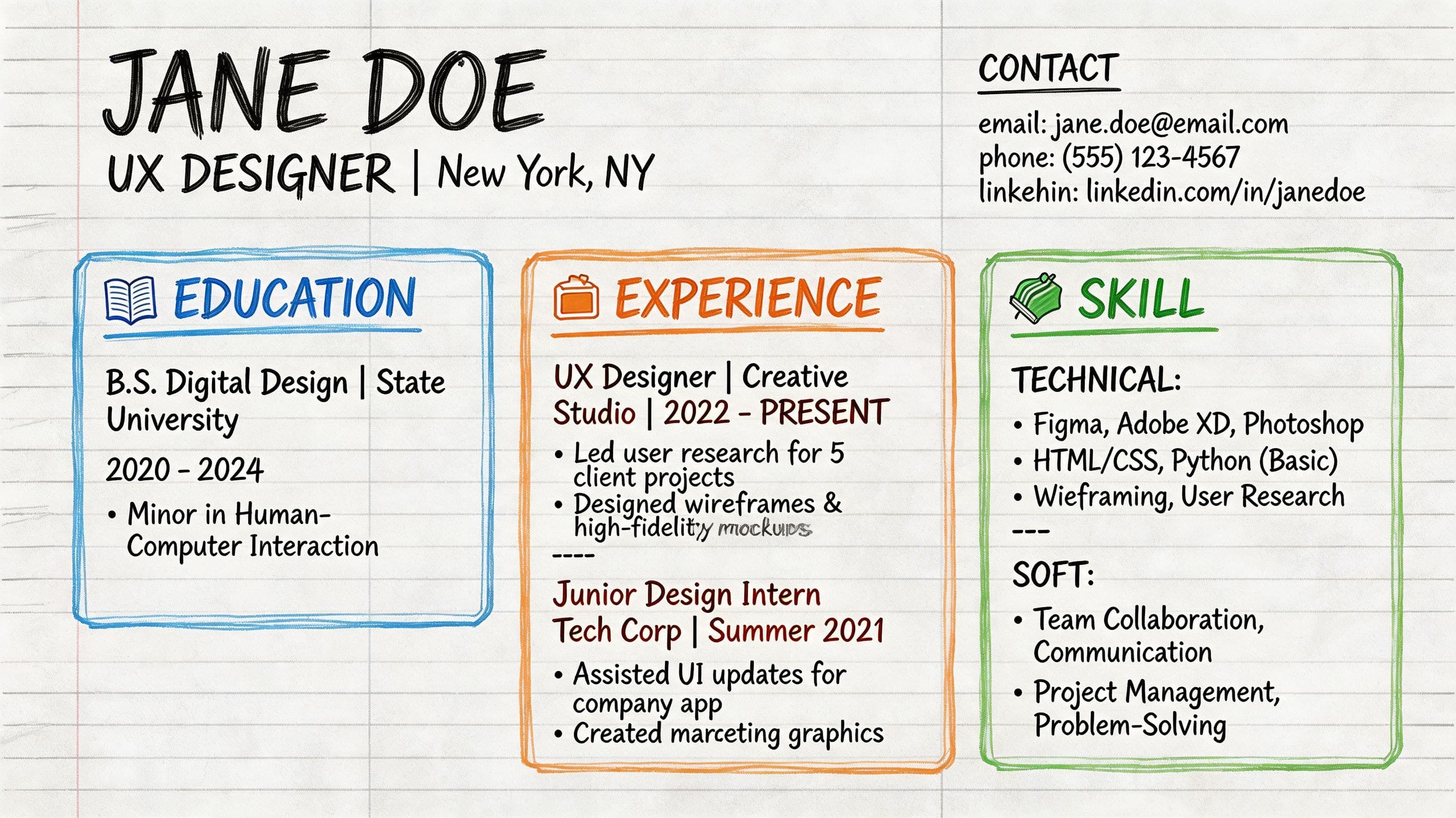
Use this section order
For most UK applications, this order works well:
- Contact details
- Professional profile
- Work experience
- Education
- Skills
- Optional extras such as certifications or relevant projects
That order puts your strongest commercial value first. If you're a recent graduate with very limited experience, you can bring education slightly higher, but don't do that by default.
The design trade-off most people miss
Formatting advice often swings too far in one direction. Some CVs are plain to the point of looking careless. Others are so designed they become unreadable to hiring systems.
That's a real issue. Over 75% of large employers use ATS systems, and those systems can struggle with complex formatting, as noted in Indeed's guide to enhancing your CV. The goal is balance. Make it clean enough for software and pleasant enough for a human being.
Quick formatting checklist
Use this as a final review:
- Keep it to two pages for most professional UK CVs
- Use a professional font such as Calibri or Arial
- Leave white space so sections don't crash into each other
- Make headings obvious and consistent
- Use bold sparingly for job titles, employers, and key results
- Save as PDF unless the employer asks for another format
- Remove clutter like full postal addresses, references, or oversized profile paragraphs
Clean layout signals good judgement. Messy layout makes the reader expect messy work.
If you want a benchmark layout, use a reliable UK CV format guide and compare your document against it line by line.
Avoid These Common UK CV Mistakes
Some CV problems aren't dramatic. They're just enough to make a recruiter move on.
The most common one is using a generic CV for every role. That approach tells the employer you want a job, but not necessarily this job. It also creates technical risk. With 99% of Fortune 500 companies and 75% of mid-sized firms using ATS, CVs without quantified achievements are filtered out 60 to 70% more often, according to Indeed's advice on quantifying a resume.
Mistake one: listing duties with no proof
A CV full of "responsible for", "assisted with", and "in charge of" reads flat. It creates no urgency to interview you because nothing distinguishes you from the next applicant.
Fix it by rewriting bullets around outcomes, scale, and evidence.
Mistake two: using a profile full of buzzwords
"Dynamic self-starter", "motivated team player", "results-oriented professional". These phrases don't help because they aren't specific enough to test.
Replace them with plain professional language and actual proof from your background.
Mistake three: adding a photo on a standard UK CV
For most UK roles, a photo isn't needed and often works against you. It uses space better spent on evidence and can make the CV look imported from another market rather than aligned with local expectations.
There are exceptions in some industries, but for typical office, graduate, operations, retail, public sector, and professional roles, leave it off.
Mistake four: keeping irrelevant detail
Old hobbies, outdated software, school achievements from years ago, and references available on request all take up room that should be doing harder work.
Cut anything that doesn't support your target role.
- Remove weak filler such as generic interests unless they add real relevance
- Trim outdated skills that no longer strengthen your case
- Drop references unless specifically requested
- Delete duplicated content between profile, skills, and experience
Mistake five: sending without a proper proofread
One typo won't always kill an application, but a pattern of rushed mistakes changes how the reader judges you. If the role needs accuracy, your CV is already acting as a work sample.
Read it aloud. Check dates. Check tense. Then ask someone blunt to read it, not someone who will only say "looks good".
A CV usually loses force through small avoidable errors, not one dramatic mistake.
Your CV Improvement Questions Answered
Some CV issues only appear once you're polishing the final version. These are the questions that come up most often.
Quick answers to common CV questions
| Question | Recommendation |
|---|---|
| How long should my CV be? | Keep it to one or two pages for most UK roles. Use two if you have enough relevant experience to justify it. |
| Should I include a photo? | Usually no for a standard UK CV. Use the space for evidence instead. |
| What should I do about a career gap? | Name it honestly and briefly if needed, then show what kept your skills current. |
| How do I show a promotion at the same company? | Split the roles clearly so progression is obvious. |
| Should I include references? | Not unless the employer asks for them. |
How do I explain a career gap without making it look worse
Keep it factual. Don't write a defensive paragraph.
You can handle it in a short line such as parental leave, caring responsibilities, study, retraining, travel, or health-related leave if you're comfortable naming it. Then shift the focus to what came next. If you completed relevant study, freelance work, volunteering, or self-directed projects, include that evidence.
How should I show a promotion in one company
Don't lump everything under one title if your responsibilities changed.
Use the company name once, then list each role beneath it with separate dates and bullet points. That makes progression visible at a glance, which is exactly what the recruiter wants to see.
Should I change my CV for every application
Yes, but don't rewrite from scratch every time.
Keep a strong master version and then adjust the profile, key skills, and bullet order for each role. That's much faster and usually produces a sharper result than trying to invent a new CV every time.
Can someone review my CV before I apply
They should, if possible. A second pair of eyes usually spots weak wording, layout issues, and missing context faster than you will after staring at the same file for hours.
If you want a benchmark for what good feedback should cover, look at this guide on CV and resume review.
A better CV isn't about sounding more impressive. It's about becoming easier to trust. Strong evidence, clear structure, and specific wording do most of the heavy lifting. If you want help turning a rough draft into an ATS-friendly, targeted CV, CV Anywhere gives you a builder, JD Fit checking, and application tracking in one place so you can spend less time guessing and more time applying well.