An AI resume builder is a smart software tool designed to help US job seekers write, optimize, and customize their resume for specific jobs, giving you a powerful advantage in today's competitive market. By analyzing job descriptions and suggesting targeted keywords, an AI resume builder significantly increases your chances of getting past automated screening systems and landing an interview. Think of it as having a personal career coach on call 24/7, ready to give you a serious edge in a crowded job market.
What Is an AI Resume Builder and Why It Matters Now
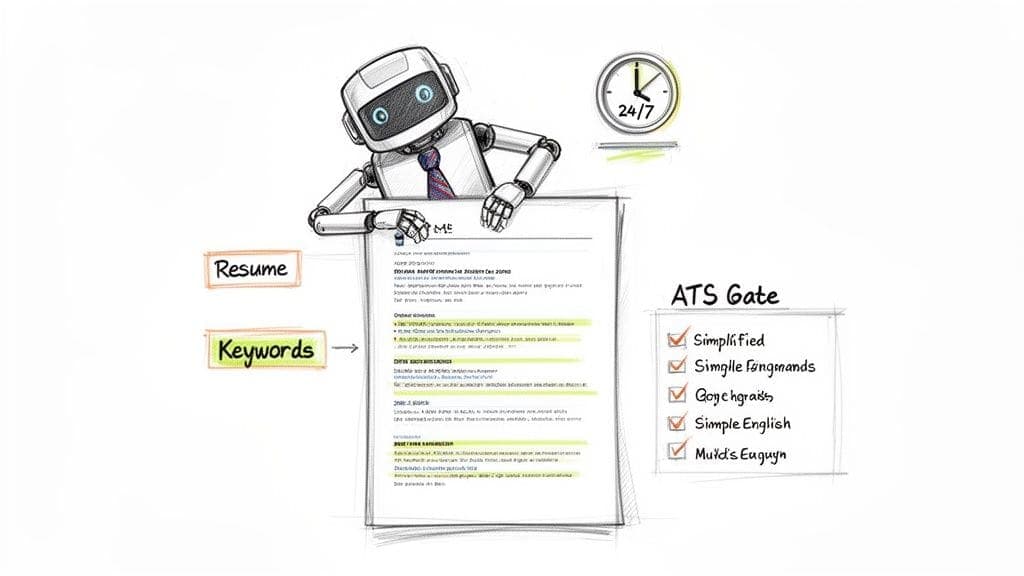
At its core, an AI resume builder is a platform built to create a polished, effective resume much faster and more strategically than you could on your own. It goes way beyond basic templates by actively analyzing job descriptions, pulling out critical keywords, and suggesting powerful ways to frame your achievements.
This isn't just about filling in blanks. These tools are engineered to make sure your resume sails through Applicant Tracking Systems (ATS)—the automated gatekeepers that over 99% of large US companies use to screen out candidates before a human ever sees their application.
The Urgency in the 2026 US Job Market
The modern US job search is no longer a simple human-to-human conversation. With hiring practices shifting and more than 1.17 million U.S. jobs cut in 2025, the pressure to optimize your resume has never been greater.
Your resume now has to impress two very different audiences: the recruiting software and the actual hiring manager. This new reality makes an AI resume builder an essential part of your toolkit, helping you navigate a hyper-competitive environment where just getting noticed is a huge win.
An AI resume builder's primary job is to get your resume past the robots and onto the recruiter's screen. It translates your experience into the language that both algorithms and hiring managers understand.
Manual vs AI Resume Building A Quick Comparison
To see the practical difference, let's compare the old way of writing a resume with the new, AI-assisted method. The table below breaks down exactly where you gain an advantage in speed, optimization, and overall effectiveness.
| Feature | Manual Resume Writing | AI Resume Builder |
|---|---|---|
| Speed | Takes hours or even days to write, edit, and tailor. | Generates a strong first draft in just minutes. |
| Optimization | Relies on guesswork for keywords and ATS formatting rules. | Automatically analyzes job descriptions for crucial keywords. |
| Customization | Requires a major effort to tailor your resume for each job. | Tailors your resume for a new role in only a few clicks. |
| Formatting | High risk of using ATS-unfriendly designs or making errors. | Uses proven, ATS-compatible templates every time. |
Simply put, these tools give you a critical advantage, helping you craft a professional story that gets results. As we'll dig into next, knowing how to use an AI resume builder is a key skill for any serious job seeker in 2026.
For a deeper look into the world of AI-powered resume creation, check out this complete guide on AI resume builders.
Build a resume that actually gets interviews
Start from your current resume — or from scratch — with step-by-step guidance so you do not get stuck.
Free. No blank page. No templates to wrestle with.
How AI Actually Upgrades Your Resume
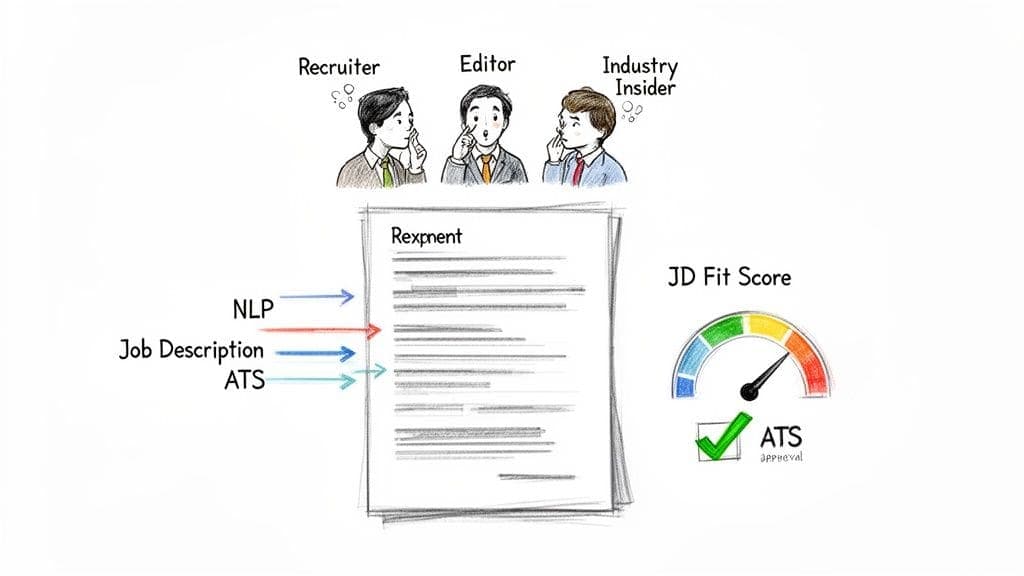
An AI resume builder is like having a seasoned recruiter, a sharp-eyed editor, and an industry insider all looking over your shoulder. It uses a technology called Natural Language Processing (NLP) to read and understand your career history, much like a person would.
It then cross-references your experience against a specific job description, pinpointing the exact skills and keywords the hiring manager is looking for. This is what separates a generic, easily-ignored resume from a document that lands interviews. It's not about just listing your past jobs; it's about framing them to show your direct value to that specific employer.
Understanding the Core Technologies
At the heart of any decent AI resume builder is NLP. Think of it as the engine that allows the software to grasp the meaning and context behind the words on your resume and in the job post. It's the same tech that helps your phone's voice assistant understand what you're asking for.
The AI uses this to run a side-by-side comparison, highlighting your strengths and, just as importantly, flagging any gaps. Doing this manually for every single application would take hours. While full-scale builders handle the whole document, there are also specialized AI writing tools for your LinkedIn profile that focus on perfecting individual sections, all using similar principles.
The core function of resume AI is translation. It translates your career history into the precise language that both automated systems and human recruiters are trained to look for.
Defeating the ATS Gatekeeper
One of the biggest upgrades AI brings to the table is ATS optimization. Applicant Tracking Systems are infamous for kicking out qualified candidates just because of a simple formatting error or a missing keyword. A good AI resume builder is built to stop that from happening.
It makes sure your document plays by the unspoken rules that keep it readable for these screening bots:
- Clean Formatting: It sticks to single-column layouts and standard fonts that parsers can process without getting confused.
- Keyword Integration: The AI scans the job description and suggests how to weave essential terms (like "project management" or "data analysis") naturally into your experience.
- Standard Sections: It organizes your history under universally recognized headings like "Work Experience" and "Skills," ditching weird custom titles that trip up the software.
This optimization gives your resume a fair shot, massively increasing the odds it lands on a recruiter's screen instead of in a digital black hole. For a deeper dive, you can learn how to use AI to write a resume that beats ATS every time.
The Power of a JD Fit Score
Maybe the most practical feature is the Job Description (JD) Fit Score. This is a real-time grade showing you exactly how well your resume lines up with a target job. No more guessing. The AI gives you a clear percentage and, better yet, a punch list of specific, actionable steps to improve it.
For instance, the tool might tell you to:
- Add a specific technical skill mentioned in the job requirements.
- Tweak a bullet point to include a key industry term.
- Quantify an achievement to show real impact (e.g., "Increased sales by 15%").
This feature turns resume writing from a frustrating guessing game into a clear-cut strategy. By following the AI's guidance, you can systematically close the gaps and craft a resume that's perfectly tailored for the opportunity right in front of you.
The Real-World Benefits of Using an AI Resume Builder
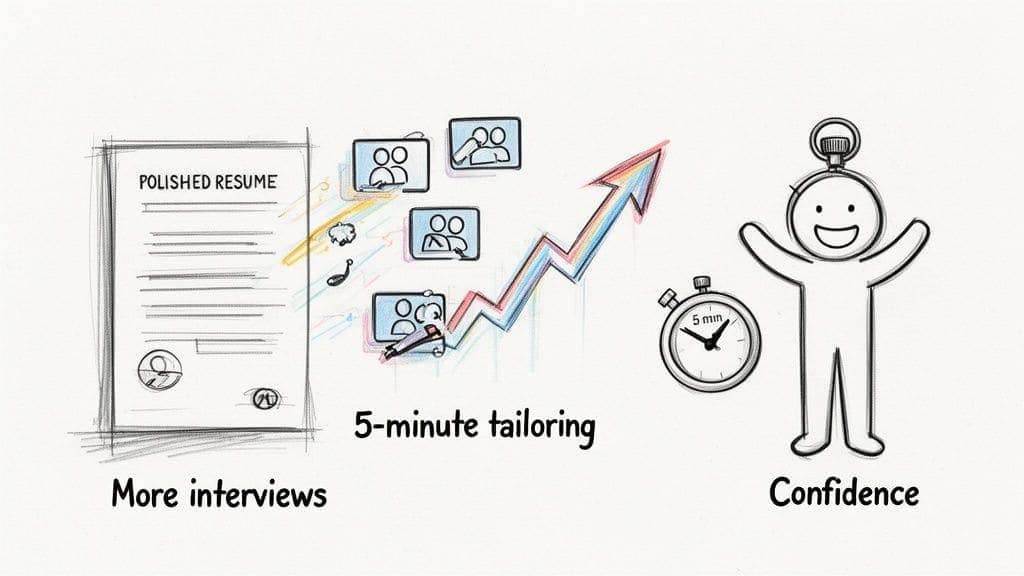
Let's cut to the chase. The biggest reason to use an AI resume builder is simple: you will get more interviews. These tools do more than just format a document; they give you back hours of frustrating work, boost your confidence, and turn the chore of tailoring your resume into a five-minute task.
Writer's block vanishes. Instead of staring at a blinking cursor, you get powerful, metric-driven bullet points and professional summaries that immediately catch a recruiter's eye.
This shift in efficiency is why the resume builder market, valued at $8.86 billion in 2025, is expected to hit $9.52 billion in 2026. Job seekers need tools that create standardized, ATS-friendly documents for modern hiring. You can discover more insights about this resume market growth on thebusinessresearchcompany.com.
From Blank Page to Polished Application in Minutes
Staring at a blank page is one of the most paralyzing parts of a job search. An AI resume builder breaks through that inertia instantly. By analyzing your history and a target job description, it gives you a solid foundation to build from.
Instead of fighting to put your value into words, you get AI-generated suggestions already packed with the right keywords and action verbs. This lets you focus your energy on refining the details, not creating them from scratch.
The real power here is speed combined with quality. It's not just about being faster; it's about being better and more strategic with your time.
This means you can apply to more relevant jobs without the burnout that comes from rewriting your resume over and over again.
Unlock Hidden Skills and Confidently Change Careers
Career changers often have a tough time connecting their past experience to a new field. An AI resume builder is incredibly good at finding and highlighting these transferable skills.
Take the story of a project manager who wanted a job in marketing operations. They worried their resume, full of construction jargon, wouldn't be taken seriously.
- Before AI: The resume was heavy on phrases like "overseeing construction crews" and "managing material procurement."
- AI Analysis: The tool zeroed in on core skills like "stakeholder coordination," "resource allocation," and "timeline optimization."
- After AI: The bullet points were reframed to highlight those skills. "Overseeing crews" became "Coordinated cross-functional teams to meet project milestones"—a perfect match for a marketing ops role.
This small shift in language gave the candidate the confidence to apply for jobs they previously thought were out of reach. The AI didn't invent skills; it just translated their experience into the language of the new industry.
Achieve Consistent Quality and Professionalism
Even tiny mistakes in formatting or tone can make a resume look amateurish. Manually keeping everything consistent across different versions is tedious and easy to mess up.
An AI resume builder acts as your quality control, enforcing a high standard every time. It makes sure your document uses a professional, ATS-friendly template, maintains a consistent tone, and presents your accomplishments in a clear, compelling way.
This frees you from sweating the small stuff so you can focus on the big picture: telling your career story effectively.
Ultimately, these platforms give you three core advantages:
- Time Savings: Slash the time you spend writing and tailoring resumes.
- Increased Confidence: Apply for jobs knowing your resume is optimized and professional.
- More Opportunities: By applying to more targeted roles, you significantly increase your chances of landing an interview.
Choosing the Right AI Resume Builder for You
With so many AI resume builder options flooding the US market for 2026, picking the right one can feel like a job in itself. The best tool acts as a strategic partner, helping you navigate the modern job hunt. The wrong one? It's just a waste of time and money.
The secret is to look past the flashy designs and focus on what actually gets you interviews: high-quality AI suggestions, real ATS compatibility, and a solid privacy policy. A great platform doesn't just slot your words into a template; it gives you clear, data-driven feedback to close the gap between your resume and what a recruiter is looking for.
This is what a modern, effective platform should look like—a central hub for all your job search activity.
A unified dashboard like this one from CV Anywhere brings your resume builder, job description analyzer, and application tracker into a single, organized space.
Your Evaluation Checklist
Not all AI tools are built the same. Before you commit to a platform, it's smart to run it through a quick evaluation. A few key questions can reveal whether a tool is genuinely helpful or just another pretty template filler.
To make things easier, here's a table you can use as a checklist when comparing different AI resume builders.
Key Features to Look for in an AI Resume Builder
| Feature | Why It Matters | What to Look For |
|---|---|---|
| Quality of AI Suggestions | Good AI helps you sound professional and outcome-focused. Bad AI just gives you generic, clichéd phrases. | Does the tool offer context-aware suggestions based on the job description? Does it explain why a suggestion is better? |
| True ATS Compatibility | Over 75% of large companies use an ATS. If your resume can't be read by the software, it won't be seen by a human. | Look for clean, single-column layouts and standard fonts. Avoid busy, multi-column designs that confuse parsers. |
| Modern & Professional Templates | Your resume needs to impress a human in about seven seconds, but it also has to be simple enough for a bot to read. | The design should be clean, readable, and professional. It needs to look good without sacrificing scannability. |
| Data Privacy Policy | You're uploading sensitive personal and professional information. You need to know where it's going. | Check for a clear, transparent privacy policy. It should explain how your data is stored, used, and protected. |
Ultimately, a good builder gives you confidence. It should provide features that empower you, not just spit out a document and wish you luck.
Free vs. Paid Platforms: When to Invest
Free tools are a decent place to start. They can help with basic formatting and offer simple suggestions to get you on the right track. But they almost always come with limits on downloads, templates, or the more advanced AI features.
Think of a paid AI resume builder as a direct investment in your career. If you're in a competitive field, changing careers, or applying to a lot of jobs, the premium features are almost always worth the small cost.
Investing in a premium tool is what unlocks the most powerful capabilities:
- In-Depth JD Fit Score: Get a detailed analysis and a clear, actionable plan to perfectly align your resume with a specific job post.
- Unlimited Resume Variations: Quickly create and save multiple tailored versions of your resume for different roles, without starting from scratch each time.
- Application Tracking: An integrated tracker helps you manage your entire job search campaign, from the first application to the final follow-up.
Essential Features for a Strategic Job Search
To go beyond just making a document and start running a proper job search campaign, you need a platform that pulls key tools together. For instance, a built-in JD Fit Checker is critical. It scores your resume against a live job description and gives you a clear roadmap for improvement, turning a good resume into a great one.
An Application Tracker is also a total game-changer. It replaces messy spreadsheets and scattered notes with a central system to manage every role, contact, and interview stage. For a detailed comparison of the top platforms that offer these kinds of integrated features, you can check out this list of the best online resume builders for 2026. Choosing a tool with these functions transforms your job search from a series of disconnected tasks into a well-managed, successful project.
Your Step-By-Step Guide to Creating an AI-Powered Resume
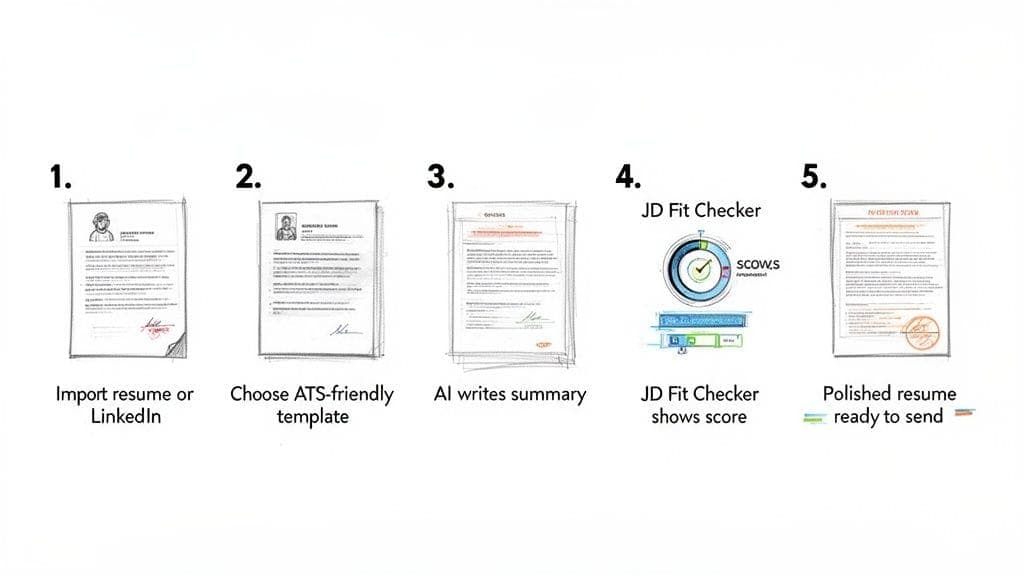
Ready to see how fast you can build a resume that actually gets traction? This guide breaks down the process into five simple steps. In just a few minutes, you can go from scattered information to a polished, high-impact document.
The core idea is simple: you provide the raw material, the AI does the heavy lifting, and you act as the final editor. You'll import your data, generate powerful content, pick an ATS-friendly template, and then fine-tune it against a specific job description. This is how you beat the bots and get in front of a real person.
This kind of strategic resume building is why the market is exploding. The global AI Resume Builder market is on track to hit $2 billion by 2025 and is expected to grow at a 15% CAGR through 2033, with the US leading the charge. This isn't just about templates; it's about personalized content, skill gap analysis, and career insights that basic tools can't touch. You can see the full research on the AI resume builder market for a deeper dive.
Step 1: Start With Your Existing Information
First, you need to give the AI something to work with. The good news is you don't have to start from scratch. The best platforms make it easy to get your career history loaded in seconds.
You'll generally have two choices:
- Upload an old resume: The system will instantly parse your document, extracting your work history, education, and skills into a structured format.
- Import your LinkedIn profile: A single click can connect your LinkedIn account, pulling in all your professional details automatically.
This first step saves a ton of time and makes sure no important details from your past get left behind. It's the foundation for everything that comes next.
Step 2: Let the AI Write Your First Draft
With your information loaded, it's time to put the AI to work. This is where you can instantly overcome writer's block and generate a strong professional summary and impactful bullet points.
Just give the AI a target job title. It will analyze your experience and write a compelling summary that puts your most relevant strengths front and center. It will also suggest achievement-focused bullet points, packed with strong action verbs and, where possible, measurable results.
Your job here is to be the editor, not the writer. Look through the AI's suggestions, choose the ones that feel right, and make small edits to match your personal tone.
This step ensures your resume starts off with professionally written, keyword-rich content that's ready for the next stage.
Step 3: Choose a Professional, ATS-Friendly Template
Now that your content is solid, it's time to pick a design. This isn't just about looks; the right template is crucial for getting your resume past Applicant Tracking Systems (ATS).
Look for these non-negotiable features in any template:
- Single-Column Layout: ATS bots read left to right, top to bottom. A single column ensures your information is parsed correctly, not jumbled.
- Standard Fonts: Stick with classics like Arial, Calibri, or Helvetica. They are universally recognized and easy for software to read.
- Clear Headings: Use standard section titles like "Work Experience," "Education," and "Skills." This helps the ATS categorize your information properly.
Steer clear of overly creative designs or multi-column layouts. They look interesting, but they often cause the ATS to fail, getting your application tossed before a human ever sees it. Clean and professional always wins.
Step 4: Analyze and Tailor With the JD Fit Checker
This is where a true AI resume builder shows its real power. You have a solid resume, but now it's time to make it a perfect match for a specific job you want.
Simply copy and paste the entire job description into the platform's JD Fit Checker. In seconds, the tool will analyze the text and give you a "fit score"—a clear percentage showing how well your resume currently aligns with what the employer is looking for.
Step 5: Implement AI Recommendations and Finalize
The final step is to put the AI's feedback into action. The JD Fit Checker will give you a list of specific, actionable suggestions to boost your score. It might tell you to add a few key skills you missed or suggest rephrasing a bullet point to include a critical keyword from the job post.
As you make these changes, you'll see your fit score go up in real-time. This gives you instant confirmation that you're making your resume a stronger fit for the role.
Once you're happy with the score, give it one last proofread, download it as a PDF, and you're set to apply. This process makes it easy to prepare a powerful resume now and repeat the process for every opportunity that comes your way.
Common Questions About AI Resume Builders
It's completely normal to have a few questions before you trust new technology with something as important as your career. Doubts about an ai resume builder are common, but the reality is that these tools are built to be your co-pilot, not a replacement for your own professional judgment.
Think of it this way: the AI gives you data-driven insights and expert writing help, but you're always the one in the driver's seat.
Let's clear up some of the most common concerns we hear from job seekers. We'll give you direct, honest answers so you can use these tools with confidence and see them for what they are: a powerful ally in your job search.
Will My Resume Sound Robotic or Generic?
This is the number one concern, and for good reason. But a quality ai resume builder is specifically designed to avoid this exact problem. It's a collaboration, not an automated takeover.
The AI handles the heavy lifting—like keyword optimization and professional phrasing—freeing you up to focus on what matters most: weaving your unique career story and personality into the document. The goal is a resume that sounds like the best, most confident version of you, not a cookie-cutter template.
Is It Cheating to Use an AI Resume Builder?
Absolutely not. Using an AI-powered tool to build your resume is no different than using a spell checker, a grammar tool like Grammarly, or getting advice from a career coach. It's simply using the best resources available to present your skills effectively.
In a job market where companies are already using AI (in the form of Applicant Tracking Systems) to screen you out, using AI to prepare your application just levels the playing field. It shows you're resourceful and serious about landing the right role.
How Do I Know If the AI Suggestions Are Any Good?
The best platforms don't just give you suggestions; they show you the why behind them. A top-tier ai resume builder will directly reference the job description you're targeting, pointing out the exact keywords you missed or the high-demand skills you need to highlight.
The most concrete proof is a JD Fit Score. As you accept the AI's advice, you should see this score climb in real-time. This gives you clear, data-driven confirmation that your resume is getting stronger and more aligned with what that specific employer wants to see.
A high JD Fit Score is your validation. It's direct evidence that the AI's suggestions are actively improving your chances by making your resume a stronger match for the role.
Are Free AI Resume Builders Good Enough?
Free tools can be a great starting point, especially if you just need help with basic formatting or want some initial ideas. They can definitely help you get a document structured. To see what's out there, you might want to read our guide on free AI resume builders.
However, if you're serious about your job search, investing a small amount in a premium tool is almost always worth it. The paid platforms are where you'll find the features that make a real difference:
- In-depth Job Analysis: That all-important JD Fit Score is usually a premium feature, giving you a massive advantage in tailoring your resume perfectly.
- Advanced Keyword Optimization: Paid tools dig deeper, finding nuanced keywords in job descriptions that you'd likely miss on your own.
- Unlimited Resumes and Downloads: This is crucial. When you're applying to multiple roles, you have to create tailored versions for each one.
Investing a little in a premium tool can pay for itself many times over with more interviews and better opportunities, particularly in competitive fields.
Ready to stop guessing and start getting interviews? CV Anywhere provides the tools you need to build a powerful, ATS-friendly resume in minutes. Use our JD Fit Checker to tailor your application perfectly for every role and track your progress with our integrated Application Tracker. Take control of your job search today.