Career Change Resume Template for the US Job Market in 2026
Making a career pivot can feel daunting, but the right resume is the bridge from your past career to your future one. The best career change resume template is a strategic document that spotlights your transferable skills, not just your chronological job history. To grab a recruiter's attention, you should use a combination resume format, write a compelling professional summary that connects your past experience to the new role, and quantify your achievements to prove your value. This guide will walk you through creating a resume that frames your transition as a smart, intentional move and helps you land your next role in the US job market.
Why Your Old Resume Won't Work for a New Career

When you're switching industries, that old chronological resume is probably doing more harm than good. It highlights a career path that looks completely unrelated to your new target, forcing recruiters to try and connect the dots themselves. Let's be honest, they just don't have the time for that.
Instead of showcasing a straightforward progression in a field you're leaving behind, your new resume has to tell a compelling story. It needs to scream, "My unique background is exactly what you need for this new role."
This requires a total mindset shift. You're not just listing past duties anymore; you're marketing your potential and translating past experiences into future value for a new employer. It's all about being strategic in what you include and how you frame it.
The Rise of Skills-Based Hiring
Luckily, the US job market is already moving in a direction that helps career changers. The shift toward skills-based hiring is one of the biggest trends right now, with data showing that 73% of employers were using these practices in recent years.
This trend is great news for you. It means what you can do is becoming far more important than the job titles you've held. Your resume needs to put those skills front and center, building that crucial bridge between your past and your future.
Your resume is no longer a historical document of your past jobs. For a career change, it must be a forward-looking marketing tool that sells your transferable skills and future potential.
Building a Persuasive Narrative
Every single part of your resume—from the summary at the top to the last bullet point—needs to build one cohesive story. You're the hero of this story, and your career change is the exciting next chapter, not some random plot twist.
By using the right format and language, you can prove that your pivot is a calculated step into a field where your unique blend of skills will make a real impact. Your goal is to make the hiring manager think, "This background is different, and that's exactly what we need."
For more foundational advice on how to write a professional resume that gets noticed, that guide is a great place to start.
Build a resume that actually gets interviews
Start from your current resume — or from scratch — with step-by-step guidance so you do not get stuck.
Free. No blank page. No templates to wrestle with.
Choosing a Resume Format That Spotlights Your Pivot
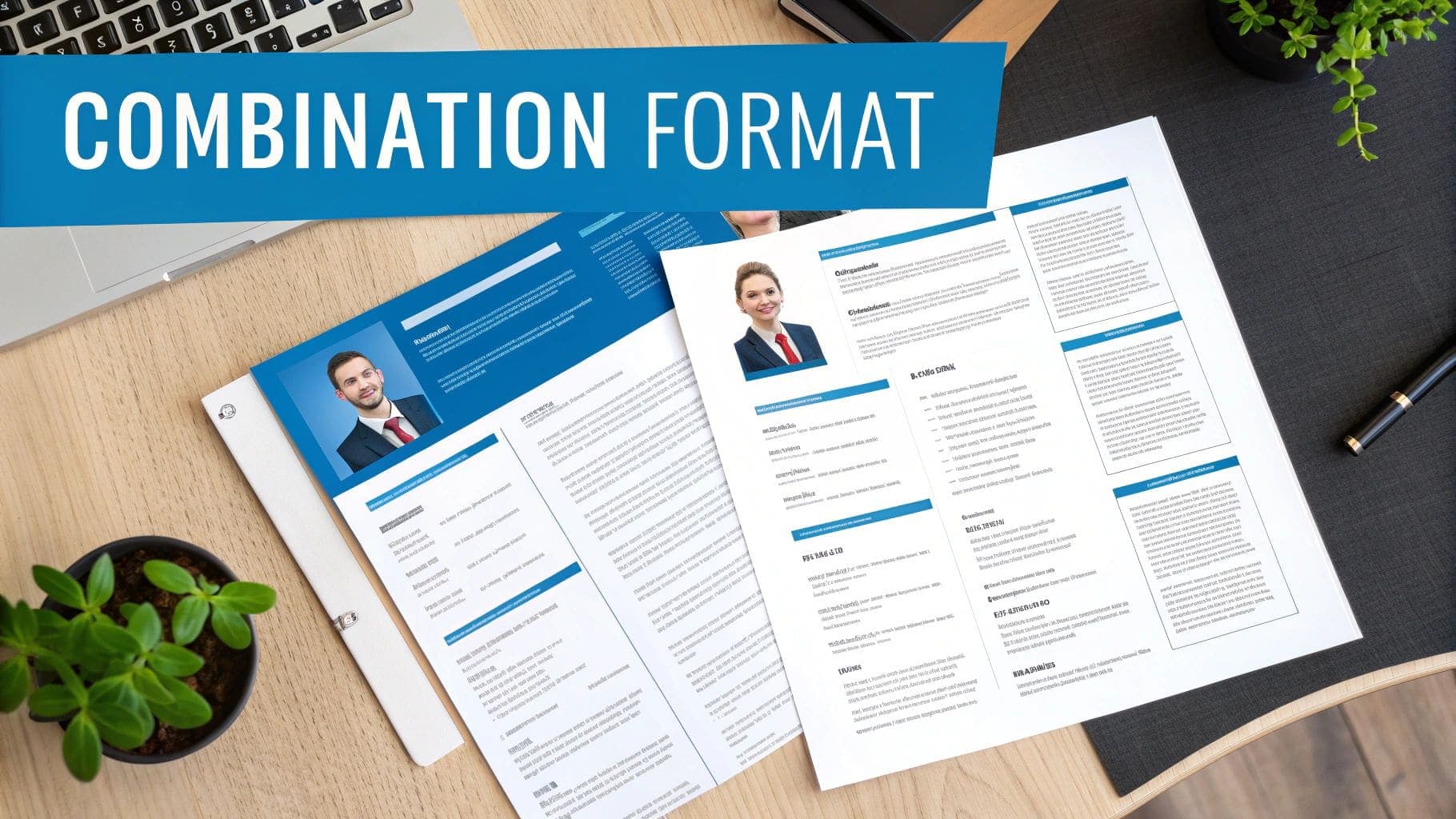
The structure of your resume is the entire frame for your career change story. If you're making a big jump, a standard chronological resume can actually work against you, burying your best qualifications under a pile of seemingly unrelated job titles.
This is where the combination resume format comes in. It's almost always the best move for a career changer. This hybrid approach lets you lead with a hard-hitting skills summary that speaks directly to the job you want, followed by a more condensed work history. You grab the recruiter's attention with what you can do for them, not confuse them with where you've been.
Getting the format right isn't just about making it look nice; it's a strategic choice. A bad format is like a poorly lit stage—your best skills are lost in the shadows. The right one is a spotlight, guiding the hiring manager's eyes exactly where you need them to go.
And if you're worried about making a change, don't be. The desire for a new career path is incredibly common. Recent data shows that a significant percentage of currently employed global workers are either actively looking or keeping an eye out for a new job. This shift means employers are more open than ever to non-linear careers, so you can present your pivot with confidence. You can check out more on this trend in these global career change statistics.
Why the Chronological Resume Fails Career Changers
A chronological resume lists your jobs from newest to oldest. It's the gold standard if you're climbing the ladder in the same field, but it becomes a major liability when you're leaping to a new one.
Let's say a marketing manager wants to become a data analyst. A chronological resume would scream "Senior Marketing Manager" at the top, followed by bullet points on brand strategy and ad campaigns. A recruiter scanning for a data analyst might see that and immediately toss it in the "no" pile, never getting to the transferable skills hidden deep inside.
- It Highlights Irrelevant History: You're forced to lead with job titles and companies that have zero obvious connection to your new target role.
- It Buries Your Best Skills: Your most valuable skills—like analyzing campaign data—get lost under job duties that sound completely unrelated.
- It Creates a Confusing Story: The format suggests a straight career line, making your pivot look random and unexplained.
The Power of the Combination Format
The combination (or hybrid) resume is the perfect fix. It cherry-picks the best parts of the chronological and functional (skills-based) formats and fuses them into a powerful storytelling tool.
It kicks off with a strong professional summary and a detailed "Summary of Skills" or "Areas of Expertise" section. This is your chance to connect the dots for the recruiter before they even glance at your work history.
Pro Tip: Think of the top half of your combination resume as the executive summary of your career pivot. It must answer the question, "Why are you perfect for this job?" within the first 15 seconds.
After you've made your case with your skills, you can follow up with a more streamlined "Professional Experience" section. This still gives recruiters the chronological context they expect, but it no longer has to do all the heavy lifting of proving you're qualified. For a deeper look at different resume structures, our guide on choosing the best resume format has more great examples.
Real-World Example: Marketing Manager to Data Analyst
Let's go back to our marketing manager. With a combination format, they can completely rewrite their professional narrative.
Original Chronological Entry:
- Managed a $500K annual marketing budget to execute multi-channel campaigns.
New Combination Format Approach:
First, they build a powerful skills section right at the top:
Data Analysis & Visualization Skills
- Data Interpretation & Reporting: Analyzed campaign performance data from Google Analytics and Salesforce to generate weekly KPI reports, identifying trends that improved lead conversion by 15%.
- Budget & Resource Allocation: Conducted ROI analysis on a $500K marketing budget to optimize spending across digital channels, reallocating funds to top-performing initiatives.
- A/B Testing & Optimization: Designed and executed dozens of A/B tests for landing pages and email campaigns, using statistical analysis to validate results and drive engagement.
This simple shift reframes their marketing background into the language of data analysis. Suddenly, their value is crystal clear, making this career change resume template a powerful tool for any pivot you're planning to make.
Writing a Professional Summary That Tells Your Story
Think of your professional summary as the most valuable real estate on your entire resume. This little three-to-four-line pitch at the top is your first—and sometimes only—shot at convincing a hiring manager that your unconventional background is a secret weapon, not a red flag.
For a career changer, the summary has one critical job: it must immediately connect the dots between your past experience and your future goals. It has to build a believable bridge that answers the recruiter's biggest question: "Why are you the right person for this job, even without the typical background?" This isn't the place for a wishy-washy objective statement; this is where you sell your pivot with confidence.
The formula is actually pretty straightforward. You'll start by claiming your new professional identity. Then, you'll highlight two or three of your strongest transferable skills, making sure to tie them directly to what the job description is asking for. Finally, you'll wrap up by clearly stating your new career ambition. Following this structure turns your summary from a passive wish list into an active, compelling pitch. Being able to communicate this value clearly is everything; broader abilities, like those developed in executive communication skills training, can make your story that much more impactful.
From Vague Objective to Powerful Pitch
Let's look at a common mistake. So many career change resumes still use an old-school objective statement that only talks about what the candidate wants.
Before (The Vague Objective):
Seeking a challenging new role in project management where I can utilize my organizational and leadership skills.
This tells the hiring manager nothing useful. It's completely generic and all about you. Now, let's see how we can transform this for a retail manager pivoting into a Project Manager role.
After (The Compelling Summary):
Accomplished retail leader with *10+ years of experience* steering complex store operations and cross-functional teams toward ambitious revenue targets. Eager to apply a proven ability in budget management, stakeholder communication, and process optimization to drive successful project outcomes as a Project Manager. Adept at translating business requirements into actionable plans and delivering projects on time and under budget.
See the difference? This version immediately claims the new title ("Project Manager"), connects past successes (budgeting, team leadership) to the new role's needs, and even uses the language of the target industry. It's a confident pitch, not a hopeful plea. You can dive deeper into these strategies in our complete guide on how to write a compelling professional summary.
The Three-Part Formula for Success
To write your own powerful summary, just break it down into these three key parts. This approach makes sure you hit all the right notes and create a story that makes sense.
- Lead with Your New Title: Start by calling yourself what you want to be. It might feel a little bold to claim the job title you're applying for, but it instantly frames you as a candidate for this role, not your old one.
- Connect Your Top 2-3 Transferable Skills: Dig through the job description and pull out the most important skills they're looking for. Pick two or three of your strongest abilities that match up perfectly and weave them into your summary. If you can, add a number or a specific achievement to back them up.
- State Your Goal and Value Proposition: End with a clear, forward-looking statement about how you plan to use those skills to help the company. This shows you've thought about what they need, not just what you want.
Key Takeaway: Your summary needs to be customized for every single job application. Sending a generic summary is one of the quickest ways to get your resume ignored. It has to echo the specific language and priorities of the job you're targeting.
A tool like CV Anywhere can be a huge help here. It helps you quickly spot the most important skills in a job description so you can craft that perfectly tailored summary.
By analyzing the job description, you get an instant roadmap of the keywords and skills to feature in your summary, making sure it gets past the screening software and grabs the hiring manager's attention.
Another Real-World Example: Teacher to Corporate Trainer
Let's run through the formula again with another common career pivot: a teacher moving into a corporate training and development role.
Before (Weak Summary):
Dedicated educator with a passion for helping others learn. Looking to transition my skills from the classroom to a corporate environment.
It's honest, but it lacks professional punch. It doesn't speak the language of business, doesn't include any metrics, and forces the recruiter to figure out how teaching skills might apply.
After (Strong, Targeted Summary):
Dynamic learning and development professional with *8+ years of experience designing and delivering engaging curriculum to diverse audiences of over 300+ students annually. Adept at assessing performance gaps, creating targeted instructional materials, and leveraging technology to improve learning outcomes by 20%*. Seeking to apply expertise in adult learning principles and facilitation to enhance employee skill development at [Company Name].
This is a night-and-day difference. It uses industry keywords ("learning and development professional," "performance gaps"), packs a punch with impressive numbers ("300+ students," "20%"), and speaks directly to the needs of a corporate training department. This is how a strategic career change resume summary opens doors.
How to Identify and Showcase Your Transferable Skills

When you're changing careers, your transferable skills are the bridge that gets you from where you are to where you want to go. These are the universal abilities you've already mastered—things like project management, data analysis, or client communication—that are valuable in any industry.
This is your secret weapon. The trick is to connect the dots for the recruiter so they see your past experience as a perfect fit for their future needs.
Simply stating "I have strong leadership skills" on your resume is a wasted opportunity. You have to prove it. This means dissecting job descriptions, translating your history into the language of your new field, and backing it all up with hard numbers.
Become a Job Description Detective
Before you can show off your skills, you need to know which ones the hiring manager actually cares about. Your best source of intel is the job description itself. Think of it as a cheat sheet pointing directly to what they value most.
Your first mission is to gather five to ten job descriptions for the role you're targeting. Don't just skim them. Print them out or pull them into a single document and get ready to do some analysis.
Look for patterns, especially in the "Requirements" or "What You'll Bring" sections. What specific words and phrases keep popping up? These are your high-priority keywords.
- Hard Skills: These are the teachable, technical abilities. Make a list of recurring software (like Salesforce or Python), methodologies (Agile, Scrum), or specific knowledge areas (SEO principles, financial modeling).
- Soft Skills: These are the interpersonal traits that make you a great teammate. Note how often you see phrases like "stakeholder communication," "cross-functional collaboration," "complex problem-solving," or "team leadership."
This detective work gives you a blueprint. The skills that show up most often are the ones you need to hammer home throughout your career change resume template.
Translate Your Experience Into Their Language
Okay, now you know what they're looking for. The next step is to act as a translator, reframing your old responsibilities into the language of your new career. This is where most career changers stumble, but it's really just about identifying the core competency behind each task.
Let's imagine a common pivot: a registered nurse moving into a Customer Success Manager role in tech.
Original Responsibility:
Conducted patient assessments and developed comprehensive care plans in a high-pressure hospital environment.
Translated Skills for the New Role:
- Stakeholder Needs Analysis: You were literally assessing the "customer's" (patient's) needs.
- Strategic Planning: You were creating a "project" (care plan) with a clear goal.
- Grace Under Pressure: You were managing critical tasks in a fast-paced, high-stakes setting.
See how that works? You're not changing the facts; you're changing the frame. This simple shift turns seemingly unrelated experience into compelling, relevant qualifications. For more ideas, you can dig into this list of examples of skills for your CV.
Key Insight: Stop describing what you did. Start explaining the skill behind the action. Every job involves managing resources, communicating with people, and solving problems. Your job is to find those universal threads.
Here's a quick table to help you practice this translation mindset:
| If you were a... | Your old task was... | Your new skill is... |
|---|---|---|
| Teacher | Managing classroom behavior and parent-teacher meetings | Stakeholder Management & Conflict Resolution |
| Retail Manager | Overseeing inventory and creating weekly staff schedules | Resource Allocation & Logistics Planning |
| Event Planner | Coordinating vendors, venues, and clients within a tight budget | Project Management & Vendor Negotiation |
This reframing is absolutely critical. It's what will make your career change resume click with a hiring manager who might not otherwise see the connection.
Quantify Your Skills with the STAR Method
Translating your skills is half the battle. The other half is proving them with cold, hard results. The single best way to structure your achievement-based bullet points is by using the STAR method.
The STAR method gives you a simple framework to tell a powerful story:
- Situation: What was the context? Briefly set the scene.
- Task: What was your specific responsibility or goal?
- Action: What exact steps did you take to address the task?
- Result: What was the outcome? Quantify it with numbers, percentages, or concrete improvements.
Let's apply this to a teacher pivoting into a corporate trainer role.
Situation: The school district rolled out a new digital grading system, but many veteran teachers found the technology confusing, leading to inconsistent student reporting.
Task: My goal was to design and lead a workshop to get all 50+ faculty members proficient on the new software before the end of the marking period.
Action: I developed a hands-on training module, created step-by-step user guides with screenshots, and personally led three two-hour workshops. I also offered one-on-one coaching for anyone who needed extra support.
Result: Because of this initiative, 100% of faculty adopted the new system on time, which led to a 40% reduction in grade reporting errors the following semester.
That's a world away from a bland bullet point like "Trained teachers on new software." It proves you can assess a need, build a solution, and deliver measurable business results—all essential skills for a corporate trainer.
Getting Your Resume Past the Robot Gatekeepers
Before a hiring manager ever sees your resume, it has to get past a critical gatekeeper: the Applicant Tracking System, or ATS. The vast majority of US companies, especially larger ones, use this software to scan, filter, and rank job applications.
If your career change resume template isn't built to be read by these bots, it could be rejected before a human even knows you exist. Think of it as a bouncer at a club—if you're not on the list, you're not getting in.
This means fancy fonts, creative graphics, and complex tables can get your application instantly disqualified. The key to beating the bots is a combination of simple, clean formatting and strategic keyword alignment.
Speaking the Language of the Job Description
Your first and most important job is to mirror the language of the role you're applying for. The ATS isn't smart enough to infer meaning; it's a matching machine programmed to look for specific keywords—skills, qualifications, and responsibilities—that the hiring manager has flagged as essential.
Start by tearing apart the job description. Pinpoint the core skills and competencies they mention over and over. These are your keywords.
Now, you need to weave these keywords naturally into your resume. Don't just stuff them in a list; contextualize them in a few key places:
- Your Professional Summary: This is prime real estate. Make sure your most important keywords are front and center.
- A Dedicated Skills Section: Create a section for "Core Competencies" or "Technical Skills" where you can cleanly list relevant terms.
- Your Experience Section: Embed keywords within your achievement-focused bullet points. This shows the ATS and the recruiter how you've actually applied those skills.
Getting this right ensures the ATS gives your resume a high match score, which is your ticket to getting seen by a real person.
The Ultimate ATS Formatting Checklist
Keywords are only half the battle. Formatting is just as important, because a confused ATS is a rejecting ATS. The software can't parse information from complicated designs, so clean and simple is always the winning strategy.
Use this quick-reference guide to make sure your career change resume gets past the bots and into human hands.
ATS Compliance Checklist
| Do This | Avoid This |
|---|---|
| Use standard, simple fonts like Calibri, Arial, or Georgia. | Use script fonts or highly stylised typefaces that are hard to read. |
| Stick to standard section headings (Experience, Education, Skills). | Get creative with headings like "My Professional Journey." |
| Submit as a .docx file unless a PDF is specifically requested. | Embed text in images, charts, or graphics. The ATS can't read it. |
| Use standard bullet points (simple circles or squares). | Use complex symbols or custom icons that might turn into garbled text. |
| Left-align all of your text for clean, predictable parsing. | Use headers, footers, or text boxes, which often get ignored. |
A common mistake is assuming PDFs are always safe. While modern ATS can usually handle them, some older systems still trip up. Submitting a .docx file is the safest bet to avoid parsing errors unless the application explicitly asks for a PDF.
Following these formatting rules ensures your content is read accurately. For a deeper dive, our dedicated ATS resume template guide has even more tips for building a document that beats the bots every time.
Tying It All Together for Maximum Impact
So, what does this look like in practice?
Let's say a project coordinator is pivoting to a marketing specialist role. The job description is packed with phrases like "content creation," "SEO principles," and "campaign analytics."
Instead of just listing those skills, they'd integrate them strategically.
Their summary might say something like, "Project coordinator with a background in applying SEO principles to drive successful content creation."
Under a past job, a bullet point could read: "Analyzed project data to produce weekly reports, developing strong skills in campaign analytics to track team performance."
This approach does more than just check boxes for the ATS. It provides context, showing a human recruiter how those skills were used. A well-optimized resume is your key to getting past the digital gatekeeper and landing that interview.
Got Questions? Let's Clear a Few Things Up
Pivoting your career is a big move, and it's totally normal to have a million questions swirling around. Even with a solid career change resume template, the little details can feel overwhelming. Let's tackle some of the most common worries I hear from professionals making a change.
The whole point is to get ahead of any potential red flags. You want your resume and cover letter to tell a story that makes your transition look like a smart, deliberate power-play—not a random shot in the dark.
How Far Back Should My Resume Go?
This is a big one. You're worried about showing a ton of history that just isn't relevant anymore. For a career change in 2026, the golden rule is to prioritize relevance over simple chronology.
- Stick to the 10-15 Year Rule: This is a great guideline for the detailed, bullet-point part of your experience. It keeps the recruiter focused on your recent and most transferable work.
- But what about that amazing thing I did 16 years ago? If you have a killer achievement from way back that's super relevant to your new target role, don't bury it! Weave it into your professional summary at the top or create a short "Early Career Highlights" section to feature it.
- What about the really old stuff? For jobs that are ancient history and completely unrelated, you can lump them together under a simple heading like "Previous Professional Experience." Just list the company, title, and location—no bullet points needed. This acknowledges your history without distracting from the main event.
Your goal is to be the director of your own movie. You want to shine the spotlight on your future potential, not get the audience bogged down in ancient history.
Do I Really Need a Cover Letter?
Yes. 100% yes. For a career changer, the cover letter isn't just important; it's your single most powerful tool.
Think of it this way: your resume shows what you've done. It's the list of facts. Your cover letter explains why it all makes sense. It's your chance to connect the dots for the hiring manager, show genuine passion for the new field, and frame your unique background as a competitive advantage. Don't just repeat your resume—give them the story behind the pivot.
A resume is the evidence, but the cover letter is the argument. It's where you persuade the hiring manager that your non-traditional path is exactly what their team needs.
How Do I Handle an Employment Gap?
First, take a deep breath. Employment gaps are more common than ever, and most recruiters in the US get it. The key is how you frame it. You want to be proactive and honest.
If you spent that time skilling up, that's a huge win. Create a section on your resume called "Professional Development" or "Continuing Education" and show off those new certifications, courses, or even relevant volunteer projects. You turned that time off into an investment.
If the gap was for personal reasons, you absolutely do not need to explain it on your resume. That's your private business. Just be ready to speak about it briefly and confidently if it comes up in an interview, always bringing the conversation back to why you're ready and excited for this role now. The focus should always be on your forward momentum, not the pause. This approach makes your career change resume template feel like a complete and honest picture of your journey.
--- Ready to take control of your career change? The CV Anywhere platform provides all the tools you need in one place. From our Smart CV Builder that perfects your resume to the JD Fit Checker that tailors it for every application, we help you build a compelling professional story. Start for free on cvanywhere.com and land your next role with confidence.