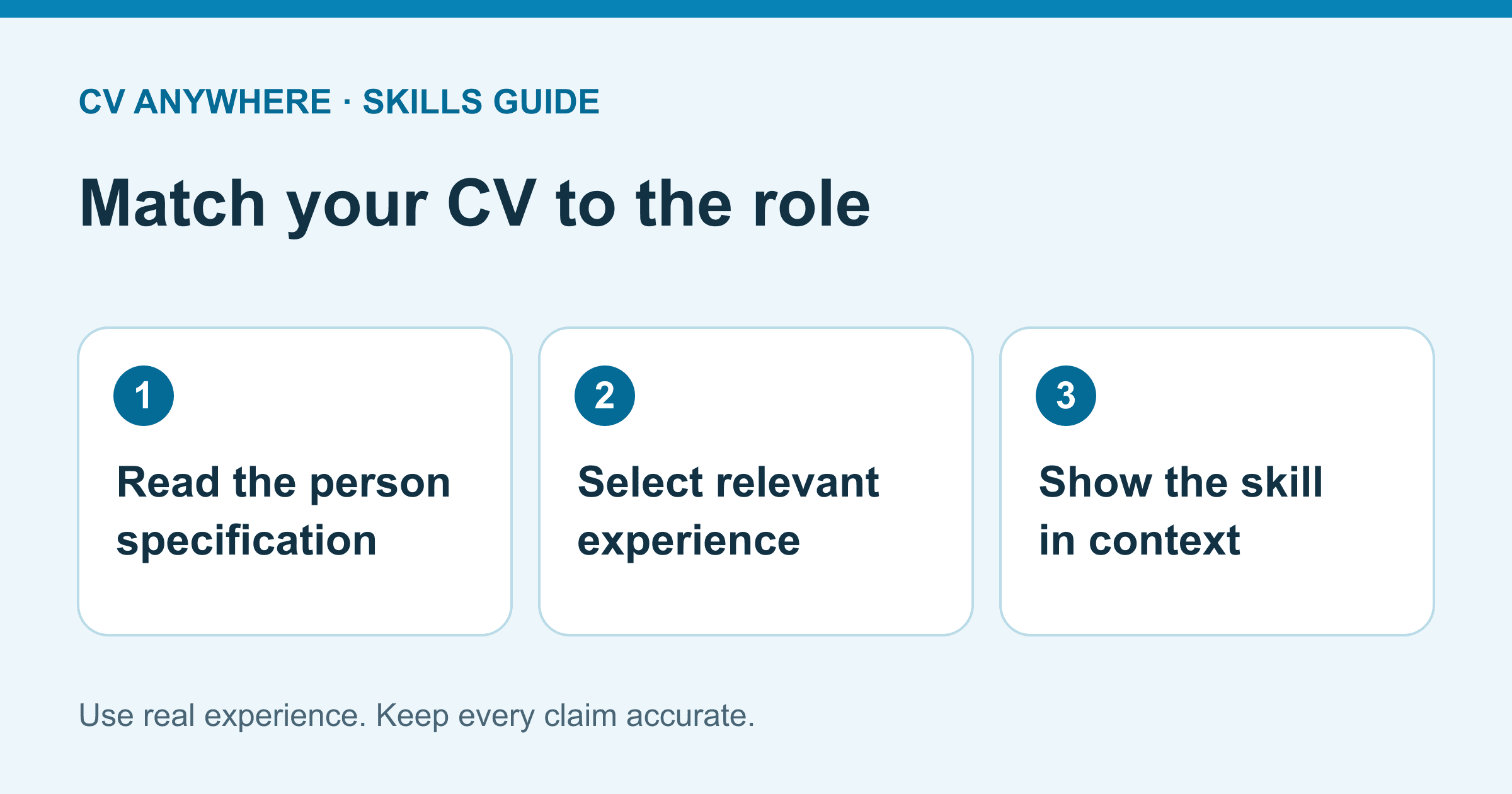
The right skills for a CV depend on the role. Use the employer's person specification to identify what matters, then show where you have used those abilities. A generic list of ten fashionable skills can miss the practical requirements of the job.
This guide focuses on matching a UK person specification. For finished wording, go to CV skills examples. For a broader role-based shortlist, see skills to put on a resume.
Separate the requirements before writing
Copy the criteria into a working document and label them essential or desirable, using the employer's own classification. Keep qualifications, practical skills and behaviours separate so you do not mistake one for another.
| Requirement type | Example from a fictional advert | What to check |
|---|---|---|
| Qualification | Specified vocational qualification or accepted equivalent | Whether you hold it and whether equivalence is explicitly permitted |
| Practical skill | Maintain accurate appointment records | A real example of updating, checking or correcting records |
| Digital tool | Spreadsheet reporting | Which functions and reports you have actually used |
| Behaviour | Communicate with different audiences | An occasion when you adapted an explanation |
| Working arrangement | Evening availability | Your actual availability; this is not a skill |
The National Careers Service CV guide recommends tailoring your CV to the opportunity and using the job description to identify relevant skills.
Is your CV actually getting responses?
Your CV might be missing something important
Upload your CV → see its weakest areas → fix them, one by one.
Free. Takes less than 2 minutes.
A completed evidence worksheet
This fictional example is for an administrative support vacancy. It shows how to turn criteria into usable content without copying the advert verbatim.
| Criterion | Evidence collected | Possible CV wording |
|---|---|---|
| Organise competing appointments | Coordinated meeting rooms and sent updates during a student placement | Coordinated room bookings and joining instructions for placement-team meetings |
| Handle enquiries clearly | Answered routine questions at a volunteer reception desk | Explained appointment arrangements and referred unfamiliar enquiries to the coordinator |
| Check information accurately | Compared sign-up forms with an attendance spreadsheet | Checked event registrations for missing details before preparing the attendance list |
Keep sensitive names and identifying information out of your notes and CV. Describe the work without copying customer, patient or pupil records.
Decide where each skill belongs
Use a short skills section for relevant tools and tasks. Put the strongest evidence in work, volunteering, placement or project bullets. Your profile can highlight one or two capabilities central to the role, but it should not repeat the entire skills list.
For example:
Key skills: Appointment coordination; spreadsheet record checks; reception enquiries; document formatting.
Then support those labels with the evidence above. Avoid star ratings: “four out of five” does not explain what you can do or how the scale was assessed.
If you have little paid experience
Look at coursework, volunteering, clubs, placements and practical projects. State the context openly. “Organised a college fundraising stall” is stronger and more accurate than describing yourself as an events manager.
Use our first-job CV examples for a complete structure. If the role requires a capability you have only practised under supervision, keep that boundary visible. Do not convert observation into independent responsibility.
If the application also asks for supporting information
Use the form's instructions to decide where detailed evidence belongs. Your CV can summarise your background while the supporting statement explains how you meet the criteria. Check the word limit and required format instead of pasting the same text into both.
Civil Service applications may assess different elements of Success Profiles. Follow the vacancy instructions and use the Civil Service application guide for that specific process.
Final matching check
Read each essential criterion alongside your draft. Can a reader find the relevant qualification, task or example? Is the level of responsibility accurate? Have you omitted an important requirement while giving space to an unrelated tool?
Do not invent a match where one does not exist. Once the content is accurate, use CV skills examples to refine the wording and the UK CV writing guide to place it in the complete document.