Master Your UK Job Search With a CV AI
Discover how a CV AI can transform your UK job search. Learn to optimize your CV for ATS, match job descriptions, and land more interviews in 2026.

In the fast-paced UK job market of 2026, using a CV AI is the single most effective way to ensure your application gets noticed. A CV AI is an intelligent tool that analyses job descriptions to find the exact skills and keywords employers are looking for, then helps you tailor your CV to match. It acts as your personal career coach, providing data-driven feedback to optimise your CV, get past automated screening systems (ATS), and significantly increase your chances of landing an interview.
This technology is designed to beat the bots and put your application directly in front of a recruiter.
What Is a CV AI and How Can It Help You
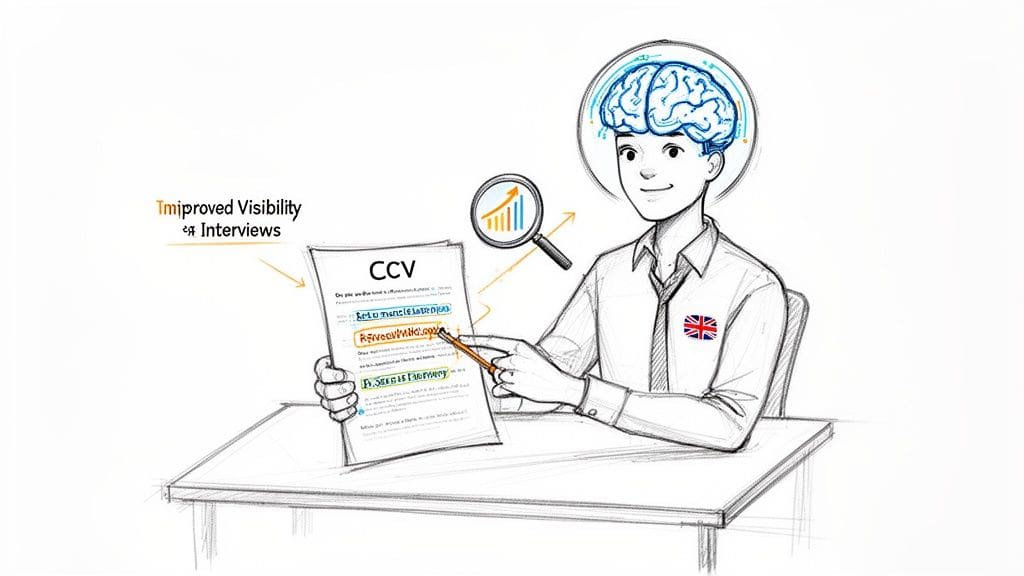
We've all been there. You find your dream job, perfect your application, and hit 'submit'. Then, nothing. Your CV vanishes into a digital black hole. This happens all the time, and it's usually because an Applicant Tracking System (ATS) filtered you out before a human ever saw your name.
A CV AI is built to beat this exact problem.
At its heart, it's a smart tool that acts as your career coach. It tears apart a job description to pinpoint the exact skills, keywords, and experience the employer is hunting for. It then scans your CV, gives you a "match score," and provides clear, actionable steps to close the gap. It's a world away from just running a spell check.
Bridging the Gap Between You and Recruiters
To really see the power of a CV AI, you have to look at how companies hire now. Many UK employers are already using their own AI to sift through applications. You can find detailed breakdowns of how to use AI in recruiting for smarter hiring, but the bottom line is this: your CV needs to be optimised for their machines.
A CV AI levels the playing field. It suggests stronger action verbs, helps you rewrite your professional summary for more impact, and ensures your experience aligns perfectly with the role. It's all about working smarter to stand out.
Here's what that looks like in practice:
- Beating the Bots: It structures and optimises your CV to sail through automated screening systems.
- Saving Hours of Time: You can tailor your CV for each specific job in minutes, not hours.
- Removing the Guesswork: Get a data-driven view of how well you fit a role, boosting your confidence.
This isn't a niche trick anymore. Recent studies show that just under half (46%) of all UK job seekers now use some form of AI to help with their job hunt. That number has exploded as recruiters have tripled their own AI use in the last year.
In 2026, using a CV AI is no longer a luxury; it's a vital part of a modern UK job seeker's toolkit. You can see the direct impact for yourself in our guide on how AI resume builders secure more job interviews.
Is your CV actually getting responses?
Your CV might be missing something important
Upload your CV → see its weakest areas → fix them, one by one.
Free. Takes less than 2 minutes.
A Look Under the Hood of a CV AI
Ever wondered what a CV AI is actually doing when it scans your document? It's not some kind of dark art, but a smart mix of proven technologies working in concert. At its heart is Natural Language Processing (NLP), the same tech that lets Siri or Alexa figure out what you're asking for.
A CV AI uses NLP to read and make sense of the text on your CV and the job description. It breaks down every sentence to recognise key pieces of information, like skills, job titles, qualifications, and even responsibilities. The system can tell that "managed a team" is fundamentally different from "managed a budget."
Think of it as a superhuman proof-reader who works at lightning speed, never gets tired, and never misses a single detail. But just finding the words is only the first step. The real intelligence lies in how it translates those words into something a machine can actually compare.
From Words to Data with Embeddings
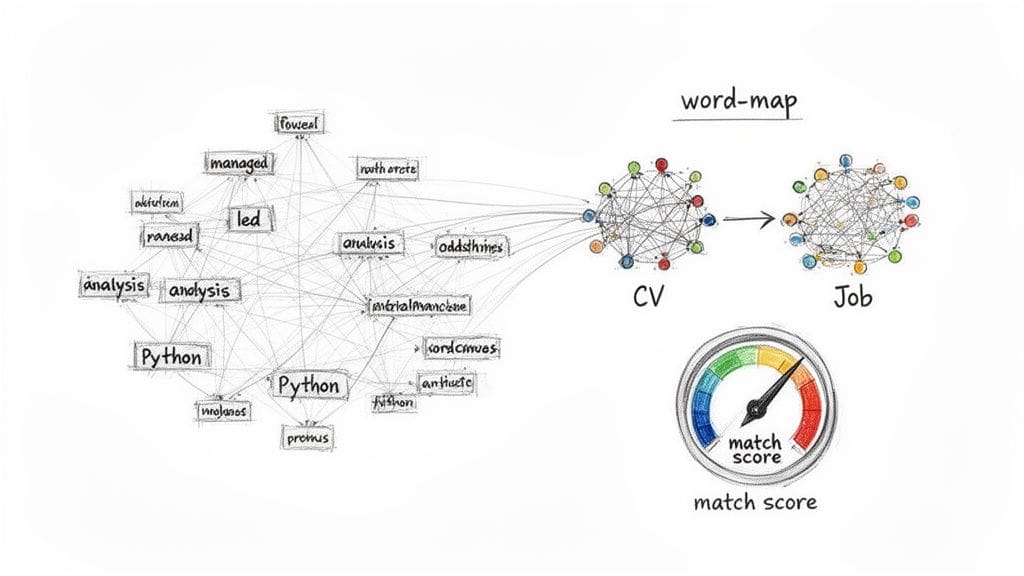
This next part, creating vector embeddings, might sound a bit technical, but the idea behind it is surprisingly simple. The AI translates every important word and phrase into a unique string of numbers, effectively plotting it on a massive, multi-dimensional map of meaning.
On this map, words that mean similar things are grouped closely together. For instance, terms like 'led', 'oversaw', and 'managed' would all land in the same digital neighbourhood. This is what allows the AI to understand the intent behind your language, not just the exact words you used.
It can see that your experience in "project leadership" is a great match for a role asking for "project management," even if you never wrote that exact phrase. It's this grasp of semantic relationships that separates a true CV AI from a basic keyword-checker. If you want to dig deeper into this, it helps to understand how AI writing tools work best when they have clear context. A good CV AI doesn't just hunt for words; it understands what they mean.
Calculating Your Match Score
Once the AI has turned both your CV and the job description into these data-rich maps, it can finally perform its most valuable function: a direct comparison.
The AI effectively overlays the map of your CV onto the map of the job description. It then measures the degree of overlap, generating a 'match score' that quantifies how well your background aligns with the employer's criteria.
A quality system won't just give you a single percentage, though. It will break the score down into useful categories, showing you exactly where you're strong and where you need to improve:
- Key Skills: Does your CV contain the required hard and soft skills, like 'data analysis' or 'stakeholder engagement'?
- Experience Alignment: Does your work history show the right level of seniority and the type of experience the role demands?
- Qualifications: Do you meet the minimum educational or certification requirements listed in the job spec?
This detailed feedback loop is what makes a CV AI a powerful ally. It takes the guesswork out of your application, giving you a precise, data-driven plan to make your CV stronger. The aim is to make sure your CV speaks the employer's language perfectly, and that's exactly where a tool like the CV Anywhere AI Assistant can give you a real edge.
Getting Your CV Past the Gatekeepers with AI
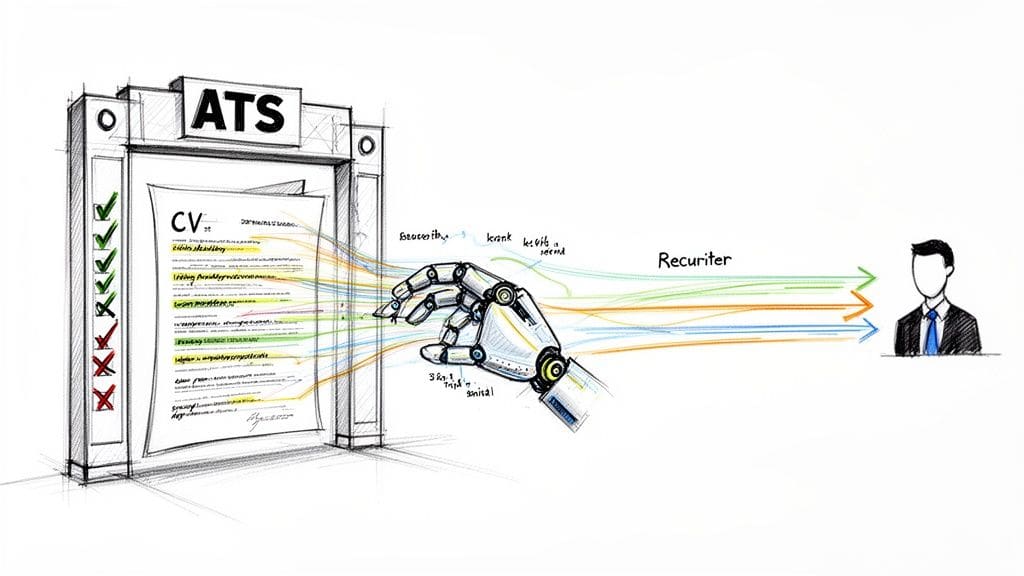
Applicant Tracking Systems (ATS) are the silent gatekeepers of today's job market. If you've applied for a job at a big company, you've met one. In fact, over 90% of large UK companies use them to pre-screen CVs before a human ever sees them. This is where a CV AI becomes your secret weapon. It gives you a data-driven way to get past the bots.
Think of it as a coach that helps you format your CV for machine readability, pick the right keywords without sounding like a robot, and directly mirror the most important criteria from the job description.
This isn't just about ticking boxes to make your CV compliant. It's about creating a document so perfectly aligned with the role that it sails through that first digital filter and lands at the top of a recruiter's pile. A good CV AI can spot critical skills in a job advert that you might have missed and show you exactly how to weave them into your experience naturally. The goal is simple: make your skills impossible to ignore.
This has become essential as AI becomes standard practice in UK businesses. A recent report on AI adoption trends in the UK for 2026 found that 63% of UK companies now use AI in some capacity. For recruiters, this tech is a game-changer. They save an average of 4.5 hours a week, and it has helped slash the average cost of hiring a new candidate by a massive 71%. Companies are all-in on using AI to find top talent faster, which means you need to be just as savvy.
The Three Pillars of ATS Optimisation
Getting past an ATS isn't magic; it comes down to three core principles: formatting, keywords, and structure. A good CV AI handles all three, but when you understand each one, you can use the tool to its full potential.
First up is formatting. An ATS doesn't see a CV the way a person does. It reads text linearly. Complicated designs with columns, tables, images, or unusual fonts can throw the software off completely, causing it to scramble or even discard your information. The best strategy is a clean, single-column, chronological format that the system can parse without a single hiccup.
Next, we have keywords. The ATS is programmed to scan for specific words and phrases lifted directly from the job description. This includes technical skills, software names, industry terms, and specific qualifications. The system then scores your CV based on how many of these it finds. It's a matching game, and keywords are the points.
Finally, there's structure. A well-structured CV presents your experience in a way that aligns with what the employer cares about most. This means putting your most relevant achievements and responsibilities front and centre, making it dead simple for the ATS to confirm that you meet the core requirements of the job.
A Practical Workflow to Beat the Bots
Using a CV AI takes the guesswork out of this whole process and turns it into a simple, repeatable workflow. You no longer have to cross your fingers and hope you've included the right details. Instead, you get a clear plan.
- Upload Your CV and the Job Description: Start by feeding both documents into the AI. This is the raw data it needs to start its analysis.
- Analyse the Match Report: The AI will produce a detailed report, often showing a 'JD Fit Score' and highlighting the key skills and phrases you're missing.
- Implement AI-Driven Suggestions: The tool will offer specific, contextual advice. This could be rephrasing a bullet point to include a missing skill or suggesting a stronger, more quantifiable achievement.
- Review and Refine: This is the crucial human step. Always read through the optimised CV to make sure it still sounds like you and accurately reflects your experience.
This process isn't about letting a machine write your CV for you. It's about using intelligent technology to ensure the hard work and experience you've already put in are presented in the most effective way possible.
By following this workflow, you take chance out of the equation. You're not just hoping you have the right stuff; you're systematically ensuring your CV is primed to get noticed. For more guidance on this, you can read our guide on creating an ATS-friendly CV in the UK, which offers extra tips on formatting and content.
See the Difference a CV AI Can Make
It's one thing to talk about the theory, but seeing the results in black and white is what really counts. The true value of a CV AI clicks into place when you see it sharpen a decent CV into an outstanding one.
This isn't just about tidying up a few sentences. It's about shifting from passively listing your duties to actively proving your impact—a change that can mean the difference between an automated rejection and an interview invitation.
Let's walk through a few before-and-after snippets to show how small, AI-guided changes can make your CV connect with both scanning software and the hiring managers reading it.
CV Snippet Transformation Before vs After AI
The table below shows exactly how a CV AI reframes common CV entries. It moves from generic, passive statements to targeted, quantified achievements that grab attention.
| CV Section | Before AI Optimisation (Generic) | After AI Optimisation (Targeted & Quantified) |
|---|---|---|
| Professional Summary | "An experienced marketing professional looking for a new opportunity. Skilled in social media management, content creation, and campaign execution. A dedicated team player eager to contribute." | "A results-driven Digital Marketing Manager with 5+ years of experience leading high-impact online campaigns. Proven expertise in growing organic traffic and managing six-figure PPC budgets to deliver a 150% ROI." |
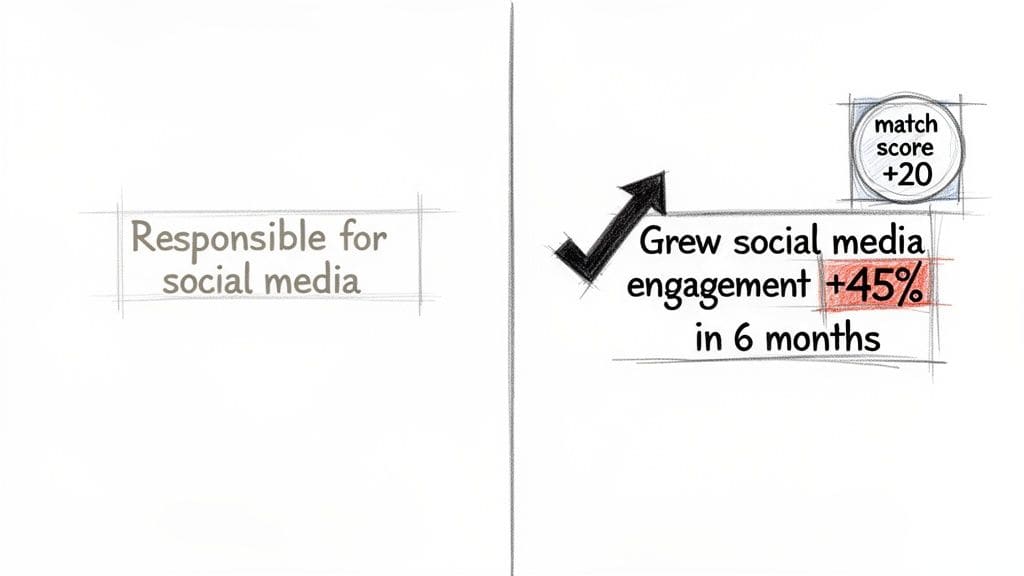
| Work Experience Bullet | "Responsible for managing the company's social media accounts." | "Grew social media engagement by 45% in six months by developing and executing a new data-driven content strategy across Instagram and LinkedIn." |
| Skills Section | "Communication, Teamwork, Microsoft Office" | "Stakeholder Engagement: Secured buy-in from cross-functional teams for a major platform migration. Data Analysis (Excel): Used pivot tables and VLOOKUPs to analyse sales data, identifying a 10% cost-saving opportunity." |
These examples highlight a critical shift in mindset. Instead of just saying what you did, you're showing how well you did it, using the language recruiters and Applicant Tracking Systems are looking for.
From Vague Duties to Measurable Achievements
One of the most common mistakes we see is a CV filled with job responsibilities instead of actual achievements. A recruiter already knows what a "Social Media Manager" does; they need to know what you accomplished in that role. This is where a CV AI shines. It prompts you to reframe your experience using evidence.
Let's break down a typical bullet point.
Before AI Optimisation:
- "Responsible for managing the company's social media accounts."
This is a passive statement. It's a duty, not an outcome, and tells the recruiter absolutely nothing about your performance or impact.
After AI Optimisation:
The AI would push you to add context, action, and metrics. The refined bullet point instantly becomes more powerful:
- "Grew social media engagement by 45% in six months by developing and executing a new data-driven content strategy across Instagram and LinkedIn."
This shift is everything. It moves beyond the 'what' to explain the 'so what?' The 'after' version gives a hard metric (45%), a timeframe (six months), and the specific action you took, making your contribution tangible and impressive.
By applying this thinking across your entire CV, an AI tool helps you build a document where every single line works to sell your skills. It ensures your CV doesn't just list your career history—it tells a compelling story of your professional impact.
If you're ready to start turning your duties into achievements, you can find more expert tips in our guide on how to improve your resume.
Choosing the Right CV AI for Your Career
With a flood of new tools hitting the market, picking the right CV AI can feel like a job in itself. But it really boils down to what you actually need. The best platform is one that solves your immediate problems with powerful, simple features.
Think of it this way: a modern job search has a few non-negotiables. You need a tool that can analyse job descriptions in real-time, provide a library of genuinely ATS-friendly templates, and give you a built-in tracker to manage your applications. Anything less is just a gadget.
Of course, features are only half the battle. The user experience is just as critical. A confusing interface is the last thing you need when you're already managing the stress of a job hunt. The right CV AI should feel like a co-pilot, guiding you through the optimisation process without a steep learning curve.
Essential Features to Look For
When you're weighing up different platforms, focus on the tools that deliver real-world results. Not all CV AI systems are built the same, so having a clear checklist of "must-haves" helps you sort the truly useful from the merely novel.
Your checklist should include:
- Real-Time Job Analysis: The tool must be able to scan any job description and give you a detailed breakdown of the keywords, skills, and qualifications you need to weave into your CV.
- ATS-Friendly Templates: Look for a library of clean, professional templates that are proven to be readable by Applicant Tracking Systems. Bad formatting can get your CV thrown out before a human ever sees it.
- Built-in Application Tracker: An integrated system to log the jobs you've applied for, their status, and any follow-up reminders is invaluable. It's what keeps you organised and professional.
- Intuitive User Experience: The platform must be easy to navigate. If you can't figure out how to get your CV optimised within a few minutes, it's not the right tool for you.
A powerful CV AI doesn't just offer suggestions; it provides a complete, organised workflow. From finding the right keywords to tracking your interview progress, the goal is to have a single platform that supports you at every stage.
This kind of systematic approach is becoming essential, especially as AI becomes a standard part of life in the UK. Research from Cybernews shows that UK AI adoption shot up from 14% in 2023 to 55% in 2025, which places the country 6th globally. This rapid embrace of AI tools by consumers feeds directly into the growing expectation that job seekers will use modern solutions like a CV AI to prepare their applications. You can discover more about the UK's high rank in AI adoption here.
How to Measure Success and Value
So, you've shortlisted a few options. How do you actually know if a CV AI is working for you? The proof is in the results. A good platform will make it easy to see your progress with clear, simple metrics.
Here are the key performance indicators to watch:
- Improved 'Match Score': The most immediate metric is the 'fit score' the tool provides against a job description. You should see a clear, actionable path to increasing this score for every job you target.
- Increase in Interview Invitations: This is the ultimate test. A successful CV AI strategy will directly lead to more responses from recruiters and more interviews in your calendar.
- Time Saved Per Application: One of the biggest wins is efficiency. Keep an eye on how long it takes you to tailor your CV for a new role—this should drop significantly.
Finally, think about the pricing models. Many platforms offer free trials or tiered subscriptions, which is a great way to test the core features before you commit. Compare the monthly or lifetime costs against the value you expect to get. Finding the right tool isn't just about the features list; it's about finding a partner that fits your budget and genuinely supercharges your job search. For more on this, you can explore our guide on the best online resume builders to see how different platforms stack up.
Answering Your Top CV AI Questions
Feeling curious—or maybe a bit sceptical—about using a CV AI? That's perfectly normal. Whenever a powerful new tool appears, it's smart to ask questions about fairness, authenticity, and whether it actually works.
This section tackles the most common queries we hear. We'll give you clear, straight answers to help you use these tools with confidence and get the results you want.
Will a CV AI Make My CV Sound Robotic?
Many job seekers worry their CV will lose its personality if it's touched by an algorithm. It's a fair concern, but the reality is quite different. A good CV AI is your co-pilot, not the autopilot.
A quality tool works with what you already have; it enhances your skills and experience, it doesn't invent them. The AI will give you suggestions for stronger, more impactful phrasing and ensure you've got the right keywords, but you always have the final say.
The goal is to refine your genuine voice into its most professional form—one that modern recruitment systems are built to understand. Think of it less like a machine writing for you and more like a collaboration. The AI finds the opportunities, and you decide which suggestions best tell your story.
Is It Cheating to Use a CV AI?
Not at all. Think of it as the 2026 version of using a spell checker or asking a career coach to look over your CV. Given that a huge number of large UK employers now use their own AI (like Applicant Tracking Systems) to sift through applications, using a CV AI simply levels the playing field.
Using these tools shows you're resourceful and know how to use current technology to present your best self. For any forward-thinking employer, that's a very desirable trait. It's about adapting to the environment you're applying in.
How Do I Know if the AI's Advice Is Good?
Reputable platforms don't just guess. Their suggestions are based on data from thousands of successful CVs and an understanding of what recruiters and their software are programmed to look for.
The real test, though, is your own results. Are you getting more interview invitations?
Top tools often provide a 'JD Fit Score' that measures how well your CV matches a specific job description. Aiming for a score over 80% is a solid benchmark. But always trust your own expertise—the AI gives you data-driven advice, but you are the expert on your career.
Can a CV AI Help Me Change Careers?
Absolutely. This is one of the areas where a CV AI really shines. When you're switching careers, showing your transferable skills is everything, but it can be tough to translate your experience from one industry to another.
An AI tool can analyse job descriptions in your target field and pinpoint the most valuable skills. It then helps you reframe your past roles using the language of your new industry. For example, it can help a teacher describe 'classroom management' as 'stakeholder coordination and project delivery' for a corporate role, making your value instantly clear to a new type of employer.
Ready to see how AI can transform your CV and supercharge your job search? CV Anywhere provides all the tools you need, from a smart CV builder to a real-time job description analyser. Start building your standout CV for free today!
Tags
Related articles
Top 12 AI CV Maker Free Tools for UK Job Seekers in 2026
The best ai cv maker free tool for most UK job seekers is CV Anywhere, offering an all-in-one platform that combines an ATS-friendly builder, job description analysis, and an application tracker. In t...
How to Write a CV Quickly: A 60-Minute Guide
You’re probably here because a job has landed in your inbox and you need to write a CV quickly without sending something sloppy. The good news is that speed isn’t the problem. Bad priorities are. A fa...
How to Improve My CV: A Step-by-Step UK Guide for 2026
If you're searching "improve my CV", you probably already know something's off. Your CV may look busy but say very little, or it may list plenty of duties without showing why anyone should interview y...
Create a CV Fast: A 60-Minute UK Workflow
Need to create a CV fast because a role closes soon, you've got three tabs open, and your old CV still talks about the wrong job. The quickest way isn't typing faster. It's using a focused workflow th...
Popular Articles
The best ai cv maker free tool for most UK job seekers is CV Anywhere, offering an all-in-one platform that combines an ATS-friendly builder, job description analysis, and an application tracker. In t...
You’re probably here because a job has landed in your inbox and you need to write a CV quickly without sending something sloppy. The good news is that speed isn’t the problem. Bad priorities are. A fa...
If you're searching "improve my CV", you probably already know something's off. Your CV may look busy but say very little, or it may list plenty of duties without showing why anyone should interview y...
Need to create a CV fast because a role closes soon, you've got three tabs open, and your old CV still talks about the wrong job. The quickest way isn't typing faster. It's using a focused workflow th...