To land a top event coordinator job in 2026, you need a resume that perfectly showcases your skills for the specific role you're targeting. A great event coordinator resume sample is optimized with keywords from the job description and packed with quantifiable achievements, demonstrating your impact through metrics like budget sizes managed, attendee numbers, and satisfaction rates. For the competitive US job market, this means tailoring your resume to pass through applicant tracking systems (ATS) and immediately grab a recruiter's attention. This guide provides six strategic examples to help you build a resume that impresses hiring managers, whether you are a recent graduate, a seasoned director, or a career changer.
Using a powerful event coordinator resume sample as your foundation is the fastest way to a polished, professional document. In the current US job market, recruiters spend mere seconds on each resume, so you must immediately convey value. This means a concise summary, bullet points starting with strong action verbs (e.g., Orchestrated, Managed, Negotiated), and metrics that prove your worth. For instance, instead of saying you 'planned events,' specify that you 'Coordinated 15+ corporate events annually, managing budgets up to $250K and achieving a 98% attendee satisfaction score.' This level of detail, combined with a clean format, will significantly increase your interview chances.
This article breaks down six distinct resume examples, each designed for a different career stage and objective. You will find annotated samples and actionable takeaways to build a compelling narrative of your professional journey. From mastering keyword optimization for ATS to highlighting unique experiences, you will learn how to create an event coordinator resume sample that not only looks professional but also works as a powerful marketing tool for your career. We will cover resumes for:
- Recent graduates entering the field.
- Experienced professionals targeting senior roles.
- Career changers pivoting into event coordination.
- Specialists in niche event markets.
1. ATS-Optimized Event Coordinator Resume
Before a hiring manager ever sees your application, it likely has to pass through an Applicant Tracking System (ATS). These software programs scan resumes for specific keywords, skills, and formatting, filtering out candidates who don't meet the initial criteria. An ATS-optimized event coordinator resume sample is designed specifically to navigate this digital gatekeeper, ensuring your qualifications get in front of a human reviewer. This approach is critical when applying to large corporations, government agencies, or any organization that receives a high volume of applicants.
The core principle behind an ATS-friendly resume is alignment. It involves using a clean, simple format and incorporating language that directly mirrors the job description. For event coordinators, this means swapping generic duties for keyword-rich, metric-driven achievements that the software is programmed to find.
Why This Resume Format Works
An ATS-optimized resume prioritizes machine readability over creative design. While a visually elaborate resume might look impressive, elements like columns, text boxes, images, and non-standard fonts can confuse an ATS, leading to a parsing error and an automatic rejection. This format strips away those potential issues, focusing purely on content and structure.
Key Insight: The goal isn't to impress the machine; it's to provide the machine with exactly the data it needs in a format it can easily understand. The human-centric design comes later, once you've passed the initial screening.
For example, a job description for a Corporate Event Coordinator at a Fortune 500 company might list "budget management," "vendor negotiation," and "stakeholder communication" as key responsibilities. An effective ATS-optimized resume will feature these exact phrases in the skills section and within the experience bullet points. To truly ensure your resume makes it past the initial screening, understanding the systems employers use is crucial. Delve into the best applicant tracking systems for small businesses, which are increasingly common.
Actionable Tips for ATS Optimization
Creating an effective ATS-friendly resume involves a few strategic steps. Follow these guidelines to build a powerful resume that gets noticed.
Mirror Job Description Language: Carefully read the job posting. If it asks for experience with "Salesforce" or "Cvent," your resume should include those exact terms, assuming you have that experience. Use a tool like CV Anywhere's JD Fit Checker to automatically identify and match these high-value keywords.
Quantify Your Achievements: Numbers speak louder than words, even to an ATS. Instead of saying "Managed event budgets," write "Managed a $250K annual event budget, delivering all projects 10% under budget." Instead of "Planned large events," specify "Orchestrated 15+ corporate conferences and galas for 500+ attendees annually."
Use a Clean and Simple Format: Stick to a single-column layout, standard fonts like Arial, Calibri, or Times New Roman, and clear section headings (e.g., "Professional Experience," "Skills," "Education"). Avoid headers, footers, tables, or graphics. You can learn more about formatting and keyword strategies to optimize your resume for passing an ATS and improve your chances.
Stick to Standard Section Titles: Use conventional headings like "Work Experience" or "Professional Experience" instead of creative ones like "My Event Journey." The ATS is programmed to look for these standard terms to categorize your information correctly. This structured approach makes your resume a clear and compelling document for both software and human readers.
Is your resume actually getting responses?
Your resume might be missing something important
Upload your resume → see its weakest areas → fix them, one by one.
Free. Takes less than 2 minutes.
2. Creative Event Coordinator Portfolio Resume
For event coordinators in creative sectors like luxury weddings, experiential marketing, or fashion, a standard resume might not be enough. A creative portfolio resume blends traditional resume content with visual design elements, functioning as a direct showcase of your aesthetic sense and creative capabilities. This type of resume is a powerful tool for roles where visual presentation and brand alignment are critical, giving you a chance to demonstrate your skills rather than just describe them.
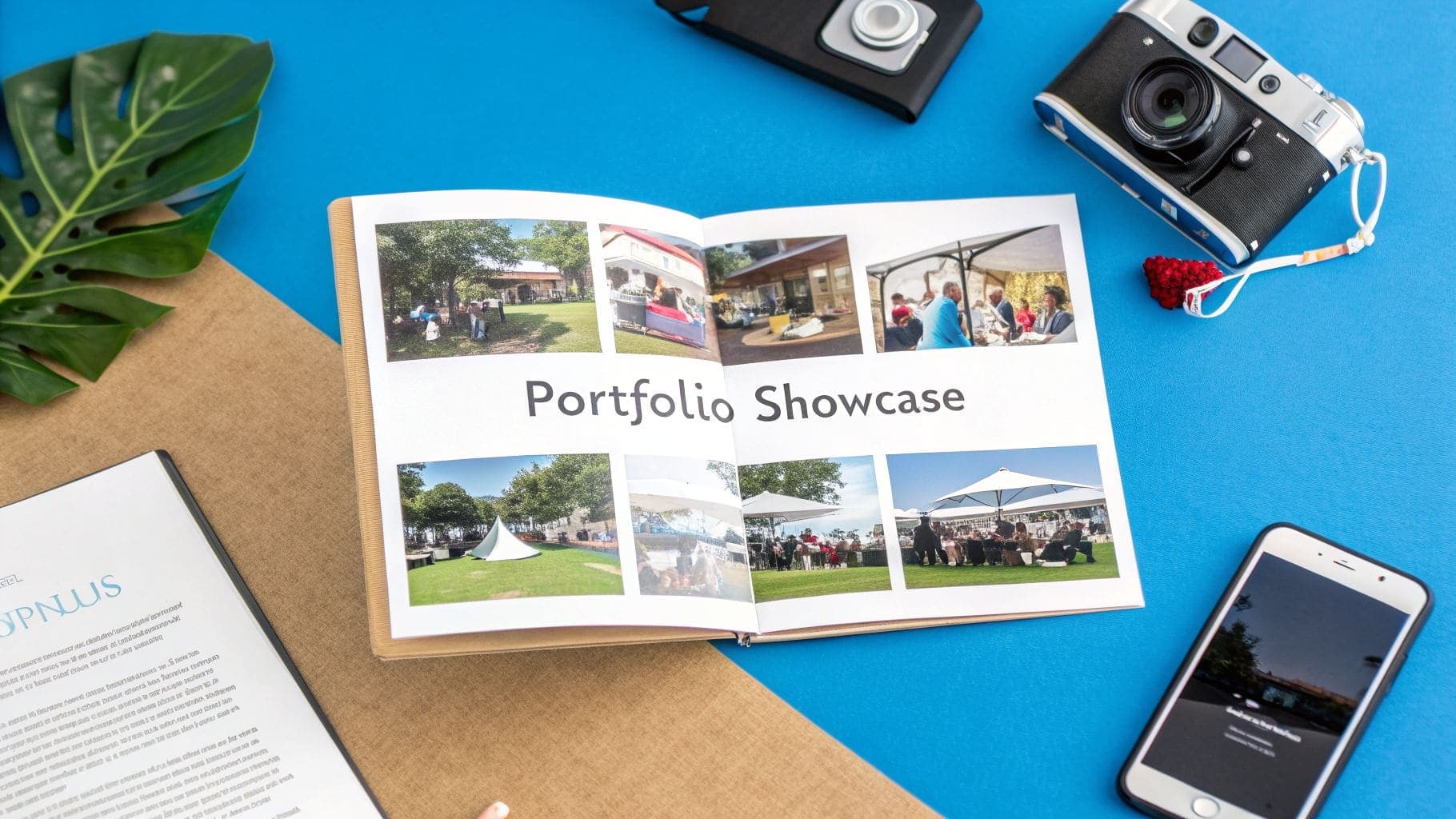
Unlike an ATS-optimized resume, which prioritizes machine readability, a creative resume is made for the human eye. It uses color, layout, and typography to tell a story about your personal brand and professional style. This approach is particularly effective for positions at creative agencies, boutique event firms, and luxury brands that value a strong visual identity.
Why This Resume Format Works
A creative portfolio resume immediately signals that you understand the importance of aesthetics and branding, which are core components of many event coordination jobs. It's a visual elevator pitch. Instead of just stating that you planned a high-end fashion show, you can incorporate design elements that echo the event's theme, providing tangible proof of your creative execution. This format proves you can deliver a polished final product, a key deliverable for any event.
Key Insight: A creative resume isn't just about looking different; it's about visually communicating your value proposition and creative fit for a specific type of role. It shows, it doesn't just tell.
For example, an event coordinator applying to a destination wedding company could use a clean, elegant layout with soft colors and high-quality images from past events. To truly showcase your creativity and experience beyond a traditional document, understanding what a digital portfolio is and how to build one can significantly elevate your application. This format turns your resume from a simple document into a compelling piece of marketing material for your personal brand.
Actionable Tips for a Creative Resume
Building a creative resume requires a careful balance between artistic expression and professional clarity. Here's how to create an effective resume that stands out for the right reasons.
Balance Creativity with Readability: While design elements are key, the primary goal is to communicate your qualifications. Ensure a hiring manager can easily find your contact information, experience, and skills within 10 seconds. Use a clear visual hierarchy to guide the reader's eye. Explore various creative resume templates for inspiration to find a design that is both stylish and functional.
Incorporate Portfolio Links: Add a QR code or a shortened URL that links directly to your online portfolio, an event photo gallery, or a professional social media profile like Instagram or LinkedIn. This bridges the gap between your static resume and a dynamic showcase of your work.
Reflect the Target Company's Brand: Research the aesthetic of the company you're applying to. If they have a minimalist, modern brand, your resume should reflect that. If they are bold and colorful, you can be more adventurous. This demonstrates your attention to detail and ability to align with a client's vision.
Keep a Plain-Text Version: Always have an ATS-friendly, plain-text version of your resume ready. Use the creative version when applying directly to a person (e.g., via email) or for roles in highly visual fields. For online applications that likely use an ATS, submit the optimized version to ensure your information is parsed correctly.
3. Executive Event Coordinator Resume (Senior-Level)
When you're a seasoned professional with over eight years of experience, your resume needs to do more than just list job duties; it must showcase strategic leadership and high-impact results. An executive resume is crafted for senior-level roles, such as Director of Events or VP of Event Management, where the focus shifts from execution to strategy, team leadership, and large-scale financial oversight. It's designed to prove you can not only run an event but also build and lead the department that produces them.
The core principle of a senior-level resume is demonstrating executive presence and business acumen. This document moves beyond logistics to highlight your influence on revenue growth, cost reduction, and process improvement. For an executive event coordinator, this means quantifying your leadership and strategic contributions with compelling metrics that resonate with a C-suite audience.
Why This Resume Format Works
An executive resume commands attention by leading with a powerful summary of qualifications that highlights major career achievements. Unlike a junior-level resume that details tasks, this format emphasizes outcomes and strategic initiatives. It's tailored for hiring committees and executive recruiters at Fortune 500 companies, large hospitality corporations, and major event agencies who are looking for proven leaders.
Key Insight: At the executive level, your resume is a business case for your leadership. It must prove you can drive departmental growth, manage significant budgets, and align event strategy with broader organizational goals.
For example, a job description for a Director of Events might prioritize "developing a multi-year event strategy" or "leading a cross-functional team of 10+." An effective executive resume would address this directly in its summary and experience sections with achievements like "Directed 50+ annual events serving 25,000+ attendees with 98% client satisfaction" and "Managed a $2.5M annual event budget, increasing event ROI by 15%." You can find more inspiration for crafting a compelling opening by reviewing top-tier executive resume summary examples from experts.
Actionable Tips for an Executive Resume
Building a resume that secures senior-level interviews requires a strategic approach. Use these guidelines to create a powerful executive resume that showcases your value.
Lead with a Powerful Executive Summary: Start with a 3-4 line summary that presents your most impressive, quantifiable achievements. Include metrics on budget management, team leadership, and event scale (e.g., "Directed 50+ annual events for 25,000+ attendees").
Highlight Leadership and Mentorship: Dedicate bullet points to your management experience. Instead of "Trained staff," write "Built and mentored a high-performing team of 8 event coordinators, improving departmental efficiency by 20%."
Focus on Strategic Contributions: Move beyond event logistics. Showcase your role in developing cost-saving measures, driving revenue, or improving processes. For example: "Negotiated multi-year vendor contracts, saving the company $300K annually."
Include Industry Certifications: Prominently display senior-level certifications like Certified Meeting Professional (CMP) or credentials from the International Live Events Association (ILEA) to validate your expertise. This adds immediate credibility to your senior-level resume.
4. Specialized Event Coordinator Resume (Niche Focus)
A specialized resume showcases your deep expertise in a specific event niche, such as virtual/hybrid events, nonprofit fundraising, or corporate tech conferences. Instead of presenting a generalist skill set, this format positions you as a subject-matter expert, making you a top-tier candidate for roles within that sector. This event coordinator resume sample is crafted to resonate with employers seeking specific, hard-to-find experience, giving you a distinct advantage over other applicants.

The central idea is to go narrow and deep. For instance, a coordinator specializing in medical conferences will highlight their knowledge of pharmaceutical compliance and CME credits, while a wedding planner will focus on vendor management and client satisfaction scores. This targeted approach demonstrates an immediate and relevant value proposition to the employer.
Why This Resume Format Works
A specialized resume immediately answers the hiring manager's biggest question: "Does this candidate understand the unique challenges of my industry?" By using niche-specific terminology, software, and metrics, you prove you can hit the ground running with minimal training. It shows you're not just an event coordinator; you're a nonprofit fundraising event coordinator or a hybrid tech conference specialist.
Key Insight: Specialization transforms your resume from a general application into a direct solution for a company's specific event needs. It shifts the conversation from your general capabilities to your precise, industry-relevant contributions.
Consider a role for a Virtual Event Coordinator. A generic resume might say, "Planned online meetings." A specialized resume, however, will state, "Produced a 3-day hybrid conference on the Hopin platform for 2,000+ attendees, achieving a 92% session attendance rate and increasing sponsor leads by 40%." This detail immediately confirms your expertise and value. Understanding how to frame your experience for a specific niche is a key part of modern job searching.
Actionable Tips for Niche Optimization
Building a powerful specialized resume requires a deep dive into your chosen field. Use these strategies to create a standout resume that highlights your unique expertise.
Integrate Niche-Specific Keywords: Research job descriptions in your sector to find essential terms. A government event role may require knowledge of "civil service protocols" and "security clearance procedures," while a trade show position will look for "exhibitor relations" and "booth traffic generation." Use CV Anywhere's JD Fit Checker to identify and incorporate these keywords.
Showcase Relevant Certifications and Software: Your skills section should be a testament to your specialization. Include credentials like the Certified Meeting Professional (CMP) for corporate events or industry-specific software proficiency in platforms like Cvent, Splash, or vFairs.
Quantify Sector-Specific Achievements: Tailor your metrics to what matters in your niche. For a nonprofit role, focus on "Increased fundraising gala revenue by 35% YoY to $500K." For a corporate conference, highlight "Boosted post-event attendee satisfaction scores from 81% to 94%."
Use Specialized Terminology: Speak the language of your target industry. Use phrases like "virtual attendee engagement," "grant-funded initiatives," or "pharmaceutical compliance" to demonstrate your insider knowledge. This authenticates your experience and builds credibility with both ATS and human reviewers.
5. Career-Change Event Coordinator Resume
Transitioning into a new industry requires a resume that strategically bridges your past experience with your future goals. For professionals pivoting into event planning, a career-change resume is specifically designed to tell a compelling story. It highlights transferable skills, showcases new learning through certifications or volunteer work, and builds a powerful narrative around your career shift. This approach is essential for candidates moving from fields like project management, marketing, or hospitality into the dynamic world of event coordination.
This resume format works by reframing your existing expertise in the language of event management. Instead of letting a non-linear career path appear as a weakness, it presents your diverse background as a unique strength, demonstrating adaptability, a broad skill set, and a deliberate, passionate choice to enter the events industry.
Why This Resume Format Works
A career-change resume prioritizes transferable skills and clear intent over a direct-match work history. For someone moving from project management to event coordination, the focus shifts from managing software deployments to managing event timelines, budgets, and vendors. The core skills are the same-budget oversight, stakeholder communication, and meticulous planning-but they are presented through an event-focused lens.
Key Insight: Your resume must explicitly connect the dots for the hiring manager. Don't make them guess how your experience as a teacher or marketing manager is relevant. Clearly state your intention to pivot and demonstrate how your skills directly apply to event coordination.
For example, a marketing professional could reframe their experience by saying, "Launched three major product marketing campaigns, coordinating with creative teams, PR agencies, and sales departments to execute within a $100K budget." This demonstrates the ability to manage complex, multi-stakeholder projects-a core competency for any event coordinator. The key is to show, not just tell, that you have the foundational abilities to succeed. For more guidance on structuring such a document, explore these effective resume templates for making a career change.
Actionable Tips for Career-Changers
Building an effective career-change resume involves a narrative-driven approach. Follow these guidelines to frame your transition successfully.
Write a Compelling Professional Summary: Start your resume with a powerful summary that addresses the career change head-on. State your former profession and express your focused intention to move into event coordination, citing your passion and relevant transferable skills.
Create a "Transferable Skills" Section: Group your most relevant skills from your previous career under a dedicated heading. Use subheadings to bridge your past and present, such as "Project Management (5+ years)" and "Event Coordination (Emerging Expertise)." This immediately shows the recruiter where your strengths lie.
Highlight Relevant Training and Certifications: Prominently feature any event-specific certifications (like from MPI), online courses, or workshops you've completed. This demonstrates a proactive commitment to learning the new industry and mitigates your lack of direct experience.
Quantify Achievements with an Event-Centric Angle: Revisit your past accomplishments and quantify them in a way that resonates with event planning. Instead of "Organized team meetings," write "Coordinated logistics for quarterly all-hands meetings for 50+ staff, including scheduling, AV setup, and catering." This reframes administrative work as mini-event management.
6. Recent Graduate Event Coordinator Resume
For recent graduates with 0-2 years of experience, breaking into the event coordination field requires a resume that strategically highlights potential over a lengthy professional history. A recent graduate resume is specifically designed to overcome this hurdle. It prioritizes educational achievements, internships, and relevant volunteer or campus activities to build credibility and showcase a candidate's readiness for an entry-level role, even with limited formal work experience. This approach is essential for graduates from hospitality, marketing, or business programs applying for their first full-time position.
The primary goal of this resume format is to translate academic and extracurricular experiences into tangible, professional skills. Instead of focusing on a lack of job titles, it demonstrates practical capabilities through projects, leadership roles, and hands-on involvement in planning and executing events in any capacity.
Why This Resume Format Works
This resume format works because it shifts the hiring manager's focus from what you haven't done to what you can do. By placing education, internships, and relevant projects at the forefront, it immediately answers the question of a candidate's qualifications and passion for the industry. It proves that while your professional timeline might be short, your experience is relevant and your skills are developed.
Key Insight: For a recent graduate, your resume is not a record of past employment; it's a compelling argument for your future potential. Every line should be a piece of evidence supporting that argument.
For instance, an internship bullet point like "Assisted with event setup" is weak. A stronger, more effective version would be "Assisted in the setup and breakdown for 5+ fundraising events, each hosting 150-300 guests, ensuring seamless transitions between program segments." This demonstrates quantifiable experience and an understanding of the event lifecycle, key attributes for an entry-level event coordinator. To build a strong foundation, it's helpful to see how this translates into a full document; you can find more guidance in this detailed guide to a successful recent graduate resume.
Actionable Tips for a Recent Graduate Resume
Creating a powerful recent graduate resume involves framing your experience to highlight your capabilities and enthusiasm. Follow these tips to make your application stand out.
Prominently Feature Your Education: Place your education section near the top of the resume. Include your degree, university, graduation date, and any relevant coursework (e.g., "Event Management Principles," "Hospitality Marketing"). If your GPA is 3.5 or higher, include it to showcase academic excellence.
Quantify Internship and Volunteer Achievements: Treat your internships and volunteer roles like real jobs. Use metrics to demonstrate impact. Instead of "Helped with social media," write "Managed social media promotion for a campus-wide festival, increasing student engagement by 30% over a 4-week campaign."
Highlight Relevant Campus Involvement: Did you plan a formal for your sorority or manage a student club's budget? Frame these experiences professionally. For example: "Elected Treasurer for the Student Business Association, managing a $15,000 annual budget and coordinating 3 professional networking events."
Showcase Technical and Soft Skills: Create a dedicated skills section listing hard skills like Cvent, Eventbrite, Microsoft Office Suite, and social media platforms. Weave soft skills like "problem-solving," "communication," and "attention to detail" into your experience bullet points by describing situations where you used them. This approach makes your resume a powerful tool for both automated systems and human reviewers.
6-Example Event Coordinator Resume Comparison
| Resume Type | Implementation Complexity 🔄 | Resource Requirements ⚡ | Expected Outcomes ⭐📊 | Ideal Use Cases | Key Advantages 💡 |
|---|---|---|---|---|---|
| ATS-Optimized Event Coordinator Resume | Low 🔄 — simple, scannable formatting; needs keyword tailoring | Low ⚡ — minimal design tools; time for JD research and ATS tests | High ⭐📊 — strong ATS pass-rate and fast recruiter scanning | Large corporations, government, hospitals, job boards using ATS | Maximizes automated screening; broadly compatible; easy to update |
| Creative Event Coordinator Portfolio Resume | Medium 🔄 — design-forward layout requiring visual balance | Medium ⚡ — design software, portfolio assets, image hosting | Medium ⭐📊 — memorable for creative roles but lower ATS compatibility | Creative agencies, experiential marketing, luxury events | Demonstrates aesthetic skill and portfolio; stands out visually |
| Executive Event Coordinator Resume (Senior-Level) | Medium–High 🔄 — strategic framing, detailed metrics and leadership proof | Medium ⚡ — time to compile P&L, testimonials, awards; possible executive editing | High ⭐📊 — positions for director/VP roles; supports higher compensation | Senior management, director/VP roles, large-scale event leadership | Emphasizes leadership, financial impact, and strategic results |
| Specialized Event Coordinator Resume (Niche Focus) | Medium 🔄 — deep industry language and compliance/technical details | Medium ⚡ — niche certifications, platform proficiency, tailored case studies | High ⭐📊 — strong JD fit and credibility within niche; fewer competitors | Virtual/hybrid, medical/pharma, nonprofit, trade shows, government events | Positions candidate as subject-matter expert; commands niche pay premiums |
| Career-Change Event Coordinator Resume | Medium 🔄 — craft pivot narrative and map transferable skills | Low–Medium ⚡ — certifications, volunteer projects, narrative development | Moderate ⭐📊 — can overcome experience gaps if pivot is clearly justified | Professionals transitioning from PM, marketing, hospitality, analytics | Leverages prior experience; highlights transferable skills and commitment |
| Recent Graduate Event Coordinator Resume | Low–Medium 🔄 — highlight education, internships, campus leadership | Low ⚡ — compile coursework, internship metrics, volunteer examples | Good ⭐📊 — effective for entry-level roles with targeted applications | Entry-level coordinator roles, assistant positions, nonprofit and campus events | Showcases potential, academic credentials, and relevant hands-on experience |
From Sample to Standout: Your Next Steps
You've just explored a full toolkit of event coordinator resume samples, each designed for a specific career scenario, from the recent graduate to the seasoned executive. The most crucial lesson is that a truly effective resume is not a static document but a dynamic marketing tool. It requires strategic customization. The path forward begins with identifying which event coordinator resume sample from our list best mirrors your own experience level and professional goals. That template is your starting point, not your final destination.
Your real work lies in translating the strategies we've discussed into a document that showcases your unique value proposition. This means moving beyond a simple list of duties and instead building a narrative of your achievements. Remember the power of quantification: every bullet point is an opportunity to demonstrate impact with hard numbers. Did you increase attendance, reduce costs, or secure high-value sponsorships? Those metrics are the language that hiring managers and recruiters understand best.
Turning Strategy into Action
The difference between a resume that gets a passing glance and one that secures an interview lies in a few key, repeatable actions. As you move from studying our examples to crafting your own document, concentrate on these three core principles:
Deconstruct the Job Description: Treat every job description as your primary intelligence document. Before you even think about sending your resume, print it out and highlight the key skills, responsibilities, and qualifications the employer is seeking. Look for repeated words and specific software mentions, like "Cvent," "Salesforce," or "Asana." These are your target keywords.
Mirror and Match: Your next step is to ensure your resume reflects the language of the job description. This is the essence of Applicant Tracking System (ATS) optimization. If the posting asks for experience in "vendor negotiation," your resume should include the phrase "vendor negotiation," not just "worked with suppliers." This direct alignment shows the system and the human reader that you are a direct fit.
Prioritize with Purpose: Don't bury your most relevant accomplishments on the second page. Using the job description as your guide, reorder your bullet points for each application to feature your most impressive and relevant achievements first. If the role emphasizes large-scale corporate events, your experience managing a 1,000-person conference should be at the top of your experience section, even if it wasn't your most recent project.
By applying these targeted tactics, you elevate your resume from a generic summary to a powerful, tailored pitch. Each application becomes a focused effort, demonstrating not only your qualifications but also your keen attention to detail and genuine interest in the specific role. This is the professional approach that consistently opens doors to new opportunities. An exceptional resume is a great blueprint, but your strategic customization is what will ultimately build your career.
Ready to put these strategies into practice and create a resume that truly stands out? The CV Anywhere platform is designed to help you apply these principles efficiently. Use our smart tools to check your resume's alignment against any job description, ensuring you never miss a critical keyword, and build a polished, professional document that gets you noticed. Visit CV Anywhere today to build a winning resume and start building the resume that will land your next great event coordinator role.