If you're asking how do i improve my cv, the fastest honest answer is this: fix the structure first, replace duties with evidence, and tailor the wording to each job. Most weak CVs aren't failing because the person lacks experience. They fail because the value is buried, vague, or written in a way that neither a recruiter nor an ATS can process quickly.
A better CV is easier to build than commonly assumed. You need a clear layout, a sharp opening summary, stronger achievement bullets, and a repeatable process for matching each application. If you're starting from scratch or have very little experience, this guide on how to write a CV with no experience is a useful companion. If you already have a draft and want to spot weak areas fast, a proper CV review workflow helps you diagnose what needs fixing before you rewrite everything.
Your CV Can Be Better: Here's How to Start
Many attempts to improve a CV involve tweaking words. That's usually the wrong first move.
Start with three priorities:
- Make it easy to scan: Your CV should be readable in seconds, not dense, cramped, or confusing.
- Show proof, not tasks: Employers hire outcomes. They don't hire bullet points that say "responsible for".
- Tailor it for the role: A solid general CV is useful, but applications improve when the wording reflects the job description.
A strong CV does two jobs at once. It helps a recruiter understand your value quickly, and it gives screening software the signals it needs to move your application forward.
Practical rule: If a recruiter only reads the top section and two bullets from your latest role, they should still understand what you're good at.
That means your improvement process should be deliberate. Don't just "freshen it up". Rebuild the order, tighten the language, and make every line earn its place.
Does your CV clearly show results for each role?
Turn a weak CV into a stronger one
Upload your CV → get stronger wording instantly → fix the weakest parts first.
No need to rewrite. Start with your current CV.
Rebuild Your CV Structure for Maximum Impact
Structure decides whether the rest of your CV gets read.
A 2025 industry study cited by Indeed says 68% of recruiters make initial pass or fail decisions based on the first two sections visible, and recruiters typically spend 6 to 7 seconds on the initial scan. That's why layout isn't cosmetic. It's functional.
Use the format recruiters expect
For most UK job seekers, the safest structure is reverse chronological. Your most recent and most relevant experience should be easiest to find.
Use this order:
- Contact details
- Professional summary
- Key skills
- Professional experience
- Education
- Optional supporting sections, such as certifications, projects, or awards
This order works because it matches how people screen. They want to know who you are, what you do, what you're strong at, and where you've done it.
If your current draft jumps straight into a long work history or opens with a generic objective, fix that first. If you need a visual model for the full layout, this CV outline guide is the most useful starting point.
Clean formatting beats clever design
Many CVs look busy because people try to make them stand out visually. That usually backfires.
Use a simple, professional design:
- Choose a readable font: Calibri, Arial, or another clean sans serif font works well.
- Keep font size sensible: A typical range is 10 to 12 point, which keeps the page readable without crowding.
- Use white space properly: Sections need room to breathe. Dense blocks of text look harder than they are.
- Stick to clear headings: Experience, Education, Skills, Summary. Don't rename standard sections just to sound original.
- Use bullet points sparingly and consistently: Good bullets help scanning. Endless bullets create noise.
A good CV doesn't need graphics, sidebars, icons, or decorative rating bars. Those elements often create parsing problems and distract from the content.
What each section needs to do
A strong structure isn't just about where sections go. Each section has a job.
| Section | What it should do |
|---|---|
| Contact details | Make it easy to reach you. Include your name, phone, email, location, and relevant LinkedIn profile if it's polished |
| Professional summary | Give a quick, role-relevant snapshot of your experience and value |
| Key skills | Surface the skills that matter for the target role |
| Professional experience | Prove capability through achievements and outcomes |
| Education | Confirm qualifications without taking over the page |
| Extra sections | Add credibility only when they support the application |
Fix the top third first
The top third of page one carries more weight than commonly understood.
If your best evidence is buried halfway down page two, many recruiters won't see it. The strongest version of your CV puts the right signals early:
- Relevant title or positioning: Make it obvious what kind of role you're targeting.
- Sharp summary: Avoid saying what you want. Say what you offer.
- Relevant skills: Prioritise the skills that match the role.
- Strongest recent experience: Show impact quickly.
The best CVs feel effortless to read because the writer has already done the sorting for the recruiter.
Keep length under control
In the UK, two pages is still the normal expectation for most professionals. If you're early in your career, one page can work well. If you're senior, two pages is usually enough if you edit properly.
Length problems usually come from weak filtering. People include old modules, dated hobbies, repetitive bullets, and entire job descriptions. Cut anything that doesn't help you win the next interview.
A useful test is simple. Remove one line and ask, "Would this change the hiring manager's view of me?" If the answer is no, cut it.
Craft a Professional Summary That Hooks Recruiters
The summary is prime space. If it's weak, generic, or self-focused, your CV starts flat.
Many applicants waste the top of the page with lines like "Hardworking individual seeking a challenging opportunity". That tells the employer nothing useful. They already know you're applying for an opportunity.
A better summary gives immediate evidence of fit. It should tell the reader what you do, where your strengths sit, and what kind of value you bring.
Why the summary matters so much
According to Exam Labs, summaries integrating 70% of keywords from the job description naturally are scored significantly higher by ATS, and a generic summary is ignored by 90% of scanners. That's exactly why the summary can't be treated as filler.
The summary has to work for two audiences:
- The ATS, which looks for role relevance and key terms
- The recruiter, who wants a quick reason to keep reading
If either audience isn't convinced, the rest of the CV may never matter.
A formula that actually works
Use a short structure like this:
[Your level or years of experience] + [your field or function] + [two or three relevant strengths] + [the type of outcome you deliver]
That gives you something direct and useful.
Here are examples.
Weak summary
Recent professional looking for a challenging role where I can use my skills and grow within a company.
Better summary
Operations coordinator with experience supporting cross-functional teams, improving workflows, and managing high-volume admin across fast-paced environments. Strong in scheduling, stakeholder communication, and process accuracy, with a track record of keeping projects organised and deadlines on track.
Another one.
Weak summary
Marketing specialist with good communication skills and a passion for digital marketing.
Better summary
Digital marketing professional with experience across content, campaign coordination, and performance reporting. Skilled in SEO, email marketing, and audience engagement, with a clear focus on turning campaign activity into measurable business results.
Keep it short and specific
Your summary should usually be 3 to 5 sentences at most. If it turns into a paragraph block, it loses its purpose.
Focus on:
- Role alignment: Match the type of role you're applying for
- Specialist language: Use the same terms the employer uses, where truthful
- Credibility: Mention strengths you can prove later in the CV
- Clarity: Avoid buzzwords like "go-getter", "dynamic", or "results-driven" unless the evidence follows immediately
What to leave out
Don't put these in your summary:
- Career objective language: The employer cares more about what you offer than what you want
- Empty adjectives: Hardworking, motivated, passionate, team player
- Overstuffed skill lists: Save detailed skill coverage for the skills section and experience bullets
- Anything generic enough to fit anyone: If another applicant could copy it word for word, it's too vague
Write the summary last, not first. Once you've tightened the rest of the CV, you'll know what your strongest themes really are.
If you're struggling, pull the repeated strengths from your best bullets and build the summary around those. That's far easier than trying to sound impressive from scratch. For more models and wording patterns, use this guide on how to write a professional summary.
Show Your Value with Quantified Achievements
If I could fix only one part of most CVs, it would be this.
People list responsibilities. Recruiters want evidence.
Saying you "managed admin tasks" or "supported the team" doesn't separate you from anyone else who held a similar title. The stronger move is to show scope, frequency, scale, or outcome.
Recruitment Junky notes that including quantifiable achievements significantly enhances CV impact, and examples like "increased sales by 37%" or "reduced time-to-hire by 10 days" turn vague statements into proof. That's the difference between describing work and demonstrating value.
Use STAR to build stronger bullets
A practical way to do this is the STAR method:
- Situation: What was happening?
- Task: What were you responsible for?
- Action: What did you do?
- Result: What changed?
You won't write all four labels on the CV, but you should think through them before writing the final bullet.
For example:
- Situation: The team had inconsistent onboarding
- Task: Improve retention and early employee experience
- Action: Revised onboarding process and coordination
- Result: Boosted employee retention by 10% year over year
That final line belongs on the CV. The thinking behind it comes from STAR.
Where to find numbers if your role wasn't "numeric"
A lot of job seekers say, "My job didn't have metrics". Usually, the data is there. It's just hidden in routine work.
Look for:
- Volume: How many clients, requests, reports, or projects?
- Frequency: Daily, weekly, monthly output
- Time: How quickly you delivered or how much time you saved
- Money: Budgets handled, costs reduced, revenue influenced
- Quality: Satisfaction scores, accuracy, retention, completion
- Scale: Team size, account load, stakeholder groups, locations covered
Even if your work wasn't tied to formal KPIs, you can often use ranges. Verified examples include phrasing like "edited 5 to 7 blogs per week" or "managed 15 to 20 clients weekly", which still gives the employer a real sense of scope.
From Responsibility to Achievement
| Weak Statement (Before) | Powerful Achievement (After) |
|---|---|
| Responsible for writing blog content | Edited 5 to 7 blogs per week to maintain publishing consistency and support content delivery |
| Helped with client accounts | Managed 15 to 20 clients weekly, maintaining service continuity across a busy portfolio |
| Worked on hiring processes | Reduced time-to-hire by 10 days through process improvements and better coordination |
| Supported onboarding | Improved employee retention by 10% year over year through onboarding changes |
| Assisted with projects | Delivered 11 cross-functional projects on time, with 54% completed under budget |
These examples work because they answer the unspoken recruiter question. "What changed because you were there?"
Strong verbs help, but proof matters more
Action verbs improve the tone of your CV, but they don't replace substance.
Useful verbs include:
- Accelerated
- Coordinated
- Delivered
- Improved
- Negotiated
- Organised
- Reduced
- Optimized
- Supported
- Led
Compare these two bullets:
- Coordinated weekly reports for management
- Produced weekly reporting that highlighted cost-saving opportunities and improved visibility on team performance
The second bullet is better because it hints at value. Add a metric where possible, and it gets stronger again.
A practical rewrite method
Take one bullet from your current CV and run this check:
- Circle the verb. Is it weak, such as "helped", "worked", or "responsible for"?
- Underline the task. What exactly did you do?
- Ask what changed. Did you save time, improve quality, reduce delays, increase output, or support a target?
- Add scope. How often, how many, how much, how large?
- Trim filler. Keep the final bullet lean.
Example:
Before
Responsible for social media and posting content.
After
Planned and published content across social channels, maintaining a consistent posting schedule and supporting campaign visibility.
If you have exact figures, use them. If not, use truthful scope and frequency.
A good bullet doesn't need to sound grand. It needs to sound real, relevant, and useful.
For more examples by role and phrasing patterns you can adapt, this library of CV accomplishment examples is worth keeping open while you edit.
Get Past the Robots: How to Optimise for ATS
A polished CV can still fail if the wording doesn't match the job.
ATS software screens applications before a recruiter reads them. If your CV doesn't reflect the language of the role, it may never reach human review. According to Cultivated Culture, ATS systems reject up to 75% of CVs that lack keywords from the job description. The same analysis found candidates often match around 60% of hard skills but only 28% of soft skills, which shows where many CVs fall short.
Start with the job description, not your old CV
Most applicants open their old CV and make small edits. That's backwards.
Open the job description first and highlight:
- Required tools or systems
- Core technical skills
- Behavioural and soft skills
- Responsibilities that appear more than once
- Words used in the title, summary, and requirements
Those repeated terms matter. If the employer says "stakeholder management", "reporting", and "cross-functional collaboration", don't hide behind looser wording like "worked with others" or "did reports". Use the language they use, if it's accurate for your experience.
Place keywords where they carry weight
Don't dump keywords into one section. Spread them naturally through the CV.
The strongest locations are:
- Professional summary: Include the most role-defining terms
- Key skills section: Surface tools, methods, and capabilities clearly
- Experience bullets: Show the keywords in action, not just in a list
That last part matters. ATS may detect terms, but recruiters still want context. "Agile" is better than nothing. "Supported Agile delivery across cross-functional teams" is better than "Agile" on its own.
Match both hard and soft skills
Applicants usually remember software, systems, and technical terms. They often miss the softer language employers also screen for.
Examples of soft skill language that often appears in job descriptions:
- Communication
- Stakeholder management
- Collaboration
- Problem solving
- Organisation
- Leadership
Don't add these as a generic list with no proof. Build them into your experience.
For example, instead of saying "excellent communication", write a bullet that shows communication in context through reporting, coordination, client handling, or project delivery.
Avoid sounding like a machine
ATS optimisation becomes a problem when the CV starts reading like a keyword dump.
A better approach is this:
- Use exact terms where relevant
- Keep the sentence human
- Tie the term to a real achievement or responsibility
Bad version:
Python, SQL, reporting, analysis, communication, teamwork, problem solving
Better version:
Used Python and SQL to support reporting and analysis, working with cross-functional stakeholders to improve visibility on team performance.
That line still carries keywords. It also sounds like a person wrote it.
Build a repeatable tailoring workflow
If you're applying regularly, don't rewrite from scratch each time. Create a master CV with all your strongest content, then tailor a copy for each role.
Use this workflow:
- Save the full master version
- Paste the target job description into your notes
- Mark the core keywords and requirements
- Edit your summary for role fit
- Reorder skills based on relevance
- Adjust bullet wording to reflect the role
- Check for missing skill language before sending
That process is much faster than a total rewrite, and it usually produces a much stronger application. If you want a deeper walkthrough of ATS formatting and keyword placement, this guide on how to optimise your CV for ATS covers the technical side in more detail.
Common CV Mistakes and Quick Wins for Instant Improvement
Once the core rewrite is done, a final pass often makes the difference between "decent" and "send it".
The biggest mistakes aren't usually dramatic. They're small credibility leaks that weaken an otherwise solid CV.
The mistakes I see most often
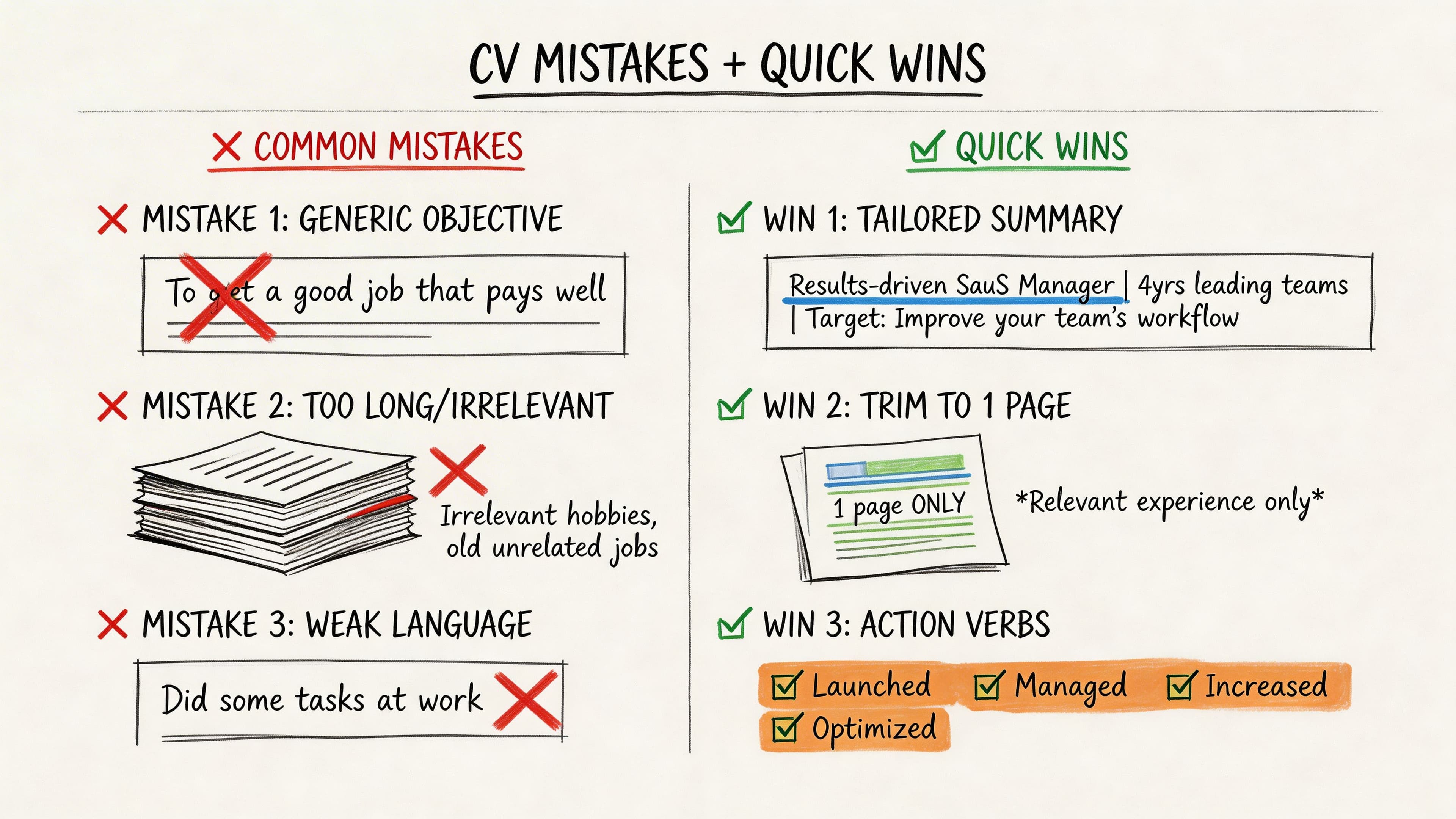
- Generic applications: The CV reads like it could be sent to any employer
- Weak opening lines: The top of the page says very little about fit
- Overlong job entries: Bullets repeat duties without adding evidence
- Poor contact details: Unprofessional email addresses or missing LinkedIn links
- Typos and date issues: Small mistakes that create doubt
- Flat skills sections: Long keyword lists with no prioritisation
Most of these can be fixed in one editing session.
Quick wins that improve the document fast
| Mistake | Quick win |
|---|---|
| Generic summary | Rewrite it around the target role and your strongest relevant strengths |
| Duty-heavy bullets | Turn at least one bullet per role into a result, scale, or outcome statement |
| Cluttered page | Cut filler, reduce text density, and standardise formatting |
| Weak skills section | Move the most relevant skills to the top and remove low-value fillers |
| No narrative | Add a summary that explains your direction, especially if you're changing fields |
Handle the ATS and human balance properly
Many applicants get stuck. They optimise for software and lose all personality.
CV Anywhere's article on ATS-friendly CV tips highlights that 43% of early-career job seekers feel their ATS-optimised CVs come across as "generic" to human recruiters. That's a real problem, especially for graduates and career changers.
The fix isn't to ignore ATS. The fix is to make the document readable while staying searchable.
Do that by:
- Writing a summary with direction: Let the reader understand your niche, strengths, or career pivot
- Using keyword-rich bullets that still describe real work
- Showing judgement in what you include: Not every possible keyword belongs on the page
- Keeping the tone natural: Professional, direct, and specific beats robotic every time
If a CV reads like it was assembled from job description fragments, a recruiter notices.
A final polish checklist
Before you send your next application, check this:
- Does the first half of page one sell you clearly?
- Does each recent role include proof, not just tasks?
- Have you removed low-value details that distract from the target role?
- Is the wording aligned to the vacancy without becoming repetitive?
- Would a recruiter understand your fit in one quick scan?
If the answer to any of those is no, the CV still needs editing.
Your CV Improvement Questions Answered
How long should my CV be in the UK
For most UK job seekers, two pages is the standard target. If you're early in your career, one page can work well. If you have more experience, two pages is usually enough.
The important rule isn't page count. It's relevance. If page two contains evidence that helps you get interviewed, keep it. If it contains old detail, repetition, or weak bullets, cut it.
Should I include a photo on my CV
For most UK roles, no. A photo usually adds nothing useful and can complicate screening.
Keep the focus on relevant skills, experience, and outcomes. A clean, text-based CV is usually the safer and stronger option.
What if I don't have impressive numbers
Use what you can prove.
That might be:
- Frequency: How often you completed the work
- Volume: How many clients, cases, reports, or tasks you handled
- Scope: Team size, departments supported, or workload managed
- Outcome: Faster turnaround, better organisation, smoother delivery, fewer issues
You don't need dramatic numbers. You need concrete evidence. Honest ranges are often enough.
How do I improve my CV if I'm changing careers
Lead with relevance, not chronology alone.
That usually means:
- Rewrite the summary to explain the direction you're moving in
- Prioritise transferable skills near the top
- Select bullets that show overlapping capability
- Cut older detail that locks you into the wrong professional identity
If you're moving from one field to another, your CV should help the reader connect the dots. Don't assume they'll do that work for you.
Should I list soft skills on my CV
Only if you can support them.
A long list of soft skills on its own is weak. It's better to show those strengths through examples in your experience section. "Stakeholder communication", "team coordination", and "problem solving" all become more convincing when tied to real work.
Is it worth tailoring my CV for every job
Yes. Not by rewriting every line, but by adjusting the parts that affect fit.
Focus on:
- Summary
- Skills order
- Keyword choice
- A few core bullets
That's usually enough to make the CV feel role-specific without turning the process into a full rewrite every time.
What should I remove from my CV first
Start by cutting:
- Objective statements
- Outdated or irrelevant roles with too much detail
- Repeated bullets
- Generic soft skill lists
- Old training that doesn't support the target role
- Personal details that employers don't need
Every line should help answer one question. Why should this person be interviewed for this role?
How often should I update my CV
Update it whenever you finish a project, take on new responsibility, earn a qualification, or start targeting a different type of role.
Waiting until you're urgently job hunting makes the process slower and less accurate. A CV works best when it's maintained regularly, then adapted when needed.
If you want to improve your CV quickly without juggling separate documents, notes, and spreadsheets, CV Anywhere is the most practical place to do it. You can build a polished ATS-friendly CV, tailor it with the JD Fit Checker, strengthen your opening with the AI Summary Generator, and track every application in one workflow. That's the difference between endlessly editing and moving from CV to interview.