11 Powerful Personal Statements Examples That Get Results
Explore top personal statements examples and effective strategies to create compelling essays for college, grad school, or career changes. Read more!

11 Powerful Personal Statements Examples That Get Results
This guide provides powerful personal statements examples across various scenarios, from undergraduate applications to major career pivots. We'll break down exactly what makes each statement effective, offering a deep strategic analysis of the techniques used. You will get specific, replicable methods and actionable takeaways to help you craft your own standout narrative. Instead of generic advice, this curated collection of annotated examples shows you how to demonstrate resilience, showcase intellectual passion, or frame professional achievements with impact. To truly elevate your personal statement and leave a lasting impression, master these strategies for writing better essays.
Ready to craft a compelling personal statement? Whilst examples provide inspiration, creating a standout statement requires the right tools. CV Anywhere's personal statement builder helps you structure your narrative, align with application requirements, and create a powerful story that gets results. Start building your personal statement for free and stand out from the competition.
Applying for UK Civil Service roles? Our specialised Civil Service personal statement builder creates Success Profiles-aligned statements with STAR examples tailored to public sector applications.
Our analysis focuses on several key types of essays you're likely to encounter, including:
- The Career Change Personal Statement
- The Research-Focused Academic Personal Statement
- The 'Why This School' Personal Statement
- The Professional Achievement Personal Statement
Let's dive into the personal statements examples that get results.
1. The Career Change Personal Statement
The career change personal statement is a crucial document for professionals pivoting to a new industry. Its primary goal is to bridge the gap between a candidate's past experience and their future aspirations, convincing an admissions committee or hiring manager that the transition is a well-considered and promising move. Crafting successful personal statements examples in this category involves weaving a compelling narrative that connects seemingly disparate experiences into a coherent story of growth and purpose.

This type of statement must directly address the "why" behind the change. It reframes past skills as transferable assets and demonstrates genuine, informed passion for the new field. For example, a teacher applying for an educational technology role might highlight their classroom management and curriculum design skills as a foundation for user-centric product development.
Strategic Breakdown
The core strategy is to transform potential perceived weaknesses (like a lack of direct experience) into unique strengths. This is achieved by showcasing a journey of discovery and preparation.
- The Catalyst: Pinpoint a specific "turning point" story that triggered the desire for change. This makes the decision feel authentic rather than impulsive.
- Connecting the Dots: Explicitly link skills from your previous career to the requirements of the new one. An engineer pursuing medicine can frame their problem-solving and analytical skills as ideal for diagnostics.
- Demonstrating Commitment: Show, don't just tell. Detail concrete actions you've taken, such as enrolling in relevant online courses, volunteering, or conducting informational interviews with professionals in the new field.
Actionable Takeaways
To build one of the strongest personal statements examples, integrate these tactics:
- Frame Your Past as an Asset: Start by quantifying achievements in your former role. For instance, "Managed a departmental budget of £200,000" establishes credibility before you pivot to discussing how those financial skills apply to business school.
- Be Honest but Positive: Acknowledge why your previous path was no longer the right fit without being negative. Focus on the pull of the new field rather than the push from the old one.
- Show Your Homework: Demonstrate a realistic understanding of the new industry, including its challenges. This shows maturity and proves your interest is more than superficial.
Does your resume clearly show results for each role?
See what's weakening your personal statement
Paste your draft → spot what's missing → strengthen each section with AI feedback.
Specific to your role, not a generic template.
2. The Overcoming Adversity Personal Statement
The overcoming adversity personal statement centres on a significant challenge the applicant has faced and conquered. Its primary purpose is to showcase resilience, maturity, and profound personal growth, demonstrating to an admissions committee how hardship has shaped the applicant's character and ambitions. Effective personal statements examples in this category transform a difficult experience into a powerful testament of strength, determination, and unique perspective.

This type of statement must move beyond simply recounting a hardship; it needs to analyse its impact. It's a narrative that shows, rather than tells, how you developed qualities like perseverance or empathy. For instance, a first-generation student might detail their journey navigating the complex college application process alone, highlighting how this fostered independence and resourcefulness, skills essential for academic success.
Strategic Breakdown
The core strategy is to frame the adversity not as a source of pity but as a crucible that forged key strengths and clarified purpose. The focus is always on the growth that resulted from the challenge.
- The Narrative Arc: Structure the story with a clear beginning (the challenge), middle (the actions you took), and end (the lessons learnt and resulting growth). This creates a compelling and easy-to-follow narrative.
- Connecting Hardship to Aspiration: Directly link the skills or insights gained from the experience to your future goals. A student who worked to support their family can connect their time management and financial discipline to their readiness for a demanding business programme.
- Demonstrating Agency: Emphasise your active role in navigating the situation. Focus on the decisions you made and the steps you took, showing you were a protagonist in your own story, not a passive victim of circumstance. Learn more about crafting a compelling story with these additional examples for personal statements from cvanywhere.com.
Actionable Takeaways
To create one of the most impactful personal statements examples in this style, integrate these tactics:
- Focus on "So What?": For every detail of the challenge you share, answer the "so what?" question. Explain how overcoming this obstacle makes you a better candidate for their specific programme or role.
- Maintain a Positive, Forward-Looking Tone: Whilst the subject matter is serious, your tone should be one of empowerment and optimism. Conclude by looking towards the future, showing how the experience has prepared you for what's next.
- Show, Don't Tell: Instead of saying you became "resilient," describe a specific moment where you demonstrated resilience. Vivid, concrete details make your story believable and memorable.
3. The Research-Focused Academic Personal Statement
The research-focused academic personal statement is a highly specialised document for graduate and doctoral programmes where research potential is paramount. Its primary purpose is to demonstrate a candidate's intellectual rigour, methodological expertise, and precise alignment with a programme's research strengths. Crafting compelling personal statements examples for this context means prioritising scholarly achievements and future research questions over a broad personal narrative, showing you are ready to contribute to the academic conversation from day one.
This type of statement must prove you are not just a student but an emerging scholar. It moves beyond listing accomplishments to synthesising them into a coherent intellectual journey. For instance, a neuroscience PhD applicant would detail their specific contributions to a study on neural plasticity, not just mention their lab experience, and connect this past work to questions they wish to pursue with a specific faculty member.
The following pie chart illustrates the ideal balance of content for this type of statement.
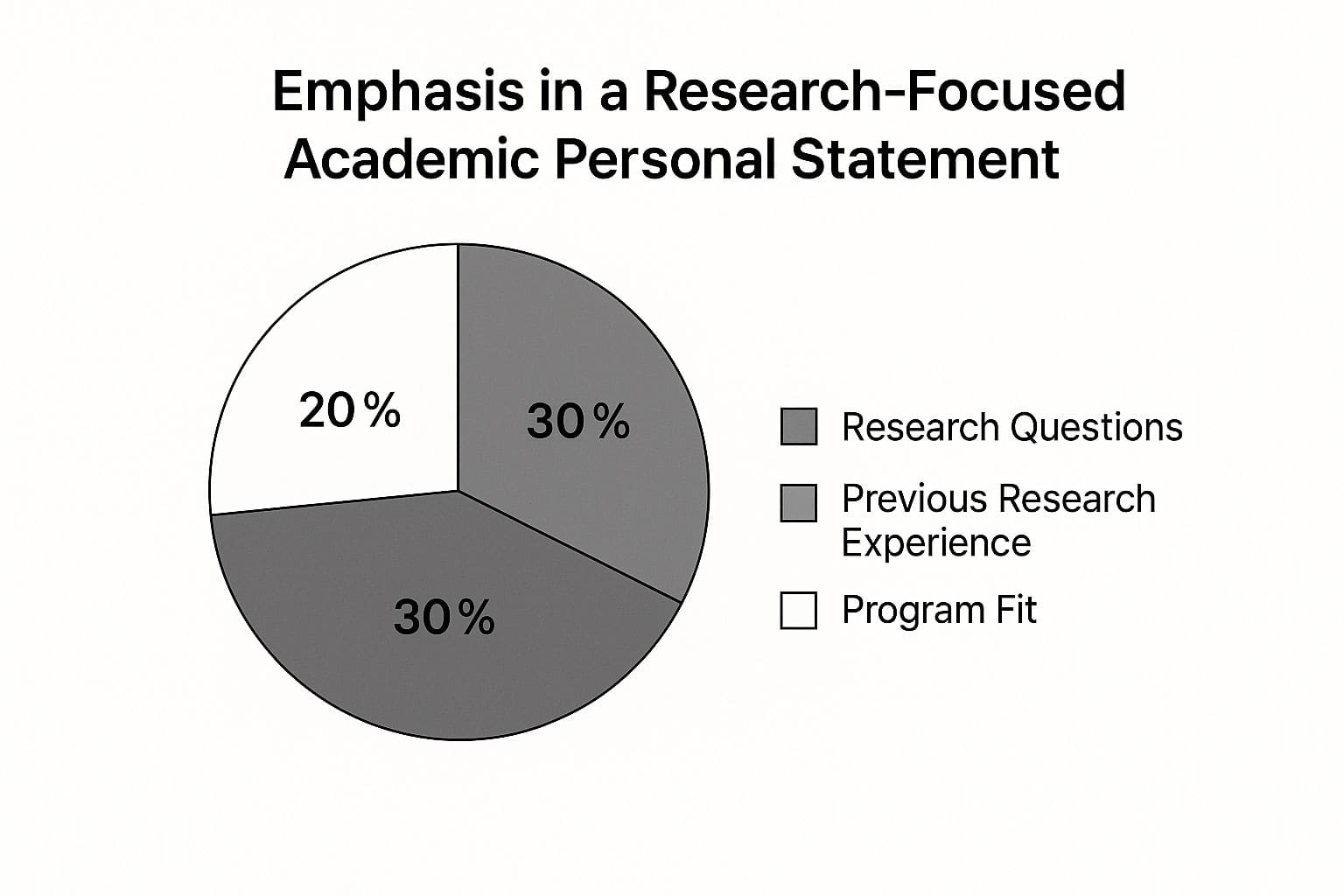
As the chart shows, the bulk of your statement should be equally dedicated to detailing your past research and explaining your fit with the specific programme, with a smaller but crucial section outlining your future research questions.
Strategic Breakdown
The core strategy is to position yourself as a junior colleague, not just an applicant. This is achieved by demonstrating a sophisticated understanding of the field and your potential place within it.
- The Intellectual Trajectory: Frame your academic path as a logical progression. Show how your interest evolved from a broad topic to a specific, researchable question.
- Methodological Fluency: Go beyond naming methods. Briefly describe why you used a particular quantitative model or theoretical framework and what insights it yielded.
- Faculty and Programme Fit: This is non-negotiable. Name specific professors whose work aligns with yours and explain precisely how your research interests complement or extend their own. This shows you've done your homework.
Actionable Takeaways
To create one of the most effective research-focused personal statements examples, integrate these tactics:
- Lead with Research: Begin by introducing your core research interest and the central question that drives you. This immediately establishes a scholarly tone.
- Quantify Your Contributions: Be specific about your role in past projects. Instead of "assisted in a lab," write "I was responsible for analysing the dataset using R and co-authored the findings section of the resulting paper."
- Use Discipline-Specific Language: Demonstrate your fluency in the academic language of your field, but avoid excessive jargon. Your goal is to sound knowledgeable, not inscrutable. For more insights, you can explore detailed breakdowns in these examples of research-focused personal statements.
4. The 'Why This School' Personal Statement
The 'Why This School' personal statement is a highly targeted essay designed to prove an applicant's deep and specific interest in a particular institution. Its goal is to move beyond generic praise and demonstrate a genuine, researched understanding of why the applicant and the school are a perfect match. Successful personal statements examples in this style convince admissions committees that the applicant isn't just seeking a prestigious name, but has thoughtfully selected their programme for its unique resources, faculty, and culture.
This statement must be rich with specific details that could only apply to that one school. For instance, an MBA applicant might discuss how a specific experiential learning lab and their desire to intern with a local partner company align with their long-term goal of launching a fintech startup. It's an exercise in specific, purposeful flattery backed by concrete connections to your own aspirations.
Strategic Breakdown
The core strategy is to demonstrate that you are not just a qualified applicant, but the ideal candidate for this specific community. You are showing that you have done extensive homework and envision yourself thriving within their unique ecosystem.
- The '3-Point Connection': Identify 3-5 specific, unique offerings of the school (e.g., a particular research centre, a professor's niche work, a specific clinic, or an interdisciplinary programme) and explicitly link each one to a past experience or a future goal of your own.
- Beyond the Brochure: Go deeper than the homepage. Mention recent faculty publications, a campus visit experience, conversations with current students or alumni, or recent news about the programme. This shows initiative.
- The Two-Way Street: Frame your interest not just in terms of what you will gain, but what you will contribute. Explain how your unique background or skills will enrich classroom discussions, student organisations, or research projects.
Actionable Takeaways
To create one of the most compelling personal statements examples, use these specific tactics:
- Name Names: Reference specific professors whose work excites you or courses you plan to take. Instead of "your strong economics department," write "Professor Jane Doe's course on behavioural finance, ECON 451, directly aligns with my thesis research."
- Tell a Story of Fit: If you visited campus or spoke with an alumnus, weave that personal interaction into your narrative. This adds a layer of authenticity and demonstrated interest that sets you apart.
- Align with Mission and Values: Show you understand the school's ethos. If the school emphasises community service, connect your volunteer experience and explain how you will engage with their specific community outreach programmes.
5. The Service and Leadership Personal Statement
The service and leadership personal statement is designed for applicants whose experiences are defined by community impact and civic engagement. Its purpose is to demonstrate character, empathy, and leadership potential by focusing on how the applicant has contributed to the well-being of others. Crafting powerful personal statements examples in this style requires moving beyond a simple list of activities to tell a story of personal growth through service.
This statement type is particularly effective for programmes that value social responsibility, such as public health, social work, or education. For instance, a candidate for a public policy programme might detail their experience organising a local voter registration drive, focusing on the challenges faced and the lessons learnt about community organising. The narrative emphasises the "how" and "why" of their service, not just the "what."
Strategic Breakdown
The core strategy is to frame your service not as an obligation but as a fundamental part of your identity and intellectual journey. It showcases your ability to identify a need, take initiative, and inspire others.
- Focus on Impact, Not Hours: Instead of just stating you volunteered for 100 hours, describe the tangible outcome of that time. Tell a specific, anonymised story about a person you helped or a problem you addressed.
- Show Leadership Evolution: Your leadership style isn't static. Describe a moment where your initial approach failed and how you adapted. This demonstrates self-awareness and resilience.
- Connect Service to Ambition: Clearly link your volunteer or leadership experiences to your future academic or career goals. For example, show how managing a student-run free clinic prepared you for the complexities of healthcare administration.
Actionable Takeaways
To create one of the most compelling personal statements examples in this category, use these tactics:
- Quantify Your Impact: Whenever possible, use numbers to illustrate the scale of your contribution. "Organised a fundraising event that raised £5,000 for local literacy programmes and served 150 children" is far more powerful than "organised a fundraiser."
- Reflect on Failure: True leadership involves navigating setbacks. Discuss a challenge or failure and, more importantly, what you learnt from it. This shows maturity and a capacity for growth.
- Demonstrate Humility: Show that you learnt from the community you served. Frame your experience as a two-way exchange, highlighting your respect for the people and their perspectives, a key skill for roles in public service. For a deeper look into this approach, see these UK Civil Service personal statement examples.
6. The Intellectual Passion Personal Statement
The intellectual passion personal statement charts the evolution of a deep academic curiosity, transforming a simple interest into a scholarly pursuit. Its primary goal is to tell the story of an intellectual journey, showing an admissions committee how specific questions, discoveries, or experiences ignited and sustained an applicant's passion for their chosen field. Crafting compelling personal statements examples in this style requires narrating a progression from initial curiosity to sophisticated engagement.

This statement is ideal for applicants to selective undergraduate programmes, honours colleges, or humanities PhD programmes where deep, intrinsic motivation is highly valued. For instance, a mathematics applicant might trace their fascination from noticing patterns in nature to independently exploring fractal geometry. The focus is less on a career path and more on the life of the mind.
Strategic Breakdown
The core strategy is to present your academic interest not as a subject you study, but as an essential part of how you see and interact with the world. This is achieved by showing a journey of increasing depth and commitment.
- The Spark: Begin with a vivid, specific moment of discovery. This "origin story" makes your passion feel authentic and deeply rooted rather than arbitrarily chosen.
- The Deepening: Show how that initial spark grew. Detail the books you read, the questions you asked, and the challenges or contradictions that complicated and enriched your understanding.
- The Action: Connect your intellectual journey to concrete actions. Mention relevant courses, independent research, or personal projects that demonstrate your proactive engagement with the field.
Actionable Takeaways
To build one of the strongest personal statements examples, integrate these tactics:
- Start Small and Specific: Begin with a focused anecdote. Instead of saying "I've always loved literature," describe the specific afternoon you spent wrestling with a single, transformative passage from a novel.
- Show, Don't Just Tell Enthusiasm: Avoid broad statements about your passion. Instead, demonstrate it by discussing complex ideas, citing influential thinkers, or explaining a difficult concept you finally grasped.
- Connect Passion to the Programme: Explicitly link your intellectual journey to the specific resources, faculty, or research opportunities at the institution. Show why their programme is the logical next step in your academic story.
7. The Professional Achievement Personal Statement
The professional achievement personal statement is a high-impact narrative designed for seasoned professionals applying to executive programmes, top-tier MBAs, or senior-level academic courses. Its purpose is to showcase a track record of significant accomplishments, leadership, and strategic thinking. Crafting powerful personal statements examples in this style means moving beyond listing job duties to articulating the tangible results and influence you've had in your career.
This statement is less about aspiration and more about proven capability. It uses concrete evidence to build a case for future potential. For instance, a consultant applying to business school wouldn't just say they led a project; they would detail how their strategic framework increased client revenue by 15% in six months. For professionals, understanding how to frame these achievements is a form of personal branding. For more on this, the ultimate guide to personal branding for consultants on LinkedIn offers valuable insights.
Strategic Breakdown
The strategy here is to build a narrative around quantifiable impact and leadership prowess. It's about demonstrating that you are already a leader and that the programme you're applying to is the logical next step to amplify your influence.
- Quantify Everything: Use the STAR method (Situation, Task, Action, Result) to structure your key achievement stories. Focus heavily on the "Result" by using hard numbers: revenue growth, cost savings, efficiency gains, or team size managed.
- Show, Don't Tell, Leadership: Instead of saying "I am a strong leader," describe a situation where you influenced a team, navigated a conflict, or drove a strategic shift. Focus on the how behind your accomplishments.
- Connect to Future Goals: Each achievement should not only highlight a past success but also a lesson learnt or skill developed that is essential for your future ambitions. This bridges your experience to the programme's curriculum.
Actionable Takeaways
To create one of the most compelling personal statements examples of this type, focus on these tactics:
- Lead with Your Best Story: Open with a powerful, concise anecdote of a major professional accomplishment. An engineer might start by describing the successful launch of a product that captured a new market segment.
- Balance Confidence and Humility: Whilst showcasing your achievements, acknowledge the contributions of your team. This demonstrates maturity and an understanding that significant results are rarely a solo effort.
- Justify the "Why Now": Clearly articulate why this specific programme is necessary for your next career stage. Explain how it will fill specific knowledge gaps and help you achieve goals that are currently beyond your reach.
7 Types of Personal Statements Compared
| Personal Statement Type | Implementation Complexity 🔄 | Resource Requirements 💡 | Expected Outcomes 📊 | Ideal Use Cases 💡 | Key Advantages ⭐ |
|---|---|---|---|---|---|
| The Career Change Personal Statement | Moderate – requires careful narrative balance and addressing scepticism | Medium – research new field, quantify past achievements | Demonstrates adaptability, transferable skills, and motivation | Professionals switching fields, applicants with non-linear careers | Stands out with unique perspective; shows learning agility |
| The Overcoming Adversity Personal Statement | Moderate – emotional tone management is critical | Low to Medium – detailed reflection and storytelling skills | Highlights resilience, character depth, and personal growth | Applicants with significant life challenges impacting their path | Creates emotional connection; memorable and distinctive |
| The Research-Focused Academic Personal Statement | High – demands in-depth field knowledge and faculty research | High – thorough research of programme, methodologies, and faculty | Showcases intellectual rigour, programme fit, and scholarly maturity | PhD/graduate applicants in research-intensive disciplines | Directly matches academic admission expectations |
| The 'Why This School' Personal Statement | High – requires tailored research for each application | High – extensive programme and institution research | Demonstrates fit, interest, and initiative | Applicants targeting selective or reach schools | Shows genuine interest; improves likelihood of admission |
| The Service and Leadership Personal Statement | Moderate – balancing impact stories with humility | Medium – gathering concrete examples of service and leadership | Highlights empathy, sustained commitment, and leadership potential | Service-oriented programmes in healthcare, social work, public policy | Shows character and values beyond academics |
| The Intellectual Passion Personal Statement | Moderate – crafting a compelling narrative without losing focus | Low to Medium – reflection and evidence of academic curiosity | Demonstrates genuine passion and intellectual curiosity | Scholarship applicants, humanities, selective undergraduate programmes | Engaging, memorable, and emotionally resonant narrative |
| The Professional Achievement Personal Statement | Moderate – clear articulation of achievements and leadership | Medium – quantification of results and leadership examples | Shows maturity, leadership impact, and career progression | MBA/executive programmes, senior-level professional applicants | Provides concrete evidence of capabilities and strategic vision |
Transform Your Story into an Offer
After dissecting the diverse personal statements examples throughout this guide, one central theme emerges: a compelling personal statement is not a passive summary of your life but an active, strategic narrative. It's the connective tissue that links your past accomplishments, your present motivations, and your future ambitions directly to the opportunity you are pursuing. Each example, from the career changer to the research-focused academic, demonstrates how a well-crafted story can bridge the gap between being qualified and being chosen.
The most effective statements do more than just list achievements; they weave them into a coherent and persuasive argument. They answer the silent questions every admissions committee or hiring manager has: Why you? Why here? Why now? Your goal is to move beyond simply stating your experiences and instead, reflect on what they taught you and how they sculpted your unique perspective.
Distilling Strategy from Examples
The power of reviewing personal statements examples lies in identifying replicable strategies. Let's recap the core principles that turned these examples from good to great:
- The "Show, Don't Tell" Mandate: Instead of claiming you are resilient, detail a specific instance where you overcame adversity. Rather than saying you are passionate about a subject, describe the specific research question that keeps you awake at night.
- The Golden Thread: A strong narrative has a unifying theme. Whether it's a commitment to social justice, a fascination with a specific academic problem, or a drive to innovate, this thread should run through your entire statement, tying disparate experiences together.
- Specificity is Your Superpower: Vague platitudes are the enemy of a memorable statement. The examples that stand out are rich with specific details, names, projects, and outcomes. This specificity demonstrates genuine engagement and makes your story credible and impactful.
Your Actionable Blueprint for Success
Armed with these insights, your next steps are clear. Don't just admire these examples; deconstruct them. Identify the narrative arc, the key turning points, and the moments of reflection. Then, turn the lens on your own life.
- Brainstorm Your Core Stories: What are the 2-3 defining experiences that have led you to this application?
- Identify Your "Golden Thread": What is the central motivation or theme that connects these stories?
- Draft with Structure: Choose a narrative structure from the examples that best fits your journey. Start with a compelling hook, build your case with specific evidence, and conclude by connecting your story to your future with the target institution or company.
Ultimately, mastering the art of the personal statement is a crucial step in your professional and academic journey. It's your chance to control the narrative and present the most authentic, compelling version of yourself. By applying the analytical frameworks and actionable takeaways from the personal statements examples we've explored, you can craft a document that doesn't just check a box but genuinely captures attention and transforms your story into a compelling offer.
Ready to ensure every part of your application tells a cohesive story? Your personal statement is just one piece of the puzzle. Use CV Anywhere to align your skills, track your applications, and tailor your entire professional profile to perfectly match your goals. Get started for free and build a truly powerful application at CV Anywhere.
Tags
Related articles
How to Write a Career Change CV Profile: 2026 Guide
The best career change CV profile uses a simple formula. It leads with the target role, bridges the gap with 2 to 3 transferable skills, and proves credibility with one quantified achievement. In the ...
Business Analyst Resume: Step-by-Step 2026 Guide
Most business analyst CV advice gets one important thing wrong. It assumes the candidate already has the title, the projects, and the obvious BA bullet points to prove it. That leaves out career chang...
10 Powerful Career Change Cover Letter Examples for the UK in 2026
The best career change cover letter examples in the UK prove your value by directly bridging your past experience to the future role. For a successful pivot, you must immediately address the hiring ma...
How to Switch Careers at 40 in the US: A Proven Guide
Switching careers at 40 isn't about starting from scratch—it's about strategically cashing in on two decades of experience. To successfully learn how to switch careers at 40, you must reframe your exp...
Popular Articles
The best career change CV profile uses a simple formula. It leads with the target role, bridges the gap with 2 to 3 transferable skills, and proves credibility with one quantified achievement. In the ...
Most business analyst CV advice gets one important thing wrong. It assumes the candidate already has the title, the projects, and the obvious BA bullet points to prove it. That leaves out career chang...
The best career change cover letter examples in the UK prove your value by directly bridging your past experience to the future role. For a successful pivot, you must immediately address the hiring ma...
Switching careers at 40 isn't about starting from scratch—it's about strategically cashing in on two decades of experience. To successfully learn how to switch careers at 40, you must reframe your exp...