A legal CV that gets interviews does three things well: it matches the job description closely, proves impact with specific evidence, and stays easy for both recruiters and screening systems to read. That matters even more in UK hiring because 54% of employers used some form of AI in recruitment in 2024, while the median number of applications per graduate vacancy was 140 in 2025.
That combination changes how strong candidates should approach legal CV tips. A polished document still matters, but polish alone won't carry a candidate from longlist to shortlist. The CV has to show the right practice area, the right evidence, and the right wording fast.
Legal recruitment remains brutally selective at first pass. Taylor Root notes that "three-quarters of CVs are rejected due to bad grammar, spelling, or poor visual layout" in its guidance on structuring an associate lawyer CV, which is why presentation still has to be treated as substantive, not cosmetic (Taylor Root legal CV guidance). The strongest legal CVs are brief, targeted, reverse chronological, and built so the top section does the heaviest lifting.
The advice below is built for graduates, paralegals, trainee solicitors, associates, senior counsel, and partners. It focuses on what legal employers scan for, what weak CVs get wrong, and how to phrase experience so it reads well to both a person and a system.
1. Tailor Your CV to Specific Legal Practice Areas and Job Requirements
A generic legal CV usually fails before anyone reaches the second half of page one. Legal employers don't hire "lawyers" in the abstract. They hire for commercial litigation, employment, pensions, data protection, public law, private client, real estate, regulatory, and other clearly defined practice needs.
That means tailoring can't stop at swapping a few words in the profile. The strongest CV aligns job title, summary, skills, and bullet points with the vacancy itself. If the role says "commercial litigation", "case management", and "client-facing disputes", those exact ideas should appear in the CV where they are true.

What tailoring looks like in practice
A candidate applying to a corporate team should move transaction work, drafting, due diligence, disclosure, and stakeholder coordination higher than unrelated litigation tasks. A candidate applying to a government legal role should foreground regulatory, policy, judicial review, procurement, or public sector advisory work before anything more general.
For junior applicants, this may mean pulling relevant modules, legal clinic work, mooting, internships, or dissertation topics into sharper focus. For experienced lawyers, it often means reordering bullets so the matters most relevant to the target role appear first.
Practical rule: Extract a small set of phrases from the vacancy and reflect them naturally in the CV's top third, work history, and skills section.
UCAS-style UK careers guidance and legal-sector recruiter advice consistently favour concise, role-targeted CVs, while Michael Page specifically advises tailoring legal CVs to the vacancy and explaining career gaps clearly (Michael Page legal CV tips).
A simple tailoring method
- Match the practice label: Use the employer's language where accurate. If the advert says commercial litigation, don't rely only on "dispute resolution".
- Prioritise relevant matters: Put the most relevant work at the top of each role, not buried in the last bullet.
- Rewrite the profile: Replace generic claims with role-specific positioning.
- Mirror the brief: If the employer wants client contact, drafting, business development, or regulatory work, show proof of each.
- Track changes by role: A candidate applying across several legal paths should keep notes. CV Anywhere's tools fit naturally here, especially if the same person is also reviewing examples such as a resume for legal assistant roles.
A strong example for an IP role might lead with trade mark support, drafting, research, and portfolio management. The same candidate applying for a data protection role should instead bring GDPR, risk review, policy drafting, and stakeholder advice to the front.
Is your CV actually getting responses?
Your CV might be missing something important
Upload your CV → see its weakest areas → fix them, one by one.
Free. Takes less than 2 minutes.
2. Quantify and Specify Legal Achievements with Measurable Outcomes
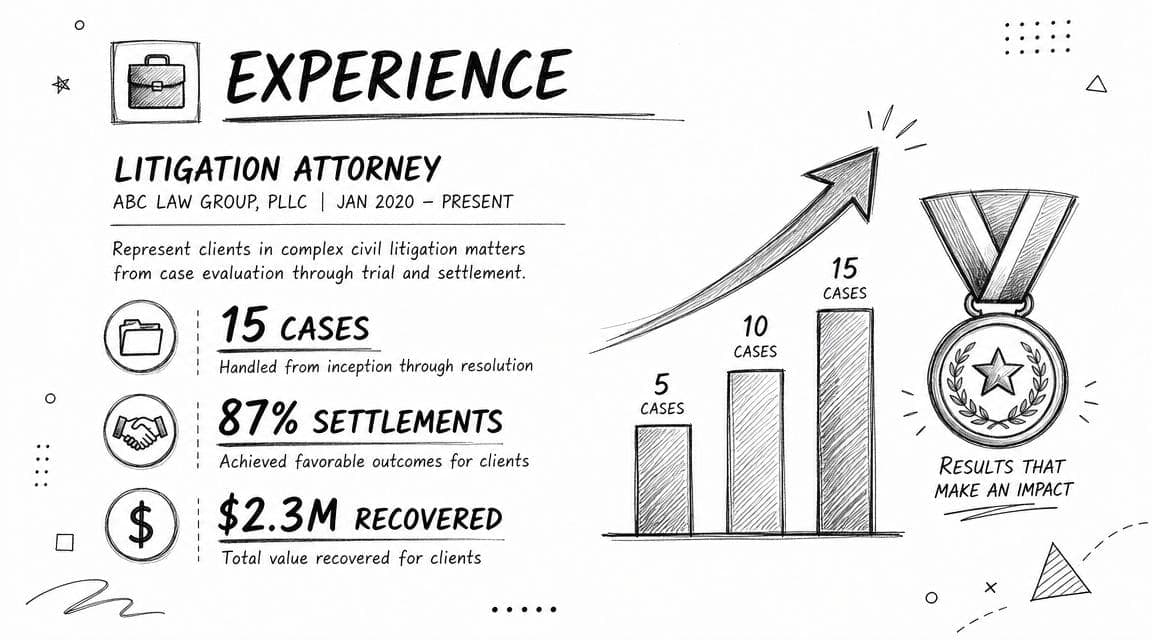
Many legal CVs are accurate but weak because they only describe duties. Recruiters already know what a solicitor, trainee, or paralegal is supposed to do. The question is whether the candidate handled meaningful work, increasing responsibility, and outcomes that matter.
That doesn't always mean publishing confidential figures. It means adding scale, complexity, context, and result wherever possible. A better bullet tells the reader what kind of matters were handled, for whom, at what level, and with what outcome.
Weak phrasing versus strong phrasing
Weak:
- Assisted with commercial contracts
- Conducted legal research
- Supported litigation matters
- Advised clients on compliance
Stronger:
- Drafted and negotiated supplier, services, and confidentiality agreements for commercial clients in a regulated environment
- Carried out research on limitation, privilege, and disclosure issues to support active commercial disputes
- Managed a mixed caseload of pre-action and live litigation files with direct responsibility for deadlines, client updates, and document preparation
- Advised internal stakeholders on data handling, policy wording, and compliance risks across day-to-day operations
The point isn't to stuff in numbers for effect. The point is to replace vague verbs with evidence. Eventus Recruitment Group highlights research, critical thinking, adaptability, analytical ability, clear writing, time management, communication, and business development as key legal CV skills, while Law Jobs similarly stresses research, attention to detail, critical thinking, commercial awareness, and problem-solving. Eventus also notes that experienced legal candidates should include role details such as dates, job title, employer size, responsibilities, achievements, and any employment gaps (Eventus legal CV skills guide).
What to measure if exact figures are confidential
- Volume of work: number of matters, hearings, files, contracts, or transactions handled
- Complexity: cross-border, high-value, regulated, urgent, contested, or multi-party work
- Scope of responsibility: drafting, negotiation, client contact, supervision, matter management
- Commercial impact: risk reduction, turnaround time, stakeholder support, deal progression
- Progression: promotion, expanded caseload, greater autonomy, new specialism
Strong legal CV bullets usually answer four unspoken questions. What work, for whom, at what level, and with what result?
Candidates who struggle with this often need examples rather than theory. That's where a bank of examples of accomplishments for resume writing can help convert flat duty statements into evidence-based bullet points.
3. Structure Your Legal Experience with Clear, Hierarchical Formatting
Formatting isn't a finishing touch in legal hiring. It's part of the screening decision. UC Berkeley Law's resume guidance says a legal resume should be concise, selective, visually appealing, and "absolutely free of typos, grammatical errors, and inconsistencies," with reverse chronological order, one phone number, one email address, and a typical font of Times New Roman size 11 or 12. MLA Global's legal resume guidance also points to one to two pages, bullet points, simple language, and tailoring for quick review (MLA Global legal resume tips).
That standard translates well to UK legal CV writing. Recruiters want to see your current role, core qualifications, and relevance quickly. Dense blocks of text, inconsistent spacing, and decorative layouts make that harder.
The structure that works
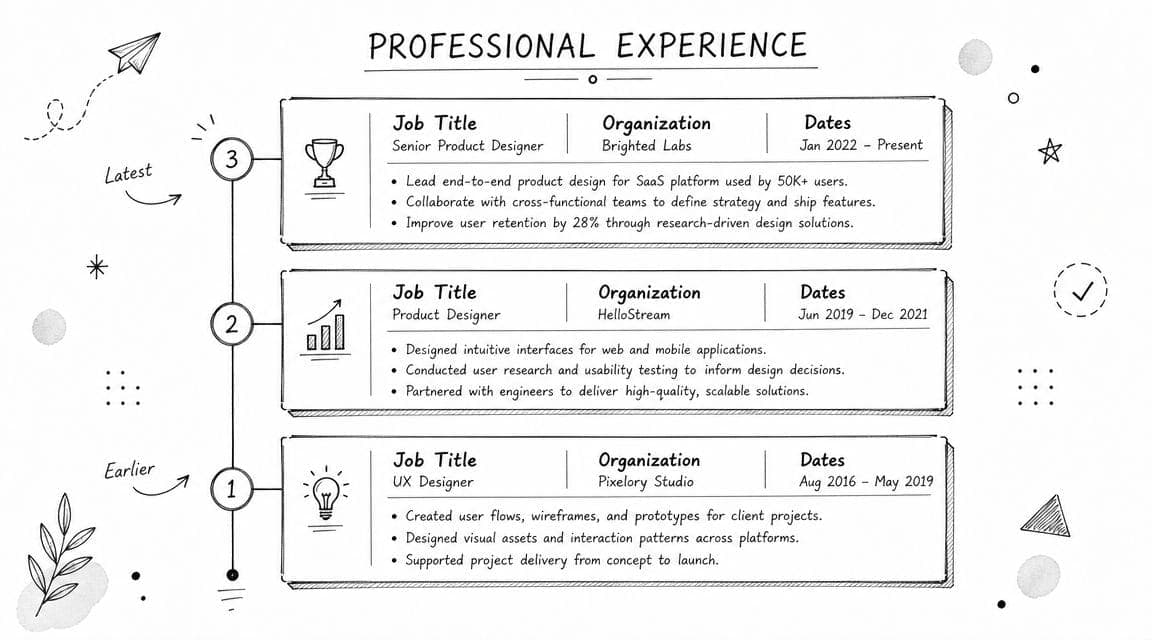
Use a clear hierarchy for each role:
Job title
Organisation
Dates
Short context line if needed
Bullet points focused on contribution and outcomes
For example:
Senior Associate
Commercial Litigation
Firm Name
Month/Year to Present
Then use focused bullets, not mini-essays. A recruiter should be able to skim the page and understand level, practice area, clients, and strengths almost instantly.
Common formatting mistakes
- Overloaded top section: Long personal statements push relevant experience too far down.
- Inconsistent dates: Switching between formats makes the CV look careless.
- Paragraph-only work history: Legal recruiters scan. Bullets support that behaviour.
- Too many bullets in every role: Older or less relevant positions should be compressed.
- Visual gimmicks: Text boxes, columns, icons, and graphics can hurt readability.
A useful rule is that the most relevant information should appear first, not just the fullest description. If a candidate has mixed practice experience, the bullet order inside each role should still prioritise the target discipline.
For candidates revisiting their format, a practical reference point is CV layout guidance such as this resume layout article, adapted to UK CV conventions and legal-sector expectations.
A legal CV should look calm under pressure. If the formatting feels busy, the candidate already looks less precise.
4. Prominently Feature Professional Qualifications, Admissions, and Accreditations
In legal hiring, status matters. Recruiters need to know quickly whether a candidate is a trainee, NQ, solicitor, barrister, chartered legal executive, foreign-qualified lawyer, or someone with legal experience but no current practising status. If that isn't clear near the top of the CV, the document creates friction immediately.
Qualifications shouldn't be buried after two pages of experience, especially when regulatory status is central to the role. A dedicated section near the top usually works best for solicitors, barristers, and experienced legal professionals.
What to include
For UK legal roles, that section may include:
- Professional title: Solicitor of the Senior Courts of England and Wales, Barrister, CILEX Lawyer, Trainee Solicitor
- Admission information: jurisdiction and admission or call date
- Academic qualifications: LLB, GDL, LPC, SQE route, BPTC, LLM where relevant
- Accreditations and panels: mediation training, specialist panels, sector-specific memberships
- Relevant memberships: Law Society, Inns of Court, specialist associations
A junior candidate can place education and legal training above work experience if qualification profile is the main selling point. An experienced commercial lawyer usually does the reverse, but admissions should still remain highly visible.
How this differs by career stage
Graduates and trainees should make education sharper and more selective. Include legal modules, clinic work, prizes, mooting, or dissertation themes only where they support the target role. Experienced solicitors should keep academic detail shorter and let admissions, specialist accreditation, and practice history carry more weight.
International candidates should make UK recognition status easy to understand. Don't assume a recruiter will decode foreign qualification routes unaided. A brief clarifying line is often enough.
This section also helps with filtering. If the advert requires a practising solicitor in England and Wales, the recruiter shouldn't have to hunt for that answer. The same applies to rights of audience, panel memberships, compliance training, and specialist credentials in areas such as family, private client, or regulatory work.
5. Demonstrate Technical Legal Knowledge and Sector-Specific Expertise
A convincing legal CV doesn't stop at "strong communication skills" or "excellent research ability". It shows where those skills have been applied and in what legal or commercial environment. That's especially important in lateral hiring, in-house moves, and specialist private practice roles.
A banking and finance team wants to see more than generic drafting. A healthcare employer wants to see awareness of regulated environments. A data protection role needs more than broad commercial support. The CV should make technical fit obvious.
Make expertise visible, not implied
Candidates should name the legal work accurately. Examples include shareholder agreements, disclosure, witness statements, tribunal matters, FCA-related advisory work, procurement challenges, trade mark filing support, judicial review, contract lifecycle work, or policy drafting.
The same principle applies to tools and systems. Legal recruiters often look for practical familiarity with products such as Westlaw, LexisNexis, NetDocuments, iManage, or Relativity where that knowledge is relevant to the role. These aren't the headline of the CV, but they can support credibility.
A stronger skills section
A legal skills section should feel specific, not padded. For example:
- Practice expertise: Commercial contracts, employment tribunal support, property transactions, data protection advisory
- Research tools: Westlaw, LexisNexis, Practical Law
- Drafting strengths: Agreements, pleadings, policies, board papers, advice notes
- Sector exposure: Financial services, public sector, technology, healthcare
- Working style: Stakeholder management, deadline control, matter coordination, client communication
Oxford-style CV guidance and legal recruiter expectations both reward simple language and relevant prioritisation. The best legal CV tips in this area come down to precision. Name the legal area, the document type, the sector, and the level of exposure.
Candidates refining this section often benefit from broader guidance on how to present role-relevant capabilities without filling the page with clichés. A useful supporting read is resume hard and soft skills, adapted through a legal lens.
Sector knowledge becomes persuasive when it's tied to real work. "Commercial awareness" is weak on its own. "Advised operational teams on contract risk in a regulated environment" is stronger.
A public law candidate, for instance, should foreground administrative law, statutory interpretation, and government decision-making rather than generic advisory work. A technology lawyer should emphasise SaaS contracts, data processing terms, IP, and product-facing stakeholder work if those are genuine strengths.
6. Balance Professional and Personal Development to Show Well-Rounded Growth
Legal employers still hire for judgement, credibility, and professional maturity, not just technical output. That's why the strongest CVs often include a concise section showing development outside pure fee-earning or file management. This can include pro bono work, mentoring, publications, speaking, committee activity, or targeted CPD.
The key is relevance. This section shouldn't become a catch-all for old societies and unrelated hobbies. It should reinforce the professional story already established in the rest of the CV.
What belongs here
Useful entries often include:
- Pro bono legal work: clinics, advice centres, supervised volunteer schemes
- Mentoring and supervision: supporting trainees, paralegals, or junior lawyers
- Writing and speaking: articles, webinars, internal training, conference panels
- Professional involvement: specialist associations, committee roles, working groups
- Focused development: CPD and study linked to the target practice area
A litigation associate applying to a disputes boutique might include published commentary on procedural developments. A junior in-house candidate might mention internal legal training delivered to commercial teams. A family lawyer could include volunteer advisory work that supports client-facing credibility and empathy.
WhisperAI's guide for legal professionals is a useful example of adjacent workflow content that fits naturally with modern legal practice, particularly where note-taking, drafting support, and documentation habits shape day-to-day effectiveness.
This matters even more for non-linear careers
One of the biggest gaps in legal CV advice is how to handle career breaks, portfolio careers, or cross-functional backgrounds. That matters because non-linear histories are common in the wider UK workforce, including people out of the labour market for caring, long-term illness, study, or other reasons, trends that show up routinely in official economic activity and labour market statistics from the Office for National Statistics.
A candidate returning after time away shouldn't try to hide the gap with awkward formatting. It's better to explain it briefly and then show current relevance through recent legal study, volunteering, contract work, consulting, or transferable achievements.
Examples that work well:
- A former compliance manager reframing prior work as evidence of risk awareness, policy interpretation, stakeholder influence, and regulatory judgement
- A returning solicitor highlighting recent CPD, freelance drafting, and pro bono clinic involvement
- A career changer from operations showing contract handling, governance, and cross-functional communication as the bridge into legal work
This section is where candidates prove they've continued to build judgement, not just pause and wait.
7. Optimise Your CV for ATS Systems and Recruiter Scanning Patterns
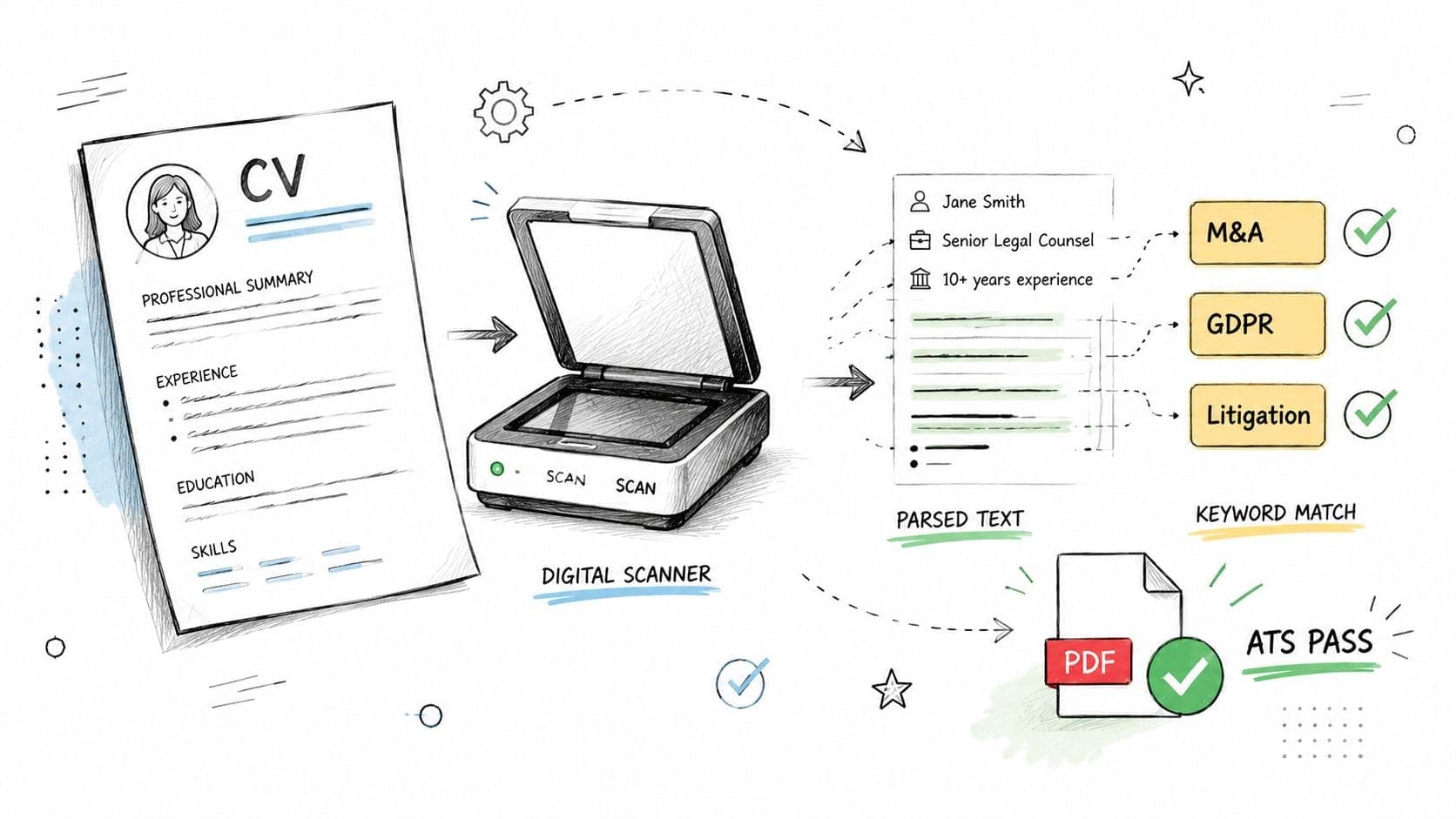
Most legal CV advice still talks about "keywords" in abstract terms. That's no longer enough. Candidates need to understand what gets parsed cleanly and what tends to break in modern screening workflows.
The practical point is simple. A legal CV must work twice. It must parse properly in software and still read well to a recruiter on a quick skim. If either part fails, the application loses momentum.
How to make a legal CV ATS-friendly
Use standard headings such as Professional Experience, Education, Qualifications, and Skills. Keep dates, employer names, and titles clear. Avoid heavy design, text boxes, complex tables, logos, and visual rating bars.
The language also matters. If the vacancy uses a specific phrase, include that phrase where accurate rather than relying only on a broader umbrella term. This is especially important in legal hiring where small wording differences can signal different practice areas.
Examples:
- "Commercial litigation" and "dispute resolution"
- "Employment tribunal" and "employment law"
- "Mergers and acquisitions" and "corporate"
- "Data protection" and "privacy"
- "Regulatory compliance" and "governance"
Why this has become more important
The CIPD's UK Recruitment, Retention and Turnover survey found that 54% of employers used some form of AI in recruitment in 2024, up from 32% in 2023, which makes dual optimisation for human readers and machine matching a practical necessity rather than a niche concern. In the graduate market, pressure is even sharper, with the Institute of Student Employers reporting a median of 140 applications per graduate vacancy in 2025, meaning small improvements in CV signal can matter materially.
A clean ATS-friendly CV doesn't mean robotic writing. It means clear wording, standard structure, and exact relevance. Save the file with a professional name, keep formatting restrained, and place the strongest matching terms early.
For candidates revising an older CV, optimize resume for ATS offers a useful framework that can be adapted to UK legal applications.
The best ATS strategy in law is simple. Use the employer's language where it's true, and prove each keyword with real experience.
A candidate for a real estate role, for example, should mention acquisitions, disposals, leases, landlord and tenant work, title review, or completion support where applicable. A candidate who only says "property matters" leaves too much for the reader, or the system, to infer.
7-Point Comparison of Legal CV Best Practices
| Approach | 🔄 Complexity | ⚡ Resources | 📊 Expected outcomes | 💡 Ideal use cases | ⭐ Key advantages |
|---|---|---|---|---|---|
| Tailor Your CV to Specific Legal Practice Areas and Job Requirements | Medium, repeated customisation per application | Moderate time per application; job-description analysis tools (Fit Checker) | Higher ATS match and interview callbacks; increased role relevance | Targeted practice-area roles (M&A, IP, public sector); competitive hires | Stronger fit with employer needs; signals genuine interest |
| Quantify and Specify Legal Achievements with Measurable Outcomes | Medium–High, needs data collection and validation | Access to case metrics, financial figures; careful confidentiality checks | Clear demonstration of impact and business value; stronger credibility | In-house counsel, corporate firms, senior litigation roles | Differentiates candidates with objective, measurable results |
| Structure Your Legal Experience with Clear, Hierarchical Formatting | Low, follows standard formatting rules | Templates and consistent editing time | Improved readability and ATS parsing; recruiters find key info quickly | All applications, especially recruiter-screened and large firms | Faster comprehension; professional, ATS-friendly presentation |
| Prominently Feature Professional Qualifications, Admissions, and Accreditations | Low, collating verified credentials | Official documents, admission dates, concise presentation | Immediate verification of eligibility; filters for qualified roles | Regulatory, government, compliance-sensitive positions | Establishes legal standing and regulatory compliance |
| Demonstrate Technical Legal Knowledge and Sector-Specific Expertise | Medium, requires up-to-date sector research | Subject-matter knowledge, software proficiency, concrete examples | Better match for specialist roles; supports senior-level expectations | In-house teams, regulated industries (finance, healthcare, tech) | Shows deep, role-specific expertise; improves keyword matching |
| Balance Professional and Personal Development to Show Well-Rounded Growth | Low–Medium, curation to avoid dilution | Records of CPD, pro bono, publications; concise selection | Signals professional engagement and leadership potential | Public sector, not-for-profit, firms valuing culture and pro bono | Demonstrates commitment beyond billable work; leadership signals |
| Optimise Your CV for ATS Systems and Recruiter Scanning Patterns | Medium, technical formatting and keyword strategy | ATS-friendly templates, keyword analysis tools, testing | Higher parsing success and delivery to human reviewers; more callbacks | Volume applications, recruitment agencies, large firms | Ensures CV reaches recruiters; reduces parsing errors and omissions |
Putting Your Legal CV to Work
A legal CV isn't just a record of jobs held. It's an advocacy document. It has to present a case quickly, clearly, and credibly. The strongest legal CV tips all come back to that point. Relevance first, evidence second, readability throughout.
For graduates, that usually means making education, legal work experience, clinic work, and role-specific keywords do more of the heavy lifting. For junior lawyers, it means showing progression, ownership, drafting exposure, and a sharper sense of practice area fit. For senior lawyers, it means stripping out dated detail and focusing on client profile, matter complexity, leadership, business development, and specialist credibility.
A good legal CV also accepts the trade-offs. It can't include every task ever done. It shouldn't read like a matter list pasted into Word. And it shouldn't try to impress with design tricks that interfere with clarity. The document needs selectivity. If a bullet doesn't strengthen the case for this specific role, it probably shouldn't be there.
That's especially true in the UK legal market, where firms, in-house teams, recruiters, and public sector employers often compare large numbers of applicants and expect concise, selective, error-free CVs. The best-performing documents tend to be the ones that answer the recruiter's practical questions at speed: What kind of legal work has this person done? At what level? In what setting? How closely does that match the role?
Candidates with non-linear backgrounds should take particular encouragement from that. A well-framed CV can turn adjacent experience into evidence of drafting, stakeholder management, risk assessment, operational judgement, client handling, or commercial understanding. The issue usually isn't lack of value. It's weak framing.
The final check should be ruthless:
- Is the target practice area obvious?
- Are admissions and qualifications easy to find?
- Does each role show evidence, not just responsibilities?
- Can a recruiter skim the first page and understand fit immediately?
- Will the formatting survive an ATS parse?
That discipline is what moves a legal CV from longlist to interview shortlist. Candidates who pair that discipline with consistent application tracking and careful tailoring put themselves in a much stronger position. Supporting assets such as a smart CV builder, a fit checker, an application tracker, and even profile work like writing a LinkedIn summary help keep the whole job search aligned rather than fragmented.
CV Anywhere helps candidates turn these legal CV tips into a faster, more repeatable process. Its CV Anywhere platform combines an AI-powered CV builder, job description fit checking, and application tracking so legal applicants can tailor each CV, keep formatting ATS-friendly, and manage every application in one place.