If a candidate is applying for restaurant work in the UK right now, the problem usually isn't effort. It's that the CV reads like generic online advice instead of something a busy restaurant manager can scan in seconds. A strong restaurant server resume needs to show pace, reliability, customer handling, and front-of-house skills fast.
Most applicants lose interviews by listing duties instead of proving they can handle service. The fix is simple. Use a clean reverse-chronological format, tailor the wording to the job advert, and show evidence of impact rather than padding the page with vague claims. UK-focused CV guidance also leans towards concise formatting and tailoring to the vacancy, especially for early-career candidates, where a one-page CV is usually enough.
How to Structure Your Restaurant Server CV
The strongest format for a restaurant server CV is reverse chronological. Put the most recent and relevant role first, keep the layout tight, and make it easy for a hiring manager to spot the essentials without searching for them.
That matters in hospitality because managers often review applications between service, rota planning, and staff gaps. A cluttered CV slows them down. A sharp one makes the decision easier.
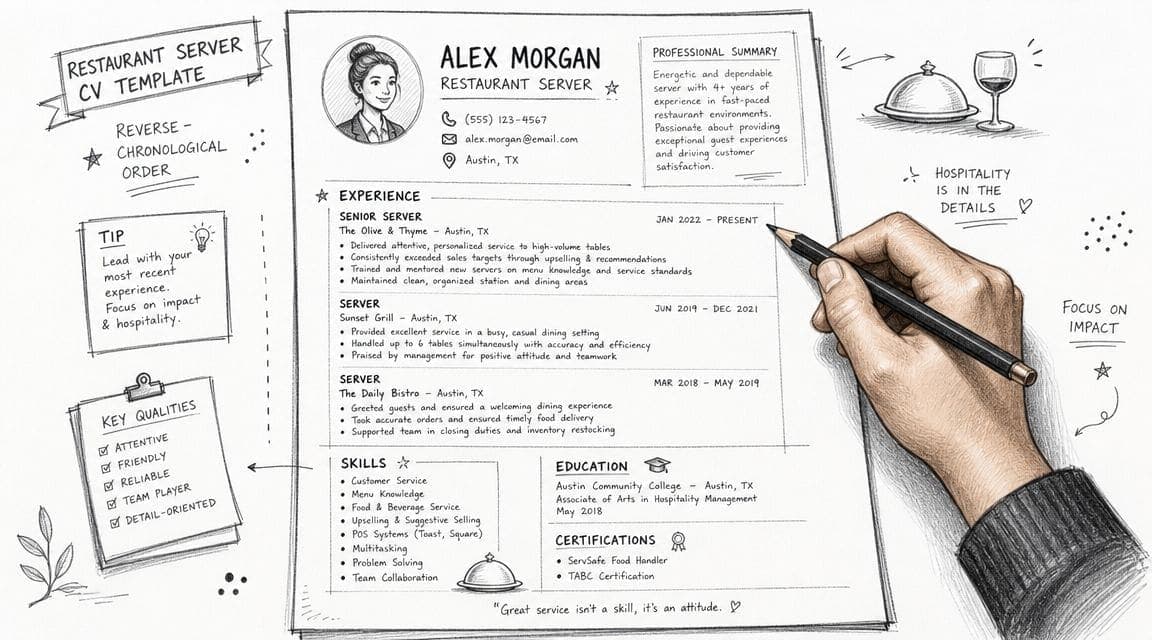
Start with a contact block that answers practical questions
The top of the page should do more than identify the candidate. In hospitality, it should also reduce friction.
Include:
- Full name: Use the same name used on job applications and work documents.
- Phone number and email: Double-check both. One typo can kill the application.
- Location: Town or city is enough. Full address isn't usually needed.
- Availability: Weekend, evening, split-shift, or immediate availability can be highly relevant.
- Right to work: If relevant, this can be stated briefly and clearly.
A clean header might look like this:
Amira Khan
Manchester
07123 456789 | amira.khan@email.com
Available evenings, weekends and bank holidays
Full right to work in the UK
Practical rule: If the contact section doesn't tell a manager whether the candidate can actually work the shifts, it's incomplete.
Write a short profile, not a vague personal statement
The profile should be 3 to 4 lines. It isn't a life story. It should tell the employer what kind of server the candidate is, what environment they've worked in, and what strengths matter most.
Good example:
Reliable restaurant server with experience in fast-paced front-of-house environments, handling guest orders, cash transactions and busy shift service. Strong menu knowledge, confident POS use and a calm approach under pressure. Available for evening and weekend shifts.
Weak example:
Hard-working individual with a passion for people and food, seeking an opportunity to grow and contribute to a successful team.
The second version says very little. The first sounds employable.
Candidates who also want to sharpen how they present themselves beyond the CV can borrow the same punchy style used in strong LinkedIn headline examples. The principle is the same. Lead with role, value, and relevance.
Use the core sections managers expect
A restaurant server CV doesn't need clever design. It needs the right sections in the right order.
| Section | What to include | What to leave out |
|---|---|---|
| Profile | Service style, experience level, availability, key strengths | Generic personality claims |
| Work history | Employer, location, dates, role title, impact-focused bullets | Dense paragraphs |
| Skills | POS use, cash handling, upselling, food safety awareness, teamwork | Random skills unrelated to hospitality |
| Education | School, college, relevant training if useful | Long detail for older qualifications |
A simple structure is usually enough:
- Contact details
- Profile
- Key skills
- Work experience
- Education
For candidates unsure what belongs in each part, this guide to CV components is a useful reference point.
Keep formatting plain and fast to scan
Restaurants aren't hiring for graphic design. They're hiring for dependable service.
That means the CV should use:
- Clear headings: Profile, Experience, Skills, Education
- Consistent dates: For example, Jan 2023 to Present
- Bullet points: Short, readable, focused on results
- One page where possible: Especially for early-career applicants
- No photo unless explicitly requested: That's not standard for most UK hospitality applications
The trade-off is simple. A decorative CV may look impressive to the applicant, but a plain CV often performs better because it's faster to read and easier to process.
Is your resume actually getting responses?
Your resume might be missing something important
Upload your resume → see its weakest areas → fix them, one by one.
Free. Takes less than 2 minutes.
Writing an Experience Section That Shows Impact
Most weak server CVs fail in the same place. The experience section becomes a list of chores:
- Took orders
- Served food
- Cleaned tables
- Used till
That doesn't help much. Every hiring manager already knows what a server does. What they want to know is whether the candidate handled busy service well, stayed accurate, sold effectively, and kept guests happy.

UK CV guidance recommends tailoring each application to the vacancy and using evidence of impact rather than long task lists. For server roles, that means showing output such as tables covered per shift, cash handled, or guest-feedback improvements.
Turn duties into proof
A useful formula is:
Action verb + result + context
Instead of writing:
- Served customers in a busy restaurant
Write:
- Handled high-volume lunch and evening service while maintaining accurate orders and prompt table coverage.
- Managed cash and card payments during busy shifts using the restaurant POS system.
- Supported smooth table turnover by coordinating closely with kitchen and bar staff during peak service.
None of those lines invents numbers. But each one still gives a stronger sense of pace and responsibility.
Before and after examples
The difference usually comes down to specificity.
| Weak bullet | Better bullet |
|---|---|
| Took food orders | Took accurate food and drink orders, checked dietary requests, and relayed changes clearly to kitchen staff |
| Worked with team | Coordinated with runners, bar staff and kitchen team to keep service flowing during busy periods |
| Handled customer complaints | Resolved guest issues calmly at table level and escalated only when needed, helping maintain a positive dining experience |
| Used till | Processed cash and card transactions accurately through the POS system and closed bills efficiently |
A better bullet gives the employer a reason to believe the candidate can step into service without constant supervision.
Hiring managers don't reward applicants for naming tasks. They shortlist people who sound ready for a live floor.
What to quantify when exact figures aren't available
Not every candidate has access to sales reports or formal KPIs. That's normal. The CV can still show impact by using grounded operational details.
Useful details include:
- Shift intensity: Busy lunch service, evening service, weekend service
- Floor coverage: Small section, full section, terrace, bar area
- Service type: Casual dining, pub, hotel breakfast, events, fine dining
- Responsibility level: Opening duties, closing duties, training new starters, handling bookings
A work history entry could look like this:
Server
The Willow Arms, Leeds
May 2023 to Present
- Delivered friendly and efficient table service in a fast-paced pub restaurant environment.
- Handled guest orders, drinks service and bill settlement using the in-house POS system.
- Maintained clean, organised service areas and reset tables quickly between sittings.
- Resolved routine guest concerns professionally and kept service standards consistent during busy shifts.
Candidates who want more examples for structuring this section properly can use this CV work experience guide.
Highlighting the Right Skills for a Server Role
A skills section matters because restaurant managers often scan for practical signals before reading the rest. In UK hospitality, employers value communication, multitasking, time management, cash handling, menu knowledge, POS use and upselling. When those show up clearly on the CV, they lower hiring risk.
The mistake is treating skills like filler. A restaurant server CV should list skills that match the actual floor.
Hard skills that make sense on a server CV
Hard skills are the teachable, operational parts of the job. These help prove that the candidate can slot into service quickly.
Useful examples include:
- POS systems: Card and cash transactions, order entry, bill splitting
- Cash handling: Till balancing, payment accuracy, end-of-shift settlement
- Menu knowledge: Specials, allergens, ingredients, drinks pairing awareness
- Food safety awareness: Hygiene, safe handling, clean service stations
- Front-of-house operations: Table setting, section management, booking coordination
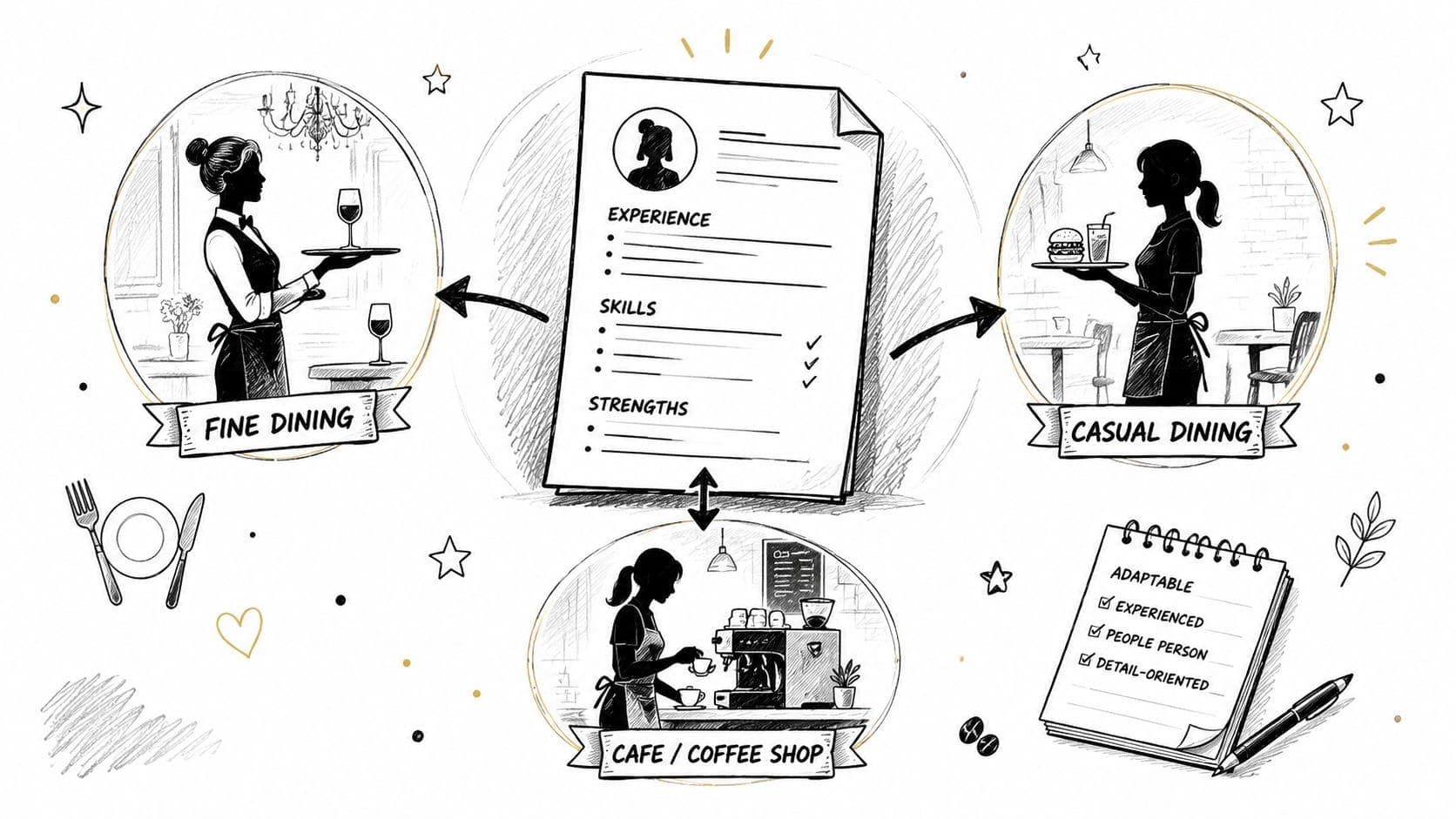
If the job advert mentions a particular service style, the CV should mirror that wording where it accurately applies. Fine dining, pub service, hotel breakfast, events and high-volume casual dining all signal different strengths.
Soft skills that actually matter in service
Soft skills aren't fluff if they're tied to the job. In server hiring, the strongest ones usually connect directly to guest experience and team flow.
A tight skills block might include:
- Communication
- Multitasking under pressure
- Time management
- Problem-solving
- Teamwork
- Customer handling
- Upselling
- Attention to detail
What works: skills that sound like daily service.
What doesn't: broad claims like "motivated", "dynamic", or "people person".
Where to place the skills section
For most applicants, skills should sit near the top of the page, just below the profile. That gives the employer an instant read on fit.
For candidates with stronger experience, the skills can sit just below work history if the jobs already prove those strengths well. Either way, the wording should stay aligned with the role being applied for. A candidate applying to a hotel restaurant should sound different from one applying to a busy brunch venue.
For more help separating operational abilities from behavioural ones, this guide to hard and soft CV skills gives a useful framework.
Customising Your CV for Any Server Job
Friday lunchtime. A manager has 20 CVs open and a gap on next week's rota. The one that gets read properly is usually the one that sounds like it belongs in that venue.
A server CV should be adapted for the job in front of you. A pub group, hotel restaurant, neighbourhood café and fine dining room can all advertise for "servers", but they are hiring for different service pressure, guest expectations and shift patterns. In the UK market, that difference matters. Hiring managers usually want quick proof that you can turn up, handle a rush, and work the style of service they run.

If the candidate has no direct server experience
Entry-level applicants can still make a strong case. The job is to pull over evidence that they can deal with people, pace and routine.
Useful experience includes:
- Retail work: Cash handling, customer interaction, queue management
- Volunteering: Event support, guest-facing roles, teamwork
- Education projects: Group work, timekeeping, public interaction
- Part-time jobs: Reliability, shift work, handling pressure
A profile for an entry-level candidate could say:
Customer-focused candidate with experience in retail and event support, confident handling fast-paced environments, customer queries and payment processing. Available for flexible shifts and keen to move into a front-of-house restaurant role.
If the candidate already has restaurant experience
An experienced server should focus on trust and range. Basic duties do not help much if every other applicant can claim the same thing.
Stronger points include:
- Training new starters
- Handling larger sections
- Opening and closing responsibilities
- Working across bar and floor
- Supporting supervisors during busy service
- Experience in premium or specialist dining settings
In practice, this is what separates a generic CV from one that gets shortlisted. Managers want to see who can be left with a section, a queue at the till, or a messy handover without problems.
If the candidate is changing careers
Career changers often undersell good experience because the job title does not match. That is a mistake I see often in hospitality hiring.
Relevant backgrounds include:
| Previous background | What to pull into the CV |
|---|---|
| Retail | Customer service, till work, upselling, stock awareness |
| Call centre | Complaint handling, communication, calm under pressure |
| Admin or reception | Booking coordination, organisation, professional communication |
| Sales | Product recommendation, confidence, relationship-building |
The candidate does not need to make old roles sound like restaurant work. They need to show the overlap clearly.
A customised CV does not rewrite history. It selects the parts of past work that prove the candidate can do this job.
Match the CV to the advert properly
Good customising is specific. Read the advert and mark the words that come up more than once.
If the advert repeats:
- fast-paced service
- weekends
- cash handling
- menu knowledge
- team player
Those themes should appear naturally in the profile, skills and work history, but only where they are true. If a venue mentions late finishes, split shifts, table service, bookings or private events, bring that experience forward. In UK hospitality, details like availability, travel distance and confidence with busy service often carry more weight than polished phrasing.
For a practical method, use this guide to matching your CV to a job description.
Final Checklist and Common Mistakes to Avoid
It often comes down to this. A floor manager has a stack of CVs, 30 seconds between tasks, and no reason to forgive sloppy details. A strong server CV can still get passed over for one wrong file name, vague availability, or bullets that say nothing useful.
Final check before sending
Run through the CV once as the applicant, then once as the person hiring for a busy Friday service. That second read usually catches the problems that matter.
Use this quick checklist:
- Contact details are correct: Phone, email, and town or city should be accurate and easy to spot.
- Availability is clear: In UK hospitality, weekend, evening, and late-finish availability often matters as much as past experience.
- Job title fits the role: If the advert says server, waiter/waitress, or front-of-house team member, use the closest truthful wording.
- Formatting is consistent: Dates, bullet points, spacing, and font style should all match.
- File name is professional: Something like Firstname-Lastname-Server-CV.pdf is clean and easy to find later.
- Length is under control: One page is usually enough for early-career and mid-level candidates.
- Spelling is clean: Misspelt venue names, menu terms, or job titles make candidates look careless.
- The venue name is correct: A surprising number of applicants send the right CV with the wrong employer name at the top.
Common mistakes that get server CVs ignored
The biggest issue I see is generic writing. UK hospitality managers usually are not looking for polished corporate language. They are looking for signs that the candidate can turn up on time, handle pressure, serve quickly, and deal with customers without drama.
These mistakes regularly cost people interviews:
- Using a profile full of empty claims: Phrases like "hard-working team player" do not separate one applicant from the next.
- Listing duties instead of proof: "Took orders" is weak. "Served full sections during busy evening shifts" says more.
- Writing for the wrong market: A lot of online advice is built around US resume habits. UK employers usually care more about shift reliability, travel distance, right-to-work readiness, and front-of-house pace than polished self-promotion.
- Sending a CV that is too long: Extra detail rarely helps for server roles unless it explains directly relevant hospitality experience.
- Adding personal details that do not support the application: Date of birth, marital status, and similar details do not improve a UK server CV.
- Including a photo without being asked: It is usually unnecessary and can distract from the actual hiring decision.
- Submitting without checking venue-specific details: Wrong restaurant name, wrong job title, or an outdated availability line can undo an otherwise good application.
A final read from someone else helps, especially if they understand hospitality hiring. For a more structured last pass, use this CV review checklist for tightening a server CV before applying.
Frequently Asked Questions About Server CVs
How long should a restaurant server CV be in the UK?
For most early-career and mid-level applicants, one page is the right target. That's especially true when the candidate has straightforward hospitality experience and can present it clearly. If there is a longer work history with several relevant roles, a second page can be justified, but only if the content still earns its space.
Should a photo go on a server CV?
Usually, no. In the UK, a photo isn't standard for most hospitality CVs unless the employer specifically asks for one. It doesn't improve the quality of the application and can distract from core hiring criteria, which are service ability, reliability and fit for the shifts.
How should employment gaps be handled?
Keep it simple. If the gap is short, the dates can usually stand on their own without drawing attention to them. If it's longer and likely to raise questions, a brief explanation can be included in a cover letter or discussed at interview. Honest and matter-of-fact is the right tone.
What if the candidate has never worked in a restaurant before?
Then the CV should focus on transferable customer-facing skills. Retail, events, bar work, reception, and volunteer roles can all support a move into front-of-house hospitality if the candidate highlights cash handling, customer service, communication and pace.
Is education important on a restaurant server CV?
It matters less than relevant service skills and practical reliability. Education should be included, but it shouldn't dominate the page unless the candidate is very early in their career and needs it to support the application.
A strong server CV doesn't need to be flashy. It needs to be clear, relevant, and easy for a hiring manager to trust. CV Anywhere helps candidates build ATS-friendly CVs, adapt them to job descriptions, and keep applications organised in one place.