TL;DR: If you searched "fix my CV", start with three things: correct the basics, get the document ATS-safe, and tailor it to the job with quantified achievements. 77% of CVs are either under 475 words or over 600 words, and only 48% include a LinkedIn profile based on Cultivated Culture's resume statistics analysis, so the fastest wins are usually structural before they're stylistic.
You're probably here because your CV isn't getting interviews, and you're not sure whether the problem is formatting, content, ATS filters, or all three. In practice, it's usually all three.
Most weak CVs don't fail because the candidate lacks ability. They fail because the document makes the reader work too hard, hides the relevant evidence, or never reaches a human at all. The fix is a diagnostic process, not another list of vague tips.
The 5-Minute CV Health Check
You open your CV to make a few quick fixes, and 20 minutes later you are still changing fonts, nudging dates, and rewriting the first line of your summary. That is the wrong starting point.
Use a fast diagnostic instead. In the first five minutes, the goal is to find the issues that block interviews before you spend time polishing wording. I use a simple 3-phase check with clients: first fix credibility errors, then fix scanability, then fix evidence gaps.
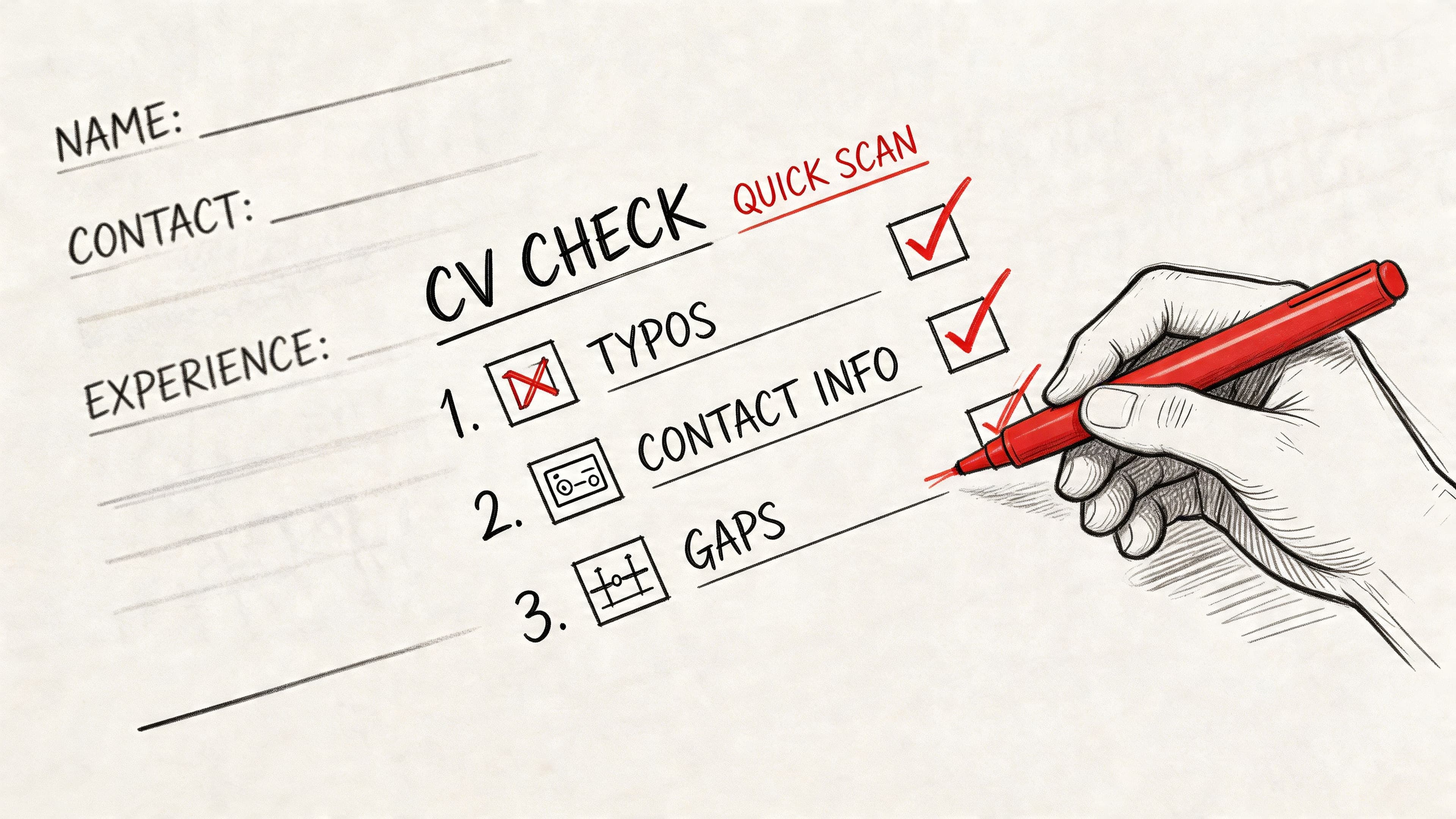
Phase 1. Check credibility errors first
These are the problems that make a recruiter hesitate before they even assess your experience.
Go through this list in order:
- Contact details: Include your full name, mobile number, professional email, town or city, and LinkedIn profile if it is complete.
- Email quality: Replace casual or outdated email addresses.
- Job title clarity: Use a title near the top that matches the work you are targeting if your internal title is too vague.
- Dates: Keep month and year formatting consistent across every role.
- Typos: Read headings, company names, and job titles out loud.
- File naming: Save the file with your name and target role.
- File format: Use PDF unless the employer asks for Word.
- Visual consistency: Use one font family, one bullet style, and consistent spacing.
Practical rule: If a recruiter notices mistakes before they notice your fit, the CV is working against you.
Skipping LinkedIn is a common mistake because recruiters often use it as a quick credibility check. The same goes for CV length. If the document is thin, bloated, or inconsistent, the problem is usually structural, not stylistic.
If you want a quick external sense-check before editing, you can try our starter CV health check app to catch basic issues and get a cleaner starting point.
Phase 2. Fix the scanability problem
A CV should be easy to assess in seconds. That means the right amount of information, in the right order, with no clutter.
Use this table to diagnose what is going wrong:
| CV issue | What it signals | What to do |
|---|---|---|
| Too short | Weak evidence or missing context | Add achievements, tools, scope, and outcomes |
| Too long | Poor prioritisation | Cut repetition, old detail, and summary fluff |
| No LinkedIn | Missed credibility check | Add a clean, updated profile URL |
| Inconsistent formatting | Low attention to detail | Standardise font, spacing, headings, and bullets |
The trade-off is simple. More detail is not better if it hides the strongest evidence. Shorter is not better if it strips out proof.
Aim for readable density. A recruiter should be able to spot your target role, recent experience, and strongest results without hunting for them.
Phase 3. Remove low-value content and rebuild weak sections
Many CVs improve fast. Cut what does not help, then replace it with evidence.
Remove these first:
- Profile fluff: Lines like "hardworking team player" add no proof.
- Irrelevant personal details: Date of birth, marital status, and similar details do not strengthen a UK CV.
- Dense paragraphs: Break them into bullets with clear outcomes.
- Unfinished links: Do not add LinkedIn unless the profile is updated.
- Decorative design: Icons, graphics, text boxes, and complex layouts often create reading problems.
If the file is messy enough that every edit creates another formatting issue, rebuild it cleanly instead of patching it. Use this quick CV creator guide when your current version needs a fresh structure, not another round of small fixes.
Done properly, this five-minute check gives you a diagnosis, not just a to-do list. That matters, because the fix for a credibility problem is different from the fix for a scanability problem, and both are different from weak evidence.
Is your CV actually getting responses?
Your CV might be missing something important
Upload your CV → see its weakest areas → fix them, one by one.
Free. Takes less than 2 minutes.
Making Your CV Robot-Friendly for ATS
A polished CV can still fail if the ATS can't read it properly. This isn't a niche problem. It's standard hiring infrastructure.
CVs with an 80 to 90% keyword match to the job description see a 35 to 50% boost in interview callbacks, while 75% of CVs are discarded by ATS filters before a human sees them, based on CV Anywhere's ATS optimisation guide.
Find the right keywords
Don't "add keywords" randomly. Pull them directly from the job advert.
Read the job description once for meaning, then a second time with a highlighter mindset. Look for:
- Core skills: software, methods, platforms, technical abilities
- Qualifications: certifications, licences, required training
- Responsibilities: tasks the employer repeats or emphasises
- Exact wording: the precise phrase they use, not your preferred variation
If the advert says "stakeholder engagement", don't swap it for "client relations" unless both are accurate. ATS software often interprets terms directly, and recruiters notice mismatch too.
For role-specific examples outside office-based jobs, a useful reference is ATS tips for a cook's resume, which shows how practical keywords differ by job type.
Put keywords where they count
A good ATS-friendly CV doesn't dump a keyword list at the bottom. It distributes relevant terms naturally.
Use this placement logic:
Professional summary Include the most important role match and top capabilities.
Skills section List tools, systems, methods, and domain skills in plain language.
Experience bullets Show where you used those skills in context.
Bad example:
- Managed a team to deliver software projects
- Worked with clients across departments
- Improved reporting processes
Better example:
- Managed a cross-functional team using agile methodologies to deliver a new software feature ahead of schedule
- Led stakeholder engagement across operations, finance, and delivery teams
- Improved reporting through structured data analysis and dashboard updates
The second version is better because it mirrors the employer's language without sounding forced.
Your CV should sound like a strong candidate wrote it, not like a keyword machine generated it.
Use formatting that software can actually read
ATS-friendly formatting is boring on purpose. That's good.
Use:
- Standard fonts: Arial or Calibri
- Straightforward headings: Profile, Experience, Education, Skills
- Left-aligned text: easier for software and humans
- Simple bullet points: no custom symbols
- Single-column layout: avoid tables, text boxes, and graphics
- PDF format: unless the application says otherwise
Avoid:
- Tables and columns
- Logos and icons
- Headers or footers with essential details
- Skill bars or rating graphics
- Overdesigned templates
If your current layout looks modern but behaves unpredictably when copied into plain text, it needs simplifying. For a deeper walkthrough, these ATS-friendly resume tips break down what tends to parse cleanly and what causes problems.
Tailoring Your CV with the JD Fit Principle
Many individuals state they tailor their CV. What they usually mean is they change a few words and hope for the best.
Real tailoring starts when you treat the job description as the brief and your CV as the response. That's the JD Fit principle. Your CV isn't a biography. It's an argument for why you fit this role.
A practical before-and-after example
Take a common situation. A candidate has a solid general CV for project support roles. It mentions coordination, reporting, stakeholder communication, and admin support. It's not bad. It's just broad.
Then they apply for a specific operations role that prioritises process improvement, reporting accuracy, stakeholder engagement, and budget tracking.
That generic CV might still look respectable to the candidate, but the recruiter won't read it generously. Hiring managers spend only 1 to 3 minutes reviewing a CV in most cases, according to High5Test's resume statistics page. If the strongest evidence isn't near the top, it gets missed.
Here's what changes when the CV is customized properly:
- The summary leads with operations coordination, reporting, and cross-functional communication.
- Relevant bullets move upward within each role.
- Budget and process work gets explicit mention.
- Generic admin tasks get cut or pushed down.
- Job description language appears where it's accurate.
Reorder before you rewrite
Most candidates jump straight into rewriting. Reordering is often faster and more effective.
Try this:
| Generic order | Better order |
|---|---|
| Routine duties first | Most relevant achievement first |
| Broad admin support | Job-specific evidence near the top |
| General skills list | Skills aligned to advert language |
| Old summary | Targeted summary tied to role |
Recruiters scan top sections first. If your strongest match is buried in bullet four, you've made the reader hunt for proof.
Put the evidence that gets you shortlisted where the eye lands first.
Apply the JD Fit principle line by line
Use this method on each application:
- Highlight the top requirements: Pick the repeated must-haves and nice-to-haves.
- Score your own evidence: Which bullets prove those points?
- Move matching bullets upward: Relevance beats chronology within a role.
- Rewrite the summary: Make it role-facing, not generic.
- Trim the rest: If a line doesn't help this application, it's probably taking space from something that would.
If you need a working model for this process, this guide on how to tailor resume to job description gives a straightforward structure you can adapt for a UK CV.
Writing Bullet Points That Prove Your Value
A CV gets stronger when it stops listing duties and starts showing outcomes. Most "fix my CV" efforts succeed or fail on this point.
Quantified CVs increase interview conversions by 42%, and the XYZ formula scores 2.5x higher in recruiter scans for technical roles, according to Resume Assassin's guide to quantifying your technical resume.
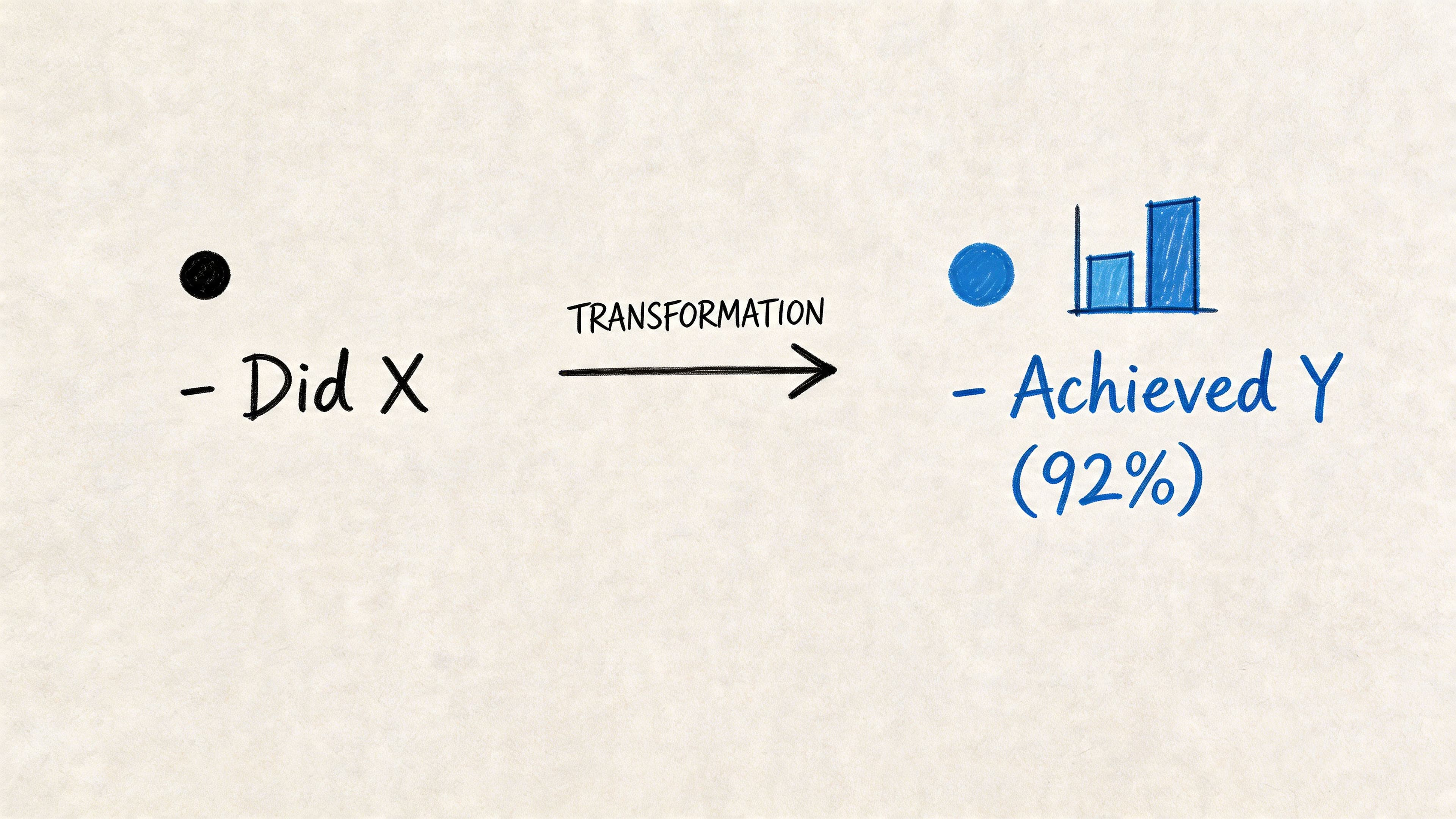
Use STAR and XYZ without overcomplicating it
You don't need to write mini essays. You need enough structure to make each bullet credible.
STAR helps you find the material:
- Situation: What was happening?
- Task: What were you responsible for?
- Action: What did you do?
- Result: What changed?
XYZ helps you write the final line:
- Accomplished X
- As measured by Y
- By doing Z
A weak bullet often stops at task level.
Example:
- Managed social media accounts
A stronger version reaches result level:
- Grew Instagram engagement by 45% in six months by introducing a content calendar and shorter video posts
The second bullet tells the reader what changed and how.
Before and after examples
Use these patterns across different roles.
Admin
Before:
- Handled scheduling and reporting
After:
- Coordinated diaries, meeting logistics, and weekly reporting for senior managers, improving deadline visibility across active projects
Customer service
Before:
- Helped customers with queries
After:
- Resolved high-volume customer queries across phone and email channels, improving response consistency through clearer triage and follow-up notes
Marketing
Before:
- Supported email campaigns
After:
- Supported campaign planning and reporting, using performance data to refine subject lines, send timing, and audience segmentation
Operations
Before:
- Worked on process improvements
After:
- Optimised internal handoff steps between teams, reducing delays and improving visibility of open actions through a shared tracking process
Tech
Before:
- Built reporting tools
After:
- Built reporting tools that gave teams faster access to operational data and reduced manual reporting work
Not every role gives you obvious sales figures. That's fine. You can still quantify or clarify:
- volume
- time saved
- turnaround speed
- accuracy
- scope
- adoption
- throughput
- satisfaction indicators
- size of team, client group, or workload
Good bullets answer two questions fast: what did you change, and why should this employer care?
How to find metrics when you think you have none
Look in places candidates forget:
- Dashboards: service levels, campaign metrics, turnaround times
- Calendars and logs: number of meetings, projects, shifts, or cases handled
- Training records: onboarding delivered, staff supported, sessions run
- Process documents: steps removed, systems improved, errors reduced
- Project notes: deadlines hit, tools used, scope managed
If you still can't attach a precise number, improve specificity another way. Name the tool, the business context, the audience, or the operational impact.
Compare these two:
- Prepared reports
- Prepared weekly Excel reports for leadership, highlighting delivery issues and outstanding actions
The second version is stronger even without a metric because it gives context.
A quick rewrite formula you can use today
Take any old bullet and ask:
- What did I do?
- What changed because I did it?
- How was that measured or observed?
- What tool, method, or skill made it happen?
Then rewrite the line in one sentence.
If you want more examples by function, these resume bullet points examples are useful for turning flat responsibilities into stronger evidence.
Advanced Fixes for Career Gaps and Changes
Career gaps don't ruin a CV. Silence does.
62% of hiring managers reject CVs with unexplained gaps over 6 months, and CVs with choppy timelines score 40% lower in ATS scans, according to Residency Advisor's piece on the "shadow CV" problem. The issue isn't the gap itself. It's the story the recruiter fills in when you leave it unexplained.
Control the narrative early
If you took time out for caring responsibilities, study, health, relocation, or retraining, address it briefly and professionally. Don't bury it and hope no one notices.
Use your summary to frame the direction of travel.
Examples:
- Operations professional returning to work after a planned career break, now focused on project coordination and stakeholder support roles
- Customer-facing manager transitioning into people operations, bringing experience in training, process improvement, and team support
- Administrator with previous public sector experience and recent upskilling in data handling and reporting, seeking an analyst support role
Each version does one job well. It tells the reader what's going on.
Build a bridge between past and target roles
Career changers often make one of two mistakes. They either hide the previous career completely, or they list it in a way that feels unrelated.
A better approach is to translate old experience into the language of the new role.
Use a short Key Skills section if needed:
- Stakeholder communication
- Process coordination
- Training and onboarding
- Reporting and documentation
- Client service
- Scheduling and case handling
Then make your older bullets support that story.
A retail manager moving into operations support shouldn't lead with "opened and closed store". They should lead with team coordination, stock process control, rota planning, issue resolution, and reporting.
Recruiters can accept a non-linear path if the CV explains the logic clearly.
What not to do
- Don't use a functional CV to hide everything. It often creates more suspicion than clarity.
- Don't leave unexplained date gaps. Add a brief factual line where needed.
- Don't apologise in the document. Stay neutral and forward-looking.
- Don't over-explain personal circumstances. One clear line is enough.
If this is your situation, a useful practical reference is these examples of how to explain resume gaps in employment, especially if you're trying to balance honesty with relevance.
From Fixed CV to First Interview
A fixed CV is only useful if you use it consistently and keep your applications organised. Good documents help, but scattered follow-up kills momentum.
The key change happens when your CV becomes part of a repeatable application process. That means keeping one strong master CV, tailoring a version for each role, storing the final copy, noting what changed, and tracking where you applied.
A simple tracker should let you record:
- Role and employer
- Version of CV used
- Application date
- Current status
- Follow-up reminder
- Interview notes
Patterns show up quickly when your search is organised. You can spot which versions get replies, which job titles fit best, and where your messaging needs tightening.
For most job seekers, the problem isn't just "fix my CV". It's "fix my process". Once the document is strong, consistency becomes the advantage. An application tracker turns your CV from a static file into part of a working system that supports better follow-up, better tailoring, and better interview prep.
Frequently Asked Questions About Fixing a CV
A lot of CV problems show up in the same three places. Missing evidence, weak relevance, and avoidable formatting choices. These questions usually sit inside the 3-phase diagnostic process covered above. First check what your CV says about your value. Then check whether an ATS can read it. Then check whether the document matches the role you want.
How do I fix my CV if I have little or no experience
Start by dropping the phrase "no experience". If you have completed coursework, group projects, volunteering, campus leadership, freelance work, or caring responsibilities with clear responsibility, you have material to work with.
The issue is usually framing. Employers are scanning for proof that you can solve a problem, work with other people, and finish tasks to a standard. That is why many early-career CVs get ignored when they list duties without outcomes. Diverse Jobs Matter notes that 71% of entry-level CVs are rejected for lacking metrics in its CV advice here: https://diversejobsmatter.co.uk/blog/5-reasons-your-cv-isn-t-getting-noticed-and-how-to-fix-it/.
Use the same bullet structure you would use for paid work. Start with the task, add the action, finish with the result.
For example:
- Course project: "Analysed survey responses from 120 students, identified three service issues, and presented recommendations that were adopted by the department for the next term."
- Student society: "Planned a six-event speaker series, coordinated venue bookings and promotion, and increased average attendance from 18 to 46 students."
- Volunteering: "Managed weekly donation sorting for a community food bank, reorganised stock labels, and cut collection-time delays during busy periods."
- Part-time work: "Handled customer queries across phone and till, resolved common issues on first contact, and supported the team during peak weekend trading."
If you use CV Anywhere, start with your master CV, pull in all academic, volunteer, and project evidence, then tighten each bullet with stronger verbs and measurable outcomes. That is faster than rewriting from scratch each time.
How far back should my work history go
Ten to fifteen years is usually enough. Go further back only if the earlier role strengthens your case for the target job.
I tell clients to keep the detail where the hiring manager will care. Recent and relevant roles get bullet points. Older roles can be reduced to job title, employer, and dates. If an old role is unrelated and takes up space you need for stronger evidence, cut it.
The trade-off is simple. A full career history shows continuity. A tighter CV protects relevance and readability. In most cases, relevance wins.
Should I include a photo on my CV in the UK
Usually no.
UK employers do not need a photo to assess whether you match the role, and adding one rarely improves response rates. It also uses space that would be better spent on evidence, skills, or a stronger opening profile. Keep the document focused on what you did, how well you did it, and how that matches the job description.
If a role specifically asks for a photo, follow the employer's instruction. Otherwise leave it out.
If you want to fix your CV faster, CV Anywhere gives you the full workflow in one place: build a cleaner CV, check job-description fit, and track applications without juggling separate docs, tabs, and spreadsheets. It's the simplest way to turn a stalled CV into a job search system you can maintain.