How to Follow Up After a Job Interview (UK Guide)
The best way to follow up after a job interview is to send a personalised thank-you email within 24 hours. Research shows that 80% of UK hiring managers find thank-you messages helpful when making decisions, yet only 25% of applicants send one. This gap is an opportunity.
A good follow-up email reinforces your interest, reminds the interviewer why you are a strong fit and gives you a chance to add anything you forgot to mention. This guide covers exactly when and how to follow up, with templates you can adapt.
What this guide covers:
- Timing: when to send your first follow-up
- What to include in a thank-you email
- How to write a subject line that gets opened
- What to do when you hear nothing back
- Advanced strategies: value-add follow-ups and LinkedIn engagement
- How to track and organise multiple applications
If you want help writing follow-up emails quickly, try the Follow-Up Generator. For interview preparation, see the Interview Coach.
Your First 24 Hours After The Interview
That period immediately after you walk out of the interview is your golden window. The conversation is still fresh in everyone's mind, and a well-timed, thoughtful email can genuinely boost your standing. This isn't just about being polite; it's your first move in a professional dialogue that shows you're engaged, proactive, and truly want the role.
If you wait too long, the impact fizzles out. A delay of a few days can come across as disinterest or just poor organisation. Acting swiftly, within that first day, ensures your message lands whilst the hiring team is still actively discussing candidates and forming their opinions. This one action can be a powerful differentiator.
The Immediate Impact Of A Thank-You Email
A prompt follow-up does more than just say "thanks." It's your chance to confirm your enthusiasm for the position and the company—a critical signal for any employer. It also gives you the perfect excuse to reiterate a key strength or briefly add a relevant point you might have forgotten to mention. Think of it as one last piece of compelling evidence for your candidacy.
This small gesture has a surprisingly big effect. Research from Robert Half shows a remarkable 80% of British hiring managers find thank-you messages helpful when making their final decision. Yet, shockingly, only about 25% of UK applicants actually send one.
This gap is a massive opportunity. By simply sending a follow-up, you immediately place yourself in the top quarter of applicants, showing a level of professionalism that many of your competitors completely overlook.
Laying The Groundwork For Future Communication
Your first email sets the tone for everything that follows. When it's professional, articulate, and personalised, it establishes you as a thoughtful communicator. The goal is to keep the conversation warm without being pushy.
Here's what this initial contact really achieves:
- It reinforces their memory. Your name and face pop back to the top of their mental list.
- It shows you paid attention. A specific reference to something you discussed proves you were genuinely listening.
- It demonstrates professionalism. It's a standard business courtesy that signals you understand workplace norms.
By getting this first step right, you build a positive foundation that makes any later follow-ups—if they become necessary—feel natural and welcome. For detailed guidance on crafting the perfect message, check out our comprehensive guide on how to write a thank-you email after an interview. This initial email isn't just a formality; it's a key tool in your job-seeking arsenal.
Is your resume actually getting responses?
Your resume might be missing something important
Upload your resume → see its weakest areas → fix them, one by one.
Free. Takes less than 2 minutes.
Writing An Interview Follow-up Email That Stands Out
Let's move beyond a simple "thank you." A truly standout follow-up email is your secret weapon to re-engage the hiring manager and add genuine value after you've left the room. The goal here is to keep the conversation going, not just to rehash your CV. It's about crafting a message that reinforces your strengths whilst showing you're still thinking about their challenges.
Knowing how to compose an effective follow-up with a message that adds something new can be the thing that tips the scales in your favour. The silence after an interview can feel agonisingly long. In fact, research from Aptitude Research shows a staggering 40% of candidates in the UK wait over two weeks for any kind of response. A compelling follow-up keeps you top of mind during this critical period.
Craft A Subject Line That Gets Noticed
Hiring managers are drowning in emails. A generic subject line like "Follow-up" or "Thank you" is practically invisible and will get lost in the noise. Your subject line needs to be clear, professional, and instantly recognisable.
A strong subject line really only needs three key things:
- A clear identifier like "Follow-up" or "Thank you".
- The specific job title you interviewed for.
- Your full name.
For instance, "Follow-up: Marketing Manager Interview - Jane Smith" is perfect. It's direct and gives the recipient all the context they need without even having to open the email. No guesswork required.
Personalise Your Opening And Body
This is where you make your move. The body of your email is your chance to truly set yourself apart. Ditch the generic templates that just say you're still interested. Instead, aim to add a piece of new, relevant information that builds on the conversation you had.
Start by immediately jogging their memory. Mentioning a specific topic you enjoyed discussing shows you were genuinely listening and engaged. You could say something like, "I particularly enjoyed our conversation about the upcoming 2026 product launch and have been thinking about how my campaign management experience could support its success."
This is also your opportunity to add a point you wish you'd made clearer or to introduce a new idea that came to you after the fact.
Think of it as a brief, strategic addendum to your interview. Did you forget to mention a relevant project? Did a new thought about a challenge they mentioned pop into your head on the way home? Briefly share it.
If writing isn't your strong suit or you're pressed for time, using a dedicated tool can be a game-changer. Our post-interview follow-up email generator can help you craft a professional, personalised message in minutes, ensuring you make the right impression.
Conclude With A Clear Call To Action
End your email on a confident and forward-looking note. Reiterate your strong interest in the role and the company. The final lines should be professional yet courteous, clearly expressing your enthusiasm for what comes next.
A simple closing like, "I am very enthusiastic about the opportunity to join your team and contribute to [Company Name]'s goals. I look forward to hearing from you regarding the next steps in the process," works perfectly. To truly make your follow-up emails effective, it helps to strengthen your overall communication skills. You can learn more about how to master key communication skills for interviews.
What To Do When You Hear Nothing Back
The silence after a great interview can be deafening. When the date they promised to get back to you slips by, it's easy to start spiralling, replaying every answer in your head. It's a completely normal feeling. The trick is to channel that nervous energy into a proactive, professional follow-up.
This waiting game is a huge source of stress for job seekers. An iHire survey found that a massive 55.3% of people said waiting for feedback was their biggest stressor during the job hunt. But don't let the radio silence get you down. A well-timed and polite second follow-up is not only acceptable—it's often necessary. You can dig into more data on hiring trends and the candidate experience at the Standout-CV.com interview statistics hub.
Timing Your Second Follow-Up
Patience is a virtue, but in a job search, persistence gets results. A good rule of thumb is to send your second follow-up about 7-10 business days after your initial thank-you note, or a few days after their promised deadline has passed. This timing strikes the right balance, showing you're organised and still keen without appearing pushy.
So, if they said, "We'll be in touch by the end of next week," hold off until the following Tuesday or Wednesday. It gives them a bit of breathing room and acknowledges that internal timelines often shift.
A delay is rarely a reflection on you. Hiring decisions are complicated, involving multiple schedules, shifting priorities, and unexpected internal hurdles. Your follow-up is just a gentle, professional nudge to remind them of your enthusiasm.
What To Include In Your Polite Nudge
Keep your second follow-up email brief, polite, and straight to the point. Your goal here is simply to check on the status of the hiring process and reiterate your interest. This isn't the time to add new information or try to sell yourself again.
A simple structure works best:
- Use a clear subject line. The easiest way is to just reply to your original thank-you email to keep the conversation in one thread. If you're starting a new email, something like "Checking in: [Job Title] Application" works perfectly.
- Start with a polite opening. A simple "I hope you're having a good week" is all you need.
- State your purpose. Briefly mention the date you interviewed and the role, then politely ask for an update on their timeline.
- Reiterate your interest. A single sentence confirming you're still very interested in the role is plenty.
- End professionally. Sign off with "Best regards" and your name.
This approach shows you respect their time whilst keeping your application top of mind. Of course, sometimes the silence continues, and you might be dealing with recruiter ghosting. If you suspect that's the case, you can learn what to do when a recruiter ghosts you in our detailed guide. Mastering this follow-up technique is a vital skill in any job search.
Advanced Strategies To Gain A Competitive Edge
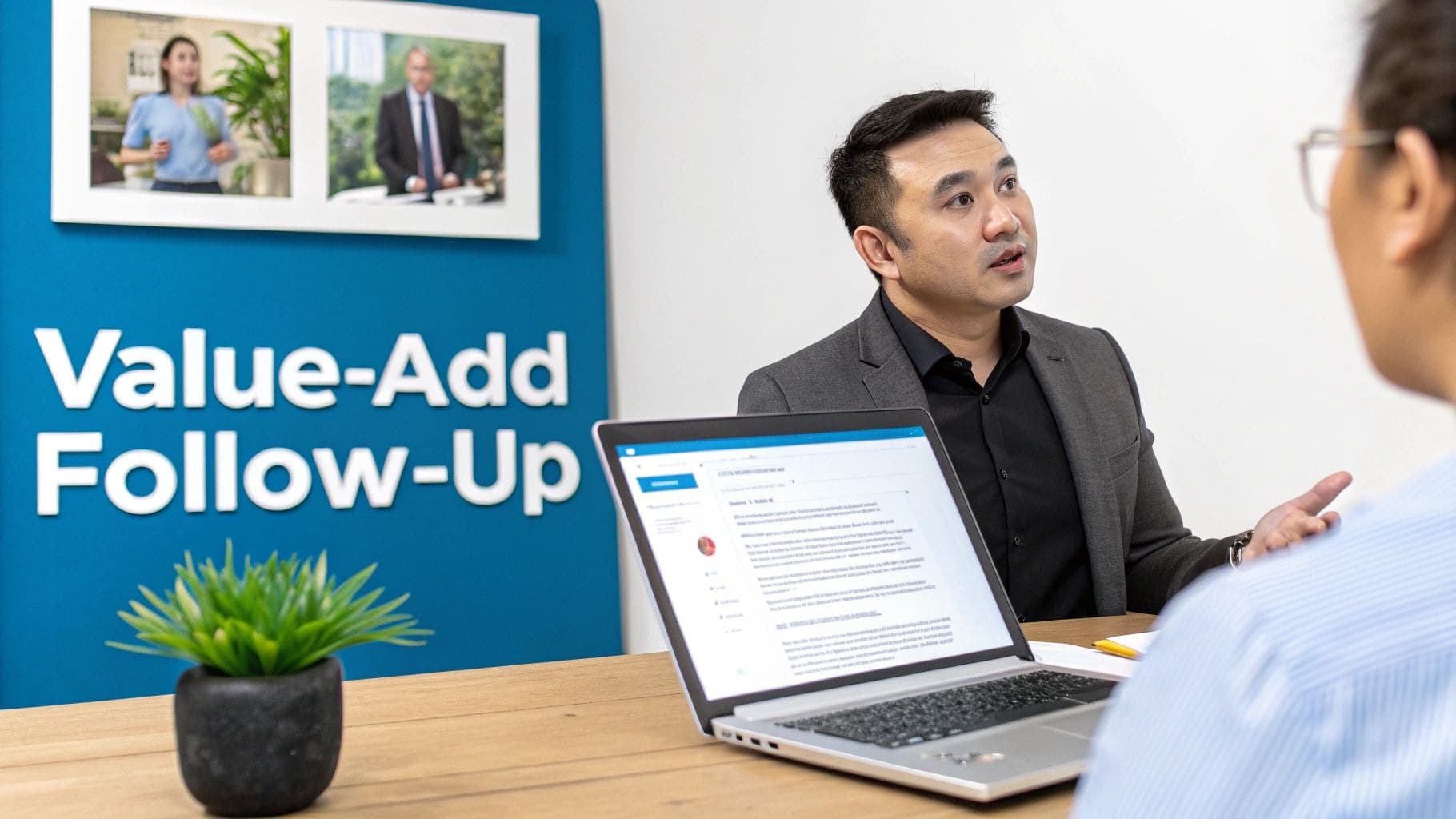
If you really want to separate yourself from the other candidates, a standard thank-you email might not cut it. This is where advanced follow-up strategies come in. They show real initiative and a genuine investment in the company's success, proving you're already thinking like part of the team.
It's about moving beyond pleasantries and offering tangible value. Knowing how to follow up after a job interview in a way that actually contributes can be the deciding factor. Instead of just saying you're interested, you're actively showing it. This approach reinforces your expertise and paints you as a proactive problem-solver—a trait every hiring manager is looking for.
The Value-Add Follow-Up
The 'value-add' follow-up is a seriously powerful technique where you share something genuinely useful that connects back to your interview discussion. This isn't about showing off; it's about being helpful. You could send a link to a relevant industry article, a brief summary of an idea you had, or even a potential solution to a minor problem mentioned during the chat.
Let's say you discussed a challenge the company is facing with social media engagement. A value-add follow-up could include a link to a case study on a competitor's successful campaign, with a short note like: "Following our chat about engagement, I came across this case study and thought it was an interesting approach. It made me even more excited about the challenges in this role."
This transforms you from a passive candidate into an active contributor. You're no longer just asking for a job; you're demonstrating the value you would bring from day one.
Personalisation is absolutely key here. In fact, adding a personal touch can boost response rates by as much as 40%. It shows your follow-up isn't just a template but a thoughtful, bespoke piece of communication.
Strategic LinkedIn Engagement
LinkedIn is another brilliant tool in your follow-up arsenal, but you need to be subtle. A simple connection request is fine, but you can do more to stay on the hiring manager's radar without being intrusive or annoying.
After sending your connection request (always with a personalised note!), start engaging with the company's content.
- Like and comment thoughtfully on company posts that align with your expertise. A simple "great post" won't do; add a sentence of insight.
- Share a company update with your own comment about why you find their work impressive.
- Engage with the interviewer's posts if they are active on the platform. Keep your comments professional and relevant to their content.
This subtle activity keeps your name and face visible in a professional context. It reinforces your interest in the company's mission and culture without you having to spell it out. For those looking to use the latest tools, exploring how AI can improve job follow-up strategies could provide a significant advantage in your job search in 2026.
These advanced methods require a bit more effort, but they can be incredibly effective. For candidates who need a hand perfecting these and other interview techniques, working with an expert UK interview coach can provide personalised strategies to help you stand out and land the offer. It's all about showing you are the solution they've been looking for.
How To Organise Your Job Application Follow-Ups
Trying to keep track of multiple job applications from memory is a recipe for disaster. We've all been there – mixing up names, interview dates, and crucial details that can instantly undermine all your hard work. The solution isn't some complex software; it's a simple, effective tracking system to manage everything from who you spoke to, to when you need to follow up.
Knowing how to follow up after a job interview is only half the battle. Doing it consistently for every single application is what makes you look like a truly organised and professional candidate. It's this organised approach that ensures you never miss a beat and can personalise every communication with total confidence.
Creating Your Tracking System
Forget complicated tools. A straightforward spreadsheet or a dedicated digital tracker is all you need to transform a chaotic job hunt into a manageable one.
Think of this system as your single source of truth for your entire job search. It lets you see your progress at a glance and makes sure every follow-up is timely and well-informed. With the average UK job application process taking around 5 weeks and only 2% of applicants actually making it to the interview stage, a polished and punctual follow-up is non-negotiable. For more on these figures, you can explore UK job interview statistics on Standout-CV.com.
To get your tracker started, focus on capturing these essential details for each role:
- Company Name and Job Title: The absolute basics to avoid any embarrassing mix-ups.
- Key Contacts: Jot down the names and titles of everyone you speak with, from recruiters to the hiring manager.
- Important Dates: Log everything – when you applied, the date of the interview, and when you sent your follow-ups.
- Status: A simple dropdown menu (e.g., Applied, Interviewed, Awaiting Reply) helps you see where to focus your energy.
- Notes: This is your space for key conversation points, inside info, or reminders about the next steps.
Having all this information in one place isn't just good housekeeping. It empowers you to write highly personalised follow-ups that reference specific details from your conversation, reinforcing your image as a detail-oriented and professional candidate.
Whilst a spreadsheet is a great starting point, a purpose-built tool can make life even easier. Check out our free Job Application Tracker for UK roles to centralise your applications and manage your follow-ups effortlessly.
Your Top Follow-Up Questions, Answered
Let's be honest, the time after an interview can feel like a minefield. You're trying to figure out the right moves without coming across as pushy or, even worse, completely forgetting to follow up. Knowing exactly how to handle those specific, slightly awkward scenarios is key to keeping your cool and staying in the race.
Think of this section as your cheat sheet for those tricky moments. We'll cover the most common questions and sticking points that trip up job seekers in the UK, giving you clear, practical answers to handle every situation with confidence.
How Soon Is Too Soon To Follow Up After An Interview?
This is the big one. The golden rule is simple: send your initial thank-you email within 24 hours of the interview. It shows you're on the ball and genuinely interested.
For any check-ins after that, it's all about respecting their timeline. If they said you'd hear back by Friday, wait until the following Monday or Tuesday before sending a polite nudge. If they didn't give you a timeline? A good rule of thumb is to wait about a week (5-7 business days) after your thank-you note before sending a friendly enquiry. This keeps you on their radar without rushing their process.
Should I Connect With The Interviewer On LinkedIn?
Absolutely, but timing is everything. Don't send the request the second you walk out the door. The best approach is to send it after your thank-you email has landed in their inbox. It feels less aggressive and more professional.
And always, always include a short, personalised note. Something simple and professional gets the job done:
"Hi [Interviewer's Name], I really enjoyed our chat on [Day] about the [Job Title] role. It would be great to connect and follow your work."
This keeps you visible in a positive, low-pressure way.
How Should I Respond To A Rejection Email?
Getting a "no" is tough, but how you handle it can leave a lasting positive impression. A gracious response is a small act of professionalism that recruiters really do remember, and it can keep the door open for other roles down the line.
Just send a brief, polite email. Thank them for their time and the opportunity to learn more about the role. You can also mention that you're still keen on the company and would appreciate them keeping you in mind for future openings. It shows maturity and helps you build your professional network, even when things don't go your way.
Is It Okay To Follow Up By Phone?
In most professional settings here in the UK, it's best to stick to email. An unscheduled phone call can feel a bit intrusive and really puts the hiring manager on the spot, which could easily undo all your hard work.
The only time you should even consider picking up the phone is if they specifically invited you to call. The other rare exception is if a lot of time has passed—think several weeks since your last email—and you have a genuinely time-sensitive reason, like an exploding offer from another company. Otherwise, email is always the safer, more professional channel.
--- At CV Anywhere, we make every step of your job search simpler—from building a CV that gets noticed to acing the interview and sending the perfect follow-up. Our platform gives you the tools to manage your applications, practise for interviews, and communicate with confidence, helping you turn an application into a job offer. Start your journey at https://cvanywhere.com.