Switching careers at 40 isn't about starting from scratch—it's about strategically cashing in on two decades of experience. To successfully learn how to switch careers at 40, you must reframe your experience as a massive asset, conduct a deep self-assessment to identify transferable skills, and run a focused job search. This involves creating a new professional narrative on your resume and LinkedIn, targeting companies that value mature professionals, and confidently articulating your value during interviews to secure a role that aligns with your future goals.
The key is to reframe the entire conversation. Your experience managing projects, leading teams, and overseeing budgets? That's not irrelevant history; it's a massive asset.
Your Guide to a Successful Career Change at 40

If the thought of changing careers feels a little overwhelming, you're in good company. But the old story about "starting over" from square one is a complete myth. In reality, you're making a strategic pivot, armed with professional wisdom, resilience, and skills that most younger candidates simply haven't had the time to build.
This isn't just a pep talk; it's a major trend. The average age for a US professional to make a significant career change is 39 years old. That puts you squarely at the inflection point where these transitions happen most. Research even shows that 21% of US workers aged 40 to 49 have considered a career change, and this group is one of the most active on the job market.
Why Your 40s Are the Prime Time for a Pivot
Making a change now is completely different than it was in your 20s. You have a much clearer sense of your non-negotiables, a deeper feel for workplace dynamics, and a proven track record of actually getting things done.
Your real challenge isn't a lack of experience. It's learning how to translate that experience into the language of a new industry.
This guide is your practical roadmap for making that happen. We'll skip the abstract advice and give you a concrete, step-by-step framework for pulling off a successful career transition in 2026. You'll learn how to:
- Pinpoint what you truly want in your next professional chapter.
- Take stock of your transferable skills and identify any critical gaps.
- Rebrand your professional story on your CV and LinkedIn profile.
- Run a targeted job search that gets you in the door.
This is all about turning that feeling of apprehension into an empowered, calculated move. It's a journey of rediscovery, not reinvention.
The Career Change at 40 Action Framework
To make the process of switching careers feel less daunting, it helps to break it down into manageable phases. The table below gives you a high-level look at the core stages, each with a clear objective and key actions that build on the last. This methodical approach takes the guesswork out and gives you a clear path to follow.
| Phase | Objective | Key Action |
|---|---|---|
| Self-Assessment | Define your new career goals, values, and non-negotiables. | Conduct a personal SWOT analysis and "love it/leave it" list for your current role. |
| Skills & Gap Analysis | Identify your transferable skills and areas needing development. | Analyze target job descriptions to map your existing skills and plan for upskilling. |
| Professional Rebranding | Create a compelling new narrative for your target industry. | Rework your CV, professional summary, and LinkedIn to highlight future potential. |
| Targeted Execution | Network effectively and find the right opportunities. | Use informational interviews and an application tracker to manage your search. |
| Closing the Deal | Ace interviews and negotiate compensation that reflects your value. | Prepare your pivot story and research salary benchmarks to articulate your worth. |
Each phase is a critical step in building your bridge to a more fulfilling career. The goal is to move forward with intention, not just hope.
A successful career change hinges on reframing your mindset. You're not "too old" or "starting over." You are a seasoned professional with valuable, cross-functional skills bringing a fresh perspective and proven stability to a new role.
If you're considering a move into the tech world, a detailed roadmap for starting an IT career can provide specific guidance. And for personalized support navigating each of these phases, consider how a dedicated career coach can support your journey.
Now, let's get started.
Is your resume actually getting responses?
Your resume might be missing something important
Upload your resume → see its weakest areas → fix them, one by one.
Free. Takes less than 2 minutes.
Assess Your Skills and Map Your New Path

Before you even think about writing a new CV, you need a map. A clear, honest map of your professional DNA. This isn't about just listing past jobs; it's about digging deep to find the high-value, transferable skills you've built over two decades—things like strategic planning, client relations, or budget management that are gold in any industry.
This is the real foundation of how to switch careers at 40. It's about building a solid bridge from where you are today to where you want to be in 2026. Let's get practical and translate your experience into a compelling case for your future.
Start with a "Love It and Leave It" List
Your first move is a deceptively simple but incredibly powerful exercise. Grab a piece of paper and draw a line down the middle. On one side, list every part of your current and past jobs that you genuinely enjoy ("Love It"). On the other, list everything that drains your soul or makes you dread Sunday night ("Leave It").
Get brutally honest here. Do you love mentoring junior colleagues but hate the administrative paperwork that comes with it? Does leading a complex project give you a rush, while quarterly budget reporting feels like a slow death? This isn't just venting; you're spotting patterns. You're identifying which tasks give you energy and which ones you'd be thrilled to leave behind for good.
For instance, a marketing director might find their list looks like this:
- Love It: Crafting campaign strategy from scratch, digging into market trends, collaborating with the creative team on new concepts.
- Leave It: Managing the nitty-gritty of department budgets, sitting through endless stakeholder meetings, navigating the performance review cycle.
This clarity is your compass. It points you toward roles that are full of your "Love It" list, ensuring your next move is about fulfillment, not just a different job title.
Conduct a Personal SWOT Analysis
With your list complete, it's time to borrow a classic tool from the business world: the SWOT analysis. This framework will help you organize your findings and look at your career change from a bird's-eye, strategic view.
- Strengths: What are your superpowers? Think of the "power skills" you've honed over 20 years—leadership, tough negotiations, untangling complex problems. These are your core assets.
- Weaknesses: Where are your blind spots for the career you're targeting? This could be a technical gap (like needing to learn Python or Salesforce CRM software) or simply not knowing a new industry's lingo. Being honest here is critical for what comes next.
- Opportunities: What trends in the market can you ride? Think about growing industries in the US, the explosion of remote work, or a niche that desperately needs experienced leaders.
- Threats: What external roadblocks could slow you down? This might be ageism (it's real, but manageable), an economic downturn, or fierce competition for roles in your target field.
Your SWOT analysis isn't just an exercise; it's an action plan. You'll use your Strengths to jump on Opportunities, while creating a concrete plan to shore up your Weaknesses and navigate the Threats. This is how you turn vague ideas into a real strategy.
Map Your Skills Against Your Target Role
Now for the fun part. Find 5-10 job descriptions for roles that genuinely excite you. These are no longer just wishful thinking; they are your blueprints. Go through each one with a highlighter, marking all the required skills and qualifications. Then, start categorizing.
A simple table is your best friend here.
| Skill Category | Example from Job Description | Do I Have It? |
|---|---|---|
| Technical Skills | "Proficiency in HubSpot and Salesforce" | No, need training. |
| Project Management | "Experience managing cross-functional projects" | Yes, 10+ years. |
| Client Relations | "Proven ability to manage key accounts" | Yes, core strength. |
| Data Analysis | "Ability to interpret performance metrics" | Somewhat, need to deepen. |
This simple analysis makes your skill gaps glaringly obvious. Instead of guessing what you need to learn, you now have a data-backed to-do list for upskilling. The good news? You probably don't need another degree. Often, a few well-chosen online certifications or short courses are all it takes to become a highly competitive candidate.
If you're unsure what skills to even look for, browsing through these examples of skills to put on your resume can give you a great starting point for seeing how your experience translates to a new field.
Build a Compelling New Professional Story
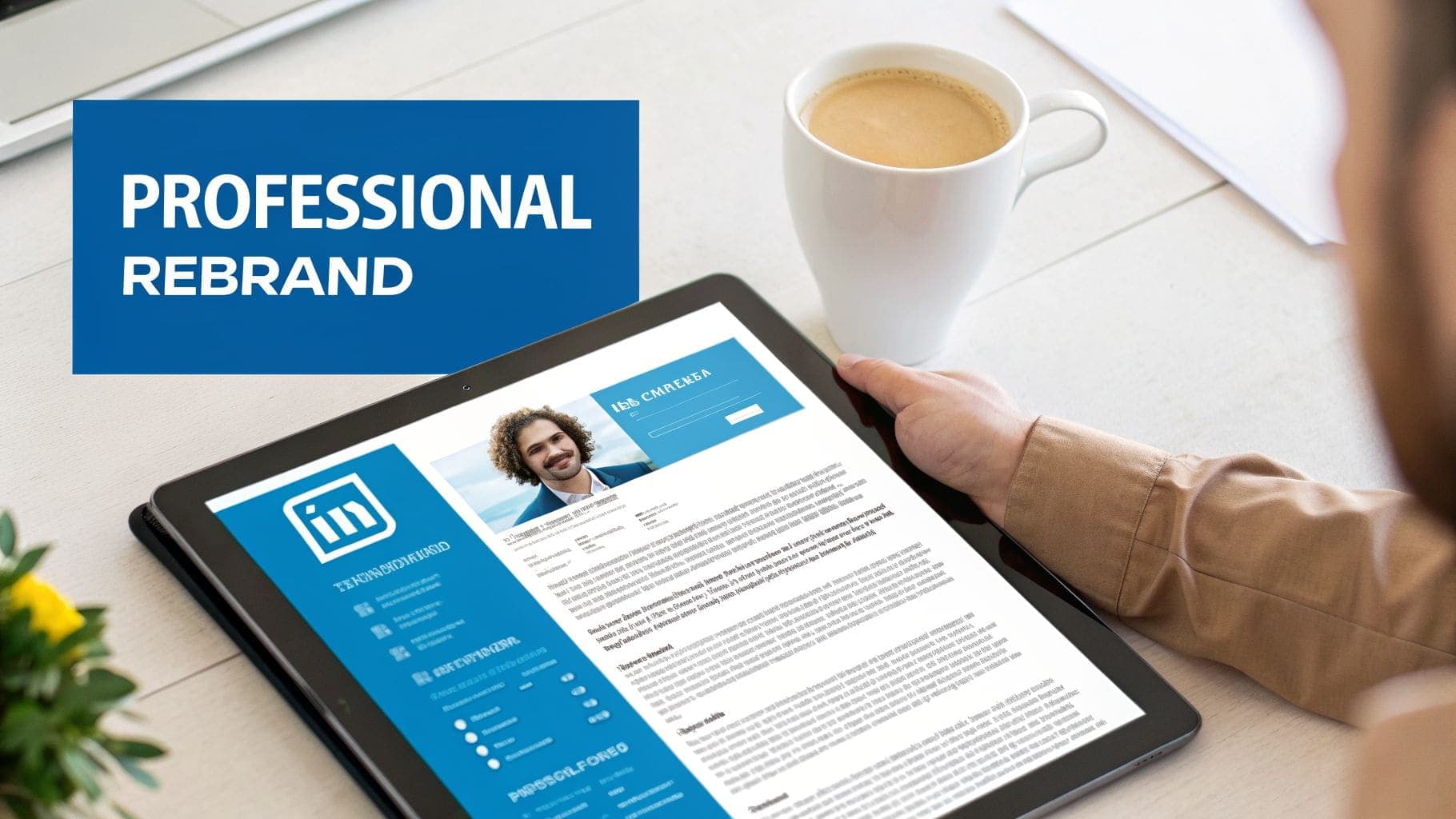
Your old CV is a history book. Your new one needs to be a sales pitch for your future. This is where you rebrand your professional identity, creating a narrative that gets you past the automated screening software and onto a hiring manager's desk.
The goal is to shift your story from "this is what I've done" to "this is what I can do for you." You have to move beyond a simple chronological list of jobs and build a story that immediately frames your two decades of work in the context of your new target career. This part is absolutely critical if you want to know how to switch careers at 40 and actually succeed.
Reframe Your CV from Past to Future
For a career changer, a traditional, chronological resume can be a dead end. It forces a recruiter to connect the dots between your past and their current opening—a job they rarely have time for. A hybrid or skills-based resume format is your solution. It puts your most relevant qualifications right at the top.
Imagine a marketing manager pivoting to SaaS sales. They shouldn't lead with old marketing titles. Instead, they should lead with transferable skills like "Client Relationship Management," "Strategic Account Growth," and "Data-Driven Performance Analysis," then use bullet points from past roles to prove those skills in action.
Your resume is no longer a comprehensive record of your employment. It is a targeted marketing document designed to get you an interview for a specific role. Every single word on it should serve that one purpose.
For a deeper dive into structuring this new document, our guide on crafting a career change resume template offers actionable examples and layouts. This approach makes sure the first thing a recruiter sees is the most important information: your relevant skills.
Write a Powerful New Professional Summary
The top third of your resume is prime real estate. It's time to ditch the outdated "Objective" statement. Replace it with a dynamic Professional Summary that immediately answers the "Why you?" question. This 3-4 sentence paragraph has to be tailored for every single application.
Your summary must connect your past experience to your future goals, all while speaking the language of your new industry.
- Old Role: Retail Store Manager
- New Target: Operations Coordinator
- Reframe: A seasoned manager with over 15 years of experience in optimizing inventory systems, leading high-performance teams, and managing six-figure operational budgets. Eager to apply proven logistical and team leadership skills to drive efficiency in a corporate operations environment.
See how it translates retail experience ("managing a store") into the language of corporate operations ("logistical skills," "drive efficiency")? That's the key.
Optimize Your LinkedIn for the Job You Want
Your LinkedIn professional profile isn't just an online resume; it's a critical tool for recruiters to find you. You need to optimize it so they discover you for the roles you want, not just the ones you've had.
Your Headline is Everything Change your headline from your current job title to one that reflects your target career.
- Before: Senior Marketing Manager at Acme Corp
- After: Strategic Marketing Leader | Driving Growth in B2B Tech | Brand Strategy & Digital Transformation
The "After" version is packed with keywords a recruiter in the tech space would actually be searching for.
Rewrite Your "About" Section Think of this as your cover letter to the world. It needs to tell your career change story with confidence and clarity. Start by stating your new career goal, then connect the dots by showing how your past experience makes you a unique and valuable candidate for that new path.
Update Your Experience Descriptions Go through each past role and rewrite the bullet points to spotlight accomplishments that align with your new goals. A project manager moving into product management should highlight experiences where they gathered user feedback or worked closely with development teams, even if that was just a small part of their old job. This targeted approach shows that your journey into this new field has been deliberate and thoughtful, not just a random whim.
Run a Targeted Job Search and Networking Campaign

With your new professional story ready to go, it's time to shift from planning to action. Forget the soul-crushing "spray and pray" method of firing off hundreds of online applications. That approach is a dead end, especially for career changers. To successfully figure out how to switch careers at 40, you need a surgical, focused strategy that turns your experience into your greatest asset.
This phase is all about smart execution. It means finding companies that genuinely value seasoned professionals, mastering the art of the informational interview, and managing your job search pipeline like a pro. A methodical approach will save you time and energy, leading to much better results.
Identify and Vet Your Target Companies
Stop reacting to whatever jobs pop up in your feed. Instead, take control by building a list of 15-20 target companies. These are the organizations where your blend of skills, new direction, and professional maturity will be a clear advantage, not a question mark.
Your research should zero in on a few key areas:
- A Culture of Growth: Hunt for companies that talk openly about internal mobility and employee development. Do their career pages feature employees who've successfully changed roles inside the company?
- Industry Adjacency: This is a huge one. If you're moving from traditional finance into FinTech, for example, your deep industry knowledge is an immediate asset. Target companies where your background gives you instant credibility.
- Company Size and Structure: Smaller, high-growth companies are often more flexible in their hiring and may appreciate a generalist with a wide range of experience. On the flip side, large corporations might have formal programs for career changers.
Once you've got your list, start following these companies on LinkedIn. Engage with their posts and identify key people in the departments you want to join. This isn't about asking for a job yet; it's about warming up the runway.
Master the Informational Interview
The informational interview is your secret weapon. It's a low-pressure, 20-minute chat—virtual or in-person—where your only goal is to ask for advice and stories, not a job. People love to talk about what they do and be seen as an expert.
Your aim is to build allies and gather insider knowledge. When you reach out to someone on LinkedIn, your message has to be brief, respectful of their time, and crystal clear about what you're asking for.
Here's an outreach message that works: "Hi [Name], I came across your profile and was really impressed by your work in [Their Field] at [Their Company]. I'm currently exploring a career change from [Your Old Field] into this space and am trying to learn from experienced professionals like yourself. Would you be open to a brief 20-minute chat in the coming weeks to share your perspective? I'd be grateful for any insights you could offer."
This approach flatters their expertise and makes it easy for them to say yes. Always send a thank-you note after the chat. If it feels right, ask if there's anyone else they'd recommend you speak with. This is how you build a powerful network, one conversation at a time.
Manage Your Search Like a Pro
A messy job search guarantees missed follow-ups and lost opportunities. Ditch that chaotic spreadsheet. A dedicated tool like the CV Anywhere Application Tracker is a game-changer, centralizing every role, contact, status, and follow-up date in one clean dashboard.
This level of organization is non-negotiable. It lets you see your entire pipeline at a glance, set follow-up reminders, and tailor every communication. To really give yourself an edge, learning about finding hiring manager emails can help you bypass generic inboxes and open up direct lines of communication.
And of course, none of this outreach works if your own online presence isn't sharp. For a deep dive, check out our guide on how to optimize your LinkedIn profile for job searching to ensure you attract the right kind of attention.
This blend of targeted outreach, genuine curiosity, and professional organization is what separates a successful career transition from a frustrating one. You're not just looking for a job; you're building a network that will pay dividends for years to come.
Ace the Interview and Negotiate Your Worth
Getting the interview is a huge win, but now you have to close the deal. For career changers, especially in their 40s, this is where the real work begins.
You'll need to tackle the "why the change?" question head-on, turning what some see as a risk into a clear advantage. We'll show you how to frame a compelling narrative, use your deep experience to answer tough behavioral questions, and ask smart questions that signal you're a strategic thinker. Finally, we'll talk money—how to research your worth and negotiate from a position of strength.
Frame Your Career Change Story
The "why are you switching careers?" question is a certainty. Your answer can't sound like you're fleeing a bad situation or apologizing for your past. It needs to be a confident, forward-looking story.
Frame your pivot as a deliberate and exciting next step. Connect the dots for the interviewer, showing how your past skills led you to this new path and why you're genuinely fired up about their company and industry.
For example, a project manager moving into customer success could say:
"My decade in project management was incredible for honing my ability to manage complex timelines and stakeholder expectations. But the more I worked with end-users, the more I realized my real passion was ensuring they have a phenomenal experience post-sale. That's what led me to customer success and specifically to your company, which is renowned for its client-first approach."
This answer is positive, links the past to the future, and proves you've done your homework. It's a story of evolution, not escape.
Turn Experience into Compelling STAR Stories
Behavioral questions—the classic "Tell me about a time when..."—are your moment to shine. They're designed to see how you handle real-world situations, and as a seasoned professional, you have a deep well of experience to draw from. The STAR method is the best way to structure your answers.
- Situation: Briefly set the scene. What was the context?
- Task: What was your specific goal or responsibility?
- Action: Describe the concrete steps you took to handle it.
- Result: Quantify the outcome. What was the positive, measurable impact of what you did?
Here's how a former retail manager interviewing for a corporate training role could use STAR to answer a question about managing a difficult team member:
"In my previous role as a store manager (Situation), a top-performing but disruptive salesperson was creating team friction, and morale was dropping (Task). I initiated a series of one-on-one coaching sessions, using active listening to understand their frustrations and co-creating a new communication plan for the team (Action). Within two months, team complaints dropped by 70%, and that employee became a mentor to new hires, contributing to a 15% increase in team sales that quarter (Result)."
This powerfully demonstrates coaching, conflict resolution, and performance management—all skills directly relevant to a training position. For more in-depth preparation, our guide on how to practice for an interview provides more frameworks and real-world examples.
Prepare Questions That Showcase Your Value
The questions you ask at the end of the interview are just as important as the answers you give. Forget generic questions about vacation time. This is your chance to show you're already thinking like a member of the team.
Your questions should prove you're a strategic thinker who is focused on delivering value.
Consider asking things like:
- "What does success look like in this role in the first 90 days, and what are the biggest challenges I should expect?"
- "How does this team collaborate with other departments to hit its goals?"
- "Based on our conversation, are there any reservations you have about my experience that I can help clarify?"
That last one is bold, but it shows confidence. It's the hallmark of a seasoned professional who isn't afraid of direct feedback and is focused on finding the right fit.
Negotiate from a Position of Strength
Your 20+ years of professional experience are an incredible asset, and your compensation should reflect that. Don't anchor yourself to your old salary, especially if you're entering a more lucrative field.
Start by researching salary benchmarks on sites like Glassdoor for salary insights and Levels.fyi for tech compensation data for your target role, location, and experience level. But don't stop at the base salary.
Think about the total compensation package: bonus potential, stock options, 401(k) matching, healthcare, and professional development budgets. You aren't an entry-level candidate. You bring a wealth of soft skills—leadership, resilience, and business acumen—that new graduates simply don't have. This is a critical part of a successful strategy for how to switch careers at 40. Be prepared to articulate how these skills will add unique value and justify your salary expectations.
Your Top Questions About Changing Careers at 40, Answered
Let's be honest. Making a big career leap after you've spent two decades building a life and a reputation is a daunting thought. It's completely natural to have some tough questions. Below are the straightforward answers to the most common concerns we hear from professionals figuring out how to navigate a career change in their 40s.
"Am I too old to make a career switch?"
Not a chance. In fact, many find their 40s are the perfect time for a pivot. You're not starting from scratch; you're bringing a level of professional maturity, resilience, and real-world problem-solving that younger candidates simply haven't had time to develop.
The average age for a US professional to make a career change is 39, so you're right in the sweet spot.
The trick is to reframe your experience as the powerful asset it is. Employers are actively looking for the stability and proven reliability that a seasoned professional adds to a team. Your age isn't a liability; it's a testament to your commitment and adaptability—qualities that are gold in any industry.
"How do I explain my career change in an interview?"
This is all about the story you tell. Your narrative needs to be confident, positive, and focused on the future. The goal is to connect the dots for the interviewer, showing them this is a deliberate move toward something better, not a desperate escape from a bad situation.
Instead of dwelling on what you're leaving behind, light up when you talk about what you're moving toward. Show genuine excitement for the new field and draw a clear line from your past accomplishments to their current needs.
For example, you could say: "While my operations role was fantastic for building my project management skills, I kept finding myself drawn to the data analytics side of the business. I've been passionately pursuing data certifications for the past year and I'm genuinely excited to apply that strategic thinking to the specific challenges I see in your industry."
An answer like this shows self-awareness, ambition, and a clear vision. It's compelling.
"Will I have to take a major pay cut?"
This is a huge fear, but a massive pay cut is not a foregone conclusion. The financial impact of your career change depends almost entirely on your strategy and the field you're targeting.
- Adjacent Moves: If you're moving to a closely related field—think from journalism to content marketing, or from sales to business development—your skills are highly transferable. In these scenarios, you can often maintain or even increase your salary.
- Completely New Fields: For a total industry reset where you need to build foundational knowledge, a temporary salary adjustment might be part of the plan. But many people in their 40s find they can negotiate a higher "entry-level" salary than a 22-year-old simply because of their broad business acumen and soft skills.
To cushion any potential dip, focus on negotiating the total compensation package. This isn't just about base salary. It includes performance bonuses, equity, remote work flexibility, and benefits. Your years of experience give you significant bargaining power here, so use it. Target roles where your wisdom is a key selling point, not a footnote.
Ready to take control of your career change? The journey from a great CV to a fantastic new job offer can feel overwhelming, but you don't have to do it alone. CV Anywhere offers an all-in-one platform to build a standout resume, check your fit against job descriptions, and track all your applications in one place. Start your journey with CV Anywhere today and build the career you deserve.