A 1 page CV format is a concise, single-page document that strategically showcases your most relevant skills, experience, and qualifications, making it the gold standard for most UK job seekers in 2026. For graduates, career changers, and professionals with under 10 years of experience, a well-crafted one-page CV is your most powerful tool to make a high-impact first impression. It respects the recruiter's time by presenting a clear, compelling argument for why you are the best person for the job, helping you stand out in a competitive market.
The goal is simple: deliver a powerful, easily digestible snapshot of your career that gets past automated systems and captures a hiring manager's attention in seconds.
Why The One Page CV Format Is A Game-Changer

Here's a sobering fact: recruiters spend an average of just six seconds scanning each application. In that tiny window, brevity is your superpower. The whole point of a 1 page CV format is to deliver a high-impact, easily digestible snapshot of your career story. It forces you to be ruthless, prioritising only the achievements and skills that directly align with the job you're chasing.
This isn't just about being concise for the sake of it. It's a strategic move. By trimming the fat and cutting out irrelevant details, you make the recruiter's job easier. In doing so, you instantly prove you can communicate effectively and identify what really matters—two skills every UK employer values.
Adapting To The Modern UK Job Market
The UK workforce is also changing. Recent data shows a sharp rise in employment gaps, which makes a focused CV even more critical. By mid-2025, analysis revealed that nearly one in four UK jobseekers (24%) had long-term gaps of 12 months or more on their CVs.
A well-crafted one-page CV helps you create a seamless narrative, shifting the focus onto your capabilities and transferable skills rather than a potentially disjointed timeline. If you want to dig deeper, you can review the full findings about UK employment gaps to see the trend for yourself.
This single-page constraint pushes you to think like a marketer, selling your most compelling features right from the start. It's a particularly smart approach for:
- Recent Graduates: You can highlight academic projects, internships, and key skills when you don't have a long work history.
- Early-Career Professionals (0-10 years): It's perfect for showcasing your career progression and measurable wins without overwhelming the reader.
- Career Changers: You can put the spotlight on your transferable skills and relevant qualifications, rather than a less-related work history.
Mastering the one-page CV isn't just about submitting a document. It's about presenting a clear, confident, and compelling argument for why you are the best person for the job. It's about making every single word count.
This guide will show you exactly how to build a one-page CV that not only gets past the Applicant Tracking Systems (ATS) but also grabs the attention of UK hiring managers. We'll break down the ideal structure, formatting rules, and content tricks to help you shrink your professional story into a single, unmissable page.
Is your CV actually getting responses?
Your CV might be missing something important
Upload your CV → see its weakest areas → fix them, one by one.
Free. Takes less than 2 minutes.
Structuring Your CV To Impress Recruiters And Beat The ATS
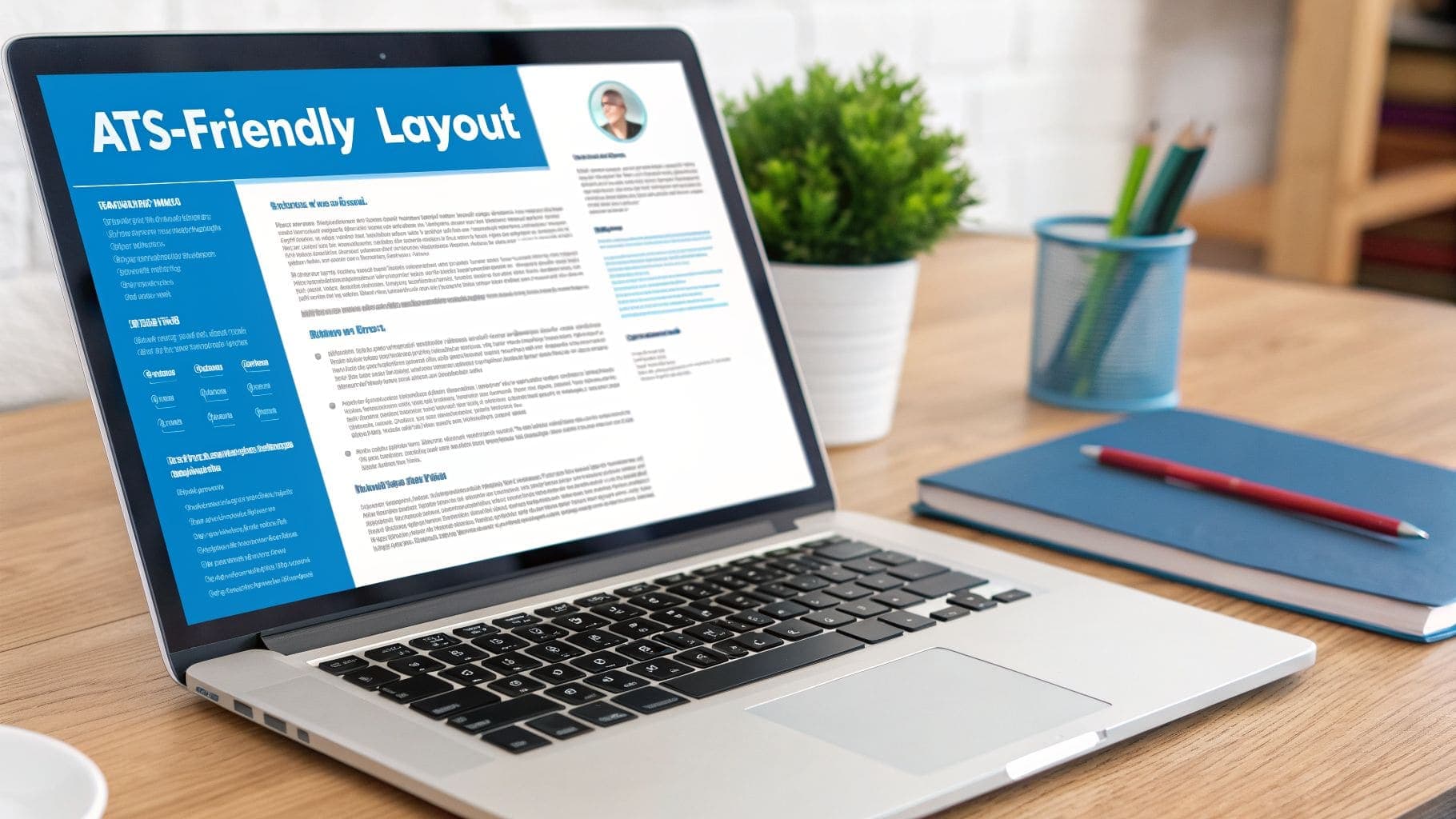
Getting your 1 page CV format UK right is an art form, a blend of smart organisation and strategic content. In the UK job market, the structure of your CV is just as vital as what's in it. Why? Because it has to pass the unblinking eye of an Applicant Tracking System (ATS) long before it ever lands in front of a human.
A winning layout pleases both. It uses clean, standard headings and follows a logical flow that makes your value instantly obvious. This means kicking things off with your contact details, hitting them with a powerful personal profile, showcasing a keyword-packed skills section, detailing your work experience with hard-hitting results, and then wrapping up with your education.
Let's be clear about the reality of modern hiring. A staggering 98% of large organisations in the UK now use automated systems to scan CVs, and for 78%, an ATS is their main screening tool. This isn't just a trend; it's the new standard. Your CV must be built to beat the bots.
The Ideal Section Order For A One-Page CV
On a single page, every inch of space counts, and the order of your sections is critical. You need to put your most persuasive information right at the top to hook the reader immediately.
Here's the flow that I've seen work time and time again:
Contact Information: This goes right at the top. Keep it simple: your name, phone number, professional email, and a link to your LinkedIn profile. One or two clean lines are all you need.
Personal Profile (or Summary): Think of this as your 3-4 sentence elevator pitch. It's a snapshot of who you are, what you bring to the table, and where you're headed next—all tailored to the specific role you're targeting.
Skills Section: Get this high up on the page, just below your profile. This section is prime real estate for ATS keywords. Use a mix of your technical (hard) skills and your interpersonal (soft) skills, making sure they mirror the job description.
Work Experience: This is still the heart of your CV. List your jobs in reverse-chronological order, with your most recent role first. But don't just list duties. Focus on achievements and use bullet points to make them easy to scan.
Education: Keep this section brief, especially if you have a few years of work under your belt. Your degree, university, and graduation year are usually enough.
The best single-page CV acts like a highlights reel of your career. By placing your skills and a strong profile at the top, you immediately signal your value to both software and human readers.
Why A Hybrid Format Often Wins
A simple, chronological CV isn't always your best bet, particularly if you're changing careers or have a few gaps in your employment history. That's where a hybrid format comes in. It's a powerful blend of a chronological and a skills-based CV.
With this structure, you lead with a prominent "Skills" or "Areas of Expertise" section right after your personal profile. This move immediately showcases your most relevant abilities and stuffs your CV with the keywords the ATS is looking for. Only after you've established what you can do for the employer does your Work Experience section provide the chronological story of where you honed those skills.
This approach is all about directing the reader's attention to your value, not just your timeline. For a deeper dive into making your CV completely scanner-proof, check out our guide on how to create an ATS-friendly CV for the UK market.
Avoiding Common ATS Pitfalls
Many perfectly good candidates get rejected before a human ever sees their application, all because of simple formatting mistakes. It's frustrating, but it's avoidable. If you want to understand the common traps, it's worth reading about why resumes often fail ATS.
To stay out of the rejection pile, stick to these rules:
- Use Standard Headings: Use clear, simple titles like "Work Experience," "Education," and "Skills." Now is not the time for creativity. The ATS might not recognise "My Career Journey" or "What I Know."
- Avoid Columns and Tables: Most ATS parsers read left to right, like a book. Columns can scramble your information, turning a well-crafted CV into gibberish. A single-column layout is always your safest bet.
- No Graphics, Images, or Logos: Fancy design elements can confuse the software, causing it to skip entire sections of your CV. This includes putting your name and contact details inside a header image—keep them as plain text.
By sticking to a clean, logical, and ATS-friendly structure, your CV will have the best possible shot at getting through the initial screen and into the hands of a hiring manager.
Mastering The Art Of Writing With Brevity
The biggest hurdle with a single-page CV isn't deciding what to put in; it's what you have the courage to leave out. Your mission is to shrink your entire career onto a single A4 sheet without it losing an ounce of its power.
This isn't about just 'being concise'. It's about adopting a ruthless editing mindset. The trick is to transform every single line from a passive job duty into a punchy, outcome-focused achievement.
First, you need to slash anything that doesn't actively sell you for the specific job you want. That means filler words, vague phrases, and old experience that's no longer relevant. Second, you have to reframe your contributions to show their direct impact, using hard numbers to prove your value. It's a total shift from saying what you did to showing what you achieved.
Transforming Duties Into Impactful Achievements
Let's be blunt: recruiters don't care about your daily to-do list. They care about the results you delivered. The most effective way to make this switch is by framing your bullet points with the STAR method: Situation, Task, Action, Result.
- Situation: Briefly set the scene. What was the context?
- Task: What was your specific goal?
- Action: What exact steps did you take? This is where you use strong, active verbs.
- Result: This is the crucial part. What was the outcome? Quantify it.
Let's see what this looks like in the real world.
Before:
- Responsible for managing the company's social media accounts.
After (using STAR):
- Revitalised the company's social media presence by launching three targeted content campaigns (Action), driving a 25% increase in follower engagement (Result) in six months (Situation/Task).
The second version is specific, punchy, and provides a clear, measurable win. It's infinitely more compelling.
The Power Of Quantification
Numbers cut through the noise. They offer cold, hard proof of your abilities and are understood instantly. Your goal is to sprinkle these metrics throughout your experience section to give your claims real weight.
Hunt for opportunities to quantify your work:
- Money: Did you boost revenue, cut costs, or manage a budget? Use the pound (£) sign.
- Percentages: Did you improve efficiency, increase sales, or reduce errors? Use the percent (%) symbol.
- Time: Did you deliver a project ahead of schedule or cut down process times?
- Volume: Did you manage a certain number of clients, support tickets, or projects?
A well-quantified achievement is undeniable proof of your value. "Increased sales" is forgettable. "Increased quarterly sales by £15,000 through a new lead generation strategy" is a statement that gets you noticed.
Even if you're in a role that doesn't feel number-heavy, get creative. If you trained new starters, how many? If you improved a process, by what estimated percentage did you speed it up? Even small numbers add substance. If you need some inspiration, our guide on crafting a powerful summary for your CV has great tips for highlighting your top-level wins.
Strategic Formatting For Maximum Space
Your content is king, but formatting is the castle. For a 1 page CV format document, clever formatting creates precious white space without sacrificing readability. An overcrowded page is just as off-putting as a two-page CV.
- Margins: Standard margins are 1 inch (2.54 cm). You can shrink them, but never go below 0.5 inches. Any tighter and the page looks cramped and can even cause printing problems.
- Font: Go for a clean, space-efficient, sans-serif font. Calibri (11pt), Arial (10pt), and Helvetica (10pt) are all excellent, professional choices that look great on any screen.
- Line Spacing: Use single line spacing (1.0 or 1.15) to keep things tight. Crucially, add a single blank line between sections and job entries. This creates vital separation and guides the reader's eye down the page.
By combining sharp, achievement-focused writing with smart formatting, you can build a CV that's both compact and incredibly powerful.
Fine-Tuning Your One-Page CV for Maximum Impact
A generic CV, even one that's perfectly formatted, is a wasted opportunity. In the UK job market, real success comes from tailoring your 1 page CV format for every single application you send.
This isn't about just changing a few words. It means leaving the one-size-fits-all approach behind and crafting a targeted marketing document that speaks directly to a specific hiring manager. You do this by dissecting the job description, pinpointing the core keywords and required skills, and then weaving them through your CV. It's the only way to ensure your application gets a nod from both Applicant Tracking Systems and human recruiters.
This level of customisation is more critical than you might think. Hiring is changing fast. One report on 2026 hiring trends found that 41% of UK employers are already moving away from CV-first screening. Only 37% still see CV credentials as the top indicator of talent.
With some roles attracting over 500 applications, your single page has to work incredibly hard to prove its relevance—instantly. A tailored CV shows your skills, your achievements, and even your professional personality in a way that screams 'perfect fit'. If you're curious about these changes, you can read the full hiring trends report for 2026 and see how AI is reshaping recruitment.
Deconstructing The Job Description
Before you write a single word, your first job is to become an expert on the role. Get a copy of the job description—print it out or save it as a separate document—and get ready to highlight. Your goal here is to decode what the employer really wants.
Hunt for these key elements:
- Must-Have Skills: You'll usually find these under "Requirements" or "Qualifications." They are the non-negotiables. If they ask for "Salesforce proficiency," that exact phrase needs to appear in your Skills section. No exceptions.
- Soft Skills and Company Values: Keep an eye out for words like "collaborative," "fast-paced environment," "innovative," or "client-focused." These are massive clues about the company culture. Your Personal Profile is the ideal spot to mirror this language.
- Key Responsibilities: Pay close attention to the verbs. If the job ad talks about "analysing market data" and "developing reports," your experience bullet points need to reflect those specific actions.
Think of the job description as a checklist. Your CV is the evidence that you've ticked every single box. The closer the match, the higher your chances of landing an interview.
Once you have your list of keywords and core duties, you can start tailoring. It's a methodical process that turns a generic CV into a bespoke application. For a deep dive into this, our guide on how to tailor your CV to a job description breaks down every step.
Weaving Keywords Into Your CV
Now for the fun part: placing those keywords and phrases you found. The trick is to make them feel natural, not just stuffed in for the sake of it.
- Personal Profile: This is your opening pitch. If the job ad is desperate for a "proactive project manager with experience in Agile methodologies," your profile should start something like: "A proactive Project Manager with 5+ years of experience leading projects using Agile methodologies..." See how that works?
- Skills Section: This is the easiest place for a direct keyword match. Create a bulleted list that includes the exact technical skills (like Python, Adobe Creative Suite, Google Analytics) and soft skills (like Stakeholder Management, Team Leadership) from the job description.
- Work Experience: This is where you bring the proof. Don't just list a skill; show how you used it to get results. Instead of a lazy "Used SEO tools," write something powerful like, "Drove a 35% increase in organic traffic by implementing an SEO strategy using Ahrefs and SEMrush." This links the skill directly to a measurable achievement. That's what gets you noticed.
When you're tailoring your CV for impact, especially for international roles, knowing how to use tools like CV language converters can be a huge help. It ensures your carefully chosen keywords maintain their punch across different languages and regions. This level of detail is what separates a good CV from a great one.
One Page CV Examples For Different Career Stages
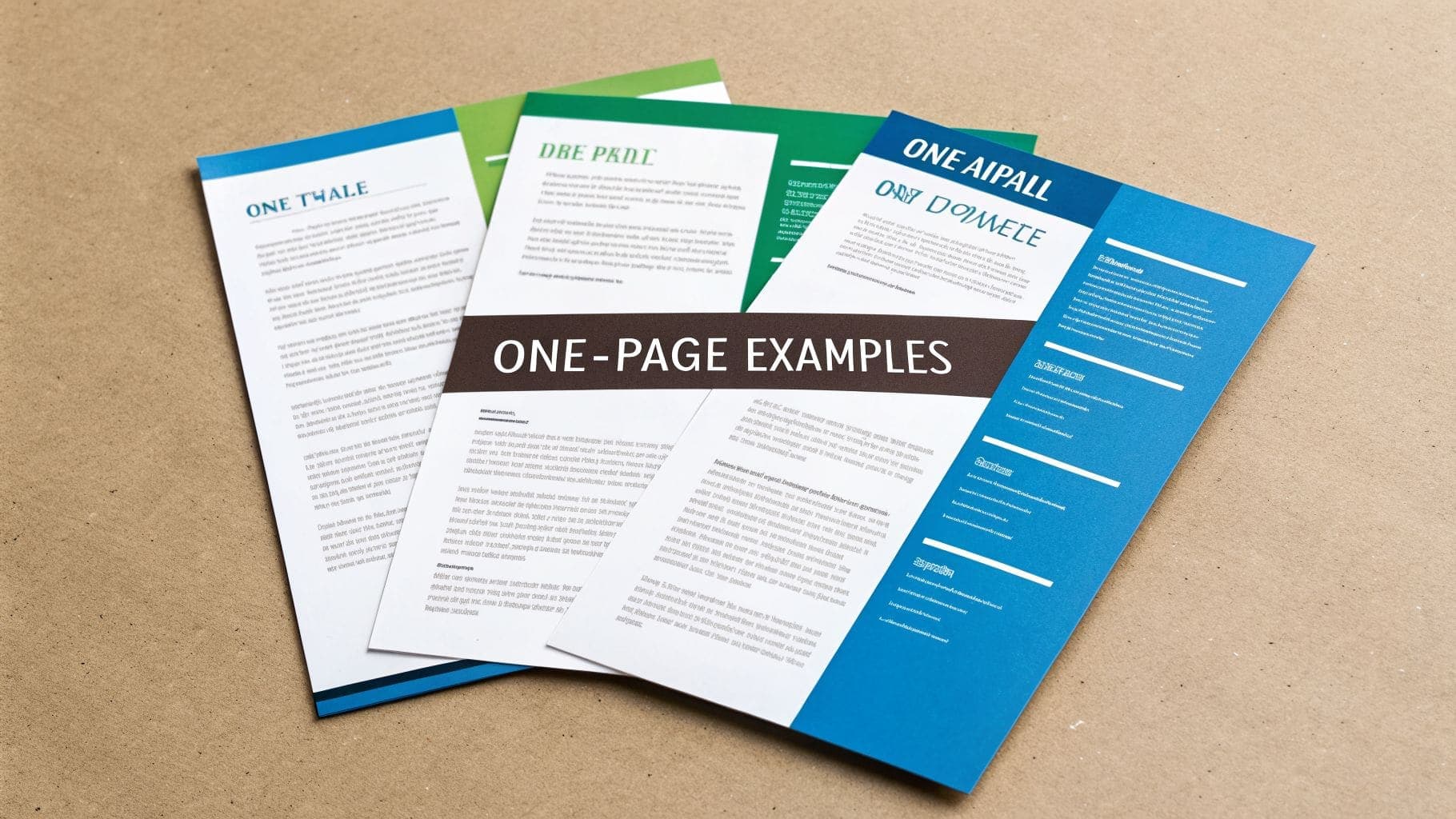
Theory is one thing, but seeing a 1 page CV format in action is where it all clicks. A well-structured example is the blueprint you need to turn all this advice into a polished, professional, and genuinely effective document.
Let's break down four distinct examples, each one built for a different stage of a UK career. Think of these not as rigid templates, but as strategic documents designed to tell a specific story. You'll see how the focus, structure, and content all shift depending on your experience and what you're trying to achieve.
The Recent Graduate CV
As a recent graduate, your main challenge is selling your potential when your professional experience is still thin. A smart CV for this stage cleverly pivots away from a sparse work history, putting the spotlight firmly on academic wins, relevant projects, and transferable skills.
Key Focus Areas:
- Education First: Your degree is your biggest and most recent accomplishment. Put it front and centre, right after your Personal Profile and Skills. Make sure to include your degree, university, and any key modules that are relevant to the job you want.
- Projects and Internships: Don't have a long work history? No problem. Create a section called "Projects" or "Relevant Experience." This is where you detail your final-year dissertation, a major group project, or any work placements. Use bullet points to explain what you did and what you achieved, just as you would for a paid role.
- Skills-Heavy: Your Skills section is absolutely critical. Pack it with the technical skills you picked up on your course (like Python, MATLAB, or the Adobe Suite) and the soft skills you proved through uni life (like Teamwork, Research, and Time Management).
A graduate CV is a testament to your potential. It uses academic work and extracurriculars as evidence of the skills and drive you'll bring to your first professional role. It sells your future, not just your past.
For example, a computer science graduate could detail a coding project, specifying the programming languages they used and the problem it solved. This gives an employer tangible proof of ability in a way that simply listing "Java" in a skills list never could.
The Early-Career Professional CV (2-10 Years)
Once you've got a few years under your belt, the whole game changes. Your work history now takes centre stage, and your mission is to show clear progression and measurable impact.
Key Focus Areas:
- Experience-Led: The Work Experience section is now the heart of your CV. It should come right after your Personal Profile and Skills section. Always use reverse-chronological order, starting with your current or most recent job.
- Achievement-Oriented Bullets: It's time to move on from just listing your duties. Every single bullet point should kick off with a strong action verb and, wherever possible, finish with a quantified result. So, instead of "Managed social media," you write, "Grew Instagram following by 40% in 12 months by implementing a new content strategy."
- Condensed Education: Your degree is still important, but it's no longer the main event. You can move the Education section towards the bottom of the page and shrink it down to a single line: "BSc (Hons) Marketing, University of Manchester."
This type of CV proves you're not just a promising candidate anymore; you're a proven contributor who gets results. If you're hunting for more layout and phrasing ideas, exploring a range of UK CV template examples can spark some fresh inspiration.
The Experienced Professional CV (10+ Years)
With over a decade of experience, your problem isn't a lack of content—it's having too much. The real art of the one-page CV at this stage is strategic curation. You have to be ruthless, choosing only the most relevant and high-impact information.
Key Focus Areas:
- Executive Summary: Ditch the "Personal Profile" and replace it with a more authoritative "Executive Summary" or "Professional Profile." This should be a punchy paragraph highlighting your career level, core expertise, and biggest achievements. For instance: "A Senior Marketing Director with 15+ years of experience in the UK tech sector, with a track record of driving revenue growth exceeding £5M annually."
- Ruthless Curation: You simply can't include every role you've ever had. Focus only on the last 10-15 years of relevant experience. For those older, foundational roles, you can group them into a single line under a heading like "Previous Experience."
- Highlight Leadership and Strategy: Your bullet points need to reflect your seniority. Concentrate on strategic wins, leadership experience, budget management, and your direct impact on the business's bottom line.
The Career Changer CV
If you're changing careers, your CV has to build a solid bridge from your past to your future. A standard chronological format often backfires here, as it just highlights experience that seems irrelevant.
Key Focus Areas:
- Hybrid or Skills-Based Format: This is absolutely crucial. You need to lead with a powerful "Summary" and a detailed "Transferable Skills" section that's loaded with keywords from your new industry. Group your skills under relevant headings like "Project Management," "Data Analysis," or "Stakeholder Communication."
- Reframe Experience: Go back through your Work Experience section and rewrite your bullet points to showcase transferable achievements. For example, if you're moving from teaching into project management, you didn't just plan lessons; you "managed a project" (curriculum development) for "stakeholders" (parents and the school board) and delivered it on time.
- Show Commitment: Add a "Professional Development" or "Certifications" section. This is where you list any new courses or qualifications you've taken to back up your career pivot. It's powerful proof that you're genuinely committed to your new path.
Your Burning Questions About the 1-Page CV, Answered
Even with the best guide in hand, I find job seekers often have a few nagging questions when it comes to crafting a one-page CV. It's a big shift for many, especially if you've built up years of solid experience. Let's tackle some of the most common worries I hear, so you can move forward with confidence.
The big one is always about length. Is a single page a non-negotiable rule? For students, graduates, and anyone with less than a decade of experience, my answer is a firm yes. Recruiters are swamped, and your ability to be concise is your first demonstration of professionalism.
But what if you're a senior leader with 10+ years of high-impact work under your belt? In that case, a two-page CV can be perfectly acceptable. The crucial test is whether every single point on that second page is packed with relevant, impressive achievements that you simply can't cut. If you're on the fence, we've gone into more detail in our article on the pros and cons of a one-page vs two-page resume.
What Should I Leave Out?
This is where the real work begins. Deciding what gets cut is often the toughest part of the process. Here's a quick-fire list of things that can almost always go to reclaim that precious space:
- Ancient history: Any role from over 10-15 years ago can usually be trimmed, unless it's uniquely and powerfully relevant to the job you're targeting now.
- Irrelevant jobs: That weekend café job from your university days? It has no place on your application for a graduate scheme in finance. Be ruthless.
- Hobbies and interests: Unless they directly prove a skill for the job (like coding personal projects for a developer role), they're just taking up valuable real estate.
- "References available upon request": This is a relic of the past. It's completely expected, and recruiters know it. Ditch the phrase.
A great one-page CV is defined not by what it includes, but by the strategic choices you make about what to leave out. It's a targeted sales pitch, not your life story.
This kind of focused editing is what makes a one-page CV so powerful. It forces you to get straight to the point, guiding the recruiter's eye directly to your most compelling skills and achievements.
Ready to create a polished, interview-winning CV in minutes? The CV Anywhere platform empowers you with an AI-powered builder, a JD Fit Checker, and an integrated application tracker to manage your job search effectively. Start building your future for free with CV Anywhere.