The best consultant resume format is a one-page, reverse-chronological document that uses a target-specific summary, quantified project-based experience, and an ATS-friendly single-column layout. It should show measurable impact before duties, because recruiters often review a CV in roughly 6 seconds.
That short review window changes the whole job of the document. A consultant CV isn't a career diary. It's a business case for hiring, where every line needs to answer the silent question: why should this person be put in front of clients? The strongest CVs do that fast, with clean structure, hard evidence, and clear judgement.
The Winning Consultant Resume Format Explained
A winning consultant resume reads like a tight client recommendation. It makes a clear case for hiring you, shows the return a firm can expect, and removes anything that does not support that case.
Recruiters do not need your full career story here. They need fast proof that you can solve problems, work with senior stakeholders, and produce measurable results. The format matters because it controls what they see first, what they remember, and whether your evidence feels credible.
That is why strong consulting resumes follow a disciplined structure instead of a personal style exercise. Each section should answer a specific hiring question:
- Header: Who are you, and how should the firm contact you?
- Summary: What role are you targeting, and what value do you bring?
- Experience: What have you changed, improved, saved, grown, or delivered?
- Education: Do you meet the academic bar, and what signals of rigour support that?
- Leadership and extras: Can you influence people, take ownership, and operate beyond your formal title?
- Skills: What tools, languages, or technical strengths add practical value?
This is the trade-off. The more space you spend on description, the less space you have for proof. A bullet like "supported client transformation projects" says very little. A bullet like "analysed cost data across 12 business units, identified £1.8M in savings, and built the steering committee pack used by the CFO" earns attention because it shows scope, action, and commercial outcome.
Good format also signals judgement. Consulting firms expect candidates to prioritise, structure information, and communicate under pressure. Your resume should demonstrate those skills before you get to the interview. If you want a broader benchmark for how consulting conventions fit within standard CV best practice, see this guide to resume format.
Use a simple test before you finalise the document. If a section does not strengthen the business case for hiring you, cut it or rewrite it until it does.
Is your resume actually getting responses?
Your resume might be missing something important
Upload your resume → see its weakest areas → fix them, one by one.
Free. Takes less than 2 minutes.
Choosing Your Core Resume Structure and Layout
Consulting resumes win interviews on speed and proof. If a recruiter cannot spot your trajectory, scope, and results in one fast scan, the format is working against you.
For almost every applicant, the right structure is reverse chronological. It puts recent evidence first, shows progression without extra explanation, and matches how consulting recruiters review candidates. A resume is a business case, not a scrapbook. The format should make the answer to "Why should we hire you?" visible within seconds.
The order changes based on experience level. Candidates with limited full-time experience should usually place education before experience because academic performance is still a primary screening signal. Candidates with established work history should lead with experience first because employers care more about delivered outcomes than university detail at that stage.
Resume Format Comparison for Consultants
| Format | Best For | Why It Works (or Fails) for Consulting |
|---|---|---|
| Reverse chronological | Most consulting applicants | Shows recent roles, progression, and impact in the order recruiters expect |
| Functional | Candidates with weak or unclear experience | Hurts credibility because it hides dates, employers, and advancement |
| Hybrid | Career changers with strong relevant projects | Works only if the chronology stays obvious and the project evidence is tightly edited |
Functional resumes create unnecessary risk. A recruiter reading a consulting CV wants to know where you worked, how long you stayed, whether you progressed, and what changed because you were there. If those facts are hard to find, the document raises questions you do not want to answer.
Hybrid formats have a narrow use case. I recommend them only for candidates with a credible non-linear path, such as an engineer moving into strategy or an operator with substantial cross-functional project work. Even then, the timeline must stay easy to follow. Put selected projects under the relevant employer instead of building a skills-heavy format that looks like it is hiding something.
One page versus two pages
Page length is a judgement test.
Early-career candidates should almost always stay on one page. That includes students, graduates, analysts, and applicants with a short employment history. The constraint forces prioritisation, which is one of the signals consulting firms are screening for.
A second page can make sense for experienced hires, but only when it adds stronger proof. Strong proof includes multiple promotions, several substantial client engagements, clear leadership scope, or a track record across industries that would otherwise be cut too aggressively. Weak reasons for a second page include task lists, outdated roles, coursework, and generic summaries.
Use these rules:
- One page for campus hiring and most early-career applications
- Two pages for experienced candidates with enough relevant, quantified evidence to justify the space
- Trim older or lower-value roles first if they do not strengthen your case for consulting
A useful test is simple. Read page two and ask whether each line increases your odds of shortlisting. If it does not add revenue growth, cost savings, operational improvement, leadership, promotion, or a rare credential, cut it.
Layout rules that actually work
Consulting firms reward clear thinking. Your layout should show it.
Use a single-column format with standard headings, consistent dates, and bullet-led experience. Fancy templates often break reading flow and create parsing issues in applicant tracking systems. Text boxes, graphics, icons, skills bars, and multi-column designs usually add friction without adding evidence.
Keep the visual rules tight:
- Single-column design for clear reading order
- Consistent date format across every entry
- Readable fonts such as Calibri, Arial, or Garamond
- Clear section spacing so the eye can scan quickly
- Bullets instead of dense paragraphs for experience and achievements
For a clean visual benchmark, review this guide to resume layout.
One more practical point. If you include LinkedIn in the header, make sure it supports the same positioning as your resume. A candidate applying for strategy roles with a vague headline like "Experienced Professional Seeking New Opportunities" creates avoidable doubt. Use this resource to optimize your LinkedIn profile headline so your profile reinforces the story your resume is making.
Crafting the Header and High-Impact Summary
The top of your resume answers a simple commercial question before a recruiter reads any project bullet. Is this candidate likely to create value for clients fast enough to justify an interview?
That is why the header must stay frictionless and the summary must read like a business case. A recruiter should be able to scan the top section and understand your market fit, your likely level, and the kind of results you tend to produce.
What belongs in the header
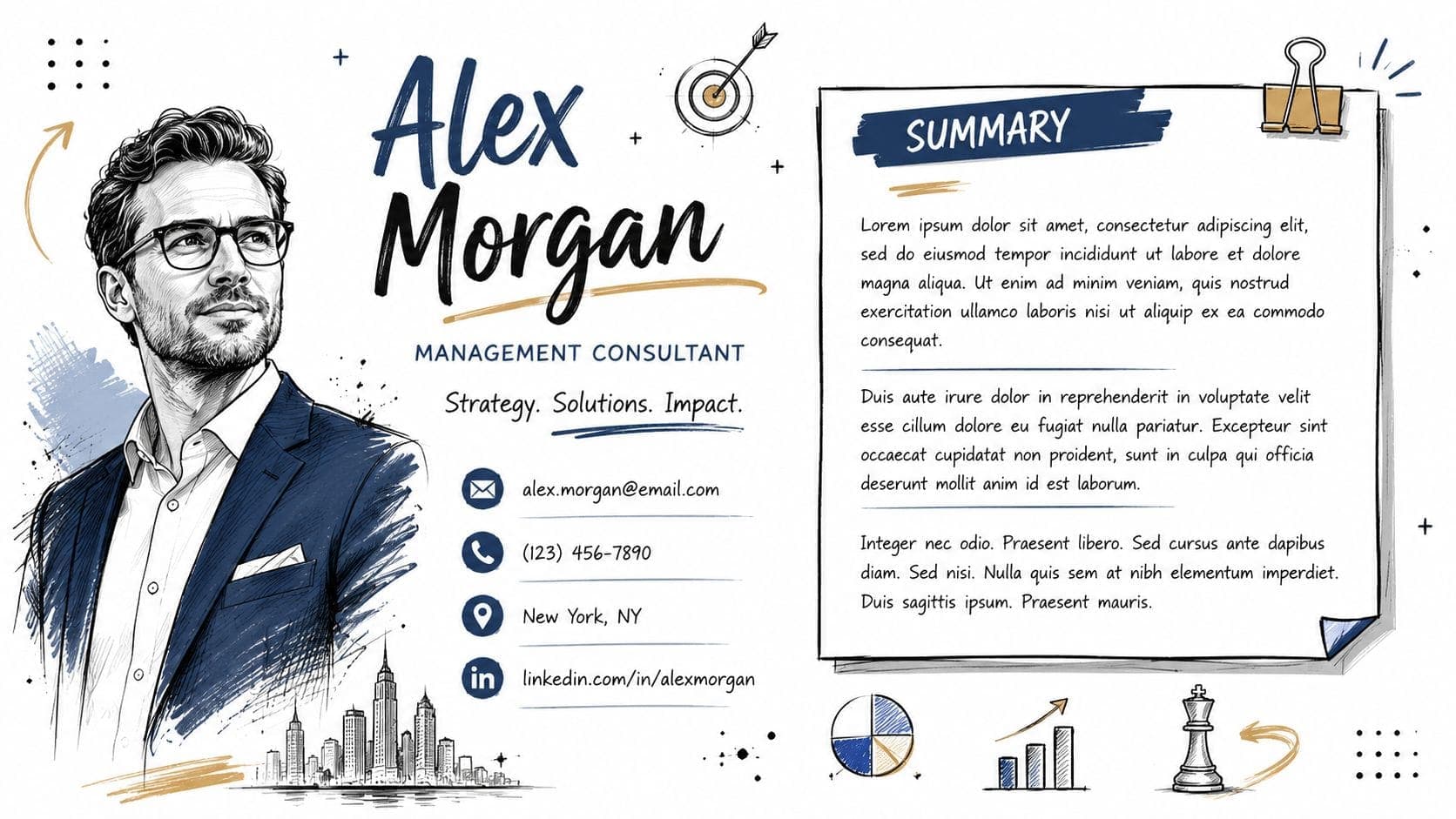
A strong header does one job well. It makes you easy to contact and easy to place.
Include only the details that help a consulting recruiter act:
- Full name in slightly larger type
- Mobile number with country code if you apply across markets
- Professional email address
- LinkedIn URL if the profile is current and supports your story
- City or region if location affects staffing or work authorization context
Leave out your full postal address, headshot, date of birth, marital status, and other personal details that add risk without adding evidence.
This section should feel almost invisible. If the header draws attention to itself, it is usually because something is off. A novelty email address, three phone numbers, or a long block of personal data signals poor judgment on a document that is supposed to show clear prioritization.
How to write a summary that earns the space
A good summary is not a personality statement. It is a short answer to, "Why should we hire you?"
The strongest summaries do three things in four lines or fewer:
- Define your professional profile
- Show consulting relevance
- Support the claim with concrete evidence
That evidence can be scale, industry exposure, project type, promotion speed, academic strength, or measurable outcomes. The point is to give the reader a reason to believe the positioning.
Weak summary:
Motivated consultant with strong communication and problem-solving skills seeking a challenging opportunity.
Strong summary:
Strategy analyst with 2 years of experience supporting commercial due diligence and growth projects in healthcare and software. Built market models used in 8 client decisions, including one pricing case that identified a 12% margin improvement opportunity. Combines top-tier academics with repeated exposure to partner-level presentations.
The difference is simple. The second version makes a hiring case.
Summary examples
Recent graduate example
Economics graduate with internship experience in strategy, operations, and campus leadership roles. Produced market research and recommendation packs for two live projects, including analysis that helped a student venture cut event acquisition costs by 18%. Brings strong academic performance, clear communication, and evidence of leading peers under deadlines.
Career changer example
Project manager transitioning into consulting after leading process improvement work in a regulated industry. Managed cross-functional initiatives affecting 4 business units, cut reporting cycle time by 30%, and presented implementation plans to senior stakeholders. Offers a mix of structured problem solving, change delivery, and credible client-facing communication.
Both examples position the candidate in terms of return, not autobiography. That is the standard to use. Every line should help the reader estimate your likely value on a team.
If you need help tightening the wording, this guide on how to write a resume summary gives useful examples and structure.
Your LinkedIn headline should match the same positioning. If the resume says "operations transformation candidate" and LinkedIn says "experienced professional open to work," the inconsistency creates doubt. Use this resource to optimize your LinkedIn profile headline so both channels support the same story.
Writing Project Experience That Proves Your Value
Your experience section is the verdict. If it reads like a job description, top firms move on.
Recruiters scan this section to answer one question: what return did this candidate create, and is it likely to repeat on a client team? That is why duty-based bullets fail. They describe activity, not value. Strong consultant resumes treat each project or role like a short business case. State the situation, show your intervention, and prove the result.
Consulting resume advice consistently favors quantified, action-led bullets over generic responsibility statements, as described in this consulting resume template guide.
Write bullets that show business impact
A weak bullet tells me what your manager assigned to you. A strong bullet tells me why your work mattered.
These bullets do not help enough:
- Managed client communications
- Supported project delivery
- Conducted market research
- Worked with cross-functional teams
Each one is missing the commercial point. What changed? What decision improved? What cost fell, process sped up, risk dropped, or stakeholder group aligned because of your work?
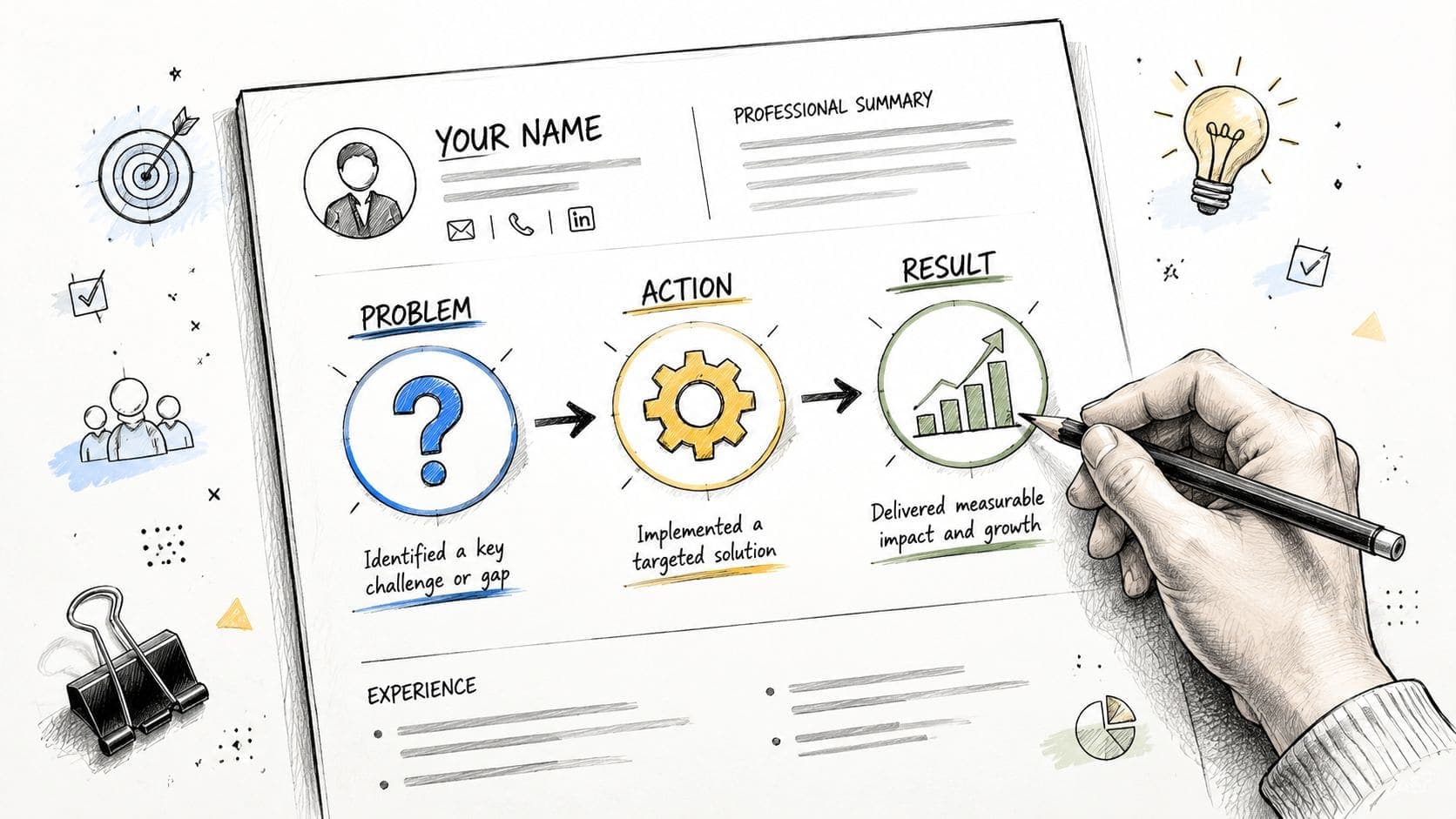
Use a simple structure:
- Business problem or objective
- What you did personally
- Result, with a metric if you can support it
Call it PAR, STAR, or plain good writing. The label does not matter. The discipline does.
Before and after examples
Good edits usually come from tightening scope and naming the outcome.
Before
- Supported commercial strategy projects for clients
After
- Analysed customer and market data for 3 growth projects, synthesised findings into recommendation packs, and helped shape priority initiatives presented to client leadership
Before
- Managed internal reporting processes
After
- Redesigned monthly reporting workflow across 4 functions, cut manual handoffs, and gave senior leaders a clearer view of operational performance
Before
- Led a student society team
After
- Led an 8-person committee, introduced milestone-based planning, and improved event delivery consistency across a full academic term
Before
- Conducted research on market trends
After
- Conducted competitor and market analysis for a proposed expansion, distilled findings into strategic implications, and informed leadership discussion on entry priorities
The second version of each bullet gives the reader something to judge. Scope. Ownership. Outcome. That is what earns interviews.
Use metrics that fit the work
Candidates often assume only revenue counts. It does not. Consulting firms hire people who can improve business performance in different ways, so the metric should match the problem.
Useful evidence includes:
- Cost reduction
- Time saved
- Cycle time improvement
- Error reduction
- Revenue influenced
- Team or stakeholder scope
- Geographic or market coverage
- Volume processed
- Adoption or implementation rate
If you do not have a hard number, write the strongest defensible result. "Produced weekly performance reporting" is weak. "Built weekly performance reporting used by directors to identify delays and reallocate resources" is better. Quantified evidence is stronger, but credible qualitative impact still beats a vague task list.
Extract value from ordinary work
Here, good candidates often undersell themselves.
A finance analyst may not own revenue, but may have reduced reporting lag, identified a control issue, or built analysis used in an investment decision. A public sector candidate may not talk about profit, but can show service redesign, policy delivery, operational coordination, or stakeholder alignment across departments. A startup founder can show customer growth, process creation, pricing tests, or launch execution without turning the resume into a company history.
Use three questions when rewriting bullets:
- What problem existed? Delay, ambiguity, poor visibility, waste, missed targets, stakeholder friction
- What did you do yourself? Built the model, ran the analysis, led the workstream, redesigned the process, presented the recommendation
- What changed? Faster decisions, lower cost, better governance, stronger adoption, reduced backlog, clearer prioritization
If a bullet could describe thousands of people with the same title, it is not specific enough for consulting.
Prioritize projects, not every task
Candidates lose good interviews by trying to document everything. The better approach is selective evidence.
Keep each role focused on the few contributions that best answer "why hire this person?" In practice, that usually means 2 to 4 bullets per role, with each bullet earning its place. I advise candidates to lead with the contribution that had the clearest business impact, then use the remaining bullets to show analytical strength, leadership, and stakeholder management.
A practical order looks like this:
- First bullet: strongest commercial, strategic, or operational result
- Second bullet: analytical or problem-solving contribution
- Third bullet: ownership, leadership, or client and stakeholder management
- Fourth bullet: differentiator, if space justifies it
That structure works because it mirrors how reviewers read. They want proof of value fast.
Present experience in a project-shaped way
Consulting is project-based, and your resume should make that easy to see. You do not need a separate project section for every job. You do need bullets that show discrete pieces of work with a clear objective and outcome.
That is especially useful for candidates whose titles do not signal consulting. Operations managers, PMO leads, analysts, transformation staff, policy professionals, and technical specialists often have stronger consulting-relevant experience than their titles suggest. Project-shaped bullets surface it.
For adjacent analytical roles, this guide to a business analyst resume that shows measurable problem-solving work is a useful reference point because the evidence style overlaps closely with consulting hiring standards.
What gets shortlisted
Patterns repeat across strong consultant resumes.
What works
- Action-led bullets with clear verbs
- Specific ownership instead of vague team language
- Commercial, strategic, or operational relevance
- Measured outcomes when the numbers are credible
- Short context followed by a clear result
What gets ignored
- Task lists
- Sector jargon without translation
- Long bullets with no visible payoff
- Claims that sound inflated
- Background detail that crowds out impact
Non-linear candidates should use the same standard. Freelance work, secondments, startup periods, parental leave returns, and career changes can all read well if the bullets show outcomes, judgment, and transferable consulting skills. The format can flex. The evidence standard cannot.
Optimizing Skills, Education, and Final Formatting
Once the experience section is strong, the supporting sections need to do their job without stealing space. Skills, education, and formatting are where many decent consultant CVs lose polish.
The technical rule set is straightforward. ATS-safe consultant CVs use a conservative single-column layout, minimal design elements, consistent date formatting, and bullets written as result-action-metric statements, as outlined in this ATS-safe resume methodology.
Positioning education correctly
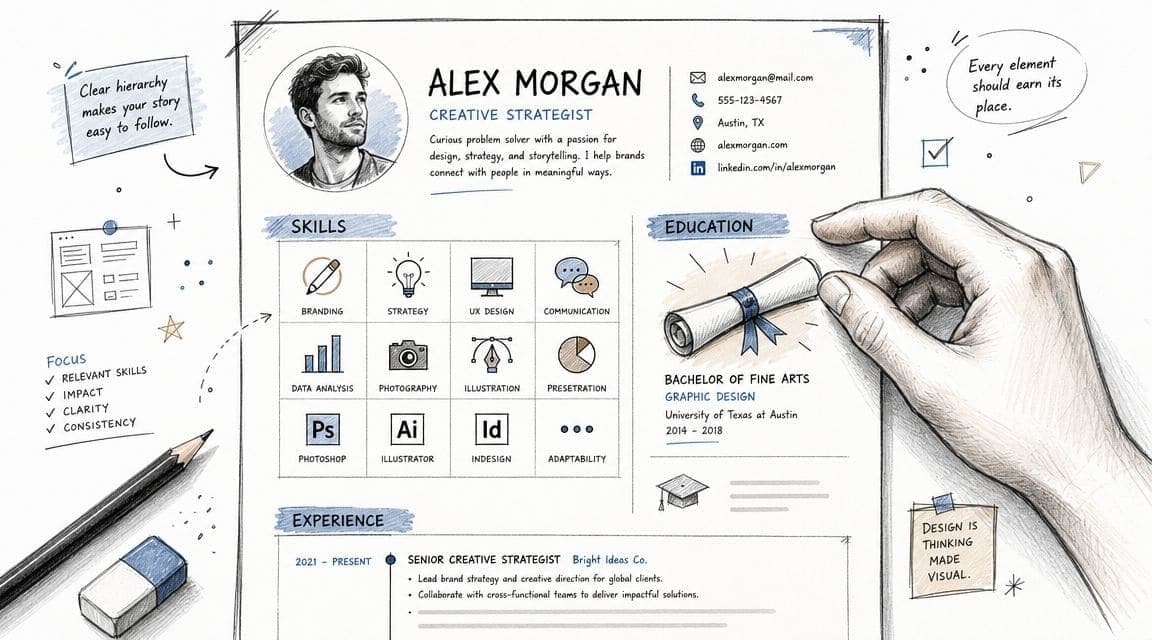
Education placement depends on experience level.
Candidates with less than two years of experience should usually place education before work experience. Candidates with more established experience should usually move it below. That ordering helps the strongest credibility signal appear first.
Education entries should include:
- Degree and institution
- Dates
- Relevant academic distinctions if they strengthen the application
- Selected coursework or dissertation topic only if clearly relevant
- Leadership or extracurricular evidence if still early career
Keep secondary school out unless there's a very specific reason to include it.
Building a skills section that helps
The skills section should support the case, not repeat empty buzzwords.
Weak skills lists include terms such as "team player", "hard-working", or "excellent communicator". Those don't carry much weight on their own. Consulting firms expect those traits to show up through experience bullets instead.
A better skills section focuses on tools and capabilities that can be verified.
Useful categories include:
- Technical tools such as Excel, Tableau, SQL, PowerPoint, Python
- Languages with honest proficiency level
- Relevant methods such as financial modelling, market analysis, data visualisation, project planning
- Certifications only if recognised and relevant
For readers refining that section, CV Anywhere has a useful reference on resume skills section examples.
Skills should be short enough to scan in one glance. If the section turns into a keyword dump, it stops helping.
Final formatting checklist
Before sending the CV, run a final quality check. Consulting recruiters notice sloppiness fast because the role itself requires precision.
Use this checklist:
- Check section order so the strongest evidence appears first
- Standardise dates in one format across the entire CV
- Keep bullets parallel so grammar and tense stay consistent
- Remove visual clutter such as icons, charts, text boxes, and columns
- Preserve white space so the page is easy to scan
- Use a professional file name with the candidate's name and role
- Export carefully so layout remains stable when opened elsewhere
Common formatting mistakes
These errors are common and avoidable:
| Mistake | Why it hurts |
|---|---|
| Multi-column template | Can confuse ATS parsing and disrupt reading flow |
| Long profile paragraph | Pushes better evidence below the fold |
| Mixed date styles | Signals weak attention to detail |
| Generic soft skills list | Wastes valuable space |
| Bullets of unequal quality | Makes the CV feel unfocused |
A clean consultant resume format doesn't win attention by looking unusual. It wins by making strong evidence impossible to miss.
Frequently Asked Questions About Consultant Resumes
Can someone break into consulting without direct consulting experience?
Yes, if the CV presents transferable evidence properly. The candidate should focus on problem-solving, structured analysis, stakeholder management, leadership, and measurable outcomes from adjacent work such as finance, operations, policy, technology, or project delivery. The title matters less than the proof.
What are the biggest red flags on a consultant CV?
The worst red flags are usually basic ones:
- Typos and inconsistent formatting
- Bullets that only list duties
- No measurable outcomes where they should exist
- Overlong summaries
- Gaps or unusual career moves presented defensively rather than clearly
Candidates with non-linear backgrounds should be direct. A short, calm explanation is better than trying to hide timeline complexity.
Should a consultant CV include extracurricular activities?
Yes, especially for students, recent graduates, and early-career candidates. Leadership positions, side projects, volunteering, society roles, or entrepreneurial activity can strengthen the case when they show initiative, responsibility, or impact. They should be written with the same discipline as professional experience.
Is a cover letter still worth including?
For top consulting firms, a customized cover letter is still worth doing when the application allows or expects it. The CV remains the primary screening document, but a strong cover letter can sharpen motivation, office preference, sector interest, and fit. It shouldn't repeat the CV line by line.
What's the best consultant resume format for career changers?
Usually a reverse-chronological CV with selective project framing. The candidate should keep the timeline visible, then use summary language and experience bullets to translate prior work into consulting-relevant evidence. A fully functional format usually creates more doubt than clarity.
A strong consultant CV doesn't need flashy design. It needs sharp structure, credible metrics, and evidence that can survive a fast screen. CV Anywhere helps candidates build ATS-friendly CVs, tailor them against job descriptions, and track every application in one place so the process stays organised from first draft to final interview.