The best way to put publications on a resume is to create a dedicated 'Publications' section and list your 3-5 most relevant works using a simplified citation format. This section should follow your 'Experience' or 'Education' section, depending on which is more critical for the US job you're targeting. For maximum impact, bold your name in the author list and hyperlink the title to the online version.
Knowing how to put publications on a resume correctly can transform your application from just another document into a powerful statement of your expertise. In the competitive 2026 US job market, showcasing your published work proves you have the deep analytical, research, and writing skills that top employers are actively seeking. This is particularly crucial in fields that value original thought, such as academia, research and development, technology, and senior corporate strategy roles. Your publications serve as tangible evidence of your ability to make a significant contribution, setting you apart from a sea of otherwise qualified candidates.
The Best Way to List Publications on Your Resume

Why Strategic Placement Matters
Recruiters spend just seconds on each resume. With US small and medium businesses seeing an average of 180 applicants per hire, you have to make every second count. And since 73% of recruiters reject resumes just for poor formatting, how you present your work is just as important as the work itself.
Your goal is to make your expertise impossible to ignore. A cleanly formatted, well-placed publications list does exactly that. It signals your credibility before a hiring manager even gets to your work history.
For roles outside of academia, think quality, not quantity. Your best bet is to pick your top 3-5 publications that speak directly to the job description. It shows you've done your homework and understand what the employer is looking for.
Tailoring for Impact in the US Market
Listing publications on a US-based job resume is a completely different game than building an academic CV. A CV is your life's work—a comprehensive, exhaustive record. A resume? It's a marketing document, plain and simple.
Here's what you need to keep in mind for the US job market:
- Relevance Over Volume: A single, highly relevant publication is far more powerful than a long list of unrelated articles.
- Clarity and Brevity: Use a simplified citation. The recruiter isn't grading your bibliography; they're trying to quickly assess your fit.
- Digital Integration: Always hyperlink the title or DOI to the publication online. This makes it dead simple for an interested hiring manager to check out your work.
We have some great pointers on structuring this in our helpful academic resume template.
And while you're polishing your resume, don't forget your online presence. A smart career strategy includes knowing how to add your resume on LinkedIn to attract recruiters to get in front of more recruiters. In the end, mastering how to put publications on a resume is all about smart selection, clean formatting, and putting them where they'll have the most impact.
Is your resume actually getting responses?
Your resume might be missing something important
Upload your resume → see its weakest areas → fix them, one by one.
Free. Takes less than 2 minutes.
How to Format Your Publications for Maximum Impact
Before you add a single citation, the first and most critical step is to be selective. I've seen countless resumes where people make the mistake of listing every article they've ever written. While impressive, it overwhelms a recruiter who isn't an academic. Remember, when it comes to how to put publications on a resume, relevance always wins over volume.
Your real goal is to curate a list that speaks directly to the job you want. Start by pulling apart the job description. What are the key skills, responsibilities, and expertise they're looking for? Now, look at your body of work and ask a simple question: which publication best proves I can solve their problems? A single, highly relevant article is infinitely more powerful than a dozen unrelated ones.
Making Citations Readable for Recruiters
Once you've picked your all-stars, you need to get them ready for a business audience, not an academic journal. Formal styles like APA or MLA are great in their own world, but they're often too dense for a quick scan on a resume. The key is to create a simplified, resume-friendly format that looks clean and professional.
No matter what, your adapted format should always include these core pieces:
- Your Name: If you're a co-author, bold your name so it pops.
- Title of Work: Keep the full, original title.
- Publication Venue: The name of the journal, conference, or book.
- Year of Publication: Just the year is enough.
This streamlined approach gives a hiring manager all the context they need without getting bogged down in volume numbers or page ranges. A clean, well-organized resume is crucial for making a good first impression. If you need more ideas on this, check out our guide on designing an effective resume layout.
Real-World Formatting Examples
Let's see what this looks like in practice. A standard APA citation for a journal article can look pretty clunky on a resume.
Before: Standard APA Style
Davis, M. R., & Chen, L. (2025). The Impact of AI on Supply Chain Logistics. Journal of Business Innovation, 42(3), 112-128.
It's technically perfect, but it's a lot for a hiring manager to wade through. Now, let's clean it up for real-world impact.
After: Resume-Friendly Format
Davis, M.R. & Chen, L. "The Impact of AI on Supply Chain Logistics." Journal of Business Innovation, 2025.
See the difference? It's cleaner, highlights your name, and is much faster to scan. The same idea applies to other work, like a chapter in a book.
Example for a Book Chapter
- Resume-Friendly Format: Miller, S. "Data-Driven Marketing Strategies." Chapter in Modern Marketing for the Digital Age, Tech Press, 2026.
Give Your Publications Some Punch with Impact Metrics
To really make your publications section work for you, add a brief impact metric. This one small addition transforms your list from a simple bibliography into hard proof of your influence and expertise. It gives a non-specialist recruiter a concrete way to understand your work's significance.
Here are a few ways to add that extra punch:
- Mention the journal's ranking or impact factor (e.g., Published in a top-tier Q1 journal).
- Include how many times your work has been cited (e.g., Cited over *50* times in subsequent research).
- Note any awards or special recognition the publication earned.
Adding these details helps a recruiter connect the dots and see the real-world value of your contributions. It's this thoughtful approach to selecting, formatting, and contextualizing your work that truly masters how to put publications on a resume.
Where to Place Your Publications Section for Recruiters to See
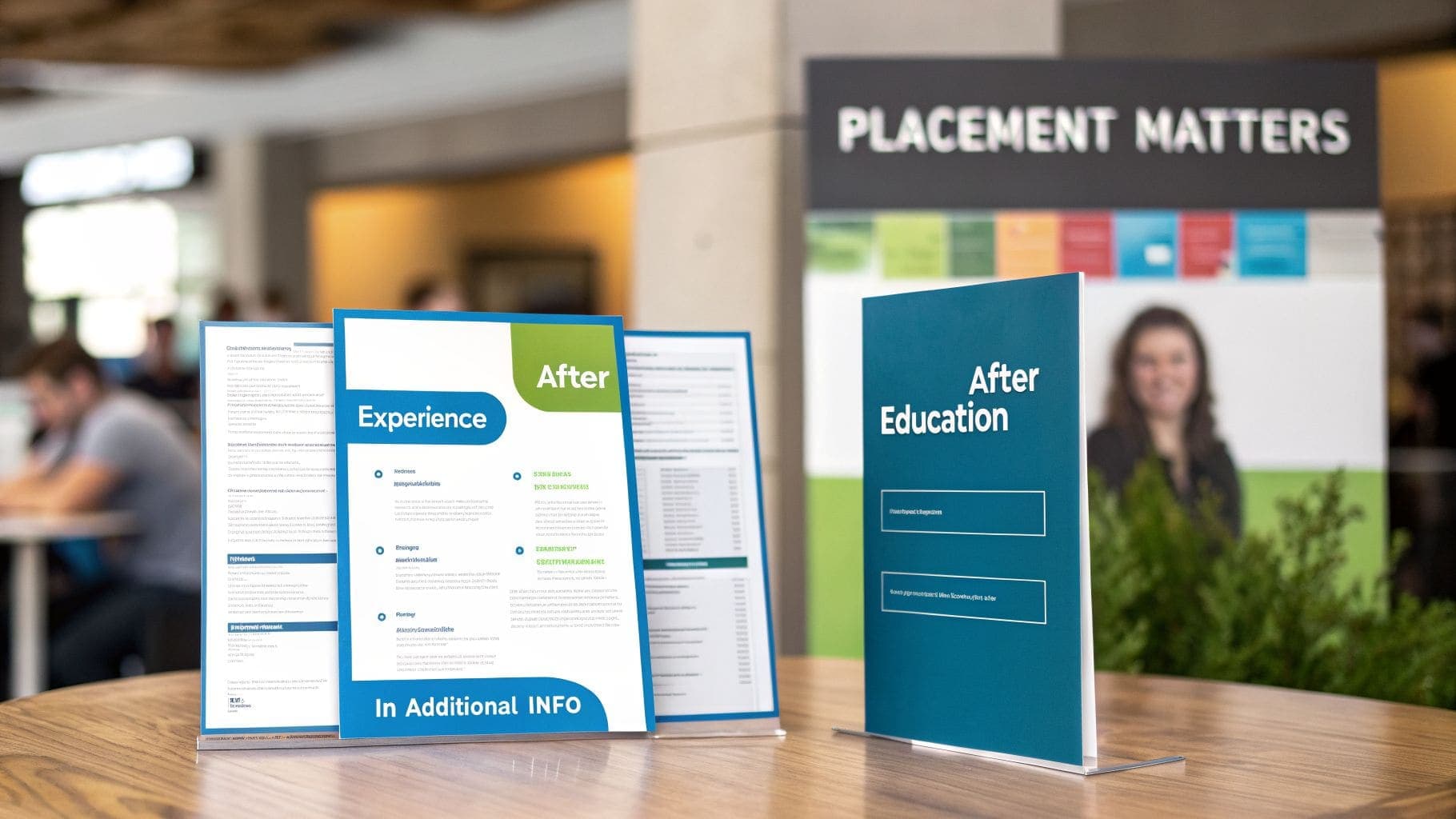
So, you've decided which publications to include. The next big question is: where do they go? With recruiters spending just seconds on each resume, placement isn't a small detail—it's everything. Getting this right ensures your most impressive work gets seen instantly.
The best spot depends entirely on your career context. Where you are in your professional life and where you're headed should dictate your strategy for how to put publications on a resume.
For most job seekers, it boils down to three high-impact locations. Each one sends a slightly different signal to a hiring manager, so let's break down the options and see which one fits you best.
For Academics and Recent Graduates
If you're fresh out of a graduate program, a PhD candidate, or working in a research-heavy field, your publications are a direct product of your education. They're the hard evidence of your scholarly chops and deep subject matter expertise.
In this case, the most logical place for your 'Publications' section is right after your 'Education'. It creates a natural story for the reader, flowing from where you studied to what you produced with that knowledge. This placement immediately frames you as a credible researcher and an expert in your field.
For Experienced Professionals in Industry
Once you have a solid professional track record, your work experience becomes the star of the show. Recruiters in corporate roles want to see your real-world impact first, and your resume needs to deliver that immediately.
For seasoned professionals, the ideal spot for a 'Publications' section is directly after your 'Professional Experience'. Here, your publications act as powerful backup for the expertise you've already demonstrated in your roles. It tells a clear story: "Here's what I've accomplished in my job, and here's the thought leadership that proves my authority."
A senior professional's resume is a narrative of impact. Placing publications after experience frames them not just as academic exercises, but as byproducts of real-world expertise and authority in your field.
For Career Changers or Those with Less Relevant Publications
What if your publications are from a previous career or don't directly align with the job you're targeting now? If they still showcase valuable transferable skills—like critical thinking, in-depth research, or strong writing—they're worth including. You just have to be strategic about it.
The best move here is to place them toward the end of your resume in a section like 'Additional Information' or 'Professional Contributions'. This approach keeps the spotlight on your most relevant skills and experience while letting the publications add extra depth to your profile. It's a subtle way to bolster your credentials without distracting the recruiter from your main pitch.
Making Your Publications ATS-Friendly
Before a human hiring manager ever lays eyes on your resume, it has to get past the gatekeeper: the Applicant Tracking System (ATS). These bots are programmed to scan for specific keywords and clean formatting, and if your resume can't be read properly, it's headed straight for the digital trash can. Learning how to put publications on a resume in a way that an ATS can understand is no longer optional in the 2026 US job market.
The number one rule? Keep it simple.
Always, always use a clean, single-column layout for your resume. I've seen too many great candidates get rejected because their fancy two-column resume with tables and text boxes completely scrambled the ATS. Stick to standard, universal fonts and steer clear of any special characters or symbols in your publication titles—they're notorious for causing parsing errors.
Using Standard Headings and Keywords
To make sure the software knows exactly what it's looking at, use a dead-simple, standard heading like "Publications" or "Research." Don't get creative here. The ATS is looking for these exact signposts to categorize the information correctly.
Once you have the heading, you can get a little more strategic by weaving in keywords from the job description itself. Right under your most relevant publication, add a single, punchy line that connects that research directly to the role you want.
- Example: If you're applying for a data analyst job that requires Python, you could add a note like this: Developed and applied Python-based statistical models for data analysis in this research.
This small tweak does a huge amount of work. It builds a direct bridge between your academic experience and what the employer actually needs, which can seriously boost your application's match score. You can dive deeper into these kinds of strategies in our full guide to creating an ATS-friendly resume for US jobs.
The Modern Best Practice of Hyperlinking
Finally, one of the most effective and modern techniques is to hyperlink your publication's title. Link it straight to the online source or its Digital Object Identifier (DOI). This is a smart move that works for both the bots and the humans reading your resume.
For an ATS, a clean hyperlink is just another piece of data it can easily parse and store. But for a recruiter, it's a one-click gateway to verify your work, which shows transparency and screams confidence.
With Applicant Tracking Systems filtering out a staggering 75% of resumes before they're even seen, getting the formatting right isn't just a minor detail—it's everything. In fact, positioning your publications correctly can increase your match score by up to 50%. In competitive US markets where a single job post can pull in hundreds of applications a week, that's the edge you need. By making your publications easy for a machine to find and a human to verify, you'll master how to put publications on a resume for the modern, automated hiring process. If you're interested in the trends driving this, you can learn more about the predicted growth of the resume service market and its intense focus on optimization.
Resume Publication Examples For Different Professions
Seeing a strategy in action is always better than just talking about it. How you list your publications really depends on where you are in your career and what kind of job you're after. A new PhD grad needs a totally different approach than a seasoned manager in the corporate world.
So, let's get practical. Here are three detailed examples showing how to put publications on a resume for very different professional scenarios. Each one comes with a breakdown of the thinking behind it, giving you a clear blueprint to work from.
The Recent PhD Graduate Entering Research
For someone fresh out of a PhD program and heading into a competitive research field, publications are everything. They're your primary currency. This is one of the few times where a more detailed list isn't just okay—it's expected. The goal is to prove you have a solid research track record and are already an active voice in your field.
Example Resume Snippet:
PUBLICATIONS
- Miller, S.L., Rodriguez, A., & Kim, J. "Quantum-Resistant Encryption Algorithms for IoT Networks." IEEE Transactions on Information Forensics and Security, 2026. (In Press)
- Miller, S.L. & Rodriguez, A. "A Novel Framework for Secure Data Transmission in Ad Hoc Networks." Proceedings of the 2025 ACM SIGSAC Conference on Computer and Communications Security (CCS), Dallas, TX.
- Presented groundbreaking research on data security protocols, cited in 15+ subsequent studies.
- Chen, B., & Miller, S.L. "Scalable Machine Learning Models for Anomaly Detection." Journal of Cybersecurity Research, 2024.
Why This Works: This format is clean and effective. It lists works from newest to oldest, bolds the candidate's name so it pops, and even includes a high-impact conference presentation. That little note under the second entry is a brilliant touch—it gives context about the paper's influence, which is a huge plus for a recent grad. For more on this, check out our detailed research scientist resume template.
The Mid-Career Corporate Professional
When you're established in a corporate career, relevance and impact are king. A hiring manager doesn't want to see a long list of academic papers from a decade ago. Here, the strategy is to be highly selective, picking just one or two powerful publications that position you as a thought leader and directly back up your professional brand.
Example Resume Snippet:
THOUGHT LEADERSHIP & PUBLICATIONS
- "The Future of Sustainable Supply Chains." Global Logistics Monthly, 2025.
- Authored an industry-leading analysis on green logistics, featured on the cover and influencing new corporate best practices.
- "Data-Driven Inventory Management for E-Commerce." Retail Tech Today, 2023.
Why This Works: The heading "Thought Leadership" sounds much more strategic and business-savvy than a plain "Publications" section. The list is short and sweet, focused only on work that matters in their corporate field. The descriptive bullet point adds powerful context about real-world impact, which is what a corporate recruiter truly cares about—not citation counts.
The Career Changer
If you're switching careers, your old publications can be a secret weapon. They can showcase incredibly valuable transferable skills like deep analysis, research, and clear communication. The trick is to reframe the publication, focusing not on its original topic but on the skills it proves you have for your new industry.
For some roles, having a major published work can be a game-changer. You might even explore resources on how to write a thought leadership book to build authority to build that kind of authority.
Example Resume Snippet:
ADDITIONAL PROJECTS & PUBLICATIONS
- Analytical Research Publication: "Statistical Analysis of Voter Turnout Patterns in Mid-Term Elections." Journal of Political Science, 2022.
- Leveraged advanced statistical modeling and large dataset analysis to identify key demographic trends—skills directly applicable to market research and consumer behavior analysis.
Why This Works: This is a masterclass in making the old relevant to the new. It smartly re-frames an academic paper for a job in, say, marketing analytics. It explicitly calls out the transferable skills used (statistical modeling, large dataset analysis) and connects them directly to the target industry's language. It's a perfect way to bridge the gap between where you've been and where you want to go.
A Few Common Questions We Hear All the Time
Figuring out the finer points of how to list publications on your resume can feel a little tricky. You might be wondering about work that isn't officially in print yet, or how many you should include without overwhelming a recruiter. Getting these details right is what makes a resume look sharp and professional, especially as we head into 2026.
This section tackles some of the most common—and sometimes awkward—questions job seekers run into. We'll give you direct, practical answers so you can handle these situations with confidence.
What About Publications That Are "In Press" or Just "Submitted"?
Yes, you can absolutely include them, but you need to be transparent and strategic. If a work has been officially accepted for publication but just isn't printed yet, you can list it with an "In Press" status. This is a great signal to recruiters that your work has passed peer review and is on its way.
For pieces you've sent to a journal that are still under review, you can use statuses like "Submitted" or "Under Review." A word of caution, though: on a standard business resume where every inch of space matters, it's often better to leave these off unless the work is incredibly relevant to the job. Published or accepted works will always carry more weight, so give them priority.
How Many Publications Should I Actually List on My Resume?
The right number really depends on where you're sending your resume. An academic CV is expected to be a comprehensive, exhaustive list of your work. A resume for a corporate or non-academic job, however, is all about curation.
For a typical two-page resume in the US, the sweet spot is usually 3-5 of your most relevant and impactful publications. Any more than that, and you risk losing the attention of a non-academic hiring manager.
If you have a long list of publications you're proud of, a great move is to create a separate, detailed list. You can then add a simple note on your resume like, "A complete list of publications is available upon request." Even better, link out to a personal website or online portfolio where the full list is hosted. If you're not sure about the difference between these documents, you can learn more about the key distinctions between a CV and a resume.
Does It Matter if I'm Not the First Author?
Not nearly as much as you might think, especially when you're applying for jobs outside of academia. What matters most is the publication's relevance to the role. The most important thing is to list the citation exactly as it appears in the official publication to maintain accuracy and professional integrity.
To make sure your contribution is clear, just bold your own name in the author list. It's a simple, effective trick.
- Example: Smith, J., Davis, M., & Jones, L. (2025).
If you want to add a little more context, you can include a brief, one-line description of your specific role right below the citation. This small addition can make a big impact by highlighting exactly what you did.
- Example Description: I spearheaded the experimental design and data analysis for this study.
Should I Create Separate Sections for Patents or Presentations?
Definitely, but only if you have enough content to warrant it. If you have several patents, conference presentations, or invited talks that are relevant to the job, creating distinct sections like "Patents" and "Invited Talks & Presentations" is a fantastic way to keep your resume organized and scannable. It's a clean approach that showcases the full scope of your professional contributions.
On the other hand, if you only have one or two of these items, it's more efficient to group them under a broader heading. A title like "Additional Professional Contributions" or "Patents & Presentations" works perfectly. This saves valuable space while still making sure these important achievements get noticed. Mastering these small details is a key part of knowing how to put publications on a resume effectively.
Ready to create a resume that truly showcases your expertise? With CV Anywhere, our Smart CV Builder helps you craft a polished, ATS-friendly resume in minutes. Use our JD Fit Checker to align your skills and publications directly with the job description, ensuring you make the best possible impression every time. Get started for free today and take control of your job search at https://cvanywhere.com.