CV and Resume Difference: The Essential Guide for UK Jobseekers in 2026
Discover the cv and resume difference and when to use each in the UK job market. Clear distinctions and tips to boost your job chances.

When applying for jobs in the UK, understanding the cv and resume difference is your first critical step. To put it simply, the main distinction lies in their purpose, length, and the level of detail they contain. For a UK audience, a Curriculum Vitae (CV) is the standard; it's a comprehensive, two-page document that details your entire career history, skills, and academic background. In contrast, a resume, which is the norm in the US and Canada, is a concise, one-page summary tailored to a specific job.
In the UK job market, recruiters almost always expect a traditional, detailed CV. Submitting a short, American-style resume can signal a misunderstanding of local professional culture and may cause your application to be overlooked. This guide will walk you through everything you need to know to create the right document and make a powerful first impression with UK employers.
Unpacking the Core CV and Resume Difference
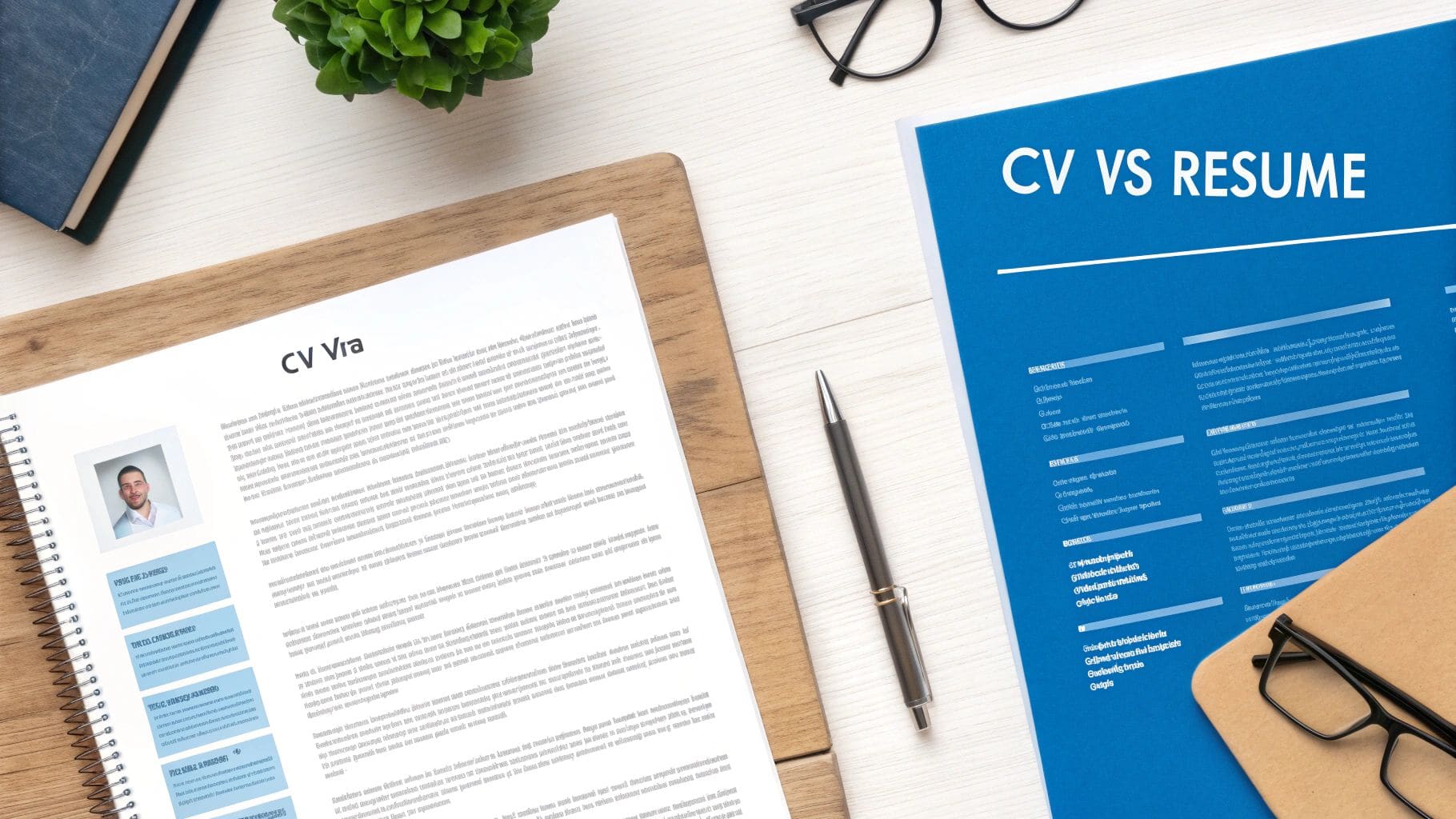
Although you might hear people use the terms interchangeably in the UK, recruiters almost always expect the traditional, detailed CV format. Getting this wrong matters. Sending a one-page resume when a CV is expected can signal that you haven't grasped the local professional culture.
The core idea is this: a CV is a document that grows with you throughout your career, while a resume is rebuilt from scratch for each new application. Understanding this distinction is your first step to making a strong impression, as a well-structured CV gives UK employers the complete career narrative they're used to seeing.
CV vs Resume at a Glance Key Differences
To make this crystal clear, let's break down the main differences in a simple table. This should help you see instantly what you need for your next UK-based application.
| Attribute | UK CV (Curriculum Vitae) | US Resume |
|---|---|---|
| Length | Typically 2 A4 pages, but can be longer for senior or academic roles. | Strictly 1 page, occasionally 2 pages for very experienced professionals. |
| Purpose | To provide a complete, chronological overview of your career and academic life. | To provide a brief, targeted summary of skills relevant to a single job. |
| Content | Includes a detailed history of employment, education, publications, awards, and skills. | Highly selective, featuring only the most relevant experience and skills for the role. |
| Layout | Generally static and chronological, updated with new information as you acquire it. | Highly customisable and often re-written for each specific job application. |
| Region | Standard in the UK, Europe, Asia, Africa, and the Middle East. | Standard in the United States and Canada for most corporate roles. |
As the table shows, a UK CV is a static, comprehensive record of your professional life, whereas a resume is a dynamic, targeted marketing tool designed for a specific audience.
The CV is your professional autobiography, providing a full story for UK recruiters. A resume is more like a 60-second advert, designed for the fast-paced North American market.
Here's a crucial insight: despite the detail in a UK CV, recruiters spend a mere 6-8 seconds on their first scan. Research shows they focus 80% of that time on just a few key areas: your name, past job titles, key dates, and education. So, even with a longer document, you have to make those first impressions count.
If you want to dig deeper into crafting a document that grabs attention, our complete guide on the meaning and purpose of a Curriculum Vitae is a great place to start.
Is your resume actually getting responses?
Your resume might be missing something important
Upload your resume → see its weakest areas → fix them, one by one.
Free. Takes less than 2 minutes.
A Detailed Comparison of Document Structure and Content

Length is just the beginning. The fundamental cv and resume difference really shows up when you look at how they're built and what they're designed to do. A UK CV is a complete, static record of your entire professional history. In contrast, a North American resume is a punchy, targeted marketing document that changes for every single job application. This core difference shapes every choice you make, from the first line to the last.
A CV is almost always written in strict chronological order. It's meant to be an unbroken timeline of your career and education, leaving nothing out. The goal is to be exhaustive, covering everything from your earliest jobs to every paper you've published. A resume, on the other hand, throws strict chronology out the window if it needs to. It puts relevance first, often using formats that spotlight the specific skills and wins that match the job advert.
The Philosophy of Content Selection
The real departure between the two documents is in the content you choose to include—or leave out. A UK CV works on a principle of full disclosure. The aim is to provide a complete, honest picture of your entire professional life.
A resume, however, is built on strategic omission. Every single line has to earn its place by speaking directly to a requirement in the job description. Anything that isn't immediately relevant gets cut to keep it sharp and, ideally, on a single page.
A UK CV is your professional autobiography, meticulously detailing every chapter. A resume is more like a film trailer, showcasing only the most exciting scenes tailored to a specific audience.
Think about a project manager. In the UK, they'd list all their roles in order, even the ones from a decade ago. Their American counterpart would cherry-pick only the projects that directly mirror the responsibilities in the job spec, possibly leaving older or less relevant roles off entirely.
Comparing Key Structural Components
To really get to grips with this, let's break down how each document handles the most common sections. The way you present your information tells a recruiter a lot about your understanding of their local professional culture.
Here's a side-by-side look at how key sections are treated:
- Personal Statement/Summary: A UK CV usually kicks off with a "Personal Profile," a short paragraph sketching out your key skills and career goals. A US resume prefers a "Resume Summary" or "Objective," which is a much punchier, results-focused statement aimed squarely at the employer's pain points.
- Work Experience: On a CV, this section is a detailed, chronological list of duties and achievements for every job you've had. On a resume, it's a curated list of accomplishments, packed with metrics and keywords pulled directly from the job advert.
- Skills Section: CVs might just have a simple list of skills. Resumes often make this section far more prominent and detailed, sometimes breaking it down into "Technical Skills" and "Soft Skills" to make sure it gets noticed by Applicant Tracking Systems (ATS).
- Additional Sections: A CV has the space for long sections like "Publications," "Conferences," and "Professional Memberships." A resume only makes room for these if they're absolutely critical for the role and there's space to spare.
Getting these structural differences right is crucial. For a deeper dive into crafting a document that meets modern hiring expectations, check out our guide on the best resume formats for 2026. The format you choose sends a powerful first signal to the person reading it.
Optimising Your CV for Applicant Tracking Systems
Before a recruiter ever lays eyes on your application, it will almost certainly face its first gatekeeper: an Applicant Tracking System (ATS). This software is the reality of modern hiring, and understanding how it works reveals a crucial element of the CV and resume difference in the UK. A detailed British CV, packed with relevant keywords from the job description, is perfectly built for an ATS—but only if the formatting is right.
Countless applications are rejected at this first hurdle because of simple, avoidable formatting mistakes. Things like complex layouts, images, tables, or unusual fonts can completely confuse the software, rendering your CV unreadable. The system is designed to parse text, so a clean, simple design is non-negotiable if you want your experience to be processed correctly.
How ATS Software Reads Your Document
An ATS doesn't "read" your CV like a person. It scans and parses it for data, hunting for keywords, job titles, and specific skills that match the role profile. It breaks down your document into logical sections based on headings like "Work Experience" and "Education." If you get creative with headings like "My Professional Journey," the software might fail to categorise your history, leading to a poor match score.
This is where the detailed nature of a UK CV gives you a serious edge. With more room to elaborate, you have more opportunities to naturally weave in the exact keywords and phrases the ATS is programmed to find.
ATS compatibility is a huge dividing line between CVs and resumes in the UK. With 98% of large firms using automated scans, a shocking 75% of CVs are rejected before a human ever sees them. Resumes, which are much shorter by design, often don't have the depth to compete with a well-structured UK CV here.
The numbers really drive this home. A study of over 6.5 million CVs found that only 27.66% hit the sweet spot of 100-300 words in the experience section for an effective ATS scan. It's a competitive field out there, and every detail matters.
Creating an ATS-Friendly CV
To make sure your CV sails through this automated screening, you need to follow a few simple but critical rules. Sticking to these guidelines gives you the best possible chance of landing in the 'yes' pile.
- Use Standard Fonts: Stick to clear, common fonts like Arial, Calibri, or Times New Roman. Don't get fancy.
- Keep Formatting Simple: Avoid tables, columns, headers, and footers. These elements can scramble your data when the ATS tries to read it.
- Use Standard Section Headings: Use obvious titles like "Work Experience," "Education," and "Skills." The machine needs clear signposts.
- Integrate Keywords Naturally: Mirror the language from the job description throughout your CV. Our guide to creating an ATS-friendly CV for the UK market has more practical tips on this.
Of course, your application isn't just about your CV. It's just as important to learn how to optimize your LinkedIn profile for career growth, as your online presence is a huge part of the modern hiring process. Your digital footprint should be just as polished as your application documents.
When to Use a CV and When to Use a Resume
Knowing the CV and resume difference isn't just a technicality—it's about choosing the right key for the right lock. Using the correct document shows you understand professional norms and respect the recruiter's time. In the UK, the choice is usually simple, but things get trickier when global opportunities come into play.
The golden rule for any UK-based application is straightforward: always use a CV. Whether you're applying for a corporate job in London, a public sector role in Manchester, or a tech startup in Edinburgh, the expectation is a comprehensive, two-page document detailing your career. British recruiters are used to this format and expect the depth it provides.
Navigating International Job Applications
The moment you start looking at jobs outside the UK, especially in North America, the rules change completely. For almost any corporate role in the United States or Canada, you'll need a resume. If you send a multi-page, UK-style CV for a marketing job in New York, your application will likely be dismissed for not following the local conventions.
This is where your awareness of the situation becomes crucial. The document you send should always match the regional expectation of the employer, not your own location.
Here's a simple breakdown for common scenarios:
- Academic or Research Roles (Globally): Stick with a comprehensive CV. These fields value a complete record of your publications, conferences, and research projects, so a detailed document is standard practice everywhere.
- Corporate Jobs in the US/Canada: A concise, one-page resume is the absolute standard. It has to be sharply tailored to the specific job description.
- Jobs in Europe, Asia, and the Middle East: Much like the UK, these regions typically prefer a CV. The expected length and detail are very similar to British standards.
The term 'resume' is rarely used in UK job descriptions. If you do see it, it's almost always being used as a synonym for CV. Unless a one-page limit is explicitly stated, your default should always be a standard two-page UK CV.
The Rise of the International CV
For roles with multinational companies or positions that require global collaboration, you might encounter the need for a 'hybrid' or 'international CV'. This document cleverly blends the comprehensive nature of a UK CV with the targeted, achievement-focused language of a US resume.
It's typically two pages long but kicks off with a powerful summary and uses bullet points packed with metrics and results, much like a resume. This format is a great middle ground when you're applying to international organisations where the hiring team might be spread across different regions. For more specific advice on this, check out our in-depth guide on how to tailor your application for any job description.
How to Tailor Your CV for the UK Job Market

Sending a generic, one-size-fits-all CV into the UK job market is the fastest way to get your application ignored. It's just not enough. To stand a chance, your CV needs to be meticulously tailored for every single role you apply for.
This means blending the targeted, punchy style of a resume with the detailed, comprehensive format expected in a UK CV. Think of your main CV as a 'master document'—a complete archive of every job, skill, and project. For each new application, you'll create a bespoke version that speaks directly to what that specific employer needs. This is where the practical cv and resume difference really comes to life.
Analysing the Job Description
Before you touch a single word of your CV, you need to become an expert on the job advert. Don't just skim it. Go through it line by line, highlighting the core skills, experiences, and qualifications the employer repeatedly mentions. These are your keywords.
This quick analysis hands you a blueprint for your tailored CV. You'll know instantly which parts of your career story to push to the front and which can take a back seat. Tools like CV Anywhere's JD Fit Checker can speed this up, giving you an instant match score and flagging any glaring gaps.
Reordering and Highlighting Relevant Sections
Now that you know the employer's priorities, restructure your CV to match them. If the role demands a specific software proficiency you have, why bury it on page two? Move your "Technical Skills" section right up under your professional summary.
If one of your past projects is a near-perfect mirror of the job's responsibilities, make sure that story is told at the very top of your "Work Experience" section. Your goal is to make the recruiter's job easy. Connect the dots for them so the most compelling information is impossible to miss in their initial glance.
UK statistics show that recruiters spend just 7.4 seconds on an initial CV scan, with 80% of applications getting rejected almost instantly. That tiny window is why a CV packed with the right keywords always beats a sparse resume. For a closer look at this competitive landscape, you can delve into job hunter statistics on livecareer.co.uk.
Transforming Duties into Achievements
Here's the single most powerful tailoring technique: stop listing duties and start showcasing achievements. Anyone can say what they were responsible for; what hiring managers want to know is the impact you made. Use the STAR method (Situation, Task, Action, Result) to inject your bullet points with metrics and tangible outcomes.
Before Tailoring:
- Responsible for managing social media accounts.
After Tailoring for a Data-Driven Role:
- Grew organic social media engagement by 45% in six months by analysing performance data and implementing a new content strategy focused on video.
This shift from what you did to how well you did it is a game-changer. It's also crucial when figuring out how to work with recruitment agencies, as they need to see clear evidence of your value. To make sure your entire document hits the mark, take a look at our detailed guide on the proper UK CV format.
Here's a simple checklist to follow when you're customising your CV for a UK job application.
CV Tailoring Checklist for UK Applications
| Step | Action | Tool to Use |
|---|---|---|
| 1. Analyse the JD | Identify and list the top 5-7 keywords and essential criteria from the job description. | CV Anywhere's JD Fit Checker |
| 2. Update Summary | Rewrite your Professional Summary to mirror the language and priorities of the role. | Your 'master document' CV |
| 3. Reorder Sections | Move your most relevant sections (e.g., Technical Skills, Key Projects) to the top of page one. | CV Anywhere's Smart CV Builder |
| 4. Refine Bullet Points | Convert duties into achievements. Add numbers and metrics wherever possible. | STAR Method notes |
| 5. Check Keywords | Ensure the keywords from the job description appear naturally throughout your CV. | CV Anywhere's JD Fit Checker |
| 6. Review & Proofread | Check for UK-specific spelling (e.g., 'organise' not 'organize') and grammar. | Any proofreading software |
Following these steps transforms your CV from a generic history into a compelling argument for why you are the right person for this specific job.
Your Top CV and Resume Questions Answered
Getting the details right on a job application can feel like navigating a minefield. To clear up any confusion around the CV and resume difference, I've pulled together the most common questions UK jobseekers ask. My goal is to give you clear, straightforward answers so you can build the right document for any opportunity with confidence.
At its heart, the distinction is simple. A UK CV is your complete professional story, typically running to two pages. A resume is a snappy one-page summary, used almost exclusively in North America. Getting this right for your target country is the first step in making a great impression.
Can I Use a Resume for a Job Application in the UK?
It's a question that comes up a lot, but the answer is almost always a firm no. You'll sometimes see UK job adverts use the word 'resume', but in nearly every case, they're just using it as another word for a CV.
Unless an application explicitly asks for a one-page 'resume', you should always submit a standard two-page UK CV. Sending a one-page document can signal to a recruiter that you don't understand local professional customs, which isn't the first impression you want to make.
How Long Should My UK CV Be?
For the vast majority of roles, the gold standard is two A4 pages. This gives you enough room to detail your experience, skills, and education without burying the reader in information. It's what recruiters expect to see.
Of course, there are exceptions. If you're an academic, a doctor, or a scientist, your CV might need to be longer to list all your publications, presentations, and research grants. But for corporate and commercial jobs, sticking to the two-page rule is a non-negotiable best practice.
The two-page standard isn't just a loose guideline; it's a firm expectation. UK recruiters are used to this format, and sending something different without a very good reason can make your application stand out for all the wrong reasons.
Do I Need to Include a Photo on My UK CV?
Absolutely not. In the UK, putting a photograph on your CV is strongly discouraged. This is a deliberate practice designed to prevent unconscious bias in the hiring process.
In fact, including a photo can get your CV rejected outright by some employers who have strict policies to ensure fair recruitment. This is a major cultural difference from some other European countries where photos are the norm.
What Is the Main Content Difference Between a CV and a Resume?
The biggest difference comes down to scope and purpose. Think of a CV as a comprehensive, chronological archive of your entire professional and academic life. It's meant to be exhaustive, covering every role, responsibility, and achievement in detail.
A resume, on the other hand, is a sharp, targeted marketing tool. Its content is carefully curated to highlight only the skills and experiences most relevant to one specific job. It prioritises direct relevance over a complete history, and anything that doesn't sell you for that particular role gets cut to save precious space. Grasping this core cv and resume difference is crucial to creating the right document.
Ready to build an application that gets noticed? The CV Anywhere platform provides all the tools you need in one place. From our Smart CV Builder to the JD Fit Checker and Interview Coach, we help you move from application to offer with confidence.
Tags
Related articles
How to write a CV for a job application: The Ultimate UK Guide for 2026
Learning how to write a CV for a job application in the UK is about creating a powerful, targeted sales pitch that proves your value in seconds. To do this effectively, you must start with a compellin...
How to Make a New CV in 2026: A Step-by-Step Guide with Examples
To make a new CV that gets you hired, you need a document that's easy to scan, passes automated checks, and showcases your value with numbers. The best approach uses a reverse-chronological format, a ...
A Modern Guide to the 1 Page CV Format UK for 2026
A 1 page CV format is a concise, single-page document that strategically showcases your most relevant skills, experience, and qualifications, making it the gold standard for most UK job seekers in 202...
How to Make a CV Stand Out in the UK for 2026
To make a CV stand out, you need to capture a recruiter's attention in the first seven seconds. In the competitive 2026 UK job market, this means tailoring the top third of your CV to be an undeniable...
Popular Articles
Learning how to write a CV for a job application in the UK is about creating a powerful, targeted sales pitch that proves your value in seconds. To do this effectively, you must start with a compellin...
To make a new CV that gets you hired, you need a document that's easy to scan, passes automated checks, and showcases your value with numbers. The best approach uses a reverse-chronological format, a ...
A 1 page CV format is a concise, single-page document that strategically showcases your most relevant skills, experience, and qualifications, making it the gold standard for most UK job seekers in 202...
To make a CV stand out, you need to capture a recruiter's attention in the first seven seconds. In the competitive 2026 UK job market, this means tailoring the top third of your CV to be an undeniable...