How to Write a CV for Part Time Work UK: 2026 Guide
Discover how to craft a strong cv part time resume that lands part-time roles fast. Expert tips on formatting, tailoring, and impact.

To write an effective cv part time for UK jobs in 2026, you must immediately highlight your availability, relevant skills, and reliability. Unlike a traditional CV focused on career progression, a part-time CV is a direct pitch that proves you can solve an employer's specific needs from day one. Lead with a powerful professional summary stating you are seeking part-time work, follow with a scannable key skills section, and ensure your work experience is tailored to the job description. This targeted approach is what makes a recruiter notice your application.
Why Your Part Time CV Needs a Fresh Approach

When you're applying for a part-time role, the hiring manager's mindset is completely different. They aren't just thinking about your long-term potential; they need someone who can solve a specific problem right now, within a very particular schedule. Your CV has to communicate that immediate capability and rock-solid reliability from the first glance.
Think of it like this: a full-time CV tells a career story, showing progression and commitment over years. A CV for part-time work, on the other hand, is much more like a direct sales pitch. It needs to quickly answer a few practical questions:
- Can you do the required tasks from day one?
- Does your availability actually fit our operational needs?
- Are you a dependable choice for a flexible role?
The Shift in Employer Mindset
Employers hiring part-time are often up against tight deadlines and specific gaps in their team. They need to know you can slot in without needing weeks of hand-holding. Your CV must get straight to the point, highlighting transferable skills and—crucially—your precise availability. This isn't a minor detail; for many recruiters, it's the first thing they look for.
To give you a clearer picture of this strategic shift, here's a quick comparison of the focus points between a full-time and part-time CV.
Full-Time vs Part Time CV Focus
| CV Element | Full-Time CV Focus | Part Time CV Focus |
|---|---|---|
| Professional Summary | Long-term career goals and broad impact. | Immediate skills, flexibility, and availability. |
| Work Experience | Career progression, promotions, and strategic wins. | Relevant tasks, transferable skills, and adaptability. |
| Skills Section | Mix of technical, soft, and leadership skills. | Specific, role-critical skills for immediate use. |
| Availability | Often assumed to be standard business hours. | Must be stated clearly and prominently. |
| Overall Tone | Narrative of growth and long-term ambition. | Practical pitch of immediate value and reliability. |
As you can see, the emphasis moves from a career narrative to a practical, skills-first presentation.
A common mistake is just sending a standard full-time CV for a part-time job. This signals you haven't really thought about what the role demands and can get your application rejected fast. You have to pivot from career history to immediate, practical value.
A Growing Market Demands a Targeted CV
The demand for part-time work in the UK isn't just a niche; it's a huge and expanding part of the labour market. Part-time employment has shown incredible resilience and growth over the decades. In fact, by November 2023, the number of part-time workers had climbed to 8.766 million. This growth means more opportunities, but it also means more competition, making a specialised CV for part-time work absolutely essential.
So, your CV has to be strategically different. Highlighting your schedule, adaptability, and the specific skills the job requires is non-negotiable for UK employers. If you need some help with the layout, have a look at our guide on creating a modern CV format. This focused approach ensures you present yourself as the ideal solution for the fast-paced hiring that's typical of part-time positions.
Is your CV actually getting responses?
Your CV might be missing something important
Upload your CV → see its weakest areas → fix them, one by one.
Free. Takes less than 2 minutes.
Structuring Your CV for Maximum Impact
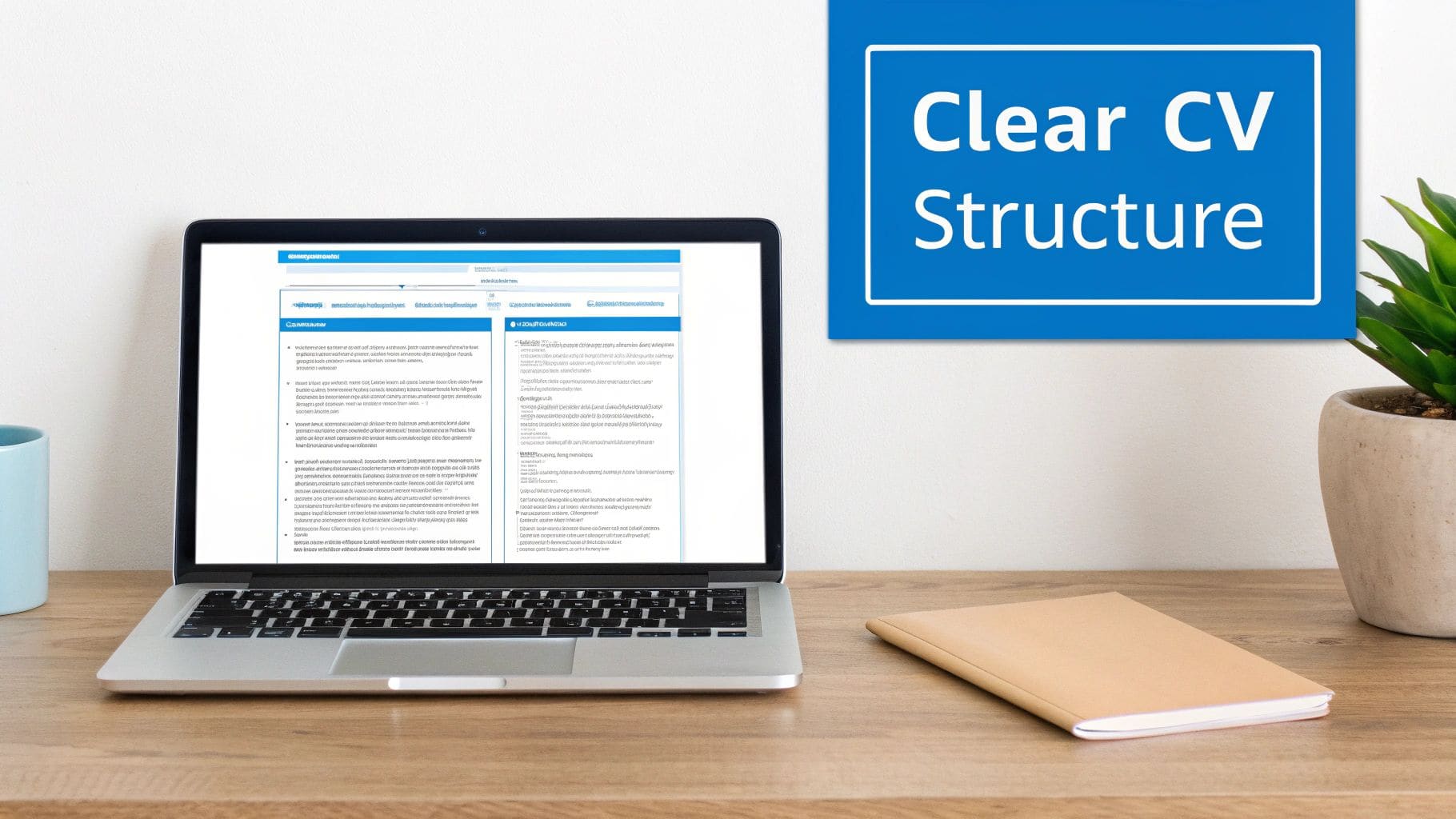
When you're applying for part-time roles, your CV needs to work fast. Hiring managers are often sifting through dozens of applications, and they need to see the most important details immediately: your skills, your availability, and the value you can bring right away.
The best structure for a part-time CV is clean, scannable, and gets straight to the point. Forget long, winding narratives. Lead with a punchy Professional Summary, follow it up with a targeted Key Skills section, then your Work Experience, and—crucially—a clear statement on your availability. This setup lets a recruiter know if you're a good fit within seconds.
Why does this work so well? It puts the recruiter's needs first. They don't have to hunt for your schedule or guess if your skills line up. It's a direct approach that shows you're organised and respect their time—two qualities every part-time employer is looking for.
The Professional Summary
Think of your professional summary as your elevator pitch. It's a short, powerful paragraph, no more than three or four lines, designed to hook the reader and convince them to keep going.
For a part-time job, this summary needs to nail three things:
- Your core expertise (e.g., "Detail-oriented customer service professional" or "Creative marketing student").
- One or two key strengths that match the job (e.g., "excellent communication skills" or "proficient in Adobe Creative Suite").
- A clear statement that you're seeking part-time work, with a quick nod to your availability.
Key Skills Section
Right after your summary, add a Key Skills section. This is a simple bulleted list that gives a snapshot of what you can do. It's brilliant for busy hiring managers and also helps your CV get past the Applicant Tracking Systems (ATS) that scan for keywords.
I recommend splitting this into two clear subheadings:
- Hard Skills: These are the specific, teachable abilities you have. Think software proficiency (Microsoft Excel, Canva), languages, or technical know-how (cash handling, data entry).
- Soft Skills: These are your interpersonal strengths. We're talking about things like communication, teamwork, problem-solving, and time management.
This layout makes your part-time CV incredibly easy to digest, letting a manager quickly tick off their mental checklist.
A well-organised CV isn't just about looking neat; it's a reflection of your professionalism. Recruiters for part-time roles need reliable, organised people, and your CV is the first piece of evidence you can provide.
Work Experience and Availability
Next up is your work history. The key here is relevance. For each role, use bullet points to describe your achievements and responsibilities, always with an eye on the part-time job you want. Even if your experience is from a completely different field, pull out those transferable skills.
Finally, and this is non-negotiable, you must include a distinct Availability section. You can place this right after your summary for maximum impact, or at the end of your CV. Be specific. Don't just say "flexible"—state your available days and hours clearly (e.g., "Available Monday-Wednesday, 9am-3pm" or "Seeking 15-20 hours per week, flexible evenings and weekends").
This one small detail can often be the deciding factor for your part-time CV.
For a deeper dive into crafting each section, check out our complete guide on how to write a professional CV.
Tailoring Your CV for Your Unique Journey
Your personal journey is your biggest asset, and your CV needs to show it off. It's only natural that a student's application will look completely different from a career changer's—and that's a strength, not a weakness.
The real trick is framing your unique experience in a way that speaks directly to what a part-time employer needs. For any cv part time, the goal is simple: prove you're reliable, skilled, and motivated enough to make an impact from day one. Let's look at some real-world examples for different backgrounds to help you tell your story and land the role you're after.
For Students and Early-Career Applicants
When you have limited formal work experience, your CV has to sell potential and highlight those all-important transferable skills. Don't fall into the trap of thinking academic projects or extracurriculars don't count. They absolutely do.
Instead of apologising for what you haven't done, shout about what you have. Think about that group project where you took the lead, the university society you helped run, or the volunteering you did on weekends. These experiences are packed with skills like teamwork, time management, and problem-solving.
Example Bullet Points for a Student CV:
- Academic Project: Collaborated with a team of four to research and present a detailed market analysis, earning a First-class mark for strategic insight and data presentation.
- University Society: Managed the social media accounts for the Debating Society, boosting student engagement by 30% over one semester through consistent, creative content scheduling.
- Volunteering: Contributed 5 hours weekly at a local charity shop, handling customer enquiries, managing the till, and organising stock, which sharpened my communication and organisational skills.
For Career Changers
If you're switching industries, your professional summary is your most powerful tool. This is your chance to connect the dots for the hiring manager and show them exactly how your past experience is relevant to their future needs. Think of it as building a bridge between where you've been and where you want to go.
Focus on achievements that transcend specific jobs. Did you manage budgets, lead projects, or streamline processes? Those skills are valuable everywhere.
Your CV isn't just a record of your past; it's a marketing document for your future. As a career changer, you must actively translate your experience into the language of the new role.
The recent explosion in part-time self-employment is a huge opportunity here. In the UK, it hit nearly 1.46 million workers in Q3 2025, a figure that's more than doubled in 25 years. This trend showcases a massive shift towards flexible work, and you can use any freelance or project work to demonstrate your adaptability and initiative. You can read more about this growing trend of self-employment on Statista.
For Parents Returning to the Workforce
Coming back to work after raising a family is a major step, and your CV should reflect the incredible skills you've gained. That employment gap isn't a weakness—it was a period of intense project management, negotiation, and world-class multitasking.
It's all about how you frame it. You could use a functional CV format that puts the spotlight on your skills rather than a strict timeline, or you can address the gap with confidence right in your professional summary.
Example Professional Summary Snippet: "Returning to the workforce after a planned career break to raise a family, during which I honed exceptional organisational, budgeting, and time-management skills. Eager to apply my proven administrative abilities and strong work ethic to a challenging part-time role."
This simple tweak reframes the gap as a period of valuable skill development. We dig into this more in our guide on how to properly tailor your CV to the job description. By positioning your unique journey as a genuine strength, your cv part time will grab the attention of any UK employer looking for a capable and dedicated team member.
Optimising Your CV with Keywords and Availability

Before your CV ever lands in front of a human, it has to get past the digital gatekeeper: the Applicant Tracking System (ATS). These bots scan every application looking for specific keywords, and if your CV doesn't have them, it gets filtered out. Game over before you've even started.
When you're chasing part-time work, especially when responding to 'wanted' ads, you need to be smart about this. To make sure you optimise your CV to stand out, you have to read the job description like a detective and weave those crucial terms through your CV naturally.
These keywords are simply the skills, duties, and qualifications the employer has flagged as essential. We're talking about things like 'cash handling,' 'customer service,' 'data entry,' or even specific software like 'Microsoft Excel' or 'Canva.' Sprinkling these into your CV tells both the ATS and the hiring manager that you've got what it takes to hit the ground running.
Unlocking the Right Keywords
Your best source for keywords is always, without fail, the job ad itself. Don't just give it a quick scan—dissect it.
- Pinpoint the Hard Skills: Look for specific tools, software, or technical know-how they mention. If the ad asks for "experience with social media scheduling," make sure that exact phrase is in your skills or experience section.
- Echo the Soft Skills: Notice the personal traits they're after, like "strong communication skills," "team player," or "excellent time management." You'll want to mirror that language in your professional summary and when you describe your achievements.
- Speak Their Language: Every industry has its own jargon. A retail role might mention "stock replenishment," while an admin job could talk about "diary management." Using their terminology shows you're already part of that world.
If you want a shortcut, CV Anywhere's JD Fit Checker is brilliant for this. It scans the job description and your CV side-by-side, telling you exactly which keywords are missing.
As you can see, the tool gives you an instant match score and flags the gaps, making the whole tailoring process much faster and more accurate. It's a great way to ensure your cv part time is perfectly aligned with what the employer is looking for.
Stating Your Availability Clearly
For part-time roles, when you can work is just as critical as what you can do. One of the most common mistakes I see is being vague about availability, and it's a surefire way to get your application tossed aside. You need to be crystal clear.
Your availability statement should be unambiguous. An employer needs to know at a glance if your schedule aligns with their operational needs. Don't make them guess.
Put this information somewhere obvious, like right at the end of your professional summary or in its own dedicated 'Availability' section. If you want to dive deeper into the technical side of beating the bots, our detailed guide can show you how to optimise your CV for ATS.
To get you started, here are a few real-world examples of how to word your availability clearly and professionally.
| Scenario | Recommended CV Statement |
|---|---|
| Student | Available for 15-20 hours per week. Fully available evenings from 5pm and all day on weekends. |
| Parent (School Hours) | Seeking a part-time role during school hours. Available Monday to Friday, 9:30am – 2:30pm. |
| Weekend Work | Available for immediate start for weekend shifts, both Saturday and Sunday, full days. |
| Flexible Schedule | Seeking 10-15 hours per week with a flexible schedule, available daytime and evenings. |
These examples leave no room for doubt. The hiring manager knows instantly whether your schedule fits their needs, making their decision to call you that much easier.
Common Mistakes That Sabotage Part-Time CVs

Even the most qualified candidate can see their chances evaporate because of small, avoidable errors. When it comes to a CV for a part-time job, the most common mistakes are surprisingly simple: firing off a generic CV, being vague about your availability, cramming in irrelevant details from old full-time roles, and just plain sloppy formatting.
These missteps don't just look unprofessional. They signal to a busy recruiter that you lack attention to detail or haven't really thought about what a part-time role demands. More often than not, it's a fast track to the rejection pile.
Think of fixing these issues as your final, essential quality check before you hit 'send'. It's what turns your application from a hopeful long shot into a targeted pitch that shows you're the reliable solution they've been looking for.
The One-Size-Fits-All CV
Sending the same CV out for every job is the fastest way to get ignored. It's a numbers game you can't win. Part-time roles are often highly specific, and a generic document just shows you haven't bothered to properly read the job description. It screams a lack of effort and genuine interest.
Instead, treat every single application as a fresh opportunity. Pull keywords directly from the job advert and mirror the language they use. If they need someone with "excellent customer service skills," make sure that exact phrase is right there in your skills section. This simple act of customisation can make a huge difference.
Being Vague About Availability
Forgetting to mention when you can work—or being woolly about it—is a cardinal sin on a CV for a part-time job. Employers simply don't have the time to chase you for this basic information. A CV without a clear schedule is often considered incomplete and gets moved to the 'no' pile almost immediately.
Be precise and upfront. State the exact days and hours you can work. Something like, "Available Tuesdays, Thursdays (9 am-3 pm) and all day Saturdays" is perfect. This clarity respects the recruiter's time and instantly answers their most pressing question.
The UK labour market is competitive but also full of opportunities. ONS data from August-October 2025 showed 717,000 job vacancies, even as unemployment rose slightly to 5.1%. With a growing number of part-time self-employed workers, a perfectly tailored CV that avoids these common pitfalls is crucial to securing one of these roles. You can find more details in the latest UK labour market overview from the ONS.
Overlooking Proofreading
Typos and grammatical errors are instant red flags. They suggest carelessness, and that's a toxic trait for any role, especially one that requires reliability and attention to detail.
Always proofread your document. Then do it again. Read it aloud, run it through a grammar checker, and if you can, ask a friend to give it a final look. A fresh pair of eyes can spot mistakes you've read over a dozen times.
It's also worth remembering that many of these mistakes, particularly odd formatting, can trip up automated screening systems. For a closer look at these technical traps, check out our guide on common ATS CV mistakes to avoid. A final polish ensures your CV for a part-time job is ready for both human eyes and recruitment software.
Your Part-Time CV Questions Answered
When you're about to hit 'send' on a job application, it's normal for a few last-minute questions to pop into your head. To clear up that uncertainty, I've pulled together the most common queries people have when putting the final touches on a CV for part-time work.
Let's get those final doubts sorted so you can apply with total confidence.
How Long Should a CV for a Part-Time Job Be?
For almost every part-time role, a one-page CV is the gold standard. Think about it from the hiring manager's perspective: they're swamped with applications and need to see your value at a glance. A concise, powerful summary of your skills is exactly what they're looking for.
Keeping it to a single page forces you to be ruthless, including only what's most relevant. That's a good thing.
Now, if you have over ten years of directly relevant experience, spilling onto a second page is fine. But the rule is, every single point must add genuine value for this specific role. Never add fluff just to fill space. Always choose impact over length.
Should I Include a Photo on My CV in the UK?
The short answer is a definite no. In the UK, putting a photo on your CV isn't just non-standard; it can actually work against you. It's seen as unprofessional in many sectors and, more importantly, can open the door to unconscious bias.
On a practical level, many companies use Applicant Tracking Systems (ATS) to scan CVs first. These systems can struggle to read documents with images, which might lead to your application being filtered out before a human even sees it.
Let your skills and experience do the talking. A well-written CV that proves your worth is far more powerful than any headshot.
How Do I Explain a Long Career Gap?
The key to handling a career gap is to frame it with confidence. Don't try to hide it or leave it as a mystery on your timeline. The best approach is to address it briefly and honestly, focusing on what you gained or skills you maintained during that time.
You can do this in your professional summary or cover letter. For example:
- "Returning to the workforce after a planned career break to raise a family, during which I honed exceptional time management and budgeting skills."
- "Seeking to re-enter the administrative field after a period spent travelling, which strengthened my adaptability and cross-cultural communication abilities."
This simple reframing turns what could be seen as a negative into a positive, showcasing personal growth and valuable transferable skills.
Is a Cover Letter Really Necessary for a Part-Time Job?
While it's not always listed as 'required', writing a cover letter is a huge opportunity to get ahead. A lot of applicants for part-time jobs will skip this step, so sending one immediately signals that you're serious and motivated.
Use it as your chance to draw a direct line between your experience and what the job ad asks for. It's also the perfect place to express genuine enthusiasm for the company and clarify your availability. A short, sharp, targeted cover letter can be the very thing that gets your CV for a part-time job moved to the top of the pile.
Ready to build a CV that answers every recruiter's questions before they even ask? The Smart CV Builder from CV Anywhere helps you create a polished, professional document in minutes, while the JD Fit Checker ensures it's perfectly optimised for the job you want. Start building for free at CV Anywhere.
Tags
Related articles
How to Write a CV for Work Experience That Lands UK Interviews in 2026
To craft a compelling CV for work experience in the UK's 2026 job market, you must focus on showcasing quantifiable achievements rather than just listing job duties. The key is to create a document th...
How to Write a Resume for a Job (Step-by-Step Guide)
Most CVs fail before their content gets a fair reading. Research analysing 125,000+ resumes found candidates include only 51% of relevant keywords from the job description, and 75% of resumes are reje...
How to Write a CV Quickly: A 60-Minute Guide
You’re probably here because a job has landed in your inbox and you need to write a CV quickly without sending something sloppy. The good news is that speed isn’t the problem. Bad priorities are. A fa...
How to Improve My CV: A Step-by-Step UK Guide for 2026
If you're searching "improve my CV", you probably already know something's off. Your CV may look busy but say very little, or it may list plenty of duties without showing why anyone should interview y...
Popular Articles
To craft a compelling CV for work experience in the UK's 2026 job market, you must focus on showcasing quantifiable achievements rather than just listing job duties. The key is to create a document th...
Most CVs fail before their content gets a fair reading. Research analysing 125,000+ resumes found candidates include only 51% of relevant keywords from the job description, and 75% of resumes are reje...
You’re probably here because a job has landed in your inbox and you need to write a CV quickly without sending something sloppy. The good news is that speed isn’t the problem. Bad priorities are. A fa...
If you're searching "improve my CV", you probably already know something's off. Your CV may look busy but say very little, or it may list plenty of duties without showing why anyone should interview y...